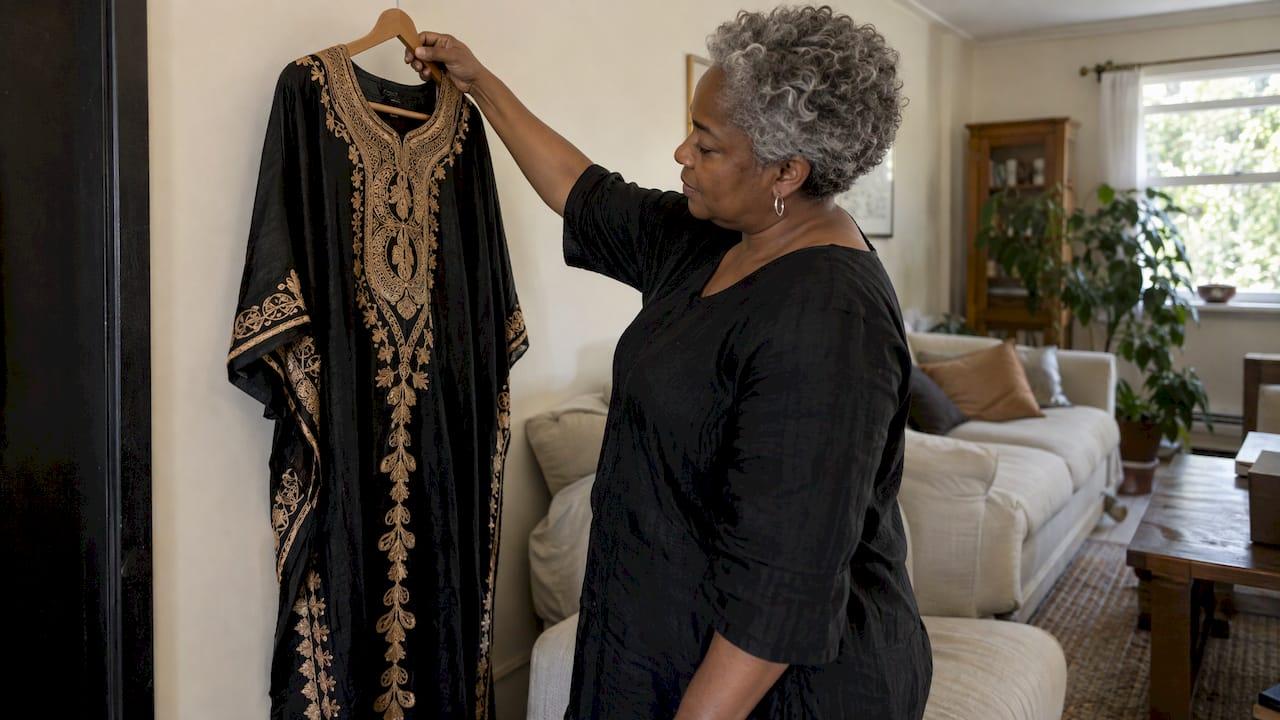
The best embroidered clothing to buy and store in your wardrobe is made by people who understand both the stitch and the story behind it. Look for even, flexible stitching on a fabric that can carry it, ask what the motif means, and choose pieces made in limited quantities with care. West African embroidery meets all of those tests. At Sena Nukunu, our ready-to-ship agbada sets, kaftans, dresses and matching sets are made in limited quantities with ethical manufacturing and artisanal craftsmanship, so each piece is chosen, not mass-stamped.
This guide shows you what to look at on a garment, how embroidery styles differ, how to wear them from the office to the wedding, and how to keep the thread beautiful for years.
TL;DR
- Judge embroidery by its stitches: flexible, flat, evenly registered, with no puckering and no loose threads that catch a fingernail.
- Fabric matters as much as the design. Embroidery is stitched into the cloth, so the base needs the structure to hold it.
- Handwork shows in small natural irregularities, a raised texture and a slightly untidy reverse side.
- Match the amount of embroidery to the occasion: a single motif for everyday, dense work for weddings and ceremonies.
- Wash gently, inside out, in cold water, and store flat or on a padded hanger.
Table of Contents
- Why embroidery is having its moment
- The kinds of embroidered clothing you will find
- How to read the stitching before you buy
- Fabric and construction: where lasting beauty starts
- Craft, culture and ethics: what to ask
- Wearing embroidered clothing: everyday, work and celebration
- Caring for embroidered clothing
- Our perspective
- Shop West African embroidered fashion with us
- FAQ
- Sources
Why embroidery is having its moment
Embroidery has moved from the margins back to the center of fashion. Marie Claire's 2025 look at the embroidery renaissance describes a surge in demand for artisanal needlework, from broderie anglaise blouses and peasant tops to slogan tees and jeans with beaded posies. It also notes that the craft still rests on a needle, thread and human effort. One example: Lesage artisans spent over 600 hours embroidering 250,000 sequins, 200,000 beads and 270 yards of ribbon on a single 1988 Saint Laurent jacket.
That is the high end of the spectrum, but the principle holds at every level. Embroidery is time made visible. When you shop for it, you are buying hours of skill, and the question is whether those hours were spent well.
In West African dress, embroidery has never been decoration alone. It marks status, celebration and belonging, on the chest of an agbada, around the neckline of a kaftan, along the hem of a gown. If you want to understand that lineage before you buy, we wrote about the role of embroidery in West African dress.
The kinds of embroidered clothing you will find
The word covers a wide range, so it helps to know what you are looking at.
- Placed motifs. A single design on a chest, collar or cuff. Easy to wear daily and easy to layer.
- Border and neckline work. Stitching that frames the garment, common on kaftans, tunics and dresses.
- Allover and panel work. Dense embroidery across a chest panel, sleeve or full front. This is the language of ceremonial agbada and occasion wear.
- Embellished work. Beads, sequins, metallic thread and mirror work add dimension and light.
Techniques named in the fashion press include crewelwork, cutwork, goldwork, bead and sequin embroidery and blackwork, according to Marie Claire. Across cultures, hand embroidery scales with the moment: Desi Fashion Journal describes a single placed motif for everyday wear, richer thread and sequin work for formal party suits, and dense work for bridal and occasion garments. The same logic guides how West African pieces are worn: the more significant the event, the more the embroidery speaks.
For a wider map of handmade categories and their origins, see our guide to types of handmade garments.
How to read the stitching before you buy
Good embroidery is easy to judge once you know where to look. You do not need to be a tailor. You need ten seconds with the garment, or a close photograph.
Check the stitch quality
Thread maker Coats lists the marks of well-made embroidery: it should be flexible, properly registered without gaps, free of puckering and tight in stitch density. The same page explains that stitches which show through or can be pulled with a fingernail are too long and will degrade quickly in laundering. Run your hand across the front: it should feel smooth and settled, not stiff like a patch glued on.

Look at the lie of the fabric
Embroidery pulls on the cloth that holds it. Research published in a textile journal found that embroidering lowers a fabric's breaking force and elongation, with the effect depending on needle parameters and stitch density. In plain terms, the garment has to be built for the work. Dense embroidery belongs on cloth with body. Lay the garment flat and check that the area around the design is not rippling or drawn in. A slight wave is a warning sign that the stitching is fighting the fabric.
Spot real handwork
Handwork is rarely perfect, and that is its signature. Desi Fashion Journal suggests looking for natural variation in stitch length, a slightly messy reverse with carried and knotted threads, a raised tactile texture, and threads that start and stop naturally. It also advises caution with outfits that are suspiciously cheap for how densely they are worked, because hours of skill cannot be made to cost nothing.

If you want to understand the time difference, our comparison of hand and machine embroidery sets the 80 to 400 hours of handwork beside the 2 to 5 hours of machine work, so you can decide which suits the moment. For a fuller checklist, read ways to recognize artisanal craftsmanship.
Quick checklist at the garment
- Smooth the embroidered area flat. It should lie without puckering.
- Turn the garment inside out. Threads should be neat enough and secured, not trailing in long loops.
- Check the edges of the motif for gaps or uneven fill.
- Feel the weight of the cloth against the weight of the design.
- Ask who made it and how many were made.
Fabric and construction: where lasting beauty starts
A beautiful motif on the wrong base will not age well. Knitwear is a good example. One knitwear manufacturer's guide notes that embroidery forms a firm, non-stretch area on a stretchy knit, which can lead to puckering and warping, and that small, tight designs tend to hold up best. A thread-making factory guide adds that puckering is most visible on lightweight silks, chiffons and fine cottons when stitch rows are too tight.
What does that mean when you shop?
- Choose woven fabrics with some structure for dense embroidery: the cloths used in agbada, kaftans and tailored jackets suit it.
- For casual tees and knit pieces, favor smaller, tighter motifs rather than large, heavy ones. If you are browsing everyday embroidered casualwear, an example such as this embroidered performance tee shows how a compact design sits on a knit.
- On light, fluid fabrics, look for airy, open embroidery that moves with the cloth.
This is why we think of embroidery and garment as one design decision, not two. The most striking pieces are the ones where thread, cloth and cut were planned together. Our guide to the qualities of handcrafted dresses goes deeper on that balance.
Craft, culture and ethics: what to ask
Embroidery carries meaning, so shopping for it well means asking more than "does it fit?"
- Whose tradition is this? Motifs and garment forms have origins. A maker rooted in the heritage can tell you where a pattern comes from and what it signifies.
- Who made it, and how? Ethical manufacturing and fair work are part of quality, not an add-on. Small-batch and made-to-order models also cut waste: the founder of Haiti-inspired label Fanm Mon told Ethos that making only confirmed orders avoids overstock.
- How many exist? Limited quantities protect the artisan's time and your sense of owning something distinctive.
These are the values we build on. Our pieces are made with ethical manufacturing and artisanal craftsmanship in limited quantities, so what you wear is also a vote for the people who made it. If you want to keep traditions alive in how you wear and treat them, our cultural fashion preservation tips are a good companion.
Wearing embroidered clothing: everyday, work and celebration
The right amount of embroidery depends on where you are going.
Everyday and the office
Choose restrained embroidery: a neckline detail on a dress, a patterned trim on a jacket, a subtle motif on a kaftan top. Pair it with plain trousers or a simple skirt and let the stitching be the one statement. For professionals, a tailored jacket with considered embroidery reads as confident and polished without needing loud color. Browse our women's collection for dresses and statement pieces that move easily from a meeting to dinner.
Weddings and celebrations
Celebration is where dense, regal embroidery belongs. For men, an agbada set with embroidery across the chest and sleeves is the classic choice for a wedding, naming ceremony, graduation or milestone birthday. Our men's agbada ensembles and three-piece sets such as the Gold Garnet Ascension ensemble are made for exactly this stage. For women, a richly worked dress or matching set does the same work. Coordinating with a partner or family in complementary colors turns a group of guests into a portrait.
Gifting
Embroidered clothing makes a meaningful gift because it comes with a story. Choose by the recipient's usual fit and the occasion, and pick a piece with a motif you can explain when you hand it over.
Caring for embroidered clothing
The care routine is simple, and gentle handling protects both the stitches and the fabric.
- Read the label first. Fabric and embellishment decide the method.
- Wash inside out, alone. This reduces friction on the surface stitching.
- Use cold water and a mild detergent. Gentle cycles or a hand wash protect color and thread. Skip bleach and fabric softener.
- Do not wring or scrub. Press water out gently in a towel.
- Dry flat or on a padded hanger, away from direct sun and heat.
- Iron on the reverse side over a soft towel so the stitching stays raised.
- Store clean, folded with tissue or hung on a padded hanger. Heavily embellished pieces rest best flat.
We cover African prints and handmade garments in more detail in our guides to how to care for African fabrics, caring for handmade garments and washing Ankara fabric without fading it. For general principles of looking after textiles at home, this guide to caring for textiles at home adds useful storage habits.
If a garment is heavily beaded or metallic-threaded, a specialist dry cleaner who handles embellished or ceremonial wear is the safer route for a major cleaning.
Our perspective
We believe embroidery is the most honest way a garment can tell you who made it. Every stitch is a decision, and when those decisions are made by artisans who are paid and respected for their work, you can feel it in the cloth.
That is why we make our West African ready-to-wear in limited quantities, with ethical manufacturing and artisanal craftsmanship at the center. A piece should not be one of ten thousand. It should be one of a few, made with care and purpose, designed to blend traditional artistry with a modern line.
When you wear an agbada, a kaftan or a dress with our embroidery, you carry a legacy forward and you support the hands that stitched it. That is the standard we hold ourselves to, and the one we hope you hold embroidery to wherever you shop.
Sena
Shop West African embroidered fashion with us
If you want embroidered clothing that is made with heritage, craftsmanship and ethics behind it, start with Sena Nukunu. Our collections include men's agbada ensembles, men's heritage pieces, and women's collections such as Woven Radiance: Queens in Bloom, Woven Crowns: Radiant Rise and Woven Shields: Queens in Motion, along with kaftans, jackets and matching statement sets. Pieces are ready to ship, and we also offer custom fashion for special occasions.
Explore the full range in our collections, browse dresses, or see our custom design services when you are planning a wedding or celebration.
FAQ
How can I tell if embroidered clothing is good quality?
Look for flat, flexible stitching with no puckering, even coverage with no gaps, and a reverse side that is tidy and secure. Stitches that sit loose or can be caught with a fingernail will not last through repeated washing. The fabric around the design should lie smooth.
Is hand embroidery better than machine embroidery?
They serve different purposes. Hand embroidery takes far longer, with our comparison citing 80 to 400 hours against 2 to 5, and it has a distinctive texture and depth that suits heirloom and ceremonial pieces. Choose the one that fits the occasion and how often you will wear it. Our hand versus machine guide walks through the details.
What should I wear embroidered African clothing to?
Subtle embroidery works daily and at the office, while richly worked agbada sets, kaftans and dresses are made for weddings, graduations, naming ceremonies and other celebrations. Match how dense the embroidery is to how significant the event is.
How do I wash an embroidered garment?
Wash it inside out and on its own, in cold water with mild detergent, on a gentle cycle or by hand. Avoid bleach and fabric softener, press out water rather than wringing, and dry flat or on a padded hanger. Always check the care label first.
Sources
- Fashion's Embroidery Renaissance, Marie Claire
- Discovering Your Embroidery Solution, Coats
- Investigation of the Influence of Technology Parameters on Embroidery, De Gruyter
- Embroidery on Knitwear, Knitwear Manufacturer's Guide
- Stitch Density Explained, Fominte
- How Haiti-Inspired Fanm Mon Stitches Together Heritage, Ethos