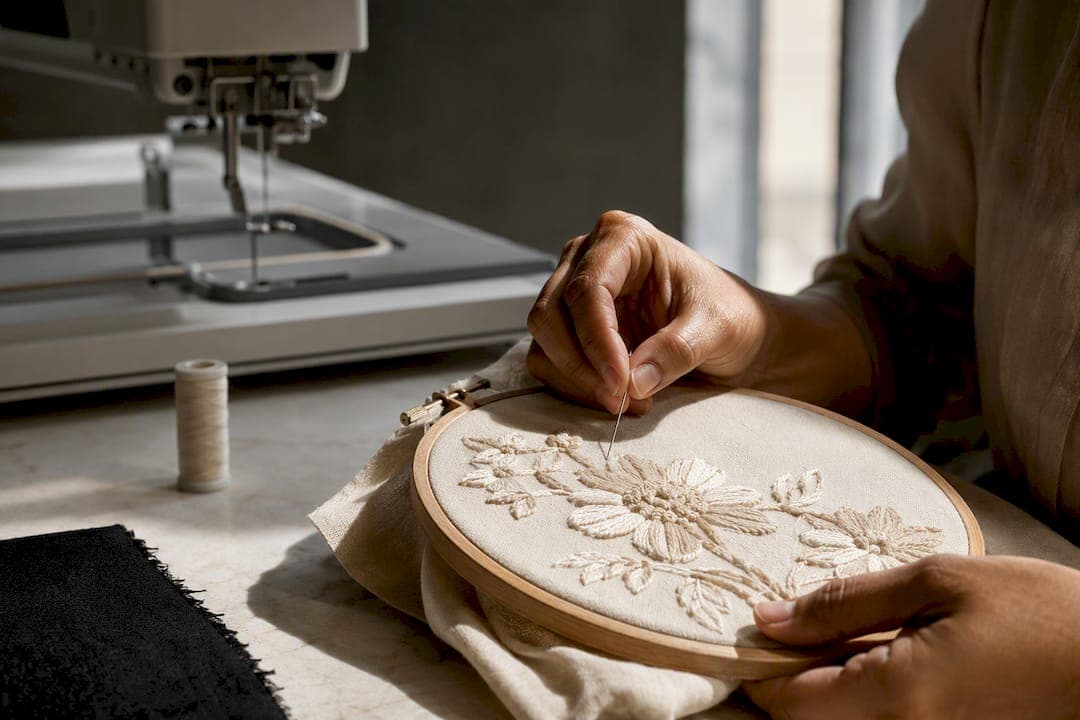
Hand embroidery delivers texture, dimension, and one-of-a-kind irregularity that a needle guided by human hands leaves behind. Machine embroidery delivers speed, consistency, and the ability to reproduce a design a thousand times without variation. Neither wins outright: hand embroidery vs machine really comes down to what you value most in a finished piece, and plenty of makers now blend both through hybrid finishing techniques. The rest of this guide breaks down the tradeoffs in time, cost, and look, so you can choose with your eyes open.
TL;DR:
- Hand embroidery typically takes between 80 and over 400 hours per piece, while machine embroidery can complete similar designs in 2 to 5 hours once digitized.
- Hand-embroidered items are more expensive due to labor intensity, with premiums reflecting hundreds of hours of skilled work, unlike machine-produced pieces.
- Hand embroidery creates textured, three-dimensional effects with small variations that distinguish it from the flat, uniform finish of machine embroidery.
- Identifying machine embroidery is easiest by checking for a dense web of bobbin thread and uniform stitch patterns on the back, while handwork shows knots and looser threads.
- Sturdy fabrics handle machine embroidery well, but delicate textiles like silk and chiffon benefit from handwork, which offers more control and protection.
Table of Contents
- Hand Embroidery vs Machine Embroidery at a Glance
- How Stitches Are Actually Made: Hand Technique vs Machine Digitizing
- Thread, Needle, and Fabric Choices That Change the Result
- How to Tell Hand Embroidery From Machine Embroidery
- What Hand and Machine Embroidery Actually Cost You in Time and Money
- Choosing Between Hand and Machine Embroidery for Your Project
- Caring for Embroidered Garments So the Detail Lasts
- A Quick Checklist for Choosing Hand or Machine Embroidery
- How Sena Nukunu Approaches Embroidery and Craft
- Shop Artisan-Embroidered Pieces at Sena Nukunu
- Why the Imperfections Are the Point
- Sources
Hand Embroidery vs Machine Embroidery at a Glance
Before choosing a method, it helps to see the two side by side. Time, price, and texture diverge so sharply between hand and machine work that the numbers alone tell most of the story, and the back of the fabric tells the rest.
Machine work runs fast because the design is digitized once and then repeated as many times as needed, while hand embroidery stays a one-pass, one-piece process from start to finish. That gap shows up everywhere, from the sticker price to the way light catches a raised metallic thread.
| Factor | Hand embroidery | Machine embroidery |
|---|---|---|
| Time to produce | 80 to 400+ hours depending on density | 2 to 5 hours per piece once digitized |
| Typical retail range | authentic hand-embroidered pieces usually cost significantly more | machine-embroidered pieces generally cost less |
| Texture and dimension | Raised, uneven, often three-dimensional | Flat, even satin fills and fills that sit close to the fabric |
| Uniformity/repeatability | Slight variation stitch to stitch, motif to motif | Identical repeats across every unit |
| Back-of-fabric cues | Tucked ends, visible knots, hand-tied clusters | Dense bobbin web, uniform lock-stitch pattern |
Those price bands are market illustrations, not fixed rules. What they show is the order of magnitude: labor, not material, drives the gap.
How Stitches Are Actually Made: Hand Technique vs Machine Digitizing
A hand embroiderer starts with a transfer, tracing or stamping a design onto fabric that's stretched taut in a hoop. From there, every stitch is a decision: how tight to pull the thread, how many strands to use, whether to layer a satin stitch over a French knot for added relief. Common stitches like the back stitch, chain stitch, and satin stitch each build a slightly different texture, and layering them is how artisans create the raised, sculptural look you see in bridal lehengas or ceremonial agbada panels.
Machine embroidery starts somewhere else entirely: software. A design gets digitized, meaning every stitch, color change, and jump is mapped as a set of coordinates the machine reads like a blueprint. The fabric gets hooped, a stabilizer gets attached underneath to keep it from puckering, and the machine's needle follows the digitized path exactly, over and over, at whatever speed its motor allows.
That precision is also the reason machine work reproduces identically piece after piece. There's no fatigue, no shifting grip, no slight drift in tension between motif ten and motif eleven, which is exactly what a hand-stitched piece will show under close inspection.
Somewhere between the two sits free-motion embroidery, a hybrid technique where a maker lowers the machine's feed dogs and guides the fabric by hand, essentially "drawing" with thread. It borrows the machine's speed but keeps a human hand steering the design, which is why free-motion pieces often split the difference in both look and cost between pure hand and pure machine work.
Thread, Needle, and Fabric Choices That Change the Result
Material choice shapes the final look as much as the technique itself. Hand embroiderers typically work with stranded cotton, silk floss, or wool, thread sold in loose skeins that gets separated into strands to control thickness. Machine embroidery relies on spool thread, usually rayon or polyester, wound tight and engineered to run smoothly through a machine's tension system without snapping or fraying mid-stitch.
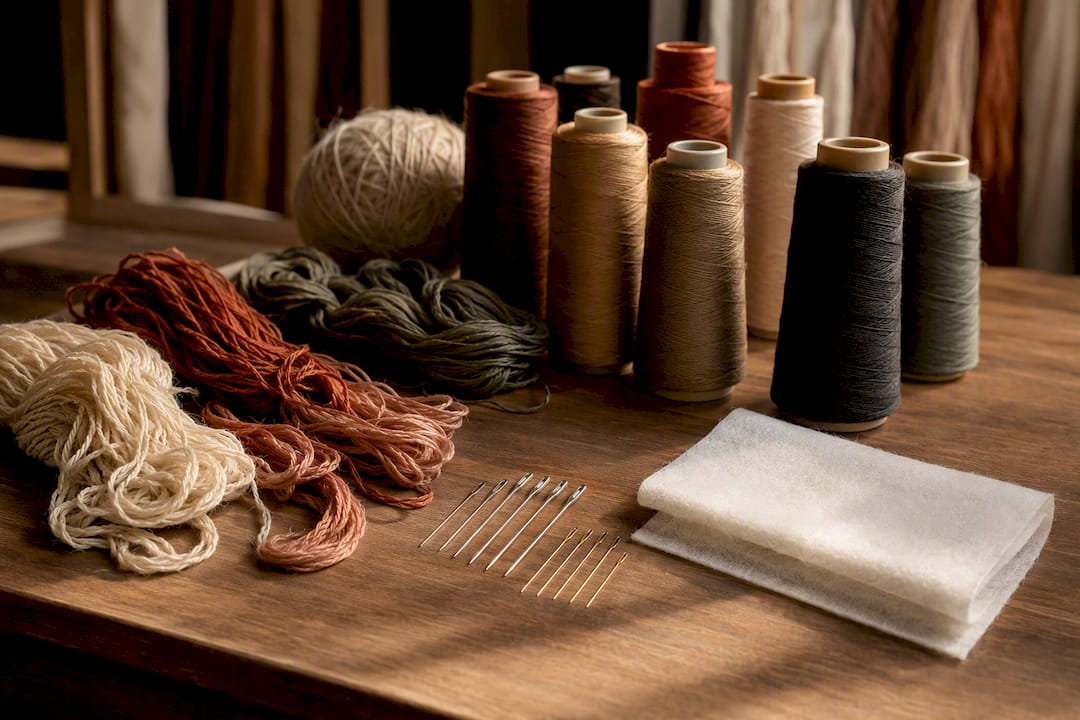
Needle choice follows the same split. Hand embroidery needles vary by eye size and point sharpness depending on thread weight and fabric density, while machine needles are matched to the machine's tension settings and swapped based on fabric type, from lightweight chiffon to heavy denim.
Stabilizer matters more on the machine side. Because a machine needle punches through fabric at speed without a hand to compensate for tension, most machine work needs a tear-away or cut-away stabilizer underneath to prevent puckering. Hand embroidery skips this step almost entirely, since the embroiderer feels the fabric's give and adjusts stitch by stitch.
Fabric handling diverges too. Delicate silks, sheer chiffons, and heavily textured brocades often favor hand work, where a slower pace protects the weave. Sturdier cottons and blends tolerate the machine's hoop tension and repeated needle punctures without distortion.
How to Tell Hand Embroidery From Machine Embroidery
The fastest way to identify a piece's origin is to flip it over. Machine embroidery leaves a dense web of bobbin thread on the back, with tight, uniform lock-stitch clusters where colors change. Hand embroidery leaves a cleaner story: tucked-in ends, visible knots where a thread was started or finished, and looser thread carries between motifs. Experts often check for these carried threads and start/stop clusters first, since they're the hardest thing to fake convincingly.
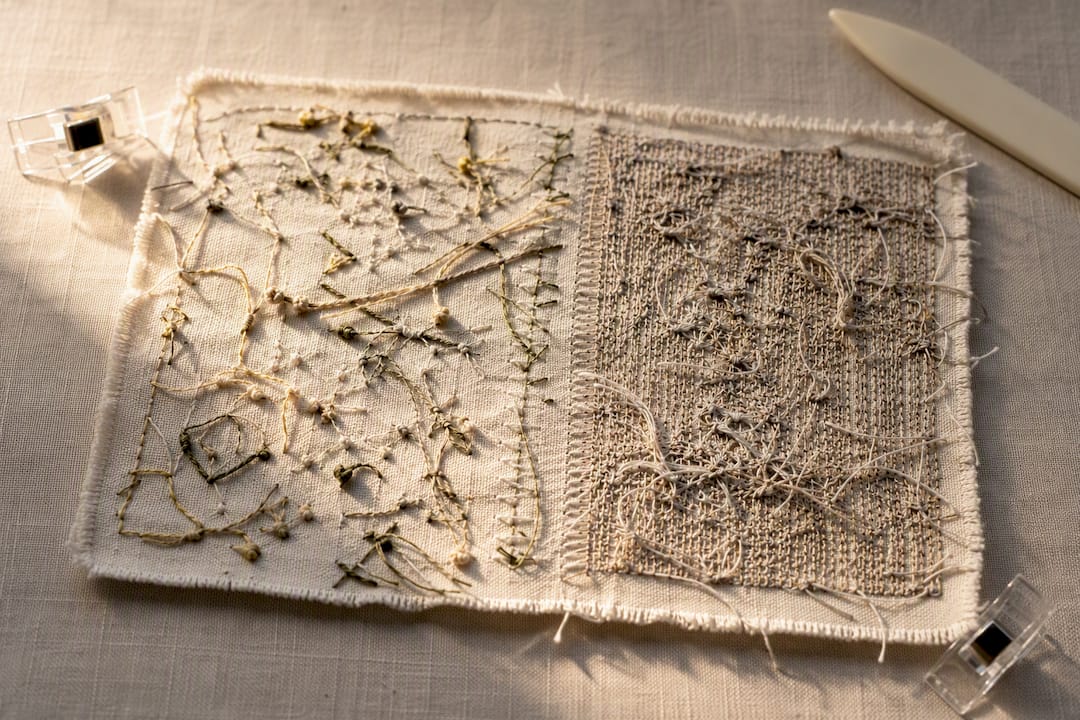
On the front, look at dimension. Techniques like couching, where a thicker cord gets stitched down by a finer thread, or zardozi-style metallic work build actual height off the fabric surface. Machine satin fills stay flatter and more uniform because the needle follows a fixed path at a fixed depth. Photography can hide this difference easily, since a flat photo flattens texture regardless of how it was made, so lighting angle and close-up detail shots matter if you're buying online.
Uniformity is your third check. Look across several repeated motifs on the same piece. Machine work will show them essentially identical, stitch for stitch. Hand work shows small, human variation: a slightly tighter knot here, a fractionally longer stitch there. That variation isn't sloppiness. It's proof the piece passed through someone's hands rather than a machine's repeat function.
What Hand and Machine Embroidery Actually Cost You in Time and Money
The labor gap between these two methods is the single biggest driver of price, and the numbers are stark. A moderately embroidered formal outfit can take 80 to 150 hours by hand, while a heavily embroidered bridal piece with dense metallic or beaded work can run 200 to 400-plus hours. A machine, once the design is digitized, can complete a comparably complex pattern in roughly 2 to 5 hours.
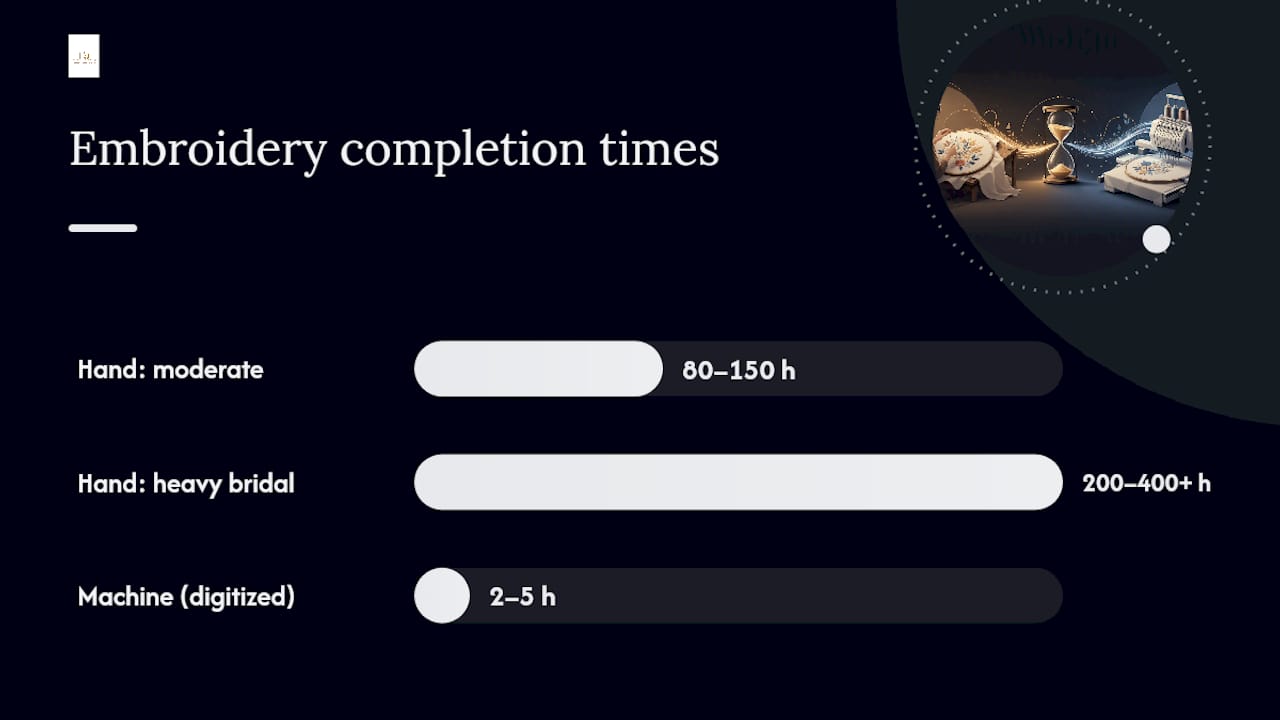
Statistic Callout: This reflects the general understanding that hand embroidery takes many times longer than machine embroidery to complete a garment.
That ratio explains the price gap you'll see in stores and studios. Market pricing commonly places machine-embroidered garments in a lower band, while genuinely hand-embroidered pieces command a premium that reflects hundreds of hours of skilled labor rather than material cost.
Hybrid workflows change this math. A brand might machine-embroider a base pattern for speed and consistency, then add hand-finished beading, French knots, or edge detailing where it matters most visually. This approach can cut total labor significantly while still delivering visible handcrafted detail where a buyer's eye actually lands, on necklines, cuffs, and hemlines.
Choosing Between Hand and Machine Embroidery for Your Project
Neither method is universally better; each solves a different problem. Knowing the tradeoffs upfront saves you from a mismatched purchase or a frustrated production run.
Hand embroidery pros:
- One-of-a-kind texture and dimension no machine currently replicates
- Ideal for heirloom, bridal, or ceremonial pieces meant to last generations
- Rhythmic stitching work even carries documented therapeutic value for the maker
Hand embroidery cons:
- High labor cost and long turnaround times
- Impractical for large orders or tight deadlines
Machine embroidery pros:
- Fast, consistent, and cost-effective at scale
- Reliable for uniforms, corporate branding, or matched sets
Machine embroidery cons:
- Flatter texture, no true dimensionality
- Feels generic on pieces meant to signal craftsmanship or status
For bridal wear, gifts meant to be kept, or small-batch fashion built around cultural storytelling, hand work is worth the wait. For uniforms, bulk orders, or budget-conscious basics, machine work is the sensible route, and a hybrid approach often wins when a brand wants both scale and a genuinely handcrafted focal point.
Caring for Embroidered Garments So the Detail Lasts
Hand-embroidered pieces need gentler handling than most closets give them. Hand wash or dry clean anything with metallic thread, beading, or raised couching work, since machine washing agitates raised stitches and can snag delicate thread. Store these pieces flat or loosely folded with acid-free tissue between layers, never on a hanger that puts strain on heavily embroidered panels.
Machine-embroidered garments tolerate more, but the anchoring still matters. Ask the seller how thread ends were finished. Poorly secured lock stitches unravel faster under regular washing than pieces with reinforced anchor points.
For both, spot-clean rather than fully submerging when possible, and press embroidered areas face down on a towel to protect texture from a hot iron. A detailed care routine tailored to embellishment type will extend the life of raised or metallic work far longer than generic laundering advice.
A Quick Checklist for Choosing Hand or Machine Embroidery
- What's your deadline? If you need the piece in under two weeks, lean machine or hybrid.
- How many units do you need? Orders above roughly 50 pieces almost always favor machine production for cost reasons.
- What's the fabric? Delicate silks and sheers favor hand work; sturdy cottons and blends handle machine hooping well.
- What's your budget ceiling? Hand work commands a premium that scales with hours, not units.
- How much does texture matter to you? If dimension and uniqueness are the point, hand embroidery is worth the cost.
Pro Tip: Before buying an "embroidered" piece online, ask the seller for a close-up photo of the fabric's back. A dense bobbin web means machine work; tucked ends and visible knots mean hand work, and any honest seller will send that photo without hesitation.
How Sena Nukunu Approaches Embroidery and Craft
Craft, for us, isn't a marketing word. It's hundreds of hours an artisan spends turning thread into something that carries a story, and that labor deserves recognition rather than a vague "handmade" label slapped on for effect. Sena Nukunu labels its pieces clearly on product pages so you know exactly what you're buying, whether that's a hand-finished detail or a machine-produced base. If you want to go deeper on how embroidery functions in West African dress traditions, or what separates genuinely handcrafted apparel from mass production, our guide to embroidery's role in West African style is a solid next stop.
Shop Artisan-Embroidered Pieces at Sena Nukunu
If the inspection cues above have you looking for a piece with real hand-finished detail, collections often highlight those details upfront. Product pages often include information about materials used and care guidance to help you understand the piece before purchase.

Some pieces are produced in limited quantities to emphasize artisanal craftsmanship over mass production. Browse the dress collection to see current hand-finished and embroidered styles, or start at the main collection page to explore what's currently available. If a piece catches your eye, check its product page for the specific embroidery notes before you check out.
Why the Imperfections Are the Point
The most common mistake I see buyers make is treating variation in hand embroidery as a flaw to tolerate rather than proof of what they're actually paying for. A slightly uneven satin stitch or a knot that's marginally tighter on one motif than another isn't a quality issue. It's the fingerprint of a real person who spent real hours on that exact piece, and no amount of digitizing software will ever produce that.
We source pieces from artisans who've spent years mastering these techniques, and we'd rather show you the honest back-of-fabric photo than let a flattering angle do the convincing for us.
— Sena
Sources
- PMC article on textile crafts and mental health
- AÏNN London — machine vs hand embroidery: how to tell the difference
- The Spruce Crafts — machine vs hand embroidery explainer
- SewingTrip — embroidery machine vs hand embroidery pros and cons