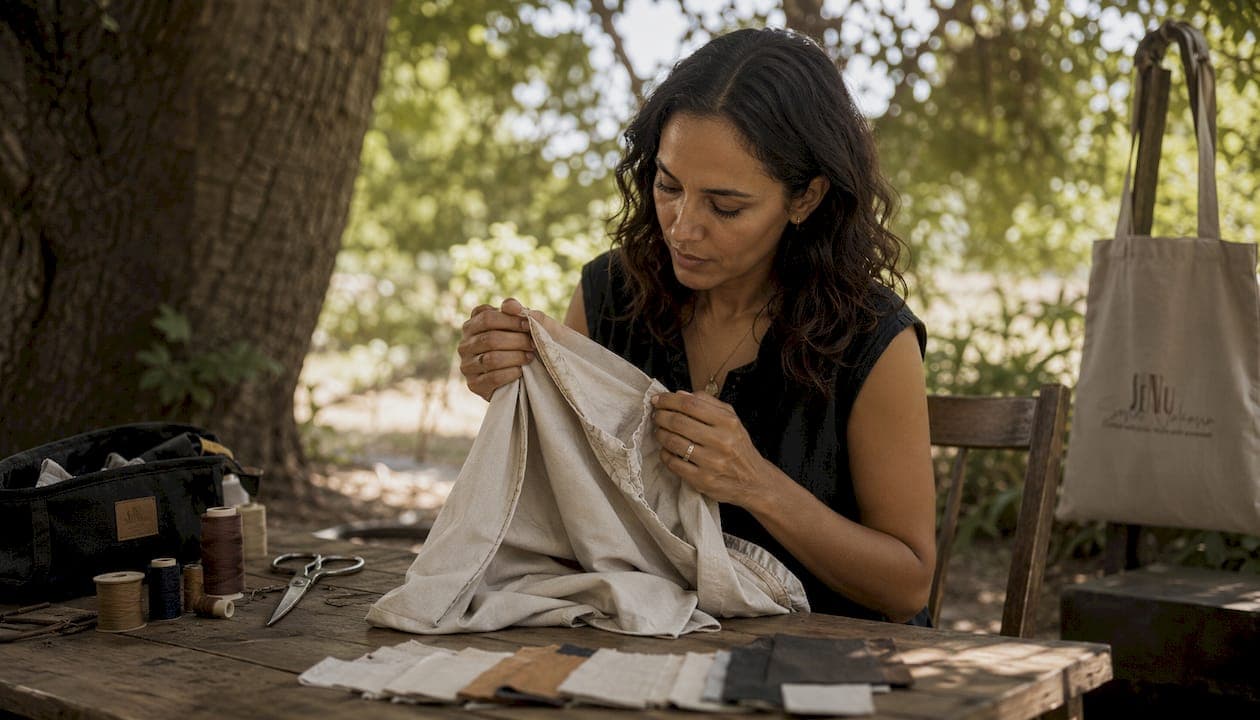
A high-quality handcrafted dress carries eight unmistakable qualities you can verify before you buy. Here is a quick inspection checklist to keep in hand, whether you are shopping in person or zooming into product photos online.
- Natural materials: Organic cotton, linen, silk, or hand-spun fibers. Run your fingers across the fabric — it should feel alive, slightly textured, and breathable rather than slick or uniform.
- Hand finishes: Look for hand-rolled hems, hand-stitched closures, or visible thread tails at seam ends. These are signs of human attention, not factory automation.
- Authentic hand techniques: Hand embroidery, block printing, hand-weaving, or appliqué. Each leaves a subtle organic variation no machine can replicate.
- True-to-body fit and drape: The fabric moves with you. A well-cut handcrafted dress flows rather than pulls, especially in lower-tension hand-loomed weaves.
- Transparent maker provenance: Named artisans, workshop origin, small-batch quantities. If a seller cannot tell you who made it, that silence is informative.
- Durable construction: Generous seam allowances, reinforced stress points, and quality trims signal a garment built to outlast trends.
- Designed-for-repair care: Replaceable closures, sturdy interfacing, and natural fibers that a tailor can work with easily.
- Small-batch production: Limited quantities tied to a specific maker or workshop confirm artisanal production rather than scaled manufacturing.
Pro Tip: Turn the dress inside out before anything else. The inside of a garment tells the truth: look for clean seam finishes, generous allowances, and hand-stitching variations that no serger produces uniformly.
Table of Contents
- 1. What do the materials in a handcrafted dress actually feel like?
- 2. Which construction details separate a crafted dress from a mass-made one?
- 3. How do hand techniques show up on a dress — and how do you verify them?
- 4. How does fit and drape reveal the quality of a handcrafted dress?
- 5. What provenance and ethical signals confirm a dress is genuinely handcrafted?
- 6. How do you care for a handcrafted dress, and how long should it last?
- 7. How do you inspect and buy a handcrafted dress with confidence?
- 8. Senanukunu's perspective on what makes a West African handcrafted dress authentic
- Key Takeaways
- Why handcrafted dresses carry a weight that fast fashion never will
- Authentic handcrafted West African dresses, curated with full provenance detail
- Useful sources and further reading
1. What do the materials in a handcrafted dress actually feel like?
The fiber content of a dress is the first and most reliable signal of artisan quality. Natural fibers — organic cotton, linen, silk, and hand-spun wool — behave differently from synthetics in ways you can feel immediately. They breathe, they drape with gravity rather than against it, and they develop a gentle patina with wear instead of pilling or degrading.
What to look and feel for:
- Organic cotton: Soft but with a slight texture; cooler than polyester blends; wrinkles naturally (a feature, not a flaw).
- Linen: Crisp when new, softening beautifully over time; has a visible slub or irregularity in the weave that confirms hand or artisan processing.
- Silk: Weightless drape, a subtle sheen that shifts with light, and a cool-to-warm temperature response against skin.
- Hand-spun or hand-loomed wool: Heavier hand, visible fiber variation, and a warmth that synthetic fleece cannot match.
On product pages, look for fiber content listed by percentage, country of origin for the textile, and any note about hand-finishing. Certifications worth trusting include the Global Organic Textile Standard (GOTS) for organic fiber claims and Fair Trade Certified labels that verify ethical production conditions. Vague phrases like "eco-friendly blend" or "sustainable fabric" without a named standard are marketing language, not verification.
Artisan-made fashion consistently favors natural fibers and hand-weaving because these techniques create subtle, unique variations and textiles that genuinely last. A handcrafted dress made from quality natural fiber is not just a purchase — it is a long-term wardrobe investment.
2. Which construction details separate a crafted dress from a mass-made one?
The inside of a garment is where craftsmanship either proves itself or falls apart. Most shoppers never look there. You should.
Seam types to seek out:
- French seams: Both raw edges are enclosed inside a second seam fold — clean on both sides, no fraying, and a mark of considered construction.
- Hand-finished hems: A rolled or slip-stitched hem shows individual stitch spacing rather than a uniform machine line.
- Reinforced stress points: Bar tacks at pocket corners, double-stitched armhole seams, and extra interfacing at button plackets all indicate a maker who anticipated real wear.
Stitch spacing in handcrafted work is deliberate but not robotically uniform. You may notice slight variations in spacing or tension — this is a sign of human hands, not a defect. Handcrafted pieces often show non-uniform top-stitching and hand-applied finishing details that industrial machines simply do not produce.
For online shopping, request close-up photos of the inside seam, the hem edge, and any decorative stitching. If a seller cannot or will not provide these, treat that as a red flag. Dirty shortcuts to watch for: glued hems (they feel stiff and crack over time), visible serging on a garment marketed as "hand-finished," and interfacing that bubbles or separates at the edge.
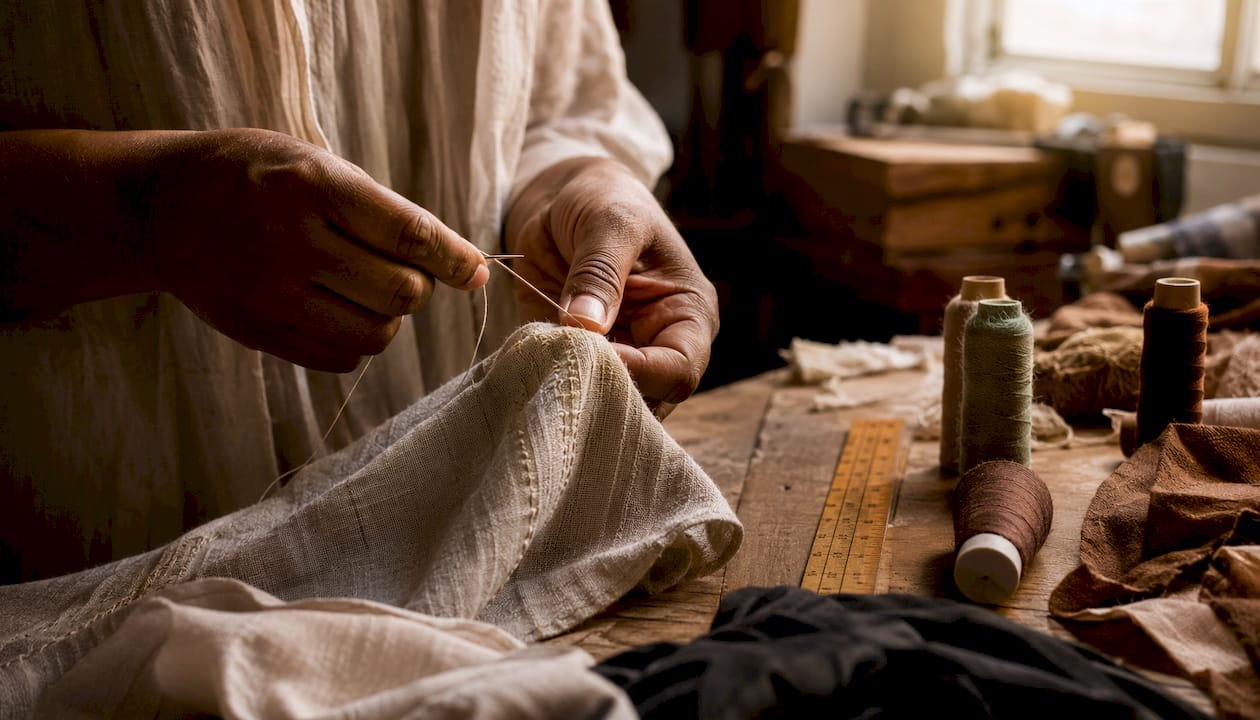
Pro Tip: Pinch the seam allowance between your fingers. A well-made handcrafted dress typically has at least 5/8 inch of allowance, sometimes more — enough for a tailor to let out or take in without compromising the seam.
3. How do hand techniques show up on a dress — and how do you verify them?
Hand techniques are what give artisan garments their soul. Each one leaves a physical signature that you can learn to read. Hand-applied embroidery, sequins, and lace display subtle organic variation that machines cannot replicate — and that variation is exactly what you are looking for.
Common hand techniques and their visual markers:
- Hand embroidery: Thread tension varies slightly across the design; the reverse side shows knotted thread ends and irregular stitch paths rather than a clean bobbin line.
- Hand-block printing: Slight misregistration between repeats, ink that bleeds softly at the edges, and color variation across the fabric surface. The ICHA Foundation notes that block printing is a centuries-old craft where each impression is placed individually by hand — perfect alignment is neither expected nor desirable.
- Hand-weaving: Visible warp and weft irregularities, a slightly uneven selvedge edge, and a drape that differs from industrial cloth.
- Appliqué: Edges that are hand-stitched rather than fused; slight dimensional lift from the base fabric.
- Beadwork: Individual bead placement with slight spacing variation; thread visible between beads rather than a continuous machine-sewn line.
The phrase "perfectly imperfect" is not a marketing excuse — it is an authenticity cue. Intentional irregularity in a handcrafted piece reflects the maker's hand, not careless production. The distinction between intentional variation and poor quality comes down to consistency of intent: the pattern is coherent, the technique is controlled, and the irregularity is distributed rather than concentrated in one area.
Three questions to ask any seller:
- Are the prints registered by hand, and can you show a close-up of the print edge?
- Can you photograph the reverse side of the embroidery?
- Was the weaving done on a handloom or a power loom?
4. How does fit and drape reveal the quality of a handcrafted dress?
Fit is where handcrafted construction becomes personal. A dress cut from a pattern tested on real bodies — not just a dress form — moves differently from one drafted purely to a size chart. High-quality handcrafted dresses use true-to-size patterns tested on real bodies, and that testing shows up in how the garment sits at the shoulder, moves at the hip, and falls at the hem.
In-person fit tests worth doing:
- Sit down fully. A well-made dress should not pull across the back or ride up significantly.
- Raise both arms overhead. The bodice should lift slightly but not expose the waist.
- Walk a few steps. The hem should swing evenly, and the fabric should move with you rather than resist.
Drape is equally revealing. Handcrafted textiles move more fluidly because lower loom tension allows fibers to retain their natural character — the cloth falls in soft folds rather than holding a stiff shape. The scrunch test is a fast way to confirm this: lightly compress a section of fabric in your palm, hold for three seconds, then release. Natural hand-loomed fibers will wrinkle slightly but feel soft and breathable; synthetic or tightly industrially woven fabrics spring back with a plasticky resistance.
Pro Tip: When a maker recommends minimal alteration, trust that guidance. Handcrafted patterns are often drafted with specific ease built in. If you are between sizes, size up only when the maker's notes suggest the cut runs narrow — otherwise, the original fit is the intended one.
5. What provenance and ethical signals confirm a dress is genuinely handcrafted?
Provenance is the paper trail behind a garment, and for handcrafted pieces, it is one of the most meaningful quality signals available. Artisanal fashion is defined by small, localized batch production where designers maintain holistic control over design and production — and that specificity should be visible to you as a buyer.
Credible provenance cues to look for:
- Named artisans or workshops, not just a country of origin.
- Small-batch quantities stated explicitly (e.g., "made in a run of 20").
- Origin of the fiber itself, separate from where the garment was sewn.
- Maker photos showing the actual person and workspace.
- Technique descriptions that are specific enough to verify (not just "handmade in India" but "hand-block printed using carved teak blocks in Jaipur").
Certifications worth trusting include GOTS for organic fiber, Fair Trade Certified for ethical labor conditions, and regional craft council designations where applicable. Treat vague claims — "artisan-inspired," "crafted with care," "ethically sourced" without a named standard — with healthy skepticism.
Maker storytelling is not just marketing. When a brand tells you who made a piece, where, and with which techniques, that narrative is a form of accountability. It is much harder to fabricate a specific maker's name and workshop photo than it is to print "handmade" on a tag. For style-conscious shoppers who care about sustainable fashion choices and artisan welfare, provenance detail is the single most powerful differentiator between genuine craft and fast-fashion imitation.
Understanding slow fashion principles also helps here — slow fashion's emphasis on transparency, traceability, and maker relationships maps directly onto what genuine provenance looks like in practice.
6. How do you care for a handcrafted dress, and how long should it last?
Handcrafted natural fiber garments require more attention than a polyester blend, and that is precisely the point. The care they need is the same care that extends their life well beyond anything fast fashion offers. Handcrafted clothing is engineered to withstand repeated wear and cleaning, breaking the disposable cycle — but only if you treat it accordingly.
Care by fiber type:
- Organic cotton and linen: Machine wash cold on a gentle cycle or hand wash; lay flat to dry to preserve shape; iron while slightly damp for best results.
- Silk: Hand wash in cool water with a pH-neutral detergent, or dry clean; never wring; store away from direct light to prevent color shift.
- Hand-embroidered or block-printed pieces: Turn inside out before washing to protect surface decoration; avoid soaking, which can loosen hand-applied elements.
- Hand-woven wool: Dry clean or hand wash in cold water; reshape while wet and dry flat; store folded, never hung, to prevent stretching.
Basic preservation and repair:
- Reinforce any loose stitching at stress points before it becomes a tear.
- Store natural fiber dresses in breathable cotton garment bags, not plastic, to prevent moisture buildup.
- Use cedar blocks rather than mothballs for wool pieces.
- When a seam opens or a hem drops, a professional tailor can restore it cleanly — the generous seam allowances in well-made handcrafted pieces make this straightforward.
Longevity signals to look for at purchase: heavier seam allowances (as noted earlier), replaceable closures like buttons rather than fused snaps, quality trims that are sewn rather than glued, and natural fiber linings that breathe and move with the outer fabric. A dress built with these details was made to be worn for years, repaired when needed, and passed on.
Pro Tip: The first wash is the most important. Always follow the maker's care instructions exactly for the first two washes — this sets the fiber and any natural dye, reducing the risk of shrinkage or color bleed in subsequent cleaning.
7. How do you inspect and buy a handcrafted dress with confidence?
Shopping for a genuinely handcrafted dress requires a short, repeatable script — whether you are in a boutique or scrolling a product page at midnight.
Questions to ask any seller:
- What fiber is this, and where was it sourced?
- Who made this piece, and in what quantity was it produced?
- Can you describe the hand technique used for the print or embroidery?
- Is this garment repairable, and do you offer any alteration guidance?
Online photo checklist:
- Request or look for close-up images of the seam interior, the hem edge, and the reverse of any embroidery.
- Zoom into print edges — hand-block printing shows soft ink bleed and slight misregistration; digital prints are perfectly sharp and uniform.
- Check for maker photos showing the actual production environment, not stock imagery.
30–60 second in-person inspection script:
- Turn the garment inside out immediately.
- Check seam allowances — generous and cleanly finished, or narrow and serged?
- Run a finger along the hem — hand-stitched or machine-topstitched?
- Scrunch a section of fabric lightly, then release.
- Check any embroidery or print edge for organic variation.
Red flags that suggest mass production:
- Perfectly uniform prints with no variation across the repeat.
- "Handmade" on the tag with no maker name, workshop, or origin detail.
- Prices that are implausibly low for the stated technique (hand embroidery takes hours; a heavily embroidered dress for $25 is not hand-embroidered).
- Glued or fused hems that feel stiff at the fold.
- Vague fiber content listed as "fabric" or "material" without a named fiber.
Pro Tip: Save this checklist to your phone's notes app before you shop. A 60-second inside-out inspection in a fitting room or a quick message to an online seller asking for interior seam photos will tell you more than any marketing copy.
8. Senanukunu's perspective on what makes a West African handcrafted dress authentic
At Senanukunu, the sourcing process starts with the same checklist you have been reading — but it goes deeper, because West African artisan fashion carries a cultural weight that demands more than a fiber content label.
Every piece in the Senanukunu collection is evaluated for named-maker provenance, small-batch production, and specific hand techniques: hand-block printing with carved wooden blocks, hand-embroidery using traditional thread work, and hand-woven textiles produced on traditional looms. The brand documents these details through maker photos, stitch close-ups, and material origin notes on each product page — the same signals this article has asked you to look for.
The artisan craftsmanship behind West African dresses, kaftans, and statement sets is not decorative context. It is the mechanism by which traditional techniques survive, artisan livelihoods are sustained, and the garment you wear carries a story worth knowing. When Senanukunu describes a piece as handcrafted, that claim is backed by the maker relationship, the production quantity, and the photographic evidence — not just a tag.
Pro Tip: When browsing Senanukunu's product pages, look for the material origin notes and technique descriptions alongside the close-up photography. These details are placed there specifically so you can apply the inspection framework from this article before you buy.
Key Takeaways
A genuinely handcrafted dress reveals itself through materials, construction, technique, and provenance — all of which you can verify before purchasing.
| Point | Details |
|---|---|
| Natural fibers are the foundation | Organic cotton, linen, silk, and hand-spun fibers feel alive, breathe naturally, and age with character rather than degrading. |
| The inside tells the truth | Turn any dress inside out: generous seam allowances, clean finishes, and hand-stitch variation confirm crafted construction. |
| Organic variation is authenticity | Slight irregularities in embroidery, block printing, or weave are certificates of hand production, not manufacturing defects. |
| Provenance detail is non-negotiable | Named artisans, small-batch quantities, and maker photos separate genuine craft from "handmade" marketing language. |
| Senanukunu documents what matters | Each piece includes maker photos, stitch close-ups, material origin, and technique descriptions so you can verify quality before buying. |
Why handcrafted dresses carry a weight that fast fashion never will
Every handcrafted dress I have ever held carries something intangible alongside its fiber content and seam allowances: the evidence of a specific person's skill, applied with intention. That is not sentiment — it is the quiet luxury of knowing exactly what you are wearing and why it was made. A thoughtfully crafted dress, rooted in cultural heritage and built from honest materials, does not just fill a slot in your wardrobe. It becomes the piece you reach for when you want to feel grounded, regal, and entirely yourself. That kind of permanence is what separates a wardrobe anchor from a seasonal purchase.
Authentic handcrafted West African dresses, curated with full provenance detail
If the inspection framework in this article resonates with you, Senanukunu was built for exactly this kind of shopper. Every dress, kaftan, and statement set in the collection comes with maker photos, close-up stitch photography, material origin notes, and technique descriptions — the same signals this article has asked you to verify.
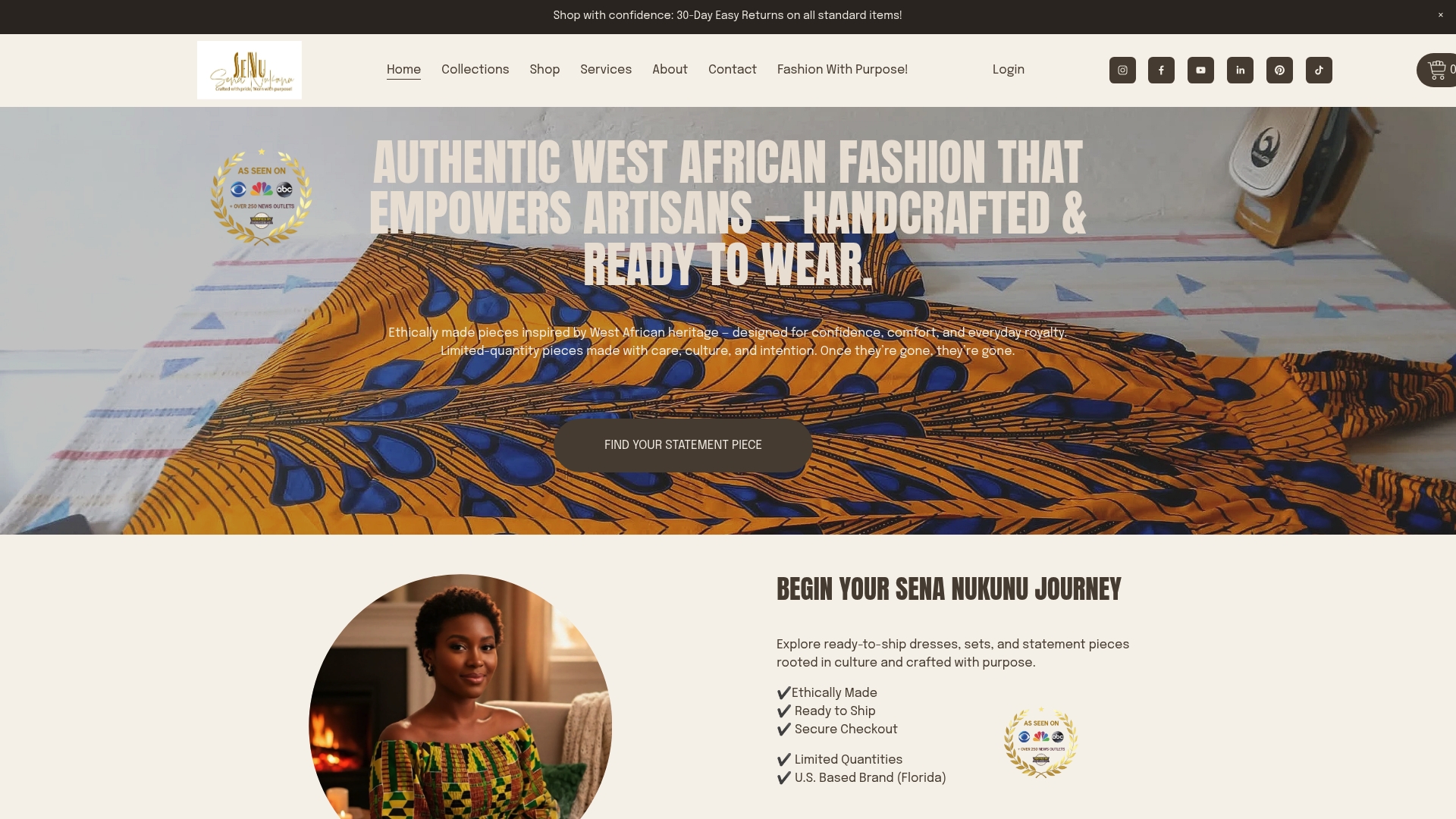
You will not find vague "handmade" tags here. You will find named techniques, small-batch quantities, and the cultural context that makes West African artisan fashion worth wearing. Browse the handcrafted dress collection to see what full provenance documentation looks like in practice, or visit Senanukunu to explore the full range of ethically crafted pieces. If you are interested in a custom or made-to-order piece, the services page outlines bespoke options with the same commitment to craft and transparency.
Useful sources and further reading
These are the primary sources behind the claims and inspection guidance in this article. Each one adds a distinct layer of verification.
- Artisan-made clothing 101 — And For Good: Establishes the philosophy and production standards behind genuine artisan clothing, including small-batch and material quality benchmarks.
- What's the difference between handloom, handcrafted, and machine-made? — Saroj Jain: Practical breakdown of production methods and how they affect materials, fit, and finish — useful for label-reading and technique verification.
- How handcrafted textiles change the way we dress — World of Crow: Explains the lower-tension weaving principle behind superior drape and the scrunch test for confirming hand-loomed fabric.
- Handcrafted clothing vs machine-made — Charkha Tales: Frames the long-term value case for handcrafted construction and its durability advantage over fast fashion.
- Artisanal fashion definition — Aalto University: Academic definition of artisanal production, including the small-batch and maker-control criteria that distinguish genuine craft from scaled manufacturing.
- Hand block printing — ICHA Foundation: Authoritative reference on the history and visual characteristics of hand-block printing, useful for verifying print authenticity.
- Fair Trade Certified: Primary source for understanding what Fair Trade certification actually verifies in garment production.
- Types of handmade garments — Senanukunu blog: Senanukunu's own reference on handmade garment categories, cultural context, and the ethical value of artisan apparel.