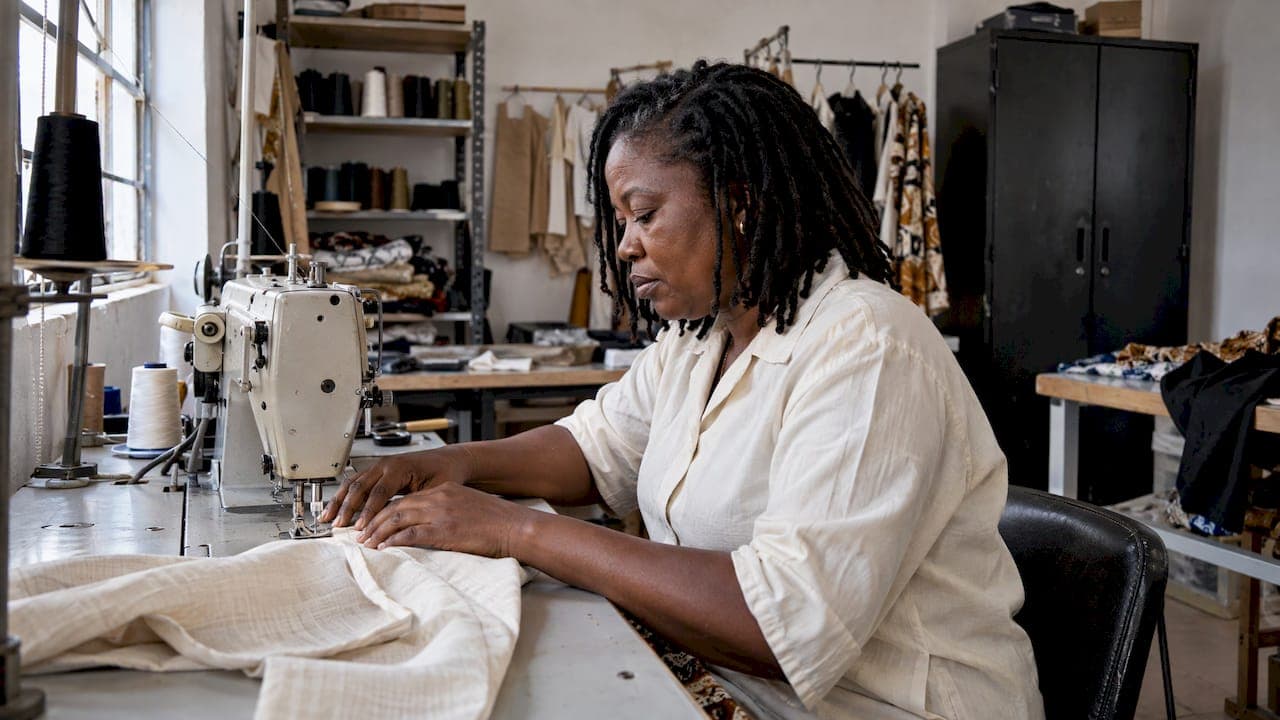
Ethical manufacturing in fashion means the people who make a garment are treated fairly: safe workplaces, fair pay and hours, freedom to organize, and freedom from harassment. It is a question about people first, and the environment second. This guide explains what the term covers, how it differs from fast fashion and from sustainable fashion, and which questions help you judge a brand's claims for yourself.
TL;DR
- Ethical manufacturing is about worker rights and welfare: wages, hours, safety, and the freedom to organize without fear.
- Ethical fashion focuses on social impact, while sustainable fashion focuses on environmental impact. The best brands care about both.
- Ask who made the piece and where, whether the brand discloses its suppliers, and whether anyone independent checks the work.
- A certification shows a process was assessed, not that every outcome is perfect, so read it as one clue among several.
- Limited-quantity, artisan-made clothing is one practical way to buy fewer, better, longer-lasting pieces.
Table of Contents
- What ethical manufacturing in fashion actually means
- Ethical fashion vs. sustainable fashion
- How ethical fashion differs from fast fashion
- How to judge whether a brand's production is ethical
- What certifications and transparency can and cannot tell you
- Wax prints, Kente and Adire: the story behind the fabric
- Materials, lifespan and what happens after you buy
- Find your statement piece
- FAQ
- Sources
What ethical manufacturing in fashion actually means
Behind every garment is a chain of people: farmers and weavers, dyers, cutters, tailors, finishers, packers. Ethical manufacturing asks whether each of those people is treated with dignity. Green America, a U.S. nonprofit, describes the core of it as worker rights and welfare, including fair safety, wage and hour standards, freedom of association and freedom from harassment.
A broader definition, from the testing and certification company SGS, adds the environmental side: designing, making and distributing clothing in a way that respects human rights, ensures fair labor practices such as living wages and safe conditions, and uses cleaner production methods. In practice, most shoppers meet the term in four places:
- Fair pay and reasonable hours. Work that supports a household, not just a minimum.
- Safe, respectful workplaces. Safe buildings, safe materials, and no harassment.
- A voice for workers. Independent unions and collective bargaining give people a way to raise problems.
- No child or forced labor. The baseline every brand should be able to speak to plainly.
For artisan-made clothing there is a fifth layer: the craft itself. When skilled makers sell directly to a wholesaler or retailer and receive fair payment, the work sustains the tradition as well as the household. Green America notes that the Fair Trade system supports fair wages and healthy working conditions, especially for economically disadvantaged artisans.
Ethical fashion vs. sustainable fashion
The two words are often used as if they were the same, and they overlap, but they answer different questions. Oxfam explains that ethical fashion focuses on the social impact of the clothing industry, such as wages, working conditions, forced labor and child labor, while sustainable clothing focuses more on the environmental impact of manufacturing, shipping and longevity.
A simple way to hold the difference:
| Ethical fashion | Sustainable fashion | |
|---|---|---|
| Main question | Were the people who made it treated fairly? | What did making, shipping and wearing it cost the planet? |
| Typical topics | Wages, working conditions, forced and child labor | Fibers, water, chemicals, emissions, durability |
| What to look for | Supplier disclosure, independent monitoring, worker voice | Evidence for fiber claims, repair and recycling options |
A garment can be strong on one and weak on the other. A cotton shirt made with low-impact fibers can still come from a factory with unsafe conditions. A beautifully fair-wage piece can be shipped across the world in plastic. That is why it helps to keep both questions in mind. If you want a wider frame for how values shape what you buy, our guide to what conscious fashion is and why it matters goes deeper.
How ethical fashion differs from fast fashion
Fast fashion is a business model, not a style. The Good Trade describes it as rapid, high-volume production cycles, low prices, and frequent copying of trends, which often leads to poor working conditions, heavy textile waste, and reliance on environmentally damaging synthetic materials. The speed and the low price are the point, and someone along the chain absorbs the cost.
The alternative is often called slow fashion. A Green Building Research Institute learning hub paper frames it as prioritizing quality over quantity, with ethically produced garments intended to last. The contrast shows up in how you shop:
- Pace. Fast fashion drops new items constantly. Slow fashion works in smaller runs and lets pieces stay relevant.
- Quantity. Mass production versus limited quantities made with care.
- Construction. Industry consultant Jennifer Walderdorff points out in National Geographic that translucent, thin materials and a lack of lining can signal a low-cost fast-fashion garment. Turn a piece inside out and look at the seams, the lining and the weight of the cloth.
- Relationship to the maker. Fast fashion hides the maker. Artisan fashion puts the maker and the story at the center.
The climate side is part of the picture too. The same learning hub paper estimates that the fashion industry is responsible for approximately 10% of global annual carbon emissions, more than international shipping and aviation combined. Buying fewer pieces that last is one of the most direct ways an individual shopper can respond.
How to judge whether a brand's production is ethical
No single label settles the question. Green America's guidance gives you a practical set of questions to ask of any brand, from a global retailer to a small online boutique:
- Who made this, and where? A brand proud of its production will say so in specific terms, not just with a country name.
- Does the brand disclose its suppliers? Naming factories and workshops makes accountability possible.
- Does anyone independent check conditions? Look for independent monitoring, published findings, and correction of violations.
- Is there worker voice? Independent unions and collective bargaining matter more than a code of conduct on paper.
- Are supplier relationships long-term? Brands that keep working with the same makers, rather than switching factories only for a lower price or a faster turnaround, tend to build better conditions over time.
- Is "Made in the USA" doing too much work? Green America cautions against relying on that phrase alone, because a domestic label does not by itself tell you about wages, unions or conditions.
What do you do if the answers are not on a product page? Read the brand's story and sourcing pages, and notice how specific they are. Concrete detail about makers, materials and methods is a better sign than lofty adjectives. Our own checklist, signs of responsibly made fashion, walks through these cues in more detail, and our roundup of responsible fashion brands shows how different kinds of brands approach them.
What certifications and transparency can and cannot tell you
Certifications are useful, and they are easy to over-read. The U.S. Department of Labor explains that a certification shows a product or process was assessed against established standards, but it approves the process, not the outcomes, and should not be treated as proof that no child or forced labor was involved. The same page notes there is no independent verification standard for terms like "sustainable" and "transparent," and that worker organizations, including trade unions, are key stakeholders to consult when judging how credible a certification is.
So treat a badge as one clue. Ask what it covers, who audits it, and whether workers had a voice in the process. SGS adds that visibility into material sourcing, labor conditions and environmental impact, backed by third-party verification, helps substantiate claims and prevent greenwashing. The same source observes that QR and RFID codes are increasingly used to trace products from raw materials to the end user, so expect more brands to offer a way to follow a garment back to its origin.
Transparency also shows up in smaller ways: a brand that explains why a piece is made in limited quantities, names the craft behind it, and answers questions plainly is practicing a kind of everyday openness that no badge can replace.

Wax prints, Kente and Adire: the story behind the fabric
Ethical questions reach all the way down to the cloth, and West African textiles are a rich example. Many people assume that vividly patterned wax-print fabric, often called Ankara, began in Africa. Marie Claire Nigeria notes that its origins are not African: Dutch traders inspired by Indonesian batik mass-produced wax-resist fabrics in the 19th century, and West African traders later embraced them and wove them into local customs. The cloth became African through use, meaning, and style, even though the industrial roots lie elsewhere.
That history has a present-day edge. CNN reports that international competitors have caused nearly all African textile print factories to shut down. So when someone asks whether wax print is sustainable, the honest answer depends on the specifics: where the cloth was made, who made it, how long the garment will be worn, and whether the money reaches the communities that carry the tradition.
The Marie Claire piece calls for supporting locally made textiles and revitalizing traditional fabrics such as Adire and Kente. If you want to know what makes these cloths distinct, these guides are a good start:
- What Adire is and how Yoruba indigo textiles are made
- How to tell Ashanti and Ewe Kente apart
- Why Kente's history matters now
- An overview of West African textile traditions
Learning the vocabulary of a cloth is itself an ethical act. It helps you buy with respect for the people and the heritage behind it, and it makes you harder to sell a imitation to.
Materials, lifespan and what happens after you buy
A responsible purchase does not end at checkout. Scientific American's beginner's guide suggests asking whether a garment fits, functions and will last, and then repairing, selling, swapping, donating or recycling it when you are done. The same guide recommends checking the evidence behind fiber claims, thinking about durability, waste, chemical and wastewater controls, and buying less or secondhand where practical.
Where clothes end up matters too. The Ghana Youth Environmental Movement describes how the secondhand clothing trade sends millions of tons of discarded garments from the West to Africa, creating textile waste in landfills, ocean pollution, and toxic emissions from burning unsellable clothing. The lesson for shoppers is simple: the most responsible garment is the one you wear for years, and the second most responsible is the one you pass on while it still has life in it.
A few habits make this easier:
- Choose pieces you can imagine wearing to several kinds of occasions.
- Prefer classic silhouettes and rich, well-made cloth over trend-of-the-week details.
- Care for pieces according to their labels, and mend small issues early.
- When you are finished with a piece, pass it to someone who will love it.
Our perspective: wear the change
At Sena Nukunu, we believe ethical fashion begins with respect: for the hands that make a garment, for the heritage it carries, and for the person who wears it. Every stitch, every pattern and every silhouette carries the spirit of a legacy, and we think that deserves to be honored from the first sketch to the final fitting.
That is why our West African ready-to-wear and custom fashion is made with ethical manufacturing and artisanal craftsmanship, in limited quantities. We would rather make fewer pieces with purpose than many pieces without it. Working this way is how we aim to support artisans, tell cultural stories honestly, and give you a statement piece that feels regal, comfortable and entirely your own.
We see every purchase as a quiet vote. When you choose a dress, a kaftan or an agbada set made with care, you help bridge cultures and keep craft traditions thriving. We are proud to be a Florida-based brand that invites you into that circle, and we hope you will wear your values with pride.
Sena
Find your statement piece
If you are ready to put these ideas into practice, explore our ready-to-ship West African fashion for men and women: dresses, kaftans, agbada sets, jackets and matching statement sets, each made in limited quantities with artisanal craftsmanship and ethical manufacturing. Browse the full collections to find a story that feels like yours, from the Woven Nobility robes to the Woven Radiance pieces made for celebration.
Looking for something for a wedding, a milestone or a day when you simply want to feel like royalty? Start with the women's shop or visit the Sena Nukunu homepage for men's agbada ensembles and heritage pieces. For ideas on styling, our piece on authentic West African cultural fashion statements for women is a good companion, and our guide to contemporary West African motifs helps you read the designs you choose.
FAQ
What is the difference between ethical and sustainable fashion?
Ethical fashion centers on people: fair wages, safe conditions, and freedom from forced and child labor. Sustainable fashion centers on the environment, including how clothes are made, shipped and how long they last. Most thoughtful brands try to address both, and as a shopper you can ask about both.
Is ethical fashion the same as slow fashion?
They are close relatives. Slow fashion is the alternative to fast fashion that puts quality over quantity and ethically produced garments meant to last. Ethical manufacturing describes how the people behind those garments are treated, and slow fashion describes the pace and philosophy of buying and making.
Does a certification prove a garment is ethical?
Not on its own. According to the U.S. Department of Labor, a certification shows that a process was assessed against a standard, not that outcomes are guaranteed. It is most useful alongside supplier disclosure, independent monitoring and a record of correcting problems.
Is wax print fabric sustainable?
It depends on where and how the cloth was made, how long the garment is worn, and who benefits from the sale. The fabric's industrial roots are Dutch and Indonesian-inspired, while its meaning in West Africa is deeply local. Choosing well-made pieces you will wear for years, and learning about traditional cloths like Adire and Kente, are good places to start.
Sources
- How to Find Sweatshop-Free Clothing, Green America
- How Ethical Fashion is Redefining the Future of Style, SGS
- Ethical fashion: Is buying charity shop clothes ethical?, Oxfam
- What Is Fast Fashion?, The Good Trade
- From Fast Fashion to Fair Fashion, Green Building Research Institute learning hub
- Ready to give up fast fashion? Give slow fashion a try, National Geographic
- The Search for Independent Verification in Fashion Supply Chains, U.S. Department of Labor
- We are preserving traditions and crafting the future of fabrics made in Africa, Marie Claire Nigeria
- The complex future of African fabric, CNN
- A Beginner's Guide to Ethical and Sustainable Fashion, Scientific American
- Sustainable Fashion, Ghana Youth Environmental Movement