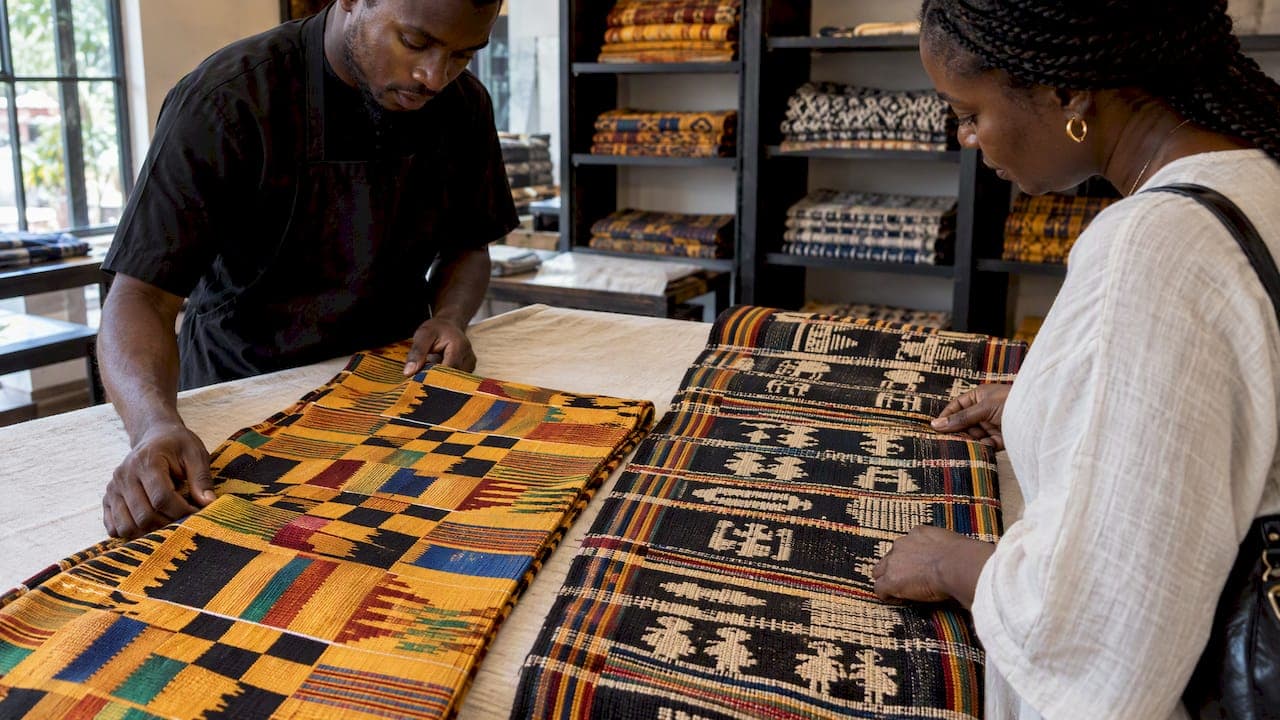
Ashanti (Asante) kente is known for geometric, high-saturation patterns woven with generous silk, a cloth historically reserved for royal regalia, while Ewe kente favors figurative weft motifs, pictorial storytelling, and cotton or rayon blends suited to everyday commissions. What follows traces the history, the techniques, the symbolism, and the authenticity questions that separate these two proud traditions, and shows you how to recognize each one with confidence.
TL;DR:
- Ashanti kente is characterized by vibrant geometric patterns woven with silk or rayon, traditionally reserved for royalty and ceremonial functions.
- Ewe kente features figurative motifs like birds and human figures, using cotton or cotton-rayon blends suited for detailed storytelling and everyday use.
- Fiber choice influences the weaving technique: silk facilitates crisp geometric blocks, while cotton allows for complex figurative imagery with layered weft floats.
- Authentic kente can be identified by hand-sewn strips, provenance details, and subtle unevenness in the weave, distinguishing it from mass-produced prints.
- Ghana has legally protected kente as a Geographical Indication since 2025, aimed at preserving the craftsmanship and authentic origin of handwoven cloth.
Table of Contents
- Visual comparison: patterns, motifs, and color palettes
- Materials and weaving techniques (looms, strip-weave assembly)
- Origins and contested histories: Bonwire, Notsie, and cross-regional exchange
- Social meaning, symbolism, and ceremonial uses
- Authenticity, modern changes, and protections (GI, mass production vs handwoven)
- Practical identification checklist: how to tell Ashanti-style from Ewe-style kente
- Historical evolution and timeline of Ashanti and Ewe kente weaving traditions
- Regional and ethnic significance within Ghana and neighboring areas
- Influence of Ashanti and Ewe kente in contemporary fashion and diasporic communities
- Why the Ashanti and Ewe distinction still matters
- Wearing the legacy: Sena Nukunu's kente-inspired collections
- FAQ
- Sources
Visual comparison: patterns, motifs, and color palettes
The quickest way to tell these two weaving traditions apart is to look at what they are trying to say. Ashanti kente speaks in geometry. Bold, repeating blocks of color form diamonds, zigzags, and checkerboards, often rendered in saturated reds, golds, greens, and blues that practically hum against each other. Silk threads, historically unraveled from imported fabric and later supplemented with rayon, give Asante cloth its characteristic sheen, a visual signature tied to centuries of royal patronage.
Ewe kente tells a different kind of story. Instead of pure abstraction, Ewe weavers favor figurative weft motifs: birds, stools, combs, drums, and human figures appear woven directly into the strips, turning the cloth into a kind of pictorial proverb. Color palettes tend to run less uniformly saturated than Asante silk work, and cotton or cotton-rayon blends show up more often than pure silk. The V&A's research on African textile traditions confirms this split: Asante weaves lean geometric and silk-forward, while Ewe weaves lean figurative and cotton-blended.
A few named motifs illustrate how these choices function as language rather than decoration:
- Fathia Fata Nkrumah is an Asante pattern associated with a historic marriage, its geometry carrying a specific commemorative meaning.
- Adwinasa, meaning "my skill is exhausted," refers to a densely patterned Asante cloth that pushes weaving complexity to its limit.
- Agbamevo, found among Ewe weavers, often incorporates figurative elements tied to community events or commissioned stories.
According to the V&A, Asante and Ewe weaves can be distinguished by fiber choice and motif style, though the museum also notes that modern production and cross-regional exchange have blurred some of these once-clear lines. That caveat matters for anyone shopping or studying today's cloth: contemporary weavers borrow freely across traditions, and market demand has encouraged hybrid patterns that resist tidy categorization. Our guide to contemporary West African motifs walks through how designers adapt these patterns for modern garments.
Materials and weaving techniques (looms, strip-weave assembly)
Both Ashanti and Ewe weavers build their cloth the same structural way: on a horizontal, double-heddle strip loom that produces narrow bands of fabric, which are then sewn together into a full cloth. This strip-weave method is the technical backbone of kente, and it is also why the craft takes years to master. A weaver sits at the loom working foot pedals to raise and lower the heddles while the shuttle carries weft thread across a narrow warp, building pattern blocks one pass at a time.
Where the two traditions diverge is in fiber choice and in how that choice shapes what the loom can produce. Asante weavers historically prized silk, originally unraveled from imported Asian textiles and rewoven into kente, which gives the finished cloth its glossy surface and crisp geometric edges. Rayon later supplemented silk for affordability without sacrificing shine. Ewe weavers more often use cotton or cotton-rayon blends, fibers with more texture and less light reflection, better suited to the slower, more detailed weft-float technique that produces figurative imagery.

That technical difference is not incidental. Figurative motifs, the birds, stools, and human figures found in Ewe cloth, require extra weft floats woven in on top of the base structure, a labor-intensive process that cotton's grip and flexibility accommodate more readily than silk's slickness. Geometric blocks, by contrast, rely on repeating warp-float patterns that silk renders especially vivid.
A few technical points worth knowing if you are examining or buying a piece:
- Strip width typically runs 3 to 4 inches, and a finished cloth is assembled from roughly 10 to 24 strips sewn edge to edge, according to textile research on kente construction.
- A traditional man's cloth measured about 6 to 7 feet by 10 to 12 feet once fully assembled, per the same research.
- Seam quality is a reliable tell: hand-joined strips show slight, consistent irregularities, while machine-finished imitation kente has uniform, almost invisible seams.
Our piece on West African textile traditions goes deeper into how strip-weave practices vary by region.
Origins and contested histories: Bonwire, Notsie, and cross-regional exchange
Kente's origin story depends on who is telling it, and both the Asante and Ewe narratives carry real historical weight rather than competing for a single "true" answer.
- The Bonwire legend credits two Asante hunters near the town of Bonwire with observing a spider, Ananse, weaving its web and bringing the technique home to the royal court, a story Smarthistory documents alongside the cloth's rise to royal and ceremonial prominence.
- The Notsie narrative ties Ewe weaving history to migration from Notsie, in present-day Togo, into the Volta Region of Ghana, where centers like Kpetoe and Agbozume became known for cotton-based strip-weaving traditions distinct from Asante court production.
- Parallel development rather than a single point of invention is the more accurate picture, since Khan Academy's treatment of kente describes the cloth as strip-woven fabric practiced by both Asante and Ewe peoples, each with its own motifs, naming conventions, and ceremonial uses that developed alongside, rather than strictly after, one another.
Trade routes and migration complicate any clean separation further. Ewe and Asante communities exchanged dyed threads, finished strips, and finished cloth across centuries, and royal demand for silk kente created commercial incentive for weavers across ethnic lines to supply the Asante court. The result is a textile history with two strong, well-documented centers of excellence rather than a single tree with one root. UNESCO's inscription file for kente craftsmanship treats the broader tradition as a shared skill transmitted through chief weavers and apprenticeship, formally recognizing it as part of humanity's intangible cultural heritage rather than crediting a single ethnic origin.
Social meaning, symbolism, and ceremonial uses
Kente has never been decoration for its own sake. Every named pattern carries a story, a proverb, or a historical reference, and knowing a cloth's name often tells you more than its colors do. Ghana's own National Commission on Culture describes this naming convention as a visual language built on proverbs, historical events, and social values rather than arbitrary pattern labels.
Within Asante tradition, kente carried rank. Certain patterns were historically reserved for chiefs and royal court members, worn at durbars, enstoolment ceremonies, and state functions where the cloth signaled status as clearly as any spoken title. Ewe kente, by contrast, grew more from commission and community life: a weaver might create a pattern to mark a specific wedding, honor a patron's achievement, or narrate a local event, making the cloth a kind of woven record rather than strictly a marker of rank.
Both traditions converge in how they function socially today:
- Weddings and naming ceremonies across Ghana frequently feature kente, regardless of ethnic origin, as a marker of celebration and heritage.
- Funerals call for specific color combinations and patterns chosen to honor the deceased and signal mourning status.
- State and diplomatic events regularly feature kente stoles and wraps, a practice that has extended into diaspora communities worldwide.
- Graduations and rites of passage in Ghana and among diaspora communities increasingly use kente stoles as a visible link to heritage.
Our guide to color symbolism in African patterns expands on what specific hues communicate across these ceremonial contexts.
Authenticity, modern changes, and protections (GI, mass production vs handwoven)
The kente market today holds two very different products under one familiar name: handwoven strip-kente, built strip by strip on a traditional loom, and mass-produced "kente print" fabric, printed in a single pass to imitate the look without the weaving. Telling them apart matters, both culturally and financially, since handwoven cloth represents months of skilled labor while printed imitation can be produced at industrial speed.
Ghana formally protected kente as a Geographical Indication starting September 30, 2025, a legal designation managed by the country's Registrar General's Department to safeguard authentic origin claims, according to a report on the GI launch. This gives kente the same category of legal protection that Champagne or Parmigiano Reggiano enjoy in their own markets, a mechanism that strengthens the authenticity narratives museums and scholars already rely on.
A handful of trust signals help separate the genuine article from the imitation:
- Museum accession records, like those maintained by the V&A, document provenance, weaver origin, and fiber content for verified pieces.
- Named weavers and village origins attached to a piece suggest a traceable, handwoven source rather than an anonymous factory run.
- GI registry status will, over time, give buyers a formal, legally backed reference point for origin claims.
- UNESCO's nomination file documents chief-weaver leadership and apprenticeship transmission, evidence of a living, regulated craft rather than a generic pattern anyone can print.
Contemporary ready-to-wear adaptation has not erased these distinctions so much as layered new choices on top of them: tailors now cut kente-inspired cloth into fitted jackets, dresses, and sets that honor the pattern's spirit while fitting modern wardrobes, a practice that works best when it starts from authentically sourced textiles rather than printed substitutes.
Practical identification checklist: how to tell Ashanti-style from Ewe-style kente
Whether you are studying a museum piece or shopping for a piece to wear, the same checks apply.
- Touch the fabric first: silk-dominant Asante-style cloth feels smooth and slightly cool, while cotton-heavy Ewe-style cloth has more texture and warmth.
- Look for figures versus geometry: birds, stools, or human shapes woven into the pattern point toward Ewe tradition, while repeating geometric blocks point toward Asante tradition.
- Count and inspect the strips: genuine strip-woven kente shows 10 to 24 narrow strips sewn together with slightly visible, hand-finished seams, per textile construction research.
- Ask about provenance: a legitimate seller should be able to name the weaving village or workshop, describe the loom type used, and explain whether the piece was a custom commission.
- Check for documentation: pieces tied to a known weaver, a museum accession number, or eventually a GI registry entry carry the strongest authenticity claims.
Pro Tip: Hold the cloth up to light. Handwoven strips show subtle unevenness in thread tension between sections, a sign of human hands at the loom rather than a printing press.
Our step-by-step guide to identifying authentic West African garments covers additional checks for buyers working outside Ghana.
Historical evolution and timeline of Ashanti and Ewe kente weaving traditions
Asante kente's documented history centers on the royal court, where the craft moved from local village production into a prestige good tied directly to the Asante monarchy, with silk threads unraveled from imported cloth becoming the material marker of status. Over generations, the court's demand for increasingly intricate patterns pushed weaving technique forward, and named cloths accumulated meaning tied to specific rulers, alliances, and events, a history Smarthistory traces from legend through royal adoption to national symbol.
Ewe weaving history follows a related but distinct arc, rooted in migration from Notsie into the Volta Region and the establishment of weaving centers such as Kpetoe and Agbozume. Rather than concentrating around a single court, Ewe weaving developed through commissioned work for weddings, funerals, and community milestones, producing a decentralized but equally sophisticated tradition built on cotton and figurative storytelling.
Both traditions moved from strictly regional practice toward national and international recognition over the twentieth century, a trajectory that culminated in UNESCO's formal inscription of kente craftsmanship as intangible cultural heritage and, more recently, in Ghana's 2025 Geographical Indication protection, legal milestones that acknowledge centuries of parallel, intertwined development rather than a single linear history.
Regional and ethnic significance within Ghana and neighboring areas
Kente's regional geography maps closely onto its two major traditions. Asante kente is historically centered in the Ashanti Region, with Bonwire remaining the most celebrated weaving town and a living center of apprenticeship and production. Ewe kente centers in the Volta Region, with towns like Kpetoe and Agbozume carrying the same kind of reputation among Ewe communities that Bonwire holds for Asante weavers.
Beyond these two core traditions, kente's reach extends into neighboring Togo, where Ewe communities share weaving practices across the border, a reminder that ethnic textile traditions rarely respect national boundaries drawn more recently than the craft itself. Within Ghana, kente has also become something larger than either single ethnic tradition, a national symbol worn at independence celebrations, parliamentary functions, and diplomatic events regardless of the wearer's own ethnic background.
This dual identity, deeply specific to Asante or Ewe heritage while also functioning as a broader Ghanaian and West African symbol, is part of what makes the cloth so culturally rich. A piece can carry precise ethnic meaning to someone who knows its pattern name and origin village, while also reading simply as a proud marker of West African identity to a wider audience, two layers of meaning operating in the same cloth at once.
Influence of Ashanti and Ewe kente in contemporary fashion and diasporic communities
Kente's influence on global fashion has grown well beyond Ghana's borders, showing up on graduation stoles, red carpets, and runway collections that borrow its colors and patterns while adapting them to new silhouettes. Diaspora communities across the globe have embraced kente as a visible, wearable connection to West African heritage, often worn at milestones like graduations, weddings, and cultural festivals as a deliberate statement of identity and pride.
Designers working in ready-to-wear spaces increasingly draw on both Asante geometric patterns and Ewe figurative motifs, sometimes blending elements from each into garments that honor the source tradition while fitting contemporary wardrobes. This adaptation raises real questions about sourcing and respect, since a printed imitation of a sacred pattern carries a very different cultural weight than a piece woven by an artisan continuing a documented lineage of skill.
The most meaningful diaspora engagement tends to pair the aesthetic with the history, understanding why a particular pattern exists before wearing it, supporting weavers and ethically run workshops rather than anonymous mass production, and treating kente as a living tradition rather than a static print. That distinction between appreciation and extraction shapes how thoughtfully the cloth's legacy travels into new wardrobes and new generations.
Why the Ashanti and Ewe distinction still matters
The instinct to flatten "kente" into one generic pattern misses most of what makes the cloth worth understanding in the first place. Ashanti and Ewe weaving represent two distinct, sophisticated technical and symbolic systems, each shaped by its own history, materials, and social function, and collapsing them into a single aesthetic does a disservice to both.
What readers tend to underestimate is how much the fiber choice alone changes the cultural story: silk's historical scarcity and cost tied Asante kente to royal power in a way cotton's wider accessibility never did for Ewe weavers, whose innovation went instead into figurative storytelling that silk's slickness makes harder to execute. Neither approach is more sophisticated than the other; they solved different problems with the materials and social structures available to each community.
The real risk today is not confusing the two traditions, it is flattening both of them into a generic "African print" aesthetic that erases the skill, the proverbs, and the centuries of apprenticeship behind every genuine strip. Buying or studying kente with real attention to which tradition you are looking at, and why its patterns look the way they do, is a small act of respect toward craftsmanship that took generations to refine.
— Sena
Wearing the legacy: Sena Nukunu's kente-inspired collections
At Sena Nukunu, we approach kente-inspired fashion the way the weavers themselves do, with patience, respect for technique, and a commitment to craftsmanship over shortcuts. Our collections draw on West African textile heritage to create statement pieces made in limited quantities, each one intended to carry forward the spirit of the weaving traditions behind it rather than flatten them into a generic print.
Our current offerings include various men's and women's ready-to-wear pieces alongside statement lines inspired by traditional weaving, each designed to bring the artistry of traditional weaving into everyday wardrobes. When you shop with us, look for the same markers of authenticity this guide covers: thoughtful construction, honest sourcing, and a story behind the pattern rather than an anonymous print. Browse our collections or visit Sena Nukunu to find a piece that fits your own story, or reach out about a custom commission built around the heritage you want to honor.
FAQ
Is kente Ghanaian or Nigerian?
Kente is a Ghanaian textile tradition, woven historically by the Asante and Ewe peoples of Ghana, with Ewe weaving communities also present across the border in Togo. It is not a Nigerian textile tradition, though it is sometimes confused with other West African woven cloths like aso oke, which comes from Yoruba weaving traditions in Nigeria.
Is Ashanti Nigerian or Ghanaian?
The Ashanti, also spelled Asante, are a Ghanaian ethnic group and historically the center of a powerful kingdom in what is now the Ashanti Region of Ghana. They are not a Nigerian ethnic group, and the Asante kingdom's royal weaving tradition is specifically tied to towns like Bonwire within Ghana.
What does Ashanti mean in Africa?
Ashanti, or Asante, refers to both an ethnic group and the historical kingdom they built in what is now central Ghana, known for its political structure, gold trade, and distinctive artistic traditions including royal kente weaving. The name is tied to a specific people and history rather than a general term applied across Africa.
What is Ashanti called today?
The group and region are most often spelled "Asante" in contemporary usage, referring to both the ethnic group and Ghana's Ashanti Region, where the historical kingdom was centered. Both "Ashanti" and "Asante" remain in common use, with "Asante" closer to the group's own spelling of its name.
Sources
- Ghana's kente becomes a Geographical Indication — Understanding geographical indication and what this means
- Cloth of a continent: Africa Fashion — V&A
- Kente cloth — Smarthistory
- Kente cloth (Asante and Ewe peoples) — Khan Academy
- UNESCO decision: Craftsmanship of traditional woven textile Kente — Representative List