TL;DR:
- West African textile traditions are living cultural practices that encode social identity, history, and spirituality through weaving and dyeing techniques. These traditions are centuries old, with regional variations like Kente, Bogolanfini, and Adire, each carrying unique cultural meanings and signaling social status. Today, they remain vital for ceremonies, but globalization and mass production threaten their authenticity and transmission.
West African textile traditions are defined as a living cultural language, combining weaving, dyeing, and symbolic patterning to communicate social identity, political rank, and spiritual meaning across generations. These are not decorative arts in the Western sense. They are material records of history, carrying the weight of ceremony, community, and collective memory. West African textile traditions explained in full reveal techniques that span over 900 years, regional systems as distinct as the ecologies that produced them, and a visual vocabulary that trained eyes can read like text. Every cloth tells a story, and understanding that story changes how you see the fabric entirely.
What are West African textile traditions and where do they begin?
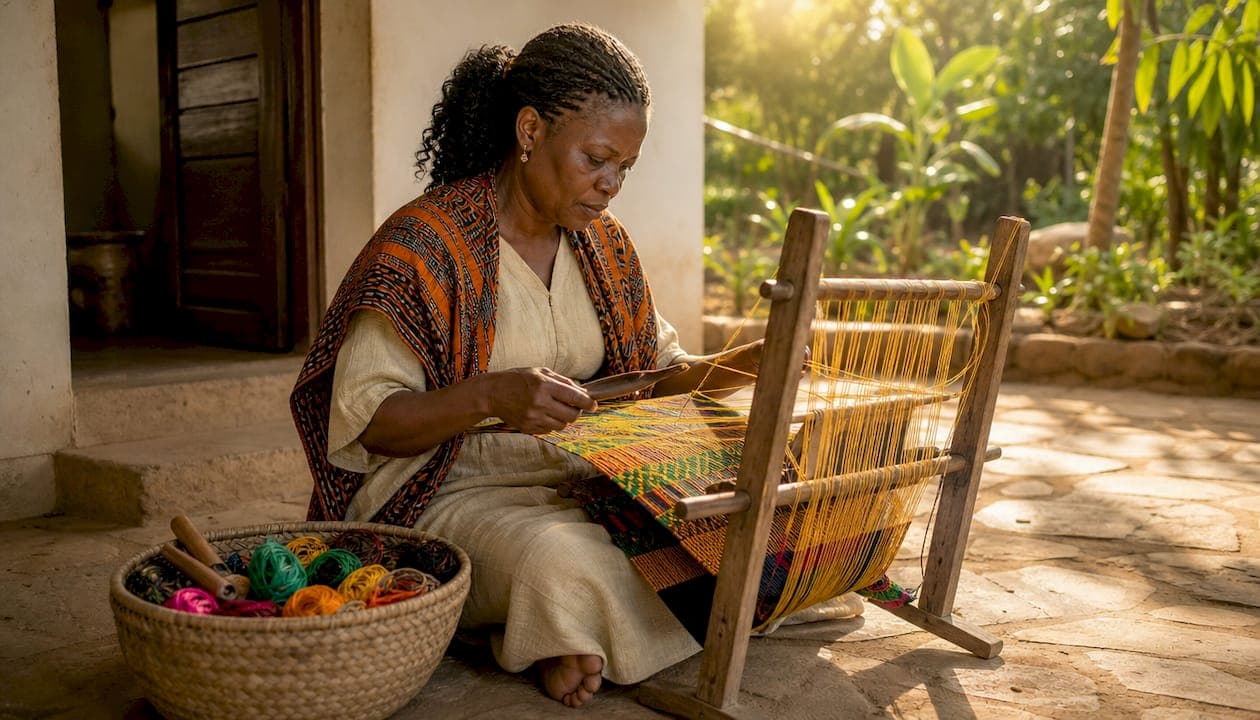
Strip-weaving dates back at least 900 years, with the earliest documented evidence found at Mali's Bandiagara Escarpment in the 11th century. That longevity is not accidental. It reflects how deeply cloth was woven into the social and economic fabric of West African empires, from the Ghana Empire's trade networks to the courts of the Ashanti Kingdom.
The technique itself is precise. Weavers produce long, narrow strips of cloth on a horizontal loom, then sew those strips together side by side to create a wider textile. The resulting seam lines are not flaws. They are signatures of the method, visible proof that a human hand, not a machine, produced the cloth.
"Cloth in West Africa has always done more than cover the body. It has spoken for the wearer, announced their rank, marked their passage through life, and connected them to ancestors who wore the same patterns before them."
Ceremonial use drove the continuity of these techniques across centuries. Naming ceremonies, weddings, initiations, and funerals each required specific textiles. That steady, life-cycle demand kept master weavers employed and their knowledge alive in ways that purely commercial markets never could.
Key historical facts about West African textile origins:
- Strip-weaving emerged in the 11th century in present-day Mali and spread across the Sahel and forest zones.
- Trade routes connecting West Africa to North Africa and the Mediterranean carried both cloth and dyeing knowledge.
- Royal courts in the Ashanti and Yoruba kingdoms used textiles to regulate social hierarchy, restricting certain patterns to nobility.
- Dyeing traditions using indigo, iron-rich mud, and plant tannins developed independently across multiple regions, each producing distinct chemical processes.
What makes Kente, Bogolanfini, and Adire distinct traditions?
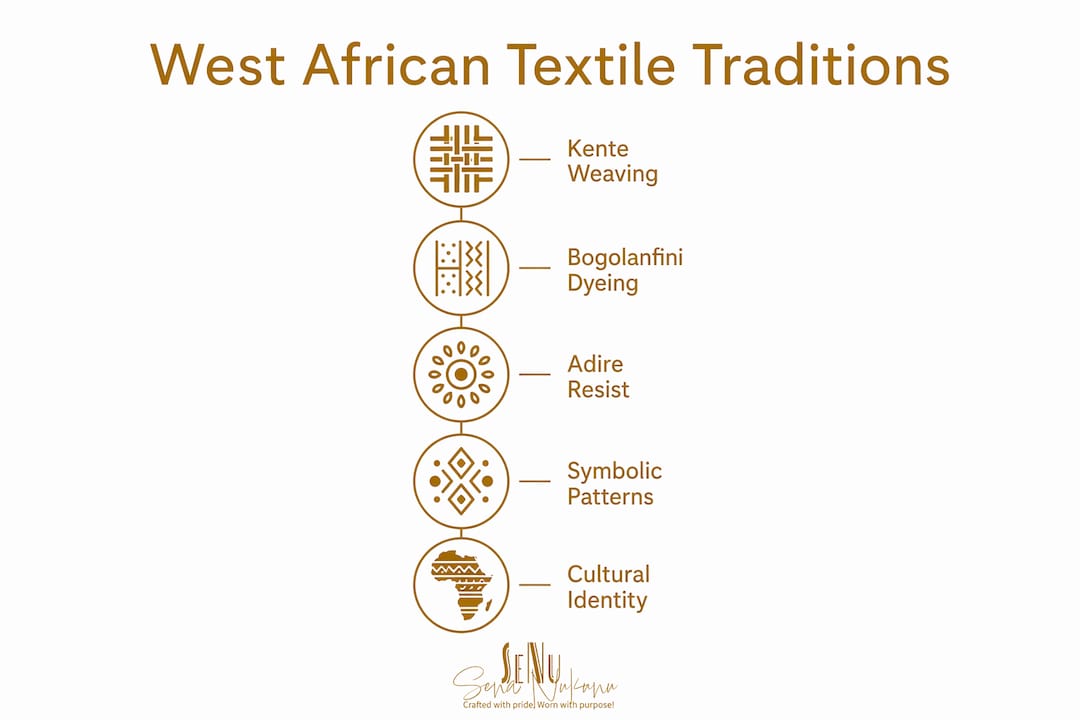
Three traditions stand out for their technical sophistication and cultural depth: Kente cloth from Ghana, Bogolanfini mud cloth from Mali, and Adire resist-dyed cloth from Nigeria's Yoruba communities.
| Tradition | Origin | Core technique | Primary symbolism |
|---|---|---|---|
| Kente | Ghana (Ashanti, Ewe) | Strip weaving on horizontal loom | Rank, proverbs, political identity |
| Bogolanfini | Mali (Bamana) | Mud dyeing with tannin-iron bond | Rites of passage, protective power |
| Adire | Nigeria (Yoruba) | Resist dyeing with indigo | Women's knowledge, community identity |
Kente weaving is a plural tradition, meaning it does not belong to a single community or style. Ashanti Kente focuses on bold geometric strips, while Ewe Kente incorporates figurative motifs that encode proverbs and tribal memory. That regional variation is critical to informed appreciation. Treating Kente as a single uniform tradition misses the depth of what each community's weavers have built over centuries. In 2025, Kente's plurality received formal recognition through geographic indication protection, acknowledging the distinct authorship of both traditions.
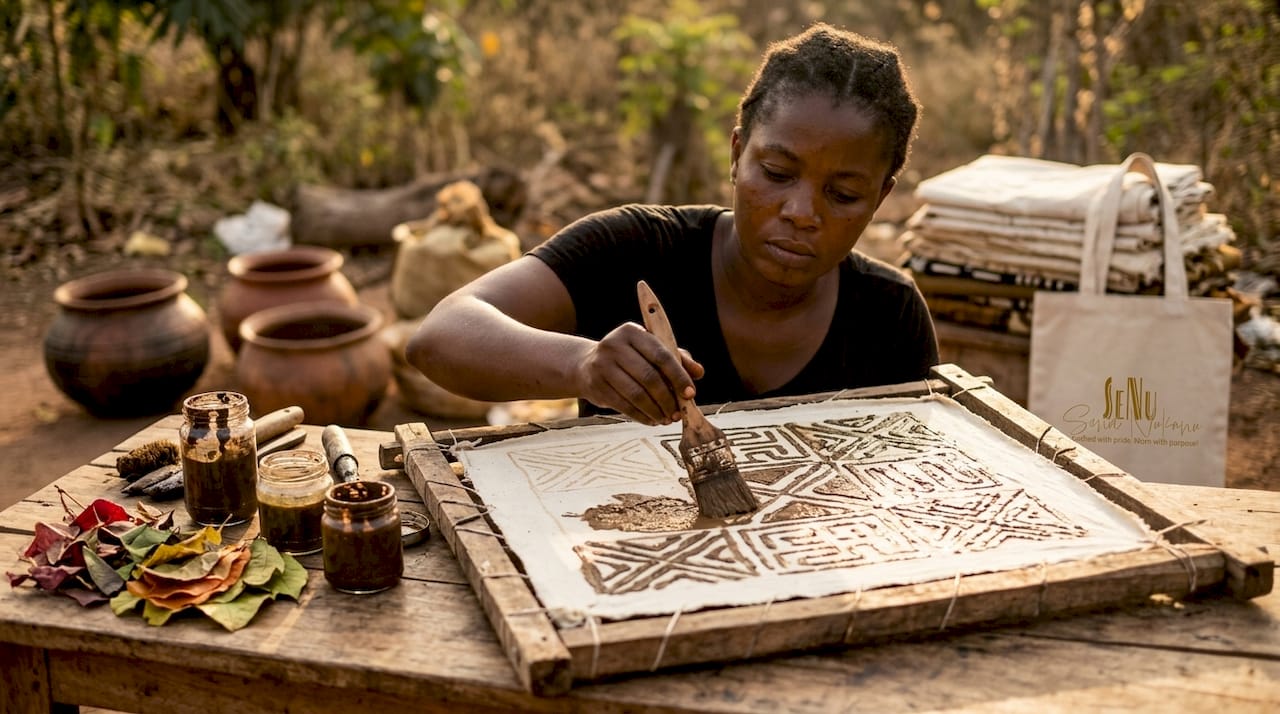
Bogolanfini operates on a different principle entirely. The cloth's coloration is not surface staining. Bogolanfini's dyeing chemistry involves a molecular bond between tannins from n'gallama leaves and iron-rich mud, creating indelible color that does not wash out. The process requires multiple stages of soaking, painting, and drying, each step building chemical depth into the fiber. That is sustainable craft science, not folk art.
Adire employs three resist-dyeing methods developed by Yoruba women: oniko, which uses raffia to bind and resist the dye; alabere, which uses stitching to create patterns; and eleko, which applies a cassava starch paste as a resist before indigo dyeing. Eleko is the most labor-intensive of the three. All three methods have been preserved through generational transfer, from mother to daughter, across communities in Abeokuta and beyond.
Pro Tip: When you examine an Adire cloth, look at the edges of the pattern. Hand-applied starch resist produces slightly irregular boundaries. Machine-printed imitations show perfectly uniform edges. That irregularity is the mark of authentic craft.
How do textile patterns function as social and political messages?
West African textiles serve as material literacy, where patterned cloth systems reflect social identities and collective knowledge within different ecological zones. A cloth is not simply beautiful. It is readable, carrying coded information about the wearer's status, community, and life stage.
In Guinea, textile systems like Kendéli and Forêt Sacrée emerge directly from local ecologies, using plant materials and dyeing knowledge specific to their region. That connection between landscape and cloth means a trained observer can identify not just a technique but a geography and a people from the fabric alone.
Color carries meaning with the same precision as pattern. Among the Ashanti, gold signals royalty and wealth. Black signals mourning and spiritual energy. Green signals growth and renewal. These are not arbitrary associations. They are codified systems passed down through generations of weavers and worn publicly at ceremonies where everyone present understands the message.
The social functions of textile patterns include:
- Rank and authority: Certain Kente patterns were historically restricted to chiefs and kings. Wearing them without status was a social transgression.
- Life-stage marking: Specific cloths mark birth, initiation, marriage, and death, making the wearer's life stage visible to the community.
- Proverb encoding: Ewe Kente motifs often represent specific proverbs, turning the cloth into a wearable philosophical statement.
- Protective symbolism: Bogolanfini patterns carry spiritual protective functions, particularly for hunters and women after childbirth.
Authentic handwoven textiles exhibit intentional irregularities that signal artisan presence and cultural authenticity. These are not defects. They are proof that a human being, with specific knowledge and skill, made this cloth. Communities recognize and value these irregularities as markers of genuine craft.
Why do West African textile traditions still matter today?
Ceremonial cloth use in naming ceremonies, weddings, and funerals remains the primary force sustaining traditional production standards. When cloth is required for a funeral, the community demands quality that honors the deceased. That social obligation keeps master weavers producing at the highest level of their craft.
The risk to these traditions comes from a specific pressure: export and tourist markets that prioritize low cost over cultural accuracy. When weavers produce for buyers who cannot read the cloth, quality standards erode. Patterns get simplified. Synthetic dyes replace plant-based ones. The result looks like the tradition but carries none of its meaning.
- Ceremonial demand sustains quality. Communities that use traditional cloth in life-cycle ceremonies create consistent, culturally informed demand that keeps craftsmanship standards high.
- Export markets create pressure. Buyers outside the tradition often cannot distinguish authentic from imitation, which rewards cheaper production and punishes skilled artisans.
- Geographic indication protections matter. Kente's 2025 geographic indication recognition sets a legal precedent for protecting cultural authorship in textile traditions across West Africa.
- Global fashion interest cuts both ways. International appreciation raises visibility and income for artisans, but it also drives demand for fast, cheap versions that undercut the real thing.
The social impact of artisan textile traditions extends beyond economics. When a tradition survives, so does the knowledge system behind it, including the botanical knowledge of dye plants, the engineering of loom construction, and the social memory encoded in pattern systems.
How do you recognize authentic West African textiles?
Authentic West African textiles carry physical evidence of their making. You can learn to read that evidence with a few focused observations.
Pro Tip: Hold the cloth up to light. Handwoven strips show slight variations in thread density that machine-woven fabric cannot replicate. That variation is your clearest signal of authentic strip weaving.
Look for these markers of authentic craftsmanship:
- Seam lines in strip-woven cloth. Kente and similar fabrics are assembled from narrow strips. Those seam lines run the length of the cloth and are a structural feature, not a flaw.
- Color variation in dyed sections. Hand-applied dyes, whether indigo, mud, or plant-based, produce subtle tonal shifts across the cloth. Uniform, flat color signals machine printing.
- Weight and hand. Handwoven cotton and silk textiles have a distinct weight and texture. They drape differently from synthetic imitations.
- Pattern irregularities. As noted, intentional irregularities in resist-dyed and woven patterns confirm artisan production.
Supporting artisans who practice sustainable West African craft means buying from sources that can name the weaver, the region, and the technique. Provenance is not a luxury detail. It is the difference between supporting a living tradition and funding its erosion.
Key Takeaways
West African textile traditions are a centuries-old system of material communication, where technique, pattern, and color together form a visual language that encodes social identity, political rank, and cultural memory.
| Point | Details |
|---|---|
| Historical depth | Strip-weaving dates to the 11th century in Mali, proving these are ancient, not recent, traditions. |
| Regional diversity | Kente, Bogolanfini, and Adire each use distinct techniques and carry different cultural meanings. |
| Material literacy | Patterns and colors encode rank, life stage, and proverbs, making cloth a readable social document. |
| Ceremonial demand preserves quality | Life-cycle ceremonies create consistent demand that keeps traditional craftsmanship standards high. |
| Authenticity markers | Handwoven irregularities, seam lines, and tonal dye variation distinguish authentic cloth from imitations. |
What these traditions taught me about seeing cloth differently
I grew up surrounded by West African fabric, and for a long time I saw it the way most people do: as color, as pattern, as beauty. It took years of learning the actual techniques before I understood that I had been reading a language without knowing the alphabet.
The moment that shifted my perspective was learning about Bogolanfini's molecular dyeing process. This is not a craft tradition that survived because it was simple or convenient. It survived because it was sophisticated, because the knowledge required to produce it correctly is genuinely difficult to acquire and pass on. That sophistication is what makes the erosion of these traditions so serious. When a master dyer stops practicing, the knowledge does not just fade. It disappears.
What concerns me most about the current moment is the gap between appreciation and understanding. People love these textiles, and that love is real and good. But appreciation without understanding can actually harm the traditions it celebrates. Buying a cheap printed imitation of Kente because it looks beautiful funds the replacement of the real thing. Wearing Bogolanfini without knowing what it means reduces a protective ritual cloth to a fashion accessory.
The balance between honoring tradition and allowing it to grow is not a problem to solve once. It is an ongoing conversation that weavers, communities, and informed buyers have to keep having together. The traditions that survive will be the ones where that conversation stays alive.
— Sena
Authentic West African fashion rooted in tradition
Senanukunu was built on the belief that every piece of clothing can carry a story worth telling. The collections at Senanukunu draw directly from West African textile heritage, translating the artistry of handwoven and hand-dyed traditions into ready-to-wear pieces that honor their origins.
Each piece is crafted with care for the cultural knowledge behind it, from the geometric confidence of Kente-inspired patterns to the earthy depth of mud-cloth aesthetics. If you are ready to wear something that means something, the Nyame Nti Embroidered Kaftan and the full dress collection are a strong place to start. Senanukunu also offers design services for those who want a piece built around their specific vision.
FAQ
How old are West African textile traditions?
Strip-weaving in West Africa dates back at least 900 years, with evidence from Mali's Bandiagara Escarpment in the 11th century. Dyeing traditions using indigo and plant-based materials developed across the region over the same period.
What is the difference between Ashanti and Ewe Kente?
Ashanti Kente focuses on geometric strip patterns symbolizing rank and wealth, while Ewe Kente incorporates figurative motifs that encode specific proverbs and community memory. Both are distinct traditions with separate cultural authorship.
How is Bogolanfini mud cloth made?
Bogolanfini is made by applying iron-rich mud to cloth pre-treated with tannins from n'gallama leaves, creating a molecular bond that produces permanent color. The process requires multiple stages and produces color that does not wash out.
How do I tell if a West African textile is authentic?
Look for seam lines in strip-woven cloth, slight color variation in dyed sections, and minor pattern irregularities. These features confirm handcraft. Uniform color, perfect pattern edges, and no seam lines indicate machine production.
Why do West African textiles carry symbolic meaning?
Textile patterns function as material literacy, encoding social rank, life-stage, and community identity in color and motif systems that trained community members can read. Cloth has historically served as both social communication and political statement across West Africa.