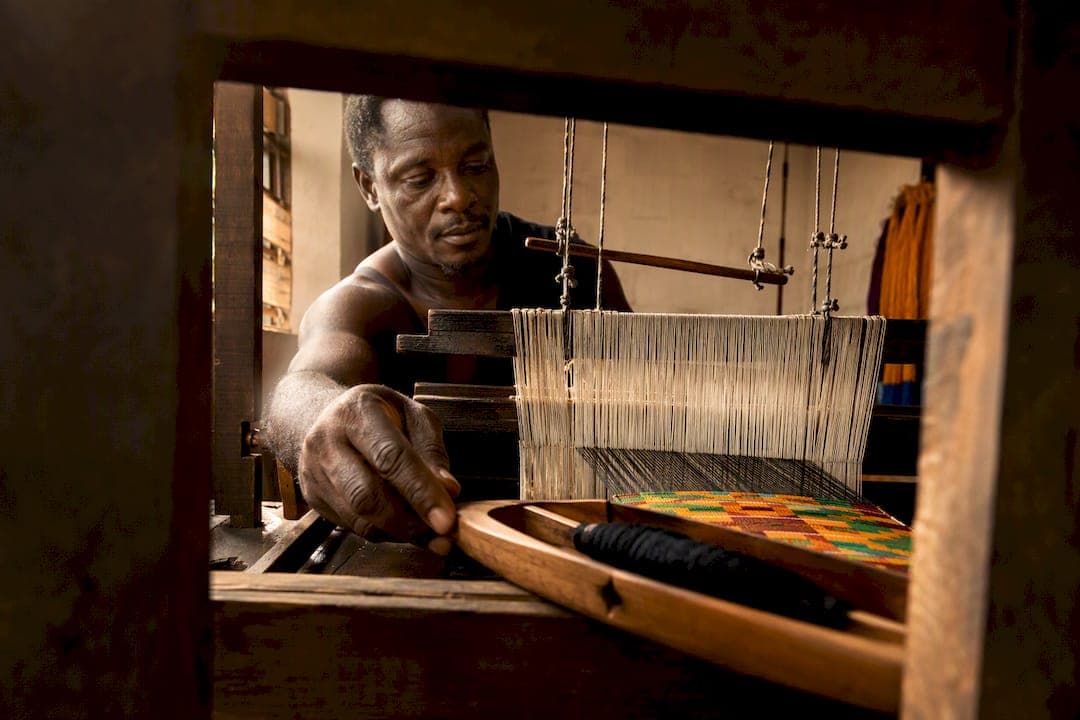
Kente is a handwoven West African cloth, originally an Asante and Ewe court textile, made from narrow strips sewn together into patterns that carry names and social meaning. It traces back to weaving traditions centered in Bonwire, in present day Ghana, where oral history credits a spider's web with inspiring the craft. With UNESCO's cultural heritage inscription and Ghana's new geographical indication protection, where a piece of Kente actually comes from now matters more than it has in generations.
TL;DR:
- Genuine Kente displays irregular tension and color variations, with sewn seams visible along the strips, unlike printed or machine-made imitations.
- Authentic Kente is produced by specific communities under clear geographic protections, now legally reinforced by Ghana’s 2025 registration as a geographical indication.
- The traditional naming of patterns functions as a form of language conveying proverbs, social commentary, or political messages, which can change over time.
- The cloth originated in Ghana’s Bonwire region through court traditions but has since become a widespread symbol of heritage and resistance globally.
- Modern Kente weavers work with traditional strip and loom methods, using natural fibers like silk, cotton, or rayon that differ from early raffia origins.
Table of Contents
- Origins and Early Development of Kente Weaving
- How Kente Is Made: Strips, Looms, and Materials
- How Kente Patterns Get Their Names and Meanings
- Kente's Role in Royal Power and National Identity
- Spotting Authentic Kente and Why New Protections Matter
- How Kente Design Has Changed Across Generations
- Kente as a Symbol Beyond the Wardrobe
- Kente's Reach Into Global Fashion
- Figures Who Shaped Kente's Modern Story
- Why Provenance Matters to Us at Sena Nukunu
- Where to Learn More About Kente's History
- Bring Home a Piece of This Legacy
- Sources
- FAQ
Origins and Early Development of Kente Weaving
The most cited origin story places Kente's invention in Bonwire, a town whose weavers are still celebrated as the cloth's spiritual home. According to Asante oral tradition, two friends, Opoku Kuragu and Kwakye Ameyaw, watched a spider spin its web and returned to recreate the pattern in thread, eventually presenting their work to the Asante royal court. The Asantehene recognized the cloth's beauty and adopted it as royal regalia, and production centralized under court authority, with specific patterns reserved for chiefs and specific occasions.
That legend, though, sits atop a much older foundation. Textile production among the Akan and Ewe peoples predates the named Kente tradition by centuries, with woven cloth traditions developing independently across the region before Kente emerged as a distinct, named practice. The Ewe, concentrated in the Volta region, built their own weaving lineage in parallel with the Asante, producing strip-woven cloth with distinct motifs and a looser relationship to royal control.
This split matters for understanding Kente today. Asante weaving grew tightly bound to court hierarchy, with designs signaling rank and privilege, while Ewe weaving spread more broadly through communities and carried its own vocabulary of pattern and purpose. Both traditions converged into what the world now recognizes as Kente, though their histories, and the families who still weave within them, remain distinct.
How Kente Is Made: Strips, Looms, and Materials
Every piece of authentic Kente begins as a narrow strip, roughly four inches wide, produced on a horizontal treadle loom. A weaver works foot pedals to shift the warp threads while passing the weft by hand, building geometric blocks of color one pass at a time. Once dozens of these strips reach the right length, they are sewn together, edge to edge, into the full cloth, a process documented in detail by educational programs that walk through the craft step by step.
Materials have shifted over generations. Early Kente relied on raffia fiber stripped from palm leaves, later giving way to silk, cotton, and now rayon as trade routes expanded and imported thread became available. The material changed, but the strip-and-sew structure stayed constant.
- Authentic Kente has visible seams where narrow strips join, never a single continuous printed field.
- Handwoven cloth carries a textured, slightly uneven weight that machine-printed imitations cannot replicate.
- Genuine strips show small irregularities in tension and color that mark human hands at the loom.
Pro Tip: Run your fingers along the seams. If you can feel ridges where strips were sewn together, you're likely holding real handwoven Kente rather than a printed copy.
How Kente Patterns Get Their Names and Meanings
Kente functions less like decoration and more like a language. Weavers and communities assign names to patterns that reference proverbs, historical events, or social commentary, and those names can shift entirely as circumstances change. According to the Smithsonian National Museum of African Art, a single motif can be renamed decades after its creation to reflect a new political moment, meaning the same threads carry different messages depending on when and why they were woven.
A well known example is the pattern once called "Fathia Fata Nkrumah," created to celebrate Kwame Nkrumah's marriage, which was later renamed to reflect changing political sentiment as Ghana's history moved past that era. Another common motif, nkyimkim, translates loosely to twisting or turning and is read as a reminder of resourcefulness and the need to adapt under pressure.
- Pattern names often function as compressed proverbs, meant to be spoken aloud when someone wears the cloth.
- Some names, like "Obaakofo mmu man" (one person does not rule a nation), carry explicit political commentary.
- The same visual pattern may hold multiple names across regions or historical periods, so meaning is never fixed permanently.
This naming practice is documented across museum scholarship on Kente, which treats each cloth as a kind of archive, holding commentary on power, marriage, loss, or resilience long after the events that inspired it have faded from daily conversation. For readers curious about how specific motifs translate into modern design choices, our guide to contemporary West African motifs breaks down how these visual traditions carry into current garments, and color itself carries its own layer of meaning, explored further in our piece on color symbolism in West African clothing.
Kente's Role in Royal Power and National Identity
Kente's earliest social function was almost entirely about hierarchy. Under Asante court control, specific patterns and color combinations were reserved for the Asantehene and senior chiefs, with chief weavers overseeing production and enforcing which designs commoners could and could not wear. Owning or wearing the wrong pattern was not a fashion mistake, it was a breach of social order.
That control loosened as Ghana moved toward independence. Kwame Nkrumah, Ghana's first president, wore Kente publicly and deliberately during the independence movement, transforming it from a regional court textile into a national and pan-African symbol, a shift documented by fashion historians tracing the cloth's rise in visibility during the mid-20th century. Nkrumah's advocacy pushed Kente onto a global stage, associating it with liberation movements well beyond Ghana's borders.
That momentum carried into the diaspora, where Kente stoles now appear at graduations, weddings, and cultural celebrations across the world as a way of signaling heritage and achievement. This widespread adoption brings real questions about respectful use, since a cloth once reserved for royalty now circulates as a general symbol of Black identity and pride, a shift that carries meaning but also invites more thoughtful sourcing than many buyers realize.
Spotting Authentic Kente and Why New Protections Matter
Telling real Kente from a printed lookalike takes a bit of attention, but the signs are consistent once you know what to check. Beyond feeling for sewn seams, ask a seller directly where the cloth was produced and by whom, since legitimate weavers and retailers are generally glad to share that information.
- Ask for the weaver's region or community, not just the country of origin.
- Look for uneven, slightly imperfect coloring, a sign of hand dyeing rather than digital printing.
- Check the weight of the fabric. Handwoven cotton or rayon Kente feels denser than a thin printed cotton blend.
One recent development changes this landscape significantly: Ghana registered Kente as its first Geographical Indication in September 2025, legally tying the name to specified producer communities and production standards. That follows UNESCO's earlier inscription of Kente weaving as intangible cultural heritage, which formally recognized the craft's transmission methods and the role of chief weavers in preserving it.
Together, these protections mean the word "Kente" is no longer just descriptive, it is becoming a traceable, licensed term tied to real communities. For weavers, that translates into stronger legal footing against mislabeling and a clearer path toward fair compensation for their work. For buyers, it means provenance questions are no longer optional extras, they are becoming the standard of responsible purchasing. Our guide to identifying authentic garments walks through this process in more detail for anyone building a collection.
How Kente Design Has Changed Across Generations
Kente's visual language has never stood still. Early cloth relied heavily on raffia and simpler geometric blocks, shaped by the limits of available fiber and dye. As silk entered West African trade routes through Europe and North Africa, weavers incorporated it into strips, producing richer color saturation and finer detail than raffia allowed.
The 20th century brought another shift, as cotton and eventually rayon became more accessible, letting weavers experiment with bolder contrasts and more intricate geometric sequences within each strip. Patterns grew more elaborate as looms and thread quality improved, and weavers began producing designs meant less for daily court wear and more for ceremonial or commercial purposes as demand grew outside royal circles.
Contemporary Kente reflects this layered history rather than replacing it. Modern weavers still use the same narrow strip structure and treadle looms their predecessors used generations ago, but they now work with a wider color palette and, in some cases, blended fibers that were unavailable to earlier generations. The naming tradition has evolved alongside the material, with newer patterns responding to contemporary events the same way older ones responded to royal marriages or political shifts. What has stayed constant through every material and stylistic change is the strip-weaving method itself, the one technical thread connecting a cloth woven in Bonwire generations ago to one being woven there today.
Kente as a Symbol Beyond the Wardrobe
Kente's meaning has always extended past what it looks like on a body. Within Asante and Ewe communities, the cloth functioned as a visible record of status, obligation, and belonging, with specific patterns marking a person's role in family or civic life long before Kente became known outside West Africa.
Politically, Kente has served as shorthand for sovereignty and resistance, a role cemented during Ghana's independence movement and carried forward whenever the cloth appears at moments tied to Black self-determination. That symbolic weight gives Kente an economic dimension too, since demand for "authentic" cloth, whether from cultural pride, ceremonial need, or fashion interest, directly affects income for the weaving communities who still produce it by hand in places like Bonwire.
This economic angle has grown more visible as global interest in Kente has increased without a corresponding increase in protections for the people who actually weave it. Cheap printed imitations flooding the market compete directly with handwoven cloth, often undercutting the weavers whose techniques and pattern knowledge took generations to develop. That imbalance is part of why Ghana's recent geographical indication registration carries real economic stakes, not just symbolic ones, since it gives legal weight to distinguishing genuine handwoven Kente from mass-produced copies claiming the same name. For weaving families whose income depends on that distinction being recognized and enforced, the difference between cultural symbol and legally protected term is not academic.
Kente's Reach Into Global Fashion
Kente's visual influence moved well beyond Ghana long before most fashion consumers understood its origins. Its bold geometric blocking and saturated color combinations have appeared on runways, in ready-to-wear collections, and across streetwear for decades, often stripped of the naming conventions and social context that give the original cloth its depth.
That crossover accelerated as Kente became closely associated with Pan-African identity during the 20th century, giving designers outside Ghana a visual shorthand for African heritage that traveled easily across borders. The cloth's structure, narrow woven strips joined into bold repeating patterns, proved adaptable to everything from accessories to full garments, which helped its patterns spread into general fashion vocabulary even among people unfamiliar with the weaving tradition behind them.
That spread has come with real tension. Printed "Kente style" fabric, produced far from Ghana and without any connection to the weaving communities who originated the design language, now dominates much of the global market for Kente-inspired clothing. This is precisely where authenticity and provenance become more than academic concerns, since a garment's visual similarity to real Kente says nothing about whether it was made ethically or whether it supports the artisans whose techniques it borrows. Ghana's new geographical indication status is a direct response to this exact problem, aiming to reclaim some control over how the name and the look of Kente circulate commercially outside the communities that created them.

Figures Who Shaped Kente's Modern Story
A handful of moments and individuals mark clear turning points in how Kente moved from regional court textile to global symbol. The Bonwire origin legend, crediting Opoku Kuragu and Kwakye Ameyaw with translating a spider's web into woven cloth, remains the foundational story that Asante weavers point to when explaining the craft's roots.
Kwame Nkrumah's public embrace of Kente during Ghana's independence movement stands as the clearest single turning point in the cloth's journey toward international recognition. By wearing Kente in official and public settings, Nkrumah linked the textile directly to national pride and pan-African solidarity, giving the cloth a political resonance it had not carried in the same way under earlier court restrictions.
More recently, UNESCO's decision to inscribe Kente weaving as intangible cultural heritage marked a different kind of milestone, one focused on protecting the craft's transmission rather than its political symbolism. Ghana's 2025 geographical indication registration builds directly on that recognition, giving legal teeth to the idea that Kente's name and reputation belong specifically to the weaving communities who developed and sustained the practice across generations. Together, these moments trace a path from royal court to global recognition, with each step adding a new layer of meaning to cloth that started as a spider's web reimagined in thread.

Why Provenance Matters to Us at Sena Nukunu
Learning Kente's history changes how you look at every woven piece you encounter, and it has shaped how we think about sourcing at Sena Nukunu. We work to bring authentic West African craftsmanship to our collections with respect for the artisans and traditions behind each piece, because provenance protections like Ghana's new geographical indication only work when buyers actually ask the questions they're designed to answer. Understanding where a garment comes from, and who made it, is part of honoring the legacy woven into every strip.
— Sena
Where to Learn More About Kente's History
For readers who want to go deeper, UNESCO's cultural heritage documentation on Kente weaving, the Lam Museum's educational materials, and reporting on Ghana's geographical indication registration all offer detailed primary sourcing. Our own guide to West African textile traditions covers related craft histories worth exploring.
Bring Home a Piece of This Legacy
Every garment in our collections draws on the same craftsmanship traditions and cultural storytelling that make Kente's history so rich, from ethically produced fabrics to limited-quantity pieces made with real artisan input. If Kente's story has you thinking about adding an authentic West African piece to your wardrobe, our Women's Collections and Men's Agbada Ensembles are built on the same commitment to provenance and craftsmanship this article describes. Browse our current collections to find a statement piece that carries real meaning, not just a print.
Sources
- Phys
- Kente gains global protection as Ghana's first geographical indication — NewsGhana
- Smithsonian National Museum of African Art — Kente pattern examples
- Ghana: Weave a Kente Cloth — Lam Museum of Anthropology
FAQ
Is it respectful to wear Kente cloth?
Wearing Kente respectfully generally means understanding its origins and choosing authentic, ethically sourced pieces rather than mass-produced imitations that strip away the cloth's history. Many diaspora communities wear Kente stoles at graduations and ceremonies as a meaningful nod to heritage, and that practice is widely embraced when approached with awareness of the cloth's cultural weight.
Which ethnic groups wear Kente?
Kente is most closely associated with the Asante people, whose court tradition centralized the cloth's early production, and the Ewe people, who developed their own parallel weaving tradition in the Volta region. Both groups continue to weave and wear Kente today, each maintaining distinct pattern names and stylistic traditions.
Who is the founder of Kente?
Oral tradition credits two Asante friends, Opoku Kuragu and Kwakye Ameyaw, with inventing Kente weaving after observing a spider spinning its web near Bonwire. The Asantehene later adopted their cloth as royal regalia, cementing its place in Asante court tradition.
Is Kente Ghanaian or Nigerian?
Kente originated in present-day Ghana, developed through Asante and Ewe weaving traditions centered around towns like Bonwire. It is not a Nigerian textile tradition, and Ghana's 2025 geographical indication registration formally ties the name to Ghanaian weaving communities.
How is Kente made?
Kente is woven on horizontal treadle looms in narrow strips, roughly four inches wide, which are then sewn together to form the full cloth. Historically woven from raffia, modern Kente is typically made from silk, cotton, or rayon.