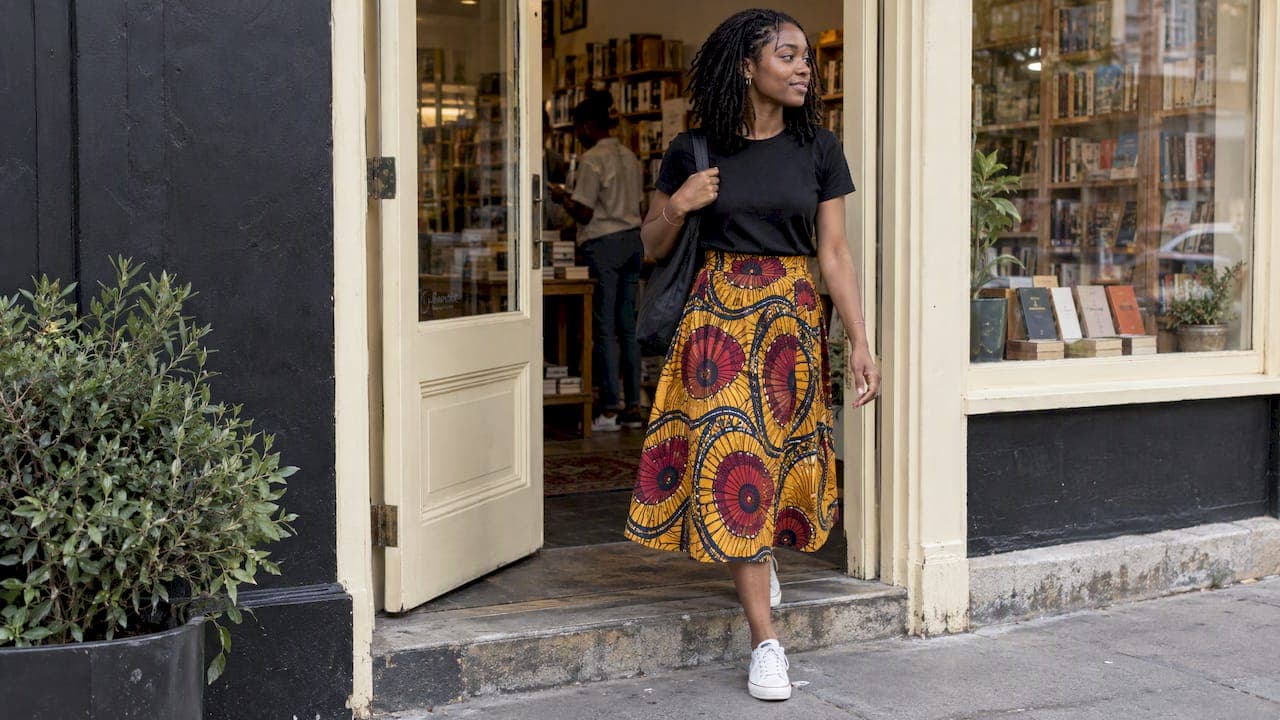
You wear African prints casually by letting one print piece lead and keeping everything around it simple. A printed skirt with a plain white tee, an Ankara top with denim and sneakers, or a print jacket over jeans: each turns a bold fabric into something you can wear to brunch, the office on a Friday, or a weekend errand run. Below, you will find the formulas that work, the reasons they work, how to respect the cloth's story, and how to keep your pieces vibrant for years.
TL;DR
- Choose one African print piece as the focal point, then build the rest of the outfit in solids such as white, black, denim or soft neutrals.
- Three easy formulas: an Ankara top with denim and sneakers, a printed skirt with a plain tee, and a print jacket over a simple dress or jeans.
- Let one or two accessories shine and keep the rest understated, so the print stays the star.
- Anyone can wear African prints with care: learn what the cloth means, buy from makers who credit their sources, and wear it with respect.
- Treat print pieces gently when washing, and always follow the care label on the garment.
Table of Contents
- Why African Prints Work So Well in Casual Style
- Start With One Statement Piece
- Three Easy Everyday Formulas
- What to Wear With an African Print Skirt
- Pairing African Prints With Denim and Wardrobe Basics
- Balancing Color, Pattern, Accessories and Fit
- Casual Does Not Mean Careless: Dressing for Work and Weekends
- Know What You Are Wearing: Prints and Their Meanings
- Wearing African Prints Respectfully
- Our Perspective: Prints Are Meant to Be Lived In
- Find Your First Casual Print Piece
- Caring for Your African Print Clothing
- A Quick Outfit Checklist
- FAQ
- Sources
Why African Prints Work So Well in Casual Style
African prints were never meant to live only in a closet reserved for special occasions. Their bold color and graphic rhythm make an ordinary outfit feel considered, and that is exactly what a casual wardrobe often lacks. A plain tee and jeans can disappear into the crowd. Add a vibrant print, and the outfit has a point of view.
There is also a practical side. Traditional garments such as the caftan and the dashiki have evolved into many styles, from simple draped cuts for daily wear to tailored pieces for formal events. So the relaxed, easy silhouette is not a modern compromise. It has long been part of how these garments are worn.
The key is to treat the print the way you would treat any strong piece in your closet, a red coat or a sequined top. Give it room. When you do, it feels effortless instead of costume-like.
Start With One Statement Piece
The most reliable rule in casual African print styling is the simplest: make one print item the outfit's focal point and keep the rest in simple solids. That item might be a midi skirt, a blazer, tailored trousers, a maxi dress or a top. Pair it with neutrals such as white or black, and the fabric does the talking.
Why does this work? Your eye needs a place to land. When two or three competing prints share the same outfit, the eye jumps from one to the next and the look feels busy. One print with calm surroundings reads as intentional.
Choosing the right piece for your day
Think about how you move through your week, then pick the statement piece that fits it:
- A printed top is the easiest entry point. It works with jeans, tailored shorts or a plain skirt.
- A printed skirt suits warm weather, brunch, museum days and errands, and it pairs with almost any solid top you already own.
- A print jacket or blazer lifts a simple dress or jeans and a tee, and it carries you from morning to evening.
- A print dress is a one-piece outfit. Add flat sandals or clean sneakers and you are done.
- Print trousers feel bolder, so keep the top fitted and plain.
If you are new to wearing prints, begin with the piece that sits closest to something you already wear confidently. Someone who lives in skirts should try a skirt. Someone who lives in jeans and jackets should start with a jacket.
Three Easy Everyday Formulas
Formulas remove the guesswork. These three come straight from the everyday pairings that stylists keep returning to, and they work across body types and seasons.
| Formula | What you wear | Good for |
|---|---|---|
| Print top, denim, sneakers | An Ankara top, straight or relaxed jeans, clean white sneakers | Weekend errands, coffee dates, casual Fridays |
| Print skirt, plain tee | A midi skirt, a white or black T-shirt, flats or sandals | Brunch, museum visits, warm-weather days |
| Print jacket, simple base | A print jacket over a solid dress or jeans and a tee | Cooler days, evenings out, layering |
Notice what repeats: one print, one or two solids, and shoes that keep things relaxed. Once you internalize that pattern, you can build dozens of outfits from a handful of pieces.
What to Wear With an African Print Skirt
Skirts are the question readers ask most, and the answer is refreshingly simple. For a relaxed daytime look, pair an Ankara midi skirt with a white T-shirt, a cropped denim jacket and sneakers or flat sandals, an easy formula for brunch, museum visits and errands.
A few refinements make the look sharper:
- Balance volume with fit. A full, voluminous skirt looks best with a fitted blouse, tank top or simple solid top. Fitted on top, full on the bottom is a classic proportion.
- Keep the top tucked or cropped. Tucking a tee into the waistband defines your shape and stops the skirt from swallowing you.
- Choose casual shoes. Flats, flat sandals and sneakers keep the mood laid-back. Heels push the same skirt toward dressy.
- Pull one color from the print. If your skirt has a deep orange thread, a tee in a soft cream or a sandal in tan echoes it without matching exactly.
In cooler months, add a denim jacket, a knit cardigan or a long neutral coat. A black turtleneck under a bright skirt is a lovely autumn move, and the print still stays the focus.
Pairing African Prints With Denim and Wardrobe Basics
Denim is the most forgiving partner for African prints. Its muted blue sits quietly behind almost any palette, from warm earth tones to saturated jewel colors, and its casual texture takes the formality out of a bold fabric.
Here are combinations worth trying:
- Print top with straight-leg or wide-leg jeans. Choose a mid or dark wash for a polished look, or a lighter wash for a relaxed one.
- Print dress with a denim jacket. The jacket breaks up the print and makes a dress feel like a daytime outfit.
- Print jacket with a white tee and jeans. This is perhaps the quickest way to wear a print if you are shy about it, because the print sits on top and you can take it off.
- Print shirt with plain trousers. Camel, black or olive trousers all work, and the shirt can be worn open over a tee.
Other basics that behave well with prints: a white button-down, a black fitted tee, a cream knit, khaki chinos, black leggings and a simple slip dress. Stay with solids in a color found in the print, or with neutrals, and you will rarely go wrong.
When to skip the neutrals
Once you are comfortable, you can play. Pair a print with a solid in one of its secondary colors, such as a mustard tee with a skirt that has mustard accents. Or try two prints of different scale, one large and one tiny, in a shared palette. If a combination makes you hesitate, take it back to one print and solids. That version always works.
Balancing Color, Pattern, Accessories and Fit
A casual African print outfit comes together through restraint in the details.

Color. Look at the print's dominant color and the accent colors. Use the dominant color sparingly in your accessories, and let neutrals fill the rest.
Pattern. If your base is already loud, keep shoes and bag plain. If the print is a subtle geometric, you have more room to add a patterned scarf or a striped tee in the same palette.
Accessories. The advice that holds up best is to let one or two accessories shine, such as statement jewelry or a bag made from traditional material, while keeping the others understated. Big earrings with a simple necklace, or a woven bag with minimal jewelry, keep the outfit from feeling crowded. If you want to think more deeply about jewelry for different settings, this guide to choosing jewelry for any occasion is a helpful companion.

Fit. Casual does not mean shapeless. Decide where the volume goes. A relaxed kaftan or boubou-style dress can be worn loose, with a belt if you want shape. A fitted top calls for a fuller skirt, and a roomy top calls for slimmer bottoms.
Casual Does Not Mean Careless: Dressing for Work and Weekends
One print piece can move between settings with small changes.
- Weekend: print top, jeans, sneakers, a crossbody bag, small hoops.
- Casual office: the same print as a blazer over a black tee and tailored trousers, with loafers or flat boots. We go deeper on this in our business casual African wear guide.
- Evening out: a print skirt with a fitted black top, a small bag and a heel or a sleek flat.
If you want more ideas for building confidence in the styling itself, our top tips for styling Ankara outfits walk through silhouettes and color choices in more depth.
Know What You Are Wearing: Prints and Their Meanings
Not every African print is the same, and knowing the difference makes wearing them more rewarding.
- Wax prints, often called Ankara, are named for their production method. Their motifs can carry symbolic meanings tied to West African life and identity, and interpretations vary across communities and contexts.
- The technique itself uses a wax or resin resist on cotton, a method passed down through generations in West Africa. The same source notes that most modern fabrics are designed and delivered from Europe, particularly Manchester, a reminder that the story of these cloths crosses continents.
- Fancy or roller prints are faster and more affordable to produce than wax prints, using roller or rotary-screen printing on one side of the cotton.
- Kente was historically worn by royalty and, by the late nineteenth century, had become widely accessible, later influencing global sportswear.
Because meanings vary, avoid claiming that a pattern "means" one fixed thing unless the maker or seller can tell you its source. If you want a deeper history, see our guide on why African prints are popular, and our provenance tests for Ankara fabric for how to look into where a cloth comes from.
Wearing African Prints Respectfully
Many people search this because they are unsure whether they are welcome to wear African prints. Everyday prints, such as the Ankara fabrics found in skirts, tops and dresses, are made, sold and worn widely, and respectful wearing starts with curiosity.
Some habits help:
- Learn the story. Industry guidance is pointing the same way. The World Intellectual Property Organization's consultation draft invites fashion companies to research the cultural significance of expressions before using them in designs. Shoppers can ask the same question of what they buy.
- Buy from makers who credit their sources. Ask who made the piece, where, and in what quantities.
- Treat ceremonial cloth with extra care. Cultural specialist Diana Baird N'Diaye says it is fine for Americans, especially those of African ancestry, to wear appropriate kente to events such as graduations and funerals, as long as the cloth was handwoven in Africa. Our guide to a graduation kente outfit covers this in detail.
- Keep your own style. Wear the print as part of your wardrobe, not as a costume or a performance of someone else's identity.
- Let the garment speak with you, not for you. Be ready to say where the piece comes from if someone asks.
For a fuller look at the ethics, read our piece on culturally inspired fashion.
Our Perspective: Prints Are Meant to Be Lived In
At Sena Nukunu, we design and sell West African fashion for people who want to feel proud in what they wear, and we have never believed that pride belongs only to special occasions. A vibrant piece can sit beside your favorite jeans on an ordinary Tuesday and still carry the spirit of the hands that made it.
We work in limited quantities, with ethical manufacturing and artisanal craftsmanship, because we want every piece to be made with care and purpose. That is also why we encourage you to wear what you buy often. A garment that is worn, washed, and loved is a garment that honors the people behind it.
Our advice to anyone starting out is gentle: choose one piece that makes you smile, give it simple company, and wear it with a story you can tell. The confidence will follow. For more on why we do what we do, see why we celebrate African designers.
— Sena
Find Your First Casual Print Piece
If you are ready to try the one-statement-piece approach, our ready-to-ship collection is a good place to begin. You will find dresses, jackets and matching sets inspired by West African heritage, made ethically in limited quantities. Start with a dress from our shop for an outfit that needs nothing else, or browse the full collections to find a jacket or skirt-style piece to build around.
If you want to understand how our ready-made pieces fit your wardrobe, our guide to ready-to-wear African attire explains the thinking behind them.
Caring for Your African Print Clothing
Bright prints stay bright with a little attention. We have no single rule that fits every fabric, so the first step is always the care label sewn into your garment. Beyond that, a few habits are widely sensible:
- Check the label first. Fabric, dye and construction differ from piece to piece, and the label is the maker's instruction.
- Wash dark and bright pieces separately for the first few washes, in case any color releases.
- Turn garments inside out before washing, to protect the printed surface.
- Choose gentle cycles and cool water unless the label says otherwise, and avoid harsh bleach.
- Dry away from direct sun when you can, since strong sunlight can fade color over time.
- Press on the reverse side with the iron setting the label allows.
For garments with embellishment, lining or structured tailoring, such as jackets, ask the seller about cleaning, or consult a professional dry cleaner before the first wash.
A Quick Outfit Checklist
Before you walk out the door, run through this:
- Is there one clear print piece?
- Is everything else a solid or a neutral?
- Do the shoes match the mood, flats or sneakers for casual?
- Have you chosen one or two accessories to stand out?
- Is the fit balanced, loose on one half and fitted on the other?
- Can you tell the story of the piece?
If you can answer yes to most of these, you are ready.
FAQ
Is it okay to wear African print?
Yes, when you wear it with respect and awareness. Learn where the fabric comes from, buy from makers who credit their sources, and treat ceremonial cloth such as kente with extra care. Wearing a print as part of your own style, rather than as a costume, is a good starting point.
What should I wear with an African print skirt?
Keep the top simple. A white T-shirt, a fitted tank or a plain blouse works well, and a cropped denim jacket adds a casual layer. Finish with sneakers or flat sandals for daytime, and let one accessory stand out.
Can I wear more than one African print at a time?
Yes, but it is easier once you are comfortable with single-print outfits. Choose prints that share a color, and vary the scale, one large and one small. If it looks busy, return to one print with solids.
How do I make an African print outfit look casual instead of formal?
Choose relaxed shoes, pair the print with denim or a plain tee, and keep accessories simple. Silhouette matters too: loose kaftans, midi skirts and unstructured jackets read as casual, while tailored pieces with heels lean dressier.
Sources
- 5 modern ways to incorporate African prints into your everyday wardrobe, The Ghana Report
- 5 Ways to Style an African Print Skirt Year-Round, JNathan Jewels
- How To Wear African Skirts Stylishly, The Chic Tribe
- West African Textiles, DocsLib
- Cross Cultural, Creative Hands Foundation
- Beloved Mother, Ghana Studies
- Sporting Kente Cloth, Fashion and Race Database
- Draft Steps When Considering the Use of Elements of Traditional Cultural Expressions, WIPO
- When Is Kente Cloth Worn and More Questions From Our Readers, Smithsonian Magazine