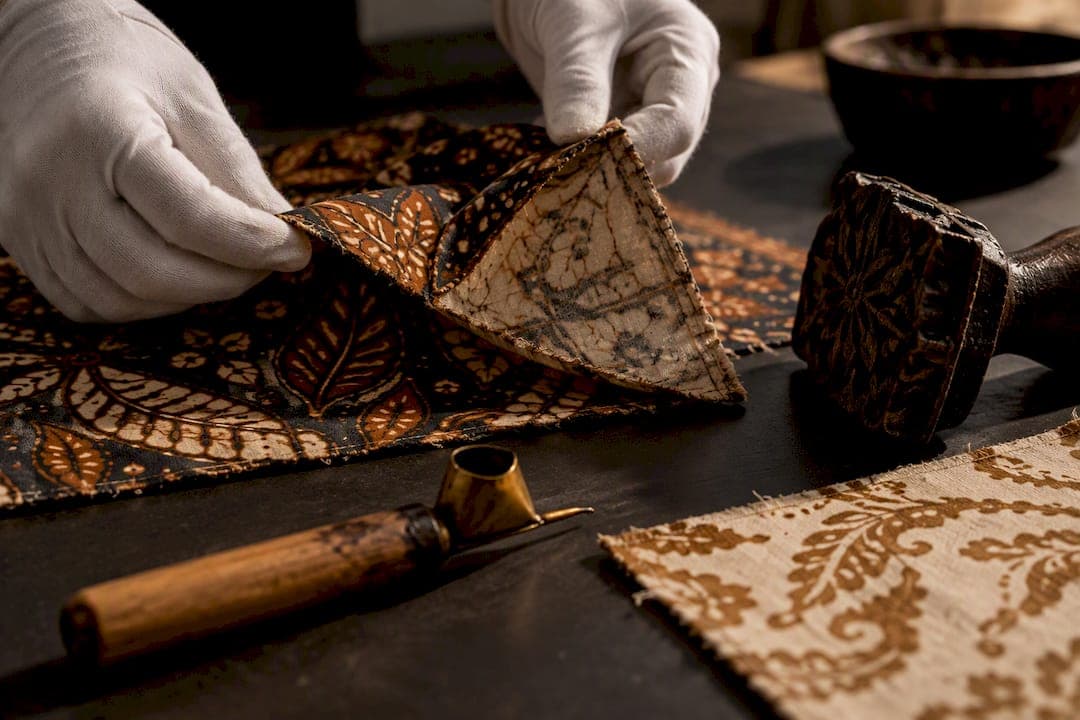
Ankara fabric began as a European industrial gamble: 19th-century Dutch manufacturers tried to mechanize Indonesian batik for sale in Southeast Asia, failed there, and found their true home in West African ports. What happened next was not passive adoption. Traders, tailors, and market women reshaped the cloth's colors, names, and meaning until it became something distinctly their own.
TL;DR:
- Authentic Ankara prints typically show nearly identical colors and patterns on both sides of the fabric, indicating resin-resist or true wax printing.
- Most modern textile labels use misleading terminology, with many prints now using resin instead of wax and sometimes skipping resist-dyeing altogether.
- Verification involves checking manufacturer stamps, design registration numbers, fabric weight, and feel, rather than relying solely on visual inspection.
- The original Ankara fabric roots trace back to Indonesian batik, but contemporary Ankara is a product of 19th-century Dutch imitations adapted and reshaped by West African traders.
- Local African manufacturers, like Ghana Textile Printing Company, now produce Ankara, competing with cheaper Asian copies that lack proper licensing and cultural context.
Table of Contents
- What Is Ankara Fabric, and Where Did It Come From?
- How Wax-Resist Printing Became Roller Printing
- How Did West African Traders Shape Ankara's Meaning?
- Ankara, Dutch Wax, or Something Else Entirely?
- How Can You Verify an Ankara Print's Authenticity?
- Who Manufactures Ankara Fabric Today?
- Why Sena Nukunu Is a Trusted Source on West African Textile Heritage
- A Personal Take on Wearing History Well
- Sources
- FAQ
What Is Ankara Fabric, and Where Did It Come From?
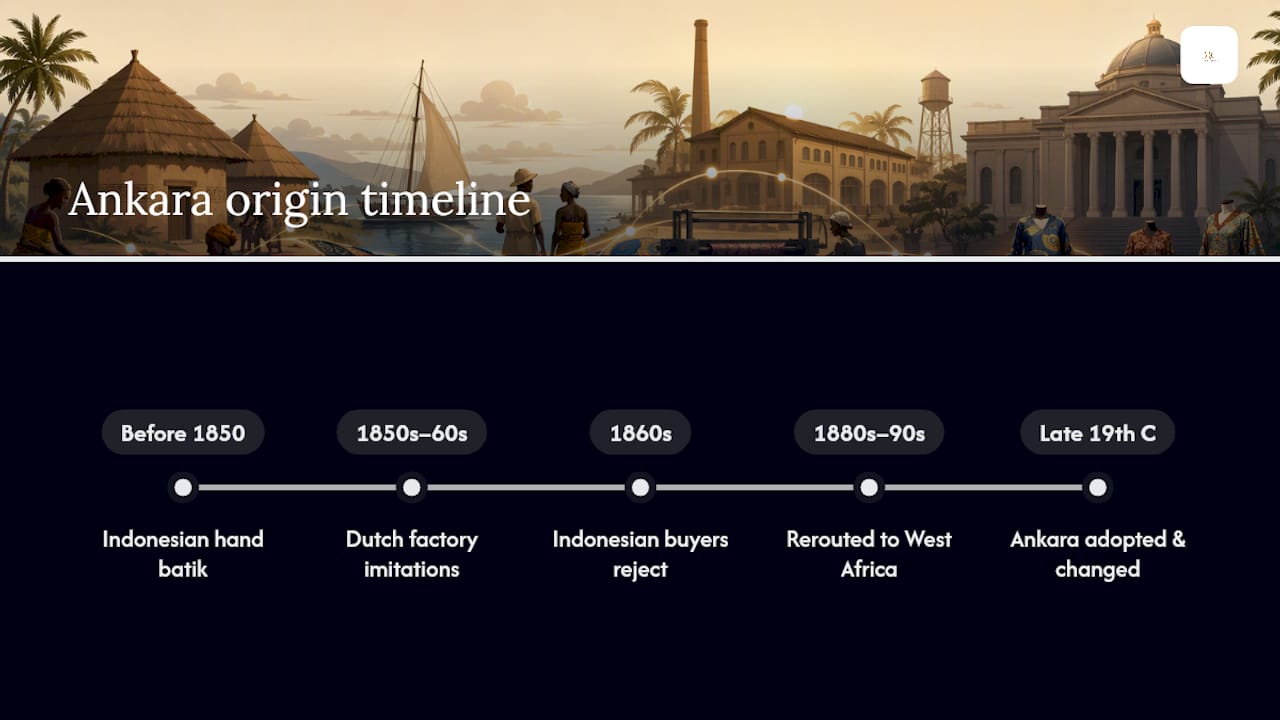
Ankara is a printed cotton cloth that became fashionable across West and East Africa starting in the late 19th century, according to the Victoria and Albert Museum. It descends from Indonesian batik, a resist-dye tradition in which artisans used a tool called a tjanting to hand-draw wax patterns onto cloth, or a stamp called a tjap to apply wax designs faster.
Dutch traders working in the Indonesian archipelago noticed the demand for batik and saw an opportunity: mechanize it, scale it, sell it cheaper. Through the 1850s and 1860s, factories in the Netherlands developed resin and wax-resist techniques meant to imitate handmade Javanese cloth, sometimes marketed under names like La Javanaise. It didn't work. Indonesian buyers spotted the imitation immediately and rejected it, put off by irregular crackle patterns and a machine-made stiffness that hand batik never had.
That commercial failure became West Africa's opening. By the 1880s and 1890s, Dutch and British trading houses were rerouting these unsold batik imitations toward ports in what is now Ghana, then a much larger cross-regional network. One of the manufacturers central to this pivot was Vlisco, founded in the Netherlands earlier in the century, which simplified its name in 1927 as it deepened its focus on African markets rather than Asian ones. West African consumers didn't just tolerate the cloth. They demanded changes to it, and the manufacturers listened.
How Wax-Resist Printing Became Roller Printing
Traditional batik is slow, precise, and handmade. A single length of cloth might take days: melted wax applied by tjanting or tjap, dyed, the wax scraped away, then reapplied for each new color layer. That labor is exactly what 19th-century European manufacturers set out to eliminate.
Their solution was mechanical resin-resist printing, later evolving into roller printing, where engraved copper rollers press dye or resist paste onto cotton at industrial speed, according to Asian Textile Studies. Early machine methods still resisted dye on both sides of the fabric, producing the characteristic crackled texture and identical front-and-back coloring that batik lovers prize. Later cost-cutting shifted many factories toward printing just one side, leaving the reverse noticeably paler.
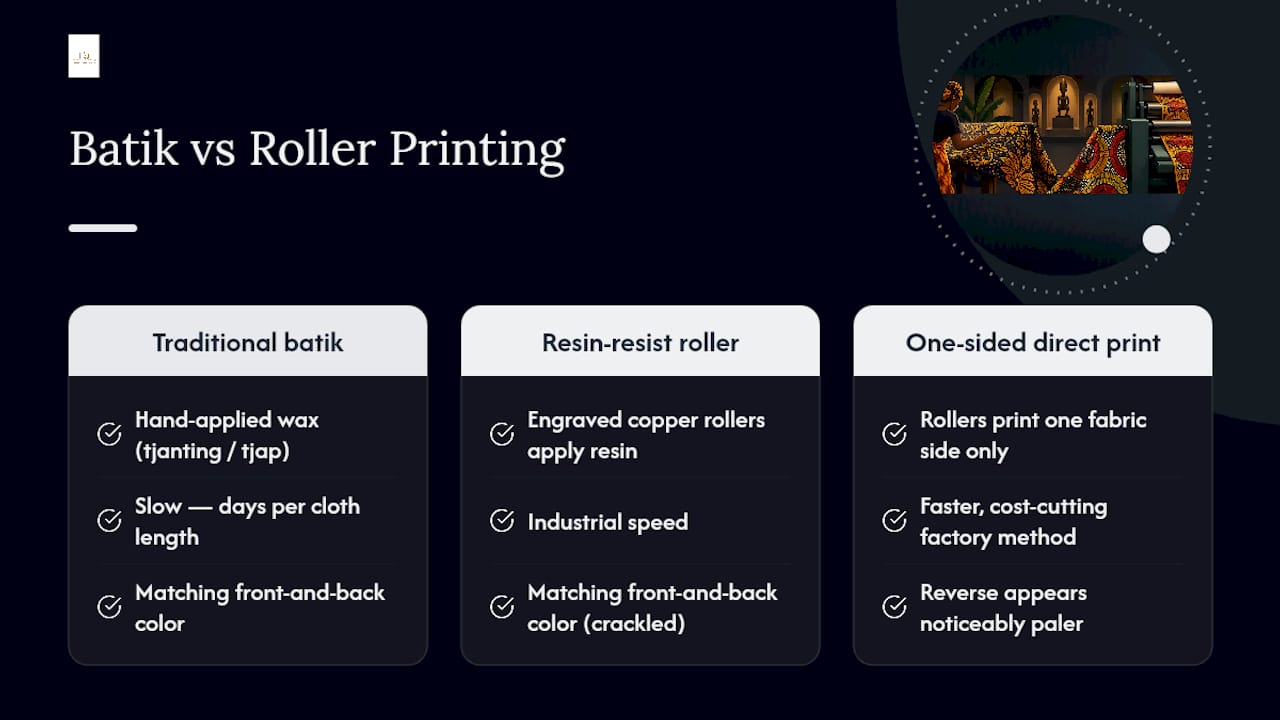
Here's the part that trips up a lot of buyers: modern "wax print" is often a misnomer. Many contemporary prints use resin, not wax, and some skip resist-dyeing altogether in favor of direct roller application. The label survives out of habit and marketing, but it tells you almost nothing about how a specific cloth was actually made.
How Did West African Traders Shape Ankara's Meaning?
The cloth's technical story explains how it was made. It doesn't explain why a Nigerian bride would choose one specific print for her wedding, or why a particular pattern might signal political allegiance in Accra. That meaning was built by African hands, not Dutch factories.
Ethnographic research on Togolese trading networks documents market women as active shapers of taste, not passive buyers waiting for European designers to decide what sold, per Patterns in Circulation from the University of Chicago Press. The most famous of these traders were the Nana Benz of Togo, women who built fortunes and market dominance so significant that some reportedly owned Mercedes-Benz cars, hence the name. They didn't just distribute cloth. They commissioned exclusive designs, controlled which patterns reached which markets, and effectively dictated what counted as fashionable.
That trader-driven feedback loop produced a naming culture unlike anything in European textile marketing:
- Prints earned nicknames tied to current events, proverbs, or gossip, sometimes changing meaning entirely from one region to the next.
- Certain patterns became associated with specific occasions: funerals, weddings, political rallies, or church celebrations.
- Wearing a particular print could signal loyalty, wealth, defiance, or humor, all legible to anyone who knew the local vocabulary.
The V&A's research into diaspora textiles documents how deeply these prints carry political and social weight, well beyond anything the original Dutch manufacturers intended or designed for.
Ankara, Dutch Wax, or Something Else Entirely?
You'll hear this cloth called Ankara, Dutch wax, African wax print, or Hollandais depending on where you are. In much of West Africa, "Ankara" is the everyday term. "Dutch wax" nods to manufacturing origin, even though production has long since spread beyond the Netherlands.
Do not confuse Ankara with older indigenous textiles. Kente is hand-woven on strip looms in Ghana, adire is Yoruba indigo resist-dye, and bogolan and aso-oke each carry their own weaving or dyeing lineages that predate industrial printing by centuries. Ankara is a newer arrival that earned its place through use, not age.
How Can You Verify an Ankara Print's Authenticity?
Visual identification alone can mislead you, since "wax print" describes a broad category rather than one consistent process, per the V&A. Still, a few checks narrow things down:
- Check both sides. True two-sided resin-resist printing shows nearly identical color and pattern on front and back; one-sided roller printing looks washed out on the reverse.
- Look for a selvedge stamp. Established manufacturers often print their name, a design number, or a registration mark along the fabric edge.
- Feel the weight and hand. Genuine cotton wax prints have a distinct crispness that cheaper polyester-blend imitations rarely replicate.
- Trace registration numbers. Design registers, like the historical Manchester Design Registry, recorded specific patterns with dates. A V&A textile sample shows registered designs dated between 1914 and 1946, evidence of exactly this kind of paper trail.
None of these checks alone proves a cloth's full story. A stamp can be forged, and weight varies by cotton grade. That's why museum object records and manufacturer archives matter more than any single visual cue.
Pro Tip: When a piece matters enough to research properly, cross-check it against a museum collection database rather than relying on a seller's word alone. Curatorial records tend to outlast marketing claims.
Who Manufactures Ankara Fabric Today?
Manufacturing didn't stay in Europe. Mid-20th-century West African nations built their own printing capacity, most notably the Ghana Textile Printing Company (GTP), established as Ghana pursued industrial independence after colonial rule. GTP joined other African-owned and joint-venture producers in a shift that mattered enormously to national pride and local employment, even as Vlisco remained a dominant historic name in the space.
That local manufacturing base now competes against a flood of cheaper imitation prints, largely from Asian factories, that copy popular West African designs without the design fees, licensing, or cultural context that shaped the originals. The V&A's diaspora textile research documents ongoing debate over these imports and what they mean for cultural ownership.
That's part of why more shoppers and designers now actively seek out garments tied to African-based production and named artisans rather than anonymous supply chains, treating that transparency as a value in itself rather than a footnote.
Why Sena Nukunu Is a Trusted Source on West African Textile Heritage
The brand builds its collections around ethical, small-batch production rooted in West African craftsmanship, not mass-market imitation. That commitment shapes how the brand talks about textile history: with respect for the traders and artisans who gave these prints meaning in the first place.
If you're exploring the deeper design vocabulary behind these fabrics, Sena Nukunu's guide to contemporary West African motifs breaks down how specific patterns carry social significance today, and its piece on spotting authentic African fashion offers practical checks for shoppers making a first purchase.
A Personal Take on Wearing History Well
Knowing where a print comes from changes how you wear it. History here isn't decoration, it's a record of who fought to make this cloth theirs, generations of traders and tailors who turned a colonial miscalculation into a language of their own. Buy from makers who tell you that story, not around it.
— Sena
Sources
- Cloth of a continent: Africa and fashion | V&A
- Dutch Wax - Asian Textile Studies
- Patterns in Circulation: Cloth, Gender, and Materiality in West Africa | University of Chicago Press
FAQ
What Is Another Name for Ankara Fabric?
Ankara is also called Dutch wax, African wax print, or Hollandais, depending on the region and generation. All refer to the same broad category of printed cotton cloth that emerged from 19th-century Dutch imitations of Indonesian batik.
How Do You Identify an Original Ankara Print?
Check whether the color and pattern appear nearly identical on both sides of the fabric, a sign of genuine resin-resist printing rather than one-sided roller printing. Look also for a manufacturer stamp or design registration number along the selvedge, and compare the weight and feel against known authentic cotton samples.
What Is the Oldest Known Fabric Tradition Linked to Ankara?
Ankara's technical roots trace back to Indonesian batik, a resist-dye tradition using hand-applied wax tools like the tjanting and tjap, long practiced in Java before Dutch manufacturers attempted to mechanize it in the 19th century. Ankara itself is a newer, distinct textile that emerged from that failed imitation, not a continuation of batik itself.
What Is the Difference Between Ankara and Kente?
Ankara is a printed cotton cloth with industrial European origins later reshaped by West African trading networks, while kente is a hand-woven textile made on strip looms, native to Ghana's Ashanti and Ewe traditions long before industrial printing existed. The two are often worn in the same communities but come from entirely separate manufacturing histories.