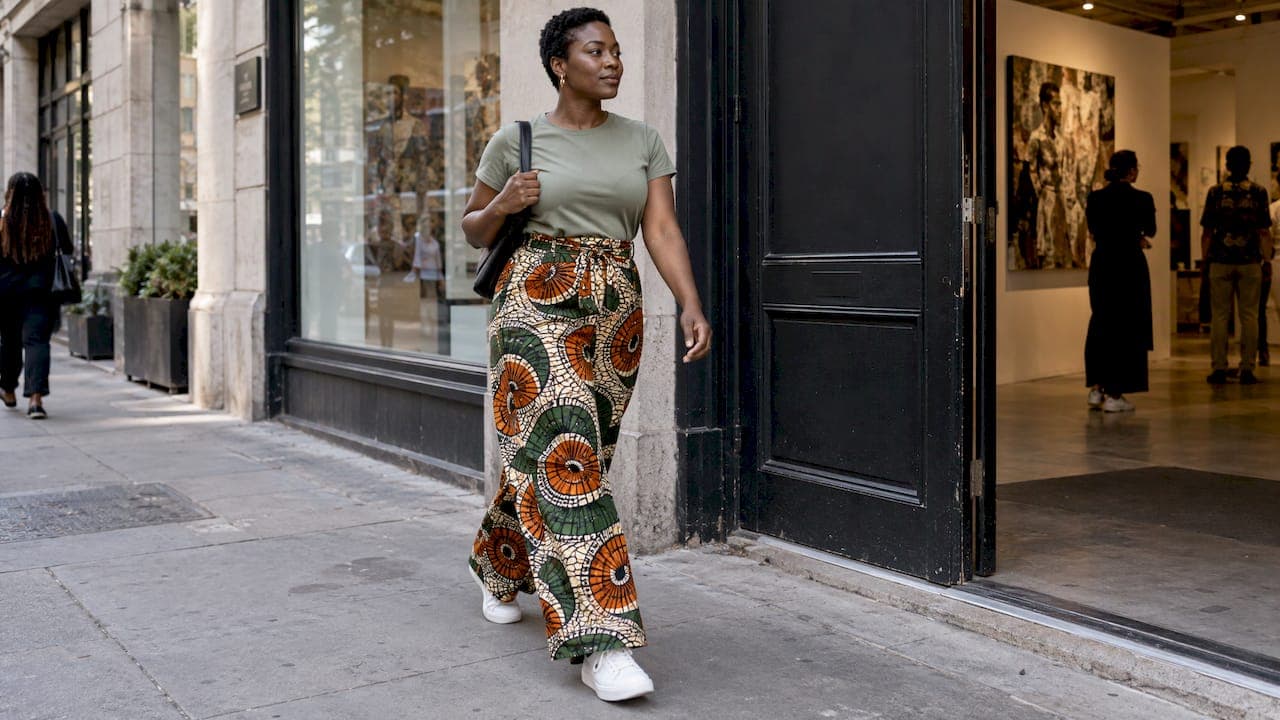
African print street style comes down to one idea: let a single bold printed piece lead, and keep everything around it relaxed, solid and comfortable. A print jacket over a plain tee, a wrap skirt with clean sneakers, or a matching set worn with slides can all read as streetwear when the fit is easy and the styling is intentional. Below, we walk you through the prints you will meet, the formulas that work, the silhouettes that flatter, and how to wear it all with respect for where it comes from.
TL;DR
- Choose one statement printed piece per outfit and build the rest from solid basics such as white, black, denim or tan.
- Repeat one shade from the print in a bag, shoes or jewelry so the look feels planned, not accidental.
- Structured jackets, wide-leg trousers, wrap dresses and midi skirts are the easiest silhouettes for everyday wear.
- Matching sets become casual the moment you swap heels for sneakers, slides or flats.
- Learn what a pattern means, buy from makers who honor its source, and wear it with pride, never as a costume.
Table of Contents
- What African print street style actually looks like
- The prints and fabrics you will see
- The anchor piece method
- Mixing prints with solids, textures and accessories
- Silhouettes that make print feel modern
- Matching sets: the easiest streetwear shortcut
- African print street style for men
- Wearing African print with cultural awareness
- Our perspective
- Find your statement piece
- Five street style formulas to save
- Frequently asked questions
- Sources
What African print street style actually looks like
Street style is fashion as people really wear it, on the way to work, to brunch, to a gallery, to a family gathering. African print street style takes the bold patterns and vibrant colors of West African textile tradition and lets them move through that ordinary day.
It looks different depending on the city. Marie Claire Nigeria's roundup of street style across Africa describes Lagos looks that pair Ankara with graphic tees and cargo pants, while in Nairobi flowing skirts and dresses, wide-legged pants with traditional motifs, and layers are common. The thread running through both is contrast: a heritage print set against something modern and relaxed.
That contrast is the heart of it. A formal agbada or a wedding kaftan is dressed to be admired from across the room. A street style outfit is dressed to be lived in, so the print becomes a signature rather than a spectacle.
The prints and fabrics you will see
When people say "African print," they usually mean a family of textiles, each with its own story. The names you will hear most often are:
- Ankara: vividly colored wax-style cotton prints, popular across West Africa and the diaspora, and the fabric most people picture first.
- Kente: a woven cloth tied closely to Ghana, where patterns carry meaning. We explain more in our piece on why kente cloth history matters now.
- Mudcloth (bogolan): a hand-dyed cloth from Mali, recognizable by its geometric markings on earthy tones.
- Adire: indigo-dyed cloth from Yoruba communities in Nigeria, resist-dyed in layered patterns.
- Shweshwe: a southern African cotton print, often in indigo and soft geometric motifs.
If you want a deeper tour, our guide to West African textile traditions covers how these cloths are made and what they have meant to the people who wear them.
For streetwear, it helps to think in terms of how loud the print is. Large, high-contrast patterns work best as the single hero of an outfit. Smaller, tonal or indigo-based patterns blend more easily into daily wear and pair well with denim.
The anchor piece method
The simplest way into African print street style is what we call the anchor piece: one bold printed item, with solid basics holding everything else steady.
The Ghana Report's guide to everyday African print suggests choosing one statement item, such as a vibrant midi skirt, a sharp blazer, tailored trousers or a maxi dress, and pairing it with solid neutrals like a crisp white shirt or a black polo neck. Fashion GHANA's casual styling advice lands in the same place: let one piece do the talking and keep the rest relaxed. Their examples include a vibrant print top with jeans and clean sneakers, or a print skirt with a plain T-shirt and sandals.
This works for a reason. The eye needs somewhere to land. When the print is the one loud voice, it reads as confident. When everything speaks at once, the message gets lost.
Easy anchor outfits to start with
- Print jacket, white tee, straight-leg jeans, white sneakers. The jacket frames your face and the neutrals keep it grounded.
- Print midi skirt, plain black tee, sandals or low boots. Easy for errands, office-casual days and weekend plans.
- Print top, dark denim, clean sneakers. The simplest version, and one you can build a week of outfits around.
- Wrap dress, denim jacket, flat shoes. The denim cools the print down and adds a street edge.
- Solid tonal outfit, one printed bag or scarf. For days you want only a whisper of pattern.
Our own walkthrough, how to wear African prints casually, every day, goes further into weekday routines if you want more ideas.
Mixing prints with solids, textures and accessories
Once the anchor method feels natural, you can start layering in more detail. The goal is to make the outfit feel composed.
Repeat a color from the print
Fashion GHANA recommends picking one shade from the print and repeating it through a bag, shoes or jewelry, or leaning on neutrals such as black, white, denim and tan. If your jacket has flecks of burnt orange, an orange-toned bag or earrings quietly tie the whole outfit together.
Add texture, not more pattern
Fashion Police Nigeria's Ankara styling guide advises mixing fabric, not just prints, pairing Ankara with textures such as lace, silk, chiffon, velvet or denim to make a look feel softer and more refined. For street style, denim and a soft knit are the easiest partners. A silk scarf or velvet bag can lift a casual outfit without making it formal.

Choose accessories with care
Fashion GHANA suggests beaded bags, raffia handbags, woven totes and African-inspired jewelry. These add texture without tipping the look into dressy territory. If you are not ready for a full print, The Ghana Report offers a "pop of print" approach: headwraps, handbags, eye-catching earrings, printed trainers, pocket squares, or a silk scarf tied to a plain tote.

Mixing more than one print
Pattern mixing is possible, but it takes practice. Fashion Police Nigeria suggests aiming to harmonize rather than exactly match, letting dominant colors or tonal families overlap between prints. If you want to try it, start with prints that share a base color and vary the scale, with one large and one small. Our guide to mixing African prints with cultural respect takes you from beginner to bold, step by step.
Silhouettes that make print feel modern
The cut of a garment changes how a print is read. The same pattern can feel formal, playful or streamlined depending on the shape beneath it.
Fashion Police Nigeria calls silhouette key to modern Ankara styling. It points to structured options like a blazer or structured jacket, wide-leg trousers (a better match for bold prints than fitted ones), and wrap dress or midi skirt shapes for everyday wear.
Here is how that translates into a street style wardrobe:
| Silhouette | Why it works | Pair it with |
|---|---|---|
| Structured jacket or blazer | Frames the print and adds polish | Plain tee, jeans, sneakers |
| Wide-leg or straight-cut trousers | Lets a bold print breathe and moves easily | Solid fitted top, flat sandals |
| Wrap dress | Flattering, adjustable, easy to layer | Denim jacket, white sneakers |
| Midi skirt | Movement and comfort with a casual edge | Basic tee, boots or slides |
| Matching set (co-ord) | Instant outfit, easy to break apart | Sneakers, a simple tote |
A useful rule of thumb: keep the shape fluid for casual days, structured for work, and tailored for formal occasions. The print stays the same, but the cut sets the mood.
Matching sets: the easiest streetwear shortcut
If you want a full print look with zero guesswork, a matching set is your friend. Fashion GHANA points out that a matching African print top and trouser or shorts set looks stylish in casual settings once you switch formal heels for white sneakers, slides, ballet flats or simple sandals.
A few ways to get more from a set:
- Wear it together with sneakers for a polished but relaxed day look.
- Split it up. Wear the jacket over jeans and the trousers with a plain tee, and you have three outfits from one purchase.
- Layer outerwear such as a denim or leather jacket over the top when the weather turns, letting the print peek through.
- Keep accessories minimal. The set already carries the pattern, so one bag and one pair of earrings is plenty.
Our dresses and women's collection include matching sets and statement pieces that suit this approach.
African print street style for men
African print is not only for women's wardrobes. According to Encyclopedia.com's entry on the dashiki, the dashiki is a unisex pullover shirt that reached the American fashion scene in the 1960s, embraced by the black pride movement and the white counterculture alike. African-inspired menswear has had a place in American style for generations.
For men, the same anchor logic applies. A print shirt or kaftan top with dark trousers and clean sneakers is an easy start. A print bomber or jacket over a plain tee and jeans does the same job as a print jacket on a woman. For celebrations, a three-piece kaftan or agbada set carries the heritage look to its fullest. You can browse those in our men's agbada ensembles and heritage pieces.
A tip for building confidence: start with a solid-colored kaftan set, where the richness comes from cut and embroidery, then move toward louder prints as you get comfortable.
Wearing African print with cultural awareness
Style is more rewarding when you know what you are wearing. African prints carry history, meaning and craft, and treating them with care is part of wearing them well.
Writing in The Root, Maiysha Kai advises picking one item or category, such as a bag, a blouse or an armful of bracelets, and letting it speak for itself, because Africa is a continent and piling on too many elements can be culturally confusing. The same piece notes that African American interest in African fashion grew out of the "black is beautiful" movement and a desire to shape a new identity, and it encourages buying from African-owned shops and designers.
Kente deserves special care. In a Smithsonian Magazine Q&A, cultural specialist Diana Baird N'Diaye says it is fine for Americans, especially those of African ancestry, to wear appropriate kente patterns at events such as graduations and funerals, as long as the cloth itself was handwoven in Africa. She adds that designers should not copy actual kente patterns but should be clear about where their inspiration comes from.
Practical habits that follow from this:
- Learn the pattern before you wear it, especially with woven cloths that carry named meanings.
- Pick one hero element rather than layering motifs from many cultures at once.
- Support makers who are open about their craft and who honor the tradition they draw from.
- Wear it as everyday clothing, not as a costume for a themed event.
For more on this, see our guides on culturally inspired fashion and how to choose it and ways to honor Black culture in fashion.
Our perspective
We believe street style is where heritage becomes personal. Nobody wears a garment to a museum; you wear it to your life. That is why we design and curate ready-to-ship pieces that move easily from a morning meeting to an evening out, and why we keep our quantities limited, so each piece feels considered rather than mass-produced.
Every stitch carries the work of artisans, and we hold ourselves to ethical production because the people behind the cloth matter as much as the cloth itself. When you wear one of our dresses, jackets, kaftans or matching sets, you are carrying a legacy of color, pattern and pride into everyday spaces.
Our advice is simple: choose the piece that makes you stand a little taller, let it be the star, and keep the rest of your outfit easy. Confidence is the best accessory a print can have, and comfort is what lets you keep wearing it.
Sena
Find your statement piece
If you are ready to build your own African print street style, start with one piece you love. Our collections bring together dresses, kaftans, jackets, agbada sets and matching statement sets, each made with ethical manufacturing and artisanal craftsmanship in limited quantities, and ready to ship from Florida.
Browse our full collections to find a piece that fits your day, or explore Woven Nobility: Kings' Robe for menswear with a regal presence. You can also read more in our guide to authentic West African cultural fashion statements for women.
Five street style formulas to save
Here is a quick reference you can return to when getting dressed:
- The Weekend Anchor: print top, dark denim, white sneakers, a woven tote.
- The Office Edge: structured print jacket, plain tee or shell, straight-leg trousers, loafers or flats.
- The Easy Set: matching print co-ord, slides or sandals, one pair of statement earrings.
- The Soft Contrast: print wrap dress, denim jacket, clean sneakers, a bag in a color pulled from the print.
- The Quiet Pop: all-neutral outfit with one printed scarf, headwrap or pair of shoes.
If you want more guidance on confident styling, our top tips for styling Ankara outfits goes into color, proportion and occasion.
Frequently asked questions
Can I wear African print every day, or is it only for special occasions?
You can absolutely wear it every day. Streetwear versions break the print into jackets, skirts, tops and wrap dresses that pair easily with jeans, tees and sneakers. Start with one printed piece and keep the rest of the outfit solid.
How do I keep an African print outfit from looking like a costume?
Keep to one hero print per outfit and use solid colors, ideally pulled from the print itself, for everything else. Choose silhouettes you would wear anyway, such as a blazer, wide-leg trousers or a wrap dress. Knowing the meaning of what you wear also helps it read as personal style.
What shoes work best with African print street style?
Clean white sneakers are the most reliable choice, followed by slides, ballet flats and simple sandals. Fashion GHANA suggests these casual options in place of formal heels, especially with matching sets.
Is it appropriate to wear African prints if I am not African?
Many people of all backgrounds wear African prints, and African American style has its own long relationship with them. The respectful approach is to learn what the pattern means, choose one piece rather than stacking many, and buy from makers who honor the source. For kente specifically, follow the guidance on handwoven cloth and avoid sacred patterns you do not understand.
Do men wear African print street style too?
Yes. Print shirts, kaftan sets, jackets and agbada ensembles are all part of modern menswear. A print shirt with dark trousers, or a kaftan set with clean sneakers, is a good first step.
Sources
- Street style inspiration as seen on the streets of Africa, Marie Claire Nigeria
- 5 modern ways to incorporate African prints into your everyday wardrobe, The Ghana Report
- Your African prints should not be reserved for special occasions, Fashion GHANA
- How to Style Ankara Dresses for a Modern Look, Fashion Police Nigeria
- Dashiki, Encyclopedia.com
- Ankara, Ankhs and the Ongoing Appropriation vs. Appreciation Argument, The Root
- When Is Kente Cloth Worn and More Questions From Our Readers, Smithsonian Magazine