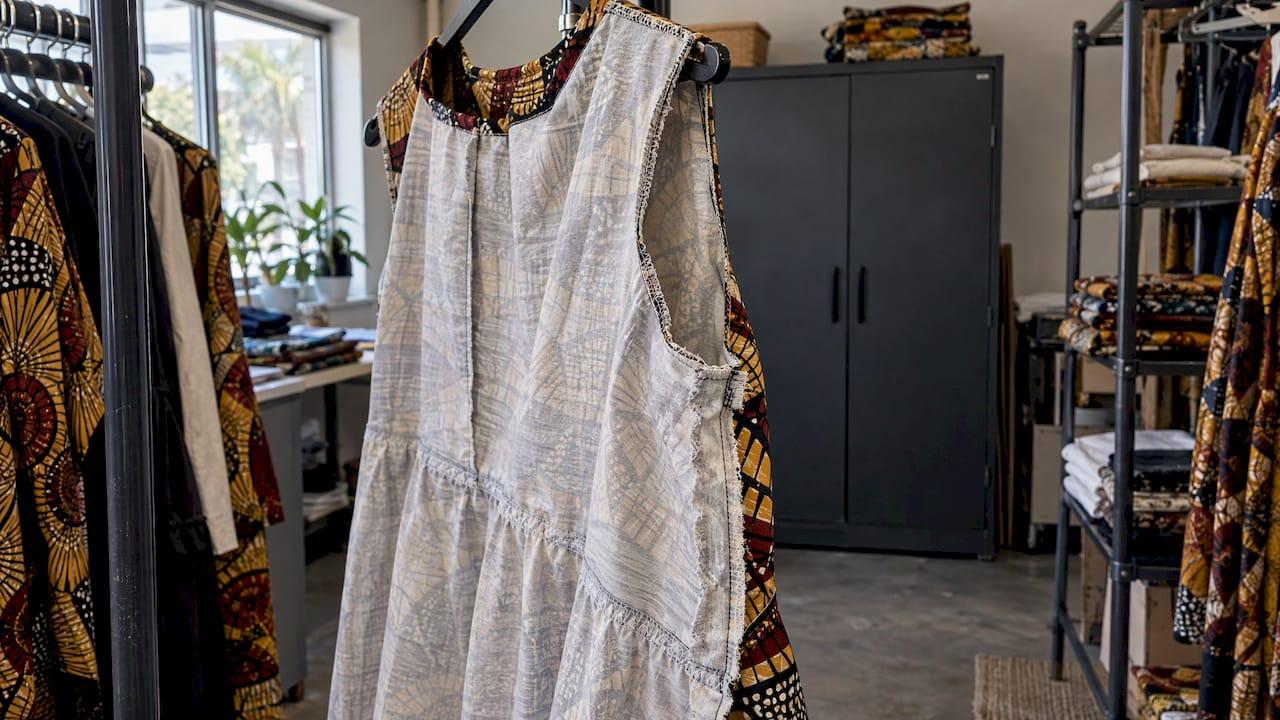
Great African clothing is judged by what happens inside the garment as much as by the color and the cut. Turn a piece inside out and look at its seams, hems, buttonholes and the way the print meets at every join. Those details show whether the maker took time over it, and they decide whether a dress, kaftan or agbada set will hold its shape through years of weddings, Sunday services and celebrations. At Sena Nukunu, we make West African ready-to-wear and custom pieces in limited quantities with artisanal craftsmanship, so this is a subject close to our hearts. Below is a plain, practical way to read any garment, ours or anyone else's, before you buy.
TL;DR
- Turn the garment inside out first. Clean, finished seams and tidy hems tell you more than the front ever will.
- Tug gently on a seam: dense, small stitches hold firm, while long stitches and see-through gaps are warning signs.
- Check where panels meet. In a well-cut African print piece, the pattern is matched or placed on purpose at side seams, pockets and openings.
- Look at the stress points: pocket corners, underarms, closures and hems should be reinforced and lie flat.
- Ready-to-wear made in limited quantities and custom pieces give a maker the room to do this finishing work with care.
Table of Contents
- Why stitching matters more than the print
- The inside-out inspection
- Seams: the first thing to test
- Stress points, closures and buttonholes
- Hems and linings
- Fabric and print: where cutting skill shows
- Fit and finish: ready-to-wear and custom pieces
- A quick five-minute routine
- Our perspective
- Find pieces made to be worn for years
- FAQ
- Sources
Why stitching matters more than the print
Bold prints and rich colors are what draw the eye, and they are meant to. But the University of Georgia's extension service points out in its guide to quality and selection in textiles that a garment's real story is told on the label and inside the garment, not by its outward appearance. The same guide notes that in mass production the first priority is how a piece looks on the rack, so knowing what to look for inside is what separates a good purchase from a poor one.
For African clothing this matters a great deal. These are often pieces you buy for a milestone: a wedding, a naming ceremony, a graduation, an important presentation. You want them to look as regal on the fifth wearing as on the first. A seam that puckers, a hem that droops or a buttonhole that frays can undo the beauty of the fabric.
The guide lists the usual signs of a shortcut: puckered and raveling seams, ragged buttonholes and uneven hems. Once you know to look for them, you will see them quickly.

The inside-out inspection
This is the single most useful habit you can build. Turn the garment inside out and ask three questions.
- Is the inside as good as the outside? Fashion educator Andrea Cheong, quoted in The Guardian's October 2026 guide to buying clothes that last, says that if the inside is as good as the outside, it is a good indication you are on the right track.
- Are the raw edges finished? Fabric edges should be enclosed, bound or neatly overlocked so they cannot unravel. Loose threads and fraying edges inside mean the garment may start coming apart after a few washes.
- Do the seams lie flat? Seams should be straight, flat and free from bulk. Wavy or bunched seams often mean the fabric was pulled while it was sewn.
Sustainability consultant Leigh Morris, in the same Guardian guide, explains that a seam's main job is to give a garment its shape and structural integrity. That is why seam quality is such a reliable predictor of how long a piece will last.
Seams: the first thing to test
Seams carry the weight of the garment. Every time you sit, reach, raise your arms or dance, they take the strain. Here is what to look for.
Allowance and edge finish
The seam allowance is the extra fabric between the stitching and the cut edge. The University of Georgia guide advises checking that allowances are generous and raw edges are finished, because skimpy allowances on a fabric that ravels begin to fray after a couple of washings. A generous allowance also gives a tailor something to work with if you ever need the piece let out.
Ankara and other wax prints are usually woven cotton, and woven cotton frays. That makes a clean edge finish especially important on African-print garments. Better-quality garments use bound, flat-felled or French seams, so there are no raw edges at all, a point made by designer Bianca Spender in The Guardian's 2022 guide to quality clothing. Spender's broader point is worth remembering: the right finish depends on the material. A simple overlocked seam can be perfectly fine on a stretchy knit, while a structured jacket or agbada calls for a more refined finish.
The gentle tug test
Hold a seam with a hand on each side and pull gently. Textile technologist Vianna Chan, quoted in the Guardian's 2026 guide, says dense stitches should hold firm rather than the threads stretching apart and letting light through. If you can see daylight between the stitches, the seam is under-stitched.
Stitch length
Look closely at the stitching itself. Max Sanderson, a fashion design lecturer at Parsons Paris, tells The Guardian to look for small stitches because they are more durable than long ones, and long stitches can be a giveaway that a garment was made quickly. Hems and seams should also be thoroughly sewn down, since a loose hem is easy to snag.
Where underarm and side seams meet
The University of Georgia guide notes that underarm seams of sleeve and bodice should meet precisely, and that mass production often sews sleeves on before the side seams, which causes mismatches. It also says seams should be flat and darts tapered to a point, because untapered darts cause puckering or bulges. On a fitted bodice or a tailored jacket, run your fingers along each dart. It should disappear smoothly into the fabric.
Stress points, closures and buttonholes
Some parts of a garment work harder than others. A well-made piece reinforces them.
- Pocket corners and zips. Vianna Chan says a quality garment reinforces areas that bear daily movement, such as pocket corners and zips. Look for small reinforcing stitches at the ends of pockets and openings.
- Waistbands. Chan also explains that inner reinforcement, like a fully interfaced waistband, costs more in labor, fabric and thread, and because it cannot be seen from outside it is the easiest place to cut corners. Press a waistband between your fingers. It should feel supported, not floppy.
- Buttonholes. The University of Georgia guide advises that they be closely stitched and follow the grain of the fabric. Ragged edges or loose threads here will only get worse.
- High-friction areas. Cheong recommends examining places prone to splitting, such as the crotch seam on trousers. For men's agbada sets, the trouser seams and the armholes of the robe deserve the same attention.
This is also where the stitching on a robe or a jacket carries real meaning. Large, flowing garments move with you, and the seams at the shoulders and sleeves take the load every time you lift an arm to greet someone or raise a glass.
Hems and linings
New Mexico State University's Clothing Construction Standards give a clear checklist you can apply to any piece:
- Hems are even in width, hang parallel to the floor and are free from raveling.
- Seams are straight, flat and free from bulk, with fabric designs matched as far as possible.
- Linings fit smoothly with seams aligned, and are hemmed 1/2 inch shorter than sleeves and 1 inch shorter than skirts or pants.
- Topstitching is straight and attractive in size and placement.
To test a hem, hold the garment up by the shoulders and look at the bottom edge against a straight line, like a door frame. A dip or a rise means uneven stitching or a cutting error. The Guardian's 2026 guide and the standards above agree on a related point: the stitching should be neat and lie flat, with nothing puckering the fabric.
For a long dress or kaftan, a hem that is deep enough also leaves room for a tailor to lengthen the piece later, which matters if you are between sizes or buying for a growing family member.
Fabric and print: where cutting skill shows
With African prints, the fabric is part of the construction. Wax prints such as Ankara are bold, large-scale designs, and how they are cut and joined shows the maker's skill. If you want the background on the cloth itself, our guide on what Ankara fabric is and how to judge its quality is a good place to start.
Check the print at every join
The University of Georgia guide says plaids and stripes should match at the seams, including side seams that are easy to forget. The same principle applies to large motifs. Look at the front opening, the pockets and the side seams. In a carefully cut piece, the print either flows across the join or is placed deliberately, for example a motif centered on the chest or mirrored on both sleeves. FabricLink, a consumer resource on fabric care, also advises that patterns should line up at the seams and that details such as pockets and collars should be even and lie flat.

A motif that is cut in half at a seam, or a front panel where the pattern slants off to one side, usually points to a cutting problem rather than a design choice. Small variations in a hand-printed or hand-dyed cloth are different: those are part of the craft.
Printed designs on cotton also depend on how the ink or dye reaches the cloth, and a breakdown of screen print versus DTG printing shows how much the method shapes the finished look and feel.
Feel the cloth and check the grain
Bianca Spender, in the 2022 Guardian guide, says she pulls fabric between her thumbs to see whether it holds its form, and rubs it to check for pilling. Max Sanderson suggests rubbing fabric against a sensitive area such as the side of the neck or forearm. She also checks that the side seam hangs straight, which shows the fabric was cut on the grain. If a seam twists around your body when you wear the garment, the fabric was probably cut off-grain.
Good cloth feels better on the skin and generally fits, drapes and wears better, as vintage store owner Dan Neilsenbeck notes in the same piece. Finally, how a piece behaves when you wash it depends on the cloth and the finishing together. Our guides on washing Ankara without fading it and on whether Ankara shrinks will help you protect your investment once it is home.
Fit and finish: ready-to-wear and custom pieces
Stitching quality and fit go hand in hand. A well-sewn garment on the wrong body will still bunch and pull, and a perfectly fitted piece with weak seams will not last.
When you try on ready-to-wear, move as you would at the event: raise your arms, sit down, take a long step. Check that:
- The shoulder seams sit at the edge of your shoulders.
- Nothing pulls across the back or at the underarm.
- The hem stays level when you walk.
- Closures sit flat without gaping.
With custom pieces, take your measurements carefully and ask about the seam allowances, so there is room for small adjustments later. That extra fabric is what lets a tailor refine a fit.
For a wider checklist on spotting skilled work, see our handcrafted fashion checklist for West African style and our guide to identifying authentic African craftsmanship in fashion.
A quick five-minute routine
You can carry this routine to any store, market or online order when it arrives:
- Turn it inside out and check that edges are finished.
- Tug the seams at the shoulders, sides and underarms.
- Look at the stitching: small, even and dense is what you want.
- Follow the print across side seams, pockets and openings.
- Hold it up and check the hem against a straight line.
- Inspect buttonholes, zips and pocket corners for reinforcement.
Our perspective
We believe a garment should be as thoughtful on the inside as it is striking on the outside. West African dress carries history, and when you wear it to a wedding, a ceremony or the office, you are carrying that history with you. It deserves seams that can bear it.
That is why Sena Nukunu works in limited quantities. Our pieces are made with ethical manufacturing and artisanal craftsmanship, so each dress, kaftan, jacket or agbada set is made with care and purpose rather than rushed out at volume. Smaller runs are how we honor the artisans behind the work and the people who wear it.
When you look closely at a piece from us, we hope you see what we see: intricate detail, cultural storytelling and a commitment to lasting quality. We encourage you to turn it inside out and read it the way this guide describes. That kind of attention is what we make for.
Sena
Find pieces made to be worn for years
If you are shopping for a wedding, a celebration or a statement piece for everyday wear, our ready-to-ship ready-to-wear collection is where to begin. It includes women's collections such as Woven Stride: Queen In Comfort and Woven Radiance: Queens in Bloom, and men's agbada ensembles and heritage pieces such as Woven Nobility: Kings' Robe. Explore the full range in our collections, or go straight to our men's agbada ensembles and women's collections.
Every piece is made in limited quantities with ethical manufacturing and artisanal craftsmanship, and we also offer custom garments for those who want something made for them.
FAQ
How can I tell if African print clothing is well made?
Turn it inside out. Look for finished edges, flat seams, small even stitches and hems that hang straight. Then check that the print matches or is placed deliberately where panels meet. As the University of Georgia extension notes, a garment's real story is told inside it, not by its outward appearance.
What is the best seam finish for Ankara and wax print?
Ankara is usually woven cotton, which frays, so you want edges enclosed or neatly finished. Bound, flat-felled and French seams leave no raw edges, according to The Guardian's 2022 guide. The right finish also depends on the garment: structured pieces such as jackets and agbada robes call for a more refined finish than a light knit.
Do small stitches really mean better quality?
Generally, yes. Fashion lecturer Max Sanderson tells The Guardian that small stitches are more durable than long ones, and long stitches can show a garment was made quickly. Combine this with the gentle tug test: a good seam shows dense stitching with no light showing through when you pull it.
What should I check on a hem?
It should be even in width, free from raveling and hang parallel to the floor, according to New Mexico State University's construction standards. A generous hem allowance also leaves room for a tailor to adjust the length later. On a lined garment, the lining should be hemmed slightly shorter than the outer fabric.
How do I keep well-stitched African clothing in good shape?
Follow the care guidance for the fabric. Wash gently, protect the colors and store the piece with care. Our guides on caring for African fabrics and dry cleaning Ankara walk you through it.
Sources
- Quality and Selection | Textiles, University of Georgia Extension
- Check the waistband and beware sneaky jargon: the expert guide to buying clothes that last, The Guardian, October 2026
- Seams pretty good: how to know you're buying quality clothes, The Guardian, 2022
- Clothing Construction Standards, New Mexico State University
- 10 Tips to Make Your Clothes Last, FabricLink