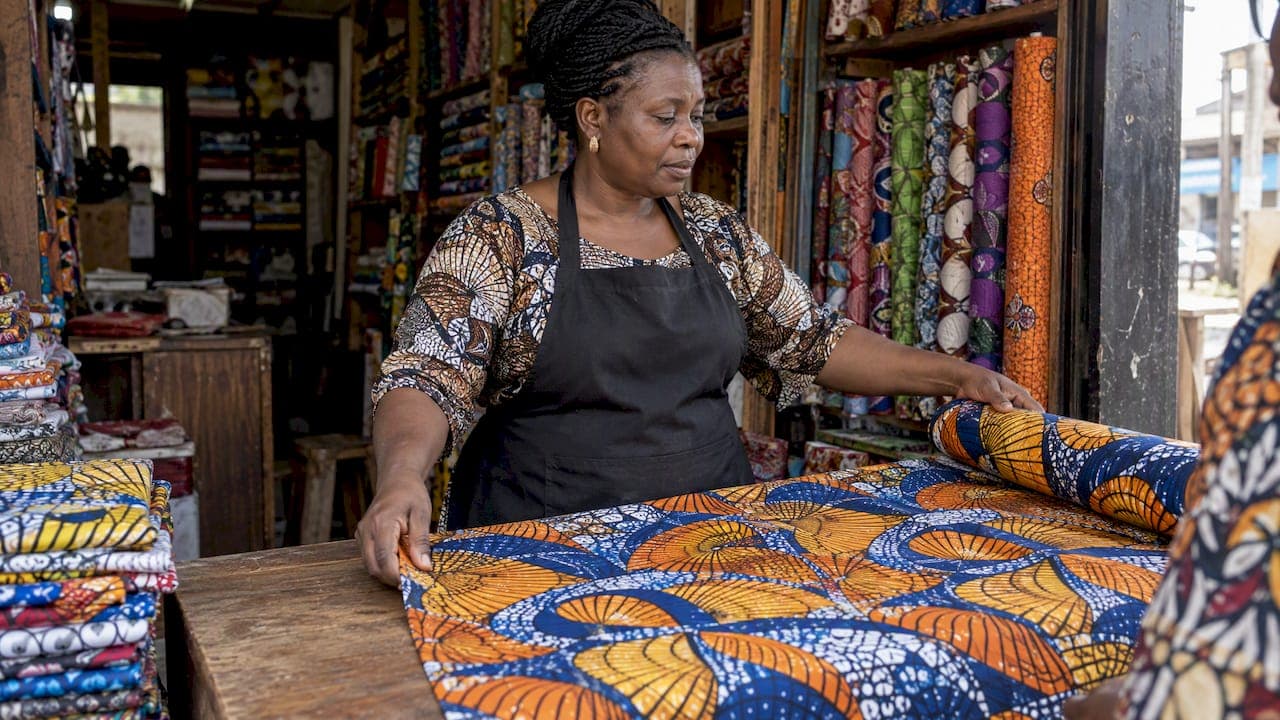
Ankara fabric is a bold, colorful printed cotton cloth worn across West Africa and the diaspora, also sold as African wax print, Dutch wax print or Holland wax. It is made with a wax-resist printing process inspired by Indonesian batik, and over more than a century West Africans made it their own, naming its patterns, trading it, saving it and dressing in it for life's biggest moments. The name has nothing to do with Turkey's capital. Below, you will find where the cloth comes from, what its patterns say, how to tell quality from imitation, and how to bring it into your wardrobe.
TL;DR
- Ankara is industrially printed, wax-resist cotton cloth, also called African wax print or Dutch wax. It is the everyday and celebration fabric of much of West Africa.
- Its roots are a story of trade: 19th-century Dutch and British merchants copied Indonesian batik, and West African buyers adopted the cloth and gave it its meanings.
- The name most likely traces back to the Hausa word for Accra, not to the city in Turkey.
- Quality shows in the hand-feel, the depth of color on both sides of the cloth and how it behaves in a damp-cloth rub test.
- Traditional tailoring starts from a 6-yard piece, so buy or commission with the finished garment in mind.
Table of Contents
- So, what exactly is Ankara fabric?
- Why is it called Ankara?
- Where Ankara really comes from
- What the patterns say
- How wax-resist printing works
- Ankara quality: what to check before you buy
- Buying yardage: why 6 yards is the traditional unit
- Our perspective: more than a print
- Ways to wear Ankara today
- Ready to wear it? Explore our collections
- FAQ
- Sources
So, what exactly is Ankara fabric?
At its simplest, Ankara is a printed cotton cloth. The V&A museum describes it as a printed cotton produced in many patterns, formed by layering polychromatic dyes, and fashionable in West and East Africa since the late 19th century. Asian Textile Studies defines the Dutch wax family as mechanically printed, wax-resist cotton textiles developed commercially in Holland for the African market.
A few features set it apart from an ordinary printed cotton:
- Saturated color. Wax-resist printing gives deep, rich hues that look vivid on both sides of the cloth.
- Large, expressive designs. Geometric forms, flowers, animals, everyday objects and abstract shapes all appear, often at a scale that makes a single garment a statement.
- The crackle effect. Fine veins of color, caused by the wax cracking during dyeing, are a signature of the technique, and many guides list them as a mark of authenticity.
- A cotton base. Quality Ankara is woven from cotton, which is why it breathes, takes a crisp crease and softens with wear.
You will see the same cloth under many names. Wikipedia notes that it goes by African wax prints, Dutch wax prints and Ankara, with local names such as Abada among the Igbo of Nigeria. In Francophone Africa it is often called pagne, and in East Africa you may hear kitenge.
Why is it called Ankara?
This is the question people ask most, and the answer surprises many. According to Wikipedia's entry on African wax prints, "Ankara" comes from the Hausa name for Accra, the capital of what is now Ghana. In the 19th century Accra was a hub for African prints, and Nigerian Hausa traders used the name for the cloth they bought there.
A scholarly article on naming and meanings of Ankara designs is direct on one point: the capital of Turkey, formerly Angora, has nothing to do with the fabric. So if you have wondered whether the cloth is Turkish, it is not. The word simply traveled with traders and stuck.
Where Ankara really comes from
The honest history is layered, and it is worth telling in full, because it is part of why the cloth matters.
In the 19th century, Dutch and later British manufacturers tried to mass-produce imitations of Indonesian batik. The V&A's collection notes describe this attempt, and Al Jazeera's reporting on Ghana's textile trade agrees that the cloth, now so closely tied to African identity, was not born in Africa. The imports did not take off in Indonesia. They found enthusiastic buyers in West Africa, where merchants and consumers pushed manufacturers toward the colors, motifs and meanings they wanted.
That is the heart of the story. Wikipedia describes how West African buyers adapted the designs and colors to their own tastes, and the V&A's blog on the fabric of the African diaspora explains how the bold patterns became interwoven with the history, artistry and identities of African communities. A cloth that began in a colonial trade system became, through the choices of the people who wore it, a symbol of pride, independence and belonging.
If you would like to go deeper on how to check a cloth's story, we wrote a guide on provenance tests for Ankara and its museum-backed origins.
What the patterns say
Ankara is never only decoration. According to textile writing on Ankara's symbolism, patterns can carry messages, and some prints are named after personalities, cities, buildings, sayings or occasions. Wikipedia describes wax prints as a form of nonverbal communication, especially among women.
The naming is often a grassroots process. The Nigerian design study mentioned above reports that print names and meanings are rarely set by the manufacturers: traders and users bestow them once a design becomes popular. The United Nations has also written about how popular names for designs, as ordinary as shoes, handbags or pencils, are used by shoppers asking for specific patterns.
So when you choose a print, you are choosing a voice. Some wearers pick a design for its proverb, others for the story of the market where they found it, and others simply because the color makes them feel like royalty. All of these are valid, and all are part of the tradition. For more on this, see our cultural guide on why West African patterns are iconic and our look at contemporary West African motifs.
How wax-resist printing works
The method is a cousin of batik. Wax or resin is applied to the cloth to block dye from the areas it covers, then the cloth is dyed. The wax can be cracked on purpose to let thin lines of a second color seep in, and the process is repeated for additional colors. Industrial versions do this with machines rather than hand tools, which is why you will often see Ankara described as mechanically printed batik-style cloth.

This is different from surface decoration added to a finished garment. If you are curious how the methods compare, this overview of screen printing, DTG and embroidery explains how those techniques sit on top of fabric, whereas wax-resist printing works to carry dye through the cotton itself. That penetration is why good Ankara looks nearly as rich on the reverse.
Ankara quality: what to check before you buy
Searches for Ankara quality come up often, because the market holds everything from heirloom cloth to thin imitations. Here is what to look for.
1. The hand-feel
Al Jazeera's report on Ghana's prints describes the difference between authentic cotton wax prints and cheaper imports. Good cotton cloth feels soft and mouldable, with some substance, and it yields under an iron. Stiff, papery or rubbery cloth often signals synthetic content or stiffening agents. Those finishes can fade after a single wash, according to the same reporting.
2. Color on both sides
Turn the cloth over. In true wax-resist printing the design reads on both sides, though one side may be brighter. A pattern that is vivid on the front and a pale ghost on the back suggests surface printing.
3. The rub test
On an inconspicuous corner, rub gently with a damp white cloth. If color transfers right away, the dye is sitting on the surface. This test is recommended in Wikipedia's Ankara entry as a sign of poor surface printing versus deeper wax dyeing. Do not lean on a "guaranteed wax" label alone, since that wording is also used as a marketing term.

4. Fiber content
Check the label or ask the seller. The grade to look for is 100% cotton. Many guides, including this overview of Ankara patterns and care, describe quality cloth by its color vibrancy and resistance to fading.
5. The pattern placement
For a finished garment, look at how the motif lands on the body. Placement on the bodice, the seams and the hem tells you whether the maker planned the print or simply cut it. Our guide on how U.S. shoppers wear Ankara, with placement and tailoring goes through this in detail.
Buying yardage: why 6 yards is the traditional unit
If you plan to sew or commission a garment, you will notice the cloth is commonly sold in lengths of about six yards. Asian Textile Studies notes that traditional African tailoring standardizes around that piece, roughly 5.5 meters. It is a cultural unit more than a retail habit: it was calculated to yield a coordinated ensemble, typically around 3 yards for a lower garment, 2 for a top and 1 for a headtie or accessory.
In practice:
| Plan | What to consider |
|---|---|
| Two-piece set | A full 6-yard piece usually gives room for matching the print across top and bottom. |
| Large or directional motifs | Allow extra so the pattern can be placed with intention. |
| Fuller silhouettes | Add extra yardage for volume and sleeves. Our guide on curvy Ankara styles suggests adding 10 to 20% fabric. |
| Headtie or accessory | The last yard is traditionally for these. |
Always ask your tailor to confirm yardage for the exact pattern before you cut.
Our perspective: more than a print
At Sena Nukunu, we think about Ankara as living culture. Its history includes colonial trade, and that matters to us, because what happened next is the part we celebrate: people took a commercial product and made it carry their stories. That is a legacy of agency, and we believe it belongs in the way a garment is made today.
That is why our pieces are made in limited quantities, with ethical manufacturing and artisan craftsmanship at the center. We would rather offer fewer garments made with care than flood the market, and we want you to feel the difference when you put one on: the structure, the comfort, the sense of stepping into a room with your head high. We design dresses, kaftans, agbada sets, jackets and matching statement sets for women and men, and we try to honor the tradition in each piece while keeping it wearable for modern life in the United States.
When you choose a print, we hope you ask what it means to you. That question is as old as the cloth itself.
— Sena
Ways to wear Ankara today
The fabric works across many moments, from a workday jacket to a wedding or naming ceremony. The collection of listings on Ako's guide is one place readers compare fabrics by use, and we have our own guides, too:
- Start with one statement piece. A single bold print, balanced with solid basics, is the easiest way in. See our styling tips for Ankara outfits.
- Try a matching set. Top and bottom cut from the same cloth read polished with no effort. Our limited run matching sets guide shows styling recipes.
- Explore dress shapes. From wrap to midi to maxi, silhouette changes the mood. Start with modern Ankara dress styles and how to choose.
- Dress the men in your life. Kaftans and agbada sets are natural ways to wear the fabric. Our curated men's Ankara outfits are a good starting point.
If you want to understand the wider appeal, read why African prints are popular.
Ready to wear it? Explore our collections
If you are ready to move from reading to wearing, we invite you to browse our women's shop and our full collections, which include Woven Nobility: Kings' Robe, Woven Stride: Queen In Comfort, Woven Shields: Queens in Motion and more. For men, our agbada ensembles and Men's Heritage pieces are ready to ship. Each is limited in quantity and made with ethical manufacturing, so you can wear a piece with the confidence of knowing how it came to be.
FAQ
Is Ankara 100% cotton?
Quality Ankara is made from 100% cotton, and that is what gives it breathability and a soft, mouldable feel. Cheaper imitations may include polyester or stiffening agents. Check the label, feel the cloth and run the damp-cloth rub test before you buy.
Why do Nigerians wear Ankara?
Because the cloth became a language. Prints are named and interpreted by traders and wearers, and the cloth is used for celebrations, community events and everyday life. Researchers describe how West Africans recontextualized a colonial-era product to express independence and cultural pride, and the fabric is often kept as a valued household asset.
Is Ankara actually African?
The cloth began as a European attempt to mass-produce Indonesian batik, so its manufacturing origin is not African. Its meaning, naming, styling and cultural role, however, were shaped by West Africans, which is why it is now deeply tied to African identity.
What is the difference between Ankara, African wax print and Dutch wax?
In everyday use they refer to the same family of wax-resist cotton prints. Ankara is the common name in Nigeria and across the diaspora, while Dutch wax points to the manufacturing history and pagne is the Francophone term. Differences in quality come from the maker and the printing process, not from the name.
Sources
- African wax prints, Wikipedia
- Ankara fabric, Wikipedia
- Ankara, V&A Explore the Collections
- Fabric of the African Diaspora, V&A Blog
- Dutch Wax, Asian Textile Studies
- Fabric wars: Ghana's colourful prints face renewed Chinese competition, Al Jazeera
- Naming and Interpretative Meanings of Selected African Prints and Ankara Fabric Designs
- Ankara Fabric: Patterns, Meaning & How to Style African Wax Print
- African history woven in fashionable fabrics, United Nations
- Adire and Ankara, Stanford FSI
- How to Identify Quality African Fabrics for Everyday and Event Wear