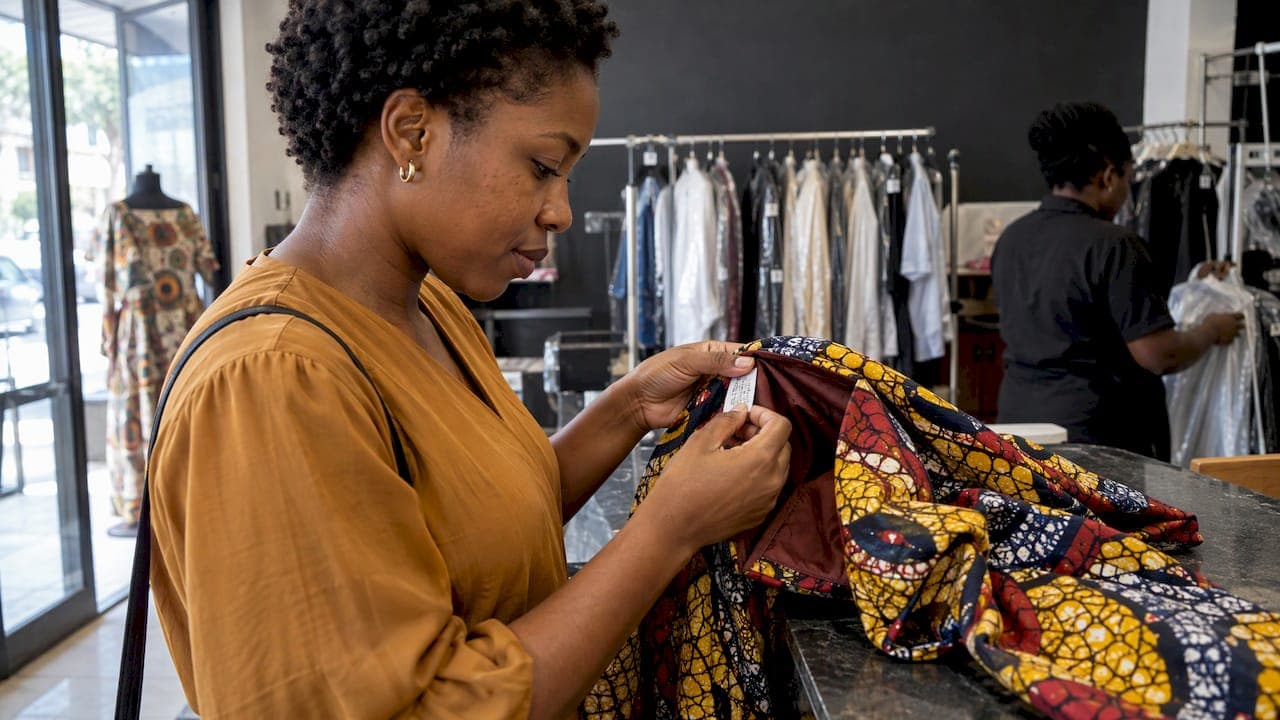
Yes, you can dry clean Ankara, and for some pieces you should. The right choice depends on the garment, not the fabric alone. A simple cotton wax print dress with a clear washing instruction can often be cleaned gently at home. A lined agbada, a structured jacket or anything with beading, embroidery or a stiff interior belongs with a professional cleaner. This guide shows you how to decide, how to wash Ankara without losing its color, and what to tell a U.S. dry cleaner before you hand your piece over.
A quick note on the search: "Ankara" also names the capital of Turkey, and many results for this phrase are dry cleaners in that city. Here, Ankara means the vibrant wax print fabric worn across West Africa and the diaspora. If you want the story behind it, our guide to what Ankara fabric is and where it comes from is a good companion.
TL;DR
- Read the care label first. Under U.S. rules, apparel must carry washing or dry-cleaning instructions, and they must have a reasonable basis.
- Choose dry cleaning for lined, embroidered, beaded, structured or multi-fabric pieces, and for anything labeled dry clean only.
- For simple washable pieces, wash cool, inside out, with similar colors, and dry in the shade.
- Point out every stain to your cleaner, and do not scrub or heat a stain you cannot identify.
- Iron on the reverse side and store your piece folded or hung in a breathable space, away from direct light.
Table of Contents
- Dry clean or wash at home: how to decide
- How to read your Ankara care label
- What to do before you visit a U.S. dry cleaner
- Washing Ankara at home without fading, bleeding or shrinking
- Drying, ironing and storing Ankara
- Removing stains from Ankara safely
- Our perspective: care is part of the craft
- Wear it, care for it, keep it for years
- FAQ
- Sources
Dry clean or wash at home: how to decide
The fastest way to decide is to ask three questions: what does the label say, what is the garment made of, and how is it built?
What the label says. The Federal Trade Commission's care labeling rule requires manufacturers and importers to provide regular care instructions, and the information needs a reasonable basis. In practice, that means your label is the starting point, and it was written by the people who know how the piece was constructed.
What it is made of. Traditional Ankara is a printed cotton, and cotton is generally sturdy. But many modern Ankara garments combine the print with linings, interfacing, lace, satin, embellishments or a second fabric. The most delicate part of the garment sets the rules for the whole piece.
How it is built. Tailored jackets, corseted bodices, structured peplums and heavily embroidered agbada robes hold their shape through internal layers. Water can shift or shrink those layers at different rates from the outer print. That is where professional cleaning earns its place.
| Garment type | Usual best method | Why |
|---|---|---|
| Unlined cotton wax print dress or skirt | Gentle hand wash or delicate cycle, if the label allows | Simple construction, single fabric |
| Matching top and trouser set, unlined | Gentle wash, or dry clean if the label says so | Check each piece, they may differ |
| Lined jacket or blazer | Dry clean | Lining and interfacing can shrink or pucker |
| Agbada robe with embroidery | Dry clean | Thread work, stiffness and layered pieces |
| Garment with beads, stones or special buttons | Dry clean | Trims can loosen or discolor |
| Headwraps and scarves | Hand wash, cool | Single layer, easy to rinse |
This table is our general guidance. Your label always comes first.
Why some labels say "dry clean only"
A label that says dry clean only does not always mean the fabric cannot touch water. The American Cleaning Institute explains that manufacturers often choose the label covering the worst-case scenario, including risks to trim or buttons, dye running or leftover shrinkage, even when the fabric itself might be washable.
For Ankara, that matters. Wax prints have deep, saturated colors, and a garment may include a trim or lining that reacts very differently from the print. Our advice is simple: if the label says dry clean only and the piece is one you treasure, follow the label. Do not test your luck on a wedding outfit or a handmade statement piece.

How to read your Ankara care label
The label can include words, symbols or both. U.S. rules allow the use of standard industry symbols, such as those under ASTM D5489, to communicate instructions, and those instructions need to match the manufacturer's evidence about what is safe for the garment, according to the FTC rule.
Here is what to look for:
- A tub symbol means washing is allowed. Dots or a number inside it point to the temperature, and a hand means hand wash.
- A circle is the dry cleaning symbol. A circle with a line through it means do not dry clean.
- Added warnings can be specific. Some labels include cautions such as "No steam," which is exactly the kind of detail to pass on to your cleaner.
- Separate labels may be sewn into the lining, the sleeves or the waistband of a set. Check every piece, because a matching set can carry different instructions on the top and the bottom.
If the label has faded, worn off or been cut out, treat the garment as delicate. When you are unsure, professional cleaning is the safest route, and the stain guide from Washington State University and its partner universities says the same for items marked non-washable or uncertain, noting that you should identify the specific stain to the cleaner.
For a deeper look at fabric-specific care across the continent's textiles, see our overview on how to care for African fabrics.
What to do before you visit a U.S. dry cleaner
A good cleaner can do wonderful work on Ankara, but only with good information. A few minutes of preparation protects your piece.
- Bring the label's message with you. Read it aloud or point to it. If it says "No steam," say so.
- Name the fabric. Tell them it is printed wax cotton, or whatever your piece is, and that the colors are saturated. Ask whether they would test for colorfastness on a hidden seam.
- Point out every stain. The university stain guide stresses that you should tell the dry cleaner what the stain is when you bring the item in. Food, wine, perfume, deodorant and oil all respond to different treatments.
- Mention trims. Beads, appliqué, metallic thread, heavy buttons and embroidery should be noted, so they can be protected or covered.
- Ask how they handle pressing. Heat and steam on a printed surface need care, and a cleaner who knows the garment is a wax print will press it from the reverse.
- Check the piece when you pick it up. Look at the color in daylight, the seams and the hem before you leave the counter.
A cleaner is a partner in the life of the garment. If a shop is unwilling to talk through your piece, find one that is.
Washing Ankara at home without fading, bleeding or shrinking
When the label allows washing, gentle habits keep the colors strong for years. This is the routine we recommend for washable pieces.
Sort by color, especially at first
The American Cleaning Institute notes that sorting by color is essential to prevent dye transfer, and that dark or vibrant prints are best washed separately from lighter items, particularly during the first few washes. Ankara is exactly that kind of fabric. Wash your new piece alone or with similar deep colors.
Our gentle wash routine
- Test first. Dampen a hidden spot, such as an inside hem, and press it with a white cloth. If color transfers, skip the machine and consider professional cleaning.
- Turn the garment inside out. This protects the printed surface from friction.
- Use cool water and a mild detergent. Avoid chlorine bleach and harsh optical brighteners, which can dull or alter color.
- Keep it short. Hand wash with gentle swishing, or use a delicate cycle in a mesh bag. Do not leave a vibrant print soaking for hours.
- Rinse until the water runs clear. Residual detergent can leave film and a faded look.
- Press out water, do not wring. Roll the piece in a clean towel to take off the excess.
If you are curious about the craft behind these colors and why they behave as they do, our piece on the origins of wax print dyeing tells that story.
Drying, ironing and storing Ankara
Most color loss and shape loss happens after the wash, so this part deserves attention.
Drying. Lay the garment flat on a clean towel or hang it on a padded hanger, in a shaded, ventilated spot. Direct sun is hard on saturated color, and high dryer heat can shrink cotton and stress seams. If you must use a dryer, we suggest the lowest setting and removal while the garment is still slightly damp.

Ironing. Turn the piece inside out and use a heat setting suited to cotton, working while the fabric is still slightly damp, or with a pressing cloth between the iron and the print. Never iron over beads or embroidery directly, and respect any "no steam" warning on your label. A shiny mark on the print usually means the iron was too hot or was used on the right side without a cloth.
Storing. Keep your piece clean before you store it, since lingering body oils and food residue can attract trouble over time. Fold unstructured garments with acid-free tissue between the layers, or hang structured ones on wide, padded hangers. Use a breathable cotton garment bag rather than plastic, and keep the closet away from direct light and damp. Give agbada robes and heavy pieces room, so the shoulders and folds are not crushed.
For more on keeping heritage garments looking their best across seasons, our cultural fashion preservation tips go deeper.
Removing stains from Ankara safely
Stains happen at weddings, dinners and celebrations, which is where many of our pieces are worn. Speed and restraint matter most.
- Blot, never rub. Rubbing pushes the stain into the fibers and can abrade the print.
- Identify the stain. The American Cleaning Institute points out that knowing what a stain is helps you treat it properly and makes you less likely to set it with the wrong approach.
- Follow the most sensitive fiber. For blends, the university stain guide recommends using the method suited to the most sensitive fiber in the fabric. A cotton print with a silk-like lining, for example, calls for the gentler path.
- Test any treatment on a hidden area. Wait for the spot to dry and check for color change before you treat the visible stain.
- Skip heat until the stain is gone. Hot water, dryers and irons can set many stains permanently.
- Know when to stop. If the stain is large, oily, of unknown origin or on a dry clean only piece, take the garment to a professional the same day, and tell them what happened.
Our dedicated guide to wax print stain care walks through specific scenarios in more detail.
Our perspective: care is part of the craft
Every Sena Nukunu piece begins with an artisan's hands, and we believe the story should not end when it leaves our hands. Ankara carries history in its color and pattern, and caring for it well is a way of honoring that legacy.
We make our pieces in limited quantities, with ethical production and real attention to craftsmanship. That is why we encourage you to treat the label as a conversation with the maker. When a piece is lined, structured or richly detailed, we would rather you trust a professional than risk the intricate work that went into it. When a piece is simple and washable, a gentle hand wash and a shaded dry will keep it vibrant.
The best care routine is one you will actually follow. Wash less often, spot treat with patience, store with respect, and your garment can serve you at weddings, celebrations, offices and family gatherings for years. A well-kept piece is not only beautiful, it is a statement of pride in the culture it comes from.
Sena
Wear it, care for it, keep it for years
Care is easier when a garment is made with care. Our collections bring together dresses, kaftans, agbada sets, jackets and matching sets, designed in limited quantities so each piece feels personal. Browse our collections to find your next statement piece, or explore women's styles and dresses if you are shopping for a celebration.
If you are choosing a piece for a wedding or milestone event, our guide to Ankara matching sets shows how to style them, and our look at signs of responsibly made fashion explains what to look for when you shop with intention.
FAQ
Can I dry clean Ankara fabric?
Yes, in most cases. Dry cleaning is a sound choice for lined, embroidered, beaded or structured Ankara pieces and for anything labeled dry clean only. Tell your cleaner it is a saturated wax print, mention any stains and share any warnings on the label, such as "No steam."
Does Ankara shrink or bleed in the wash?
It can, especially in the first few washes, because the colors are deep and cotton can shrink with heat. Wash a new piece alone in cool water, and test a hidden spot for color transfer before you wash it. Skip high-heat drying.
How often should I clean my Ankara outfit?
Less often than everyday clothing. Air the garment after wearing, spot treat small marks and clean the whole piece when it is truly soiled. Fewer cleanings protect the color, the seams and any trims.
Can I iron Ankara?
Yes. Iron it inside out at a heat suited to cotton, or use a pressing cloth, and keep the iron away from beads and embroidery. Always follow any steam warning on your care label.
What if my Ankara garment has no care label?
Treat it as delicate. Test for colorfastness, wash by hand in cool water if the garment is simple and unlined, and take anything lined, embellished or valuable to a professional cleaner, telling them what you know about the fabric.
Sources
- Care Labeling of Textile Wearing Apparel and Certain Piece Goods, Federal Trade Commission
- Ask ACI: When Clothes Are Really Dry Clean Only, American Cleaning Institute
- Laundry Basics, American Cleaning Institute
- Stain Removal Guide for Washable Fabrics, Pacific Northwest Extension