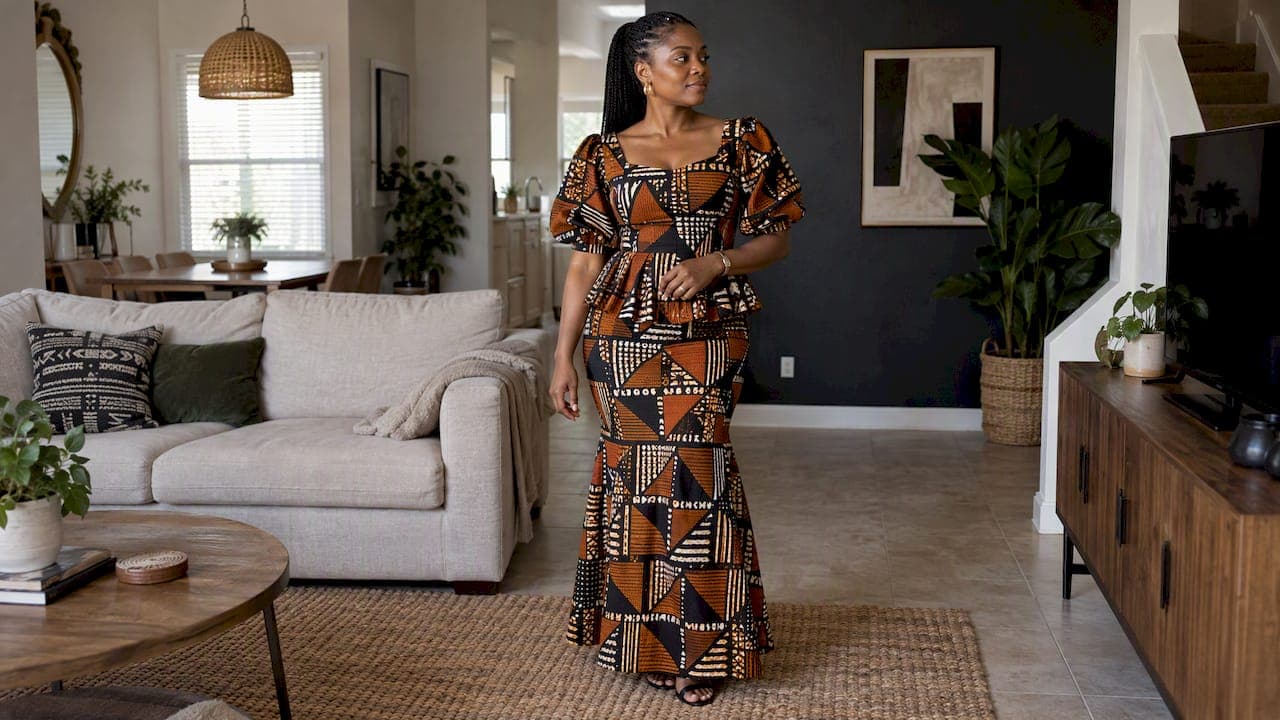
An Ankara skirt and blouse is one of the most versatile ways to wear West African wax print: two pieces cut from the same cloth, or from prints chosen to speak to each other, that can move from a Sunday service to a wedding to a Monday meeting. The best set is made from real cotton wax print, cut to your measurements, and styled with one clear focal point. Below, we walk you through the fabric, the silhouettes, the fit, the styling and the questions to ask before you buy.
TL;DR
- Look for soft, double-sided cotton wax print with consistent color on both faces. Stiff, synthetic-feeling cloth drapes poorly and is harder to tailor.
- Measure your bust, waist and hips with a soft tape. Ankara rarely stretches, and a tailor can take a garment in far more easily than let it out.
- For the office, keep the print in one place and everything else solid. For weddings and celebrations, let the full set shine.
- Choose named certifications and clear labels over vague "eco-friendly" claims, and ask who made the garment.
Table of Contents
- Why the skirt and blouse set endures
- Know your cloth before you choose the cut
- Silhouettes that define a modern skirt and blouse
- Getting the fit right when you order online
- How to style an Ankara skirt and blouse
- Our perspective: a set should be worn, not just admired
- Ethical and sustainable: how to read the claims
- Care: keeping the color alive
- Shop the look with Sena Nukunu
- Before you buy: a short checklist
- FAQ
- Sources
Why the skirt and blouse set endures
The two-piece set is a staple of West African wardrobes. Ankara is worn daily in Nigeria, Ghana, Senegal, the Ivory Coast and across the region, in skirts, blouses, dresses, headwraps and matching sets that shift from practical to ceremonial. A skirt and blouse is the simplest version of that idea. You can wear the pieces together for impact, or separate them and discover that each one works with the rest of your closet.
There is a deeper layer, too. In the aso-ebi tradition, families and friends wear coordinated fabrics at weddings and ceremonies to show solidarity and belonging. A skirt and blouse in a shared cloth is often how that coordination looks in practice. When you choose a set, you are choosing a piece of a living language, not only a pattern you like.
Know your cloth before you choose the cut
Ankara is also called African wax print or Dutch wax print, and its history is complicated. According to the V&A, it was developed by European manufacturers to imitate Indonesian batik and was then embraced and reclaimed by West African communities as a vehicle for identity and pride. That reclamation is why the cloth carries so much meaning today. If you want the full story, our guide to what Ankara fabric is, with its origins and quality markers goes deeper.
Quick quality checks
When a set arrives, or when you are looking at photos and descriptions, check these things:
- Both sides of the cloth. Authentic wax print is traditionally printed so the color is consistent on the front and the back. A pale reverse is a warning sign.
- Small imperfections. Slight misalignments or tiny bubbles are part of the resin-resist technique that hand-made batik inspired. Perfect digital uniformity can point to a cheaper "fancy print."
- Hand feel. Good cotton wax print is soft and yields under a hot iron. Stiff, synthetic-heavy imitations are harder to sew and hang badly.
- Selvage and fiber content. Our checklist of five checks to verify authentic wax print covers selvage, double-sidedness and cotton in more detail.
Cotton also matters for comfort. A cotton skirt and blouse breathes in a Florida summer and holds a crisp shape in a cooler office. A synthetic blend may look similar in a photo and feel very different after four hours.
Silhouettes that define a modern skirt and blouse
What shapes the look is the cut. Trend reporting for 2026 shows corsetry, sheer panels and sculpted hemlines taking over from stiff, floor-length designs, with lace and aso-oke fusions added to ceremonial and wedding guest pieces for depth and texture. Here are the shapes you will meet most often.
| Silhouette | What it looks like | Best for |
|---|---|---|
| Flared or pleated skirt with fitted blouse | Movement at the hem, a defined waist | Weddings, church, dinners |
| Pencil or straight skirt with structured top | Clean, close line | Workdays, presentations |
| Peplum blouse with long skirt | Flare at the waist, elongated lower half | Celebrations, photos |
| Puff-sleeve blouse with wide-leg pants or skirt | Volume on top, ease below | Everyday statement wear |
| Corset-inspired top with sculpted hem | Architectural, modern | Evening events, guest attire |
Matching the print to the shape
A useful principle is the print-to-silhouette ratio. Complex prints call for simple, structured silhouettes, while architectural cuts can carry simpler patterns. A dense, multi-color geometric print on a plain A-line skirt looks confident. The same print on a ruffled peplum with a tiered skirt can overwhelm the eye. When in doubt, let either the cloth or the cut lead, never both at full volume.

Getting the fit right when you order online
Online shopping is where most disappointment with Ankara happens, and it is almost always about fit. Non-stretch cotton has no forgiveness. Follow these steps before you order.
- Use a soft tape. A soft tailor's tape is the most accurate tool for measuring yourself at home.
- Measure bust, waist and hips while wearing the fitted undergarments you plan to wear with the outfit.
- Compare against garment measurements, not only body measurements. Vendors differ on which they publish. Some size charts, such as this garment measuring guide, explain how bust is measured straight across and doubled, which shows why two charts can disagree.
- If you fall between sizes, size up. Ankara is much easier for a tailor to take in than to let out.
- Plan for a tailor. A skirt hem, a blouse sleeve length or a waistband adjustment often turns a good set into a perfect one.
For a blouse, pay attention to the shoulder seam and the bust, which are hard to alter. For a skirt, the waist and hips matter most, and length is the easiest thing to change.
How to style an Ankara skirt and blouse
The simplest rule comes from stylists who work with the cloth: one print per outfit, everything else solid. Ankara already does a great deal of visual work, so the supporting pieces should be quiet. Our own tips for styling Ankara outfits with confidence build on the same idea.
For the office
At work, concentrate the Ankara in one element, such as a pencil skirt, and pair it with solid neutral tailoring. Guidance on professional styling notes that mixing bold prints in high-contrast professional settings can shift an outfit from professional to ceremonial. So wear the skirt with a plain ivory or navy blouse, add a blazer, and keep accessories minimal. Save the full matching set for the celebration.
For weddings and celebrations
Here the full set belongs. A flared skirt with a fitted or peplum blouse, a statement headwrap or gele, and gold or beaded jewelry make a complete look. If you are attending as family or friends of the couple, ask whether an aso-ebi color has been chosen so you can coordinate. Our guide on what to wear as a West African wedding guest covers etiquette, and our piece on planning aso oke outfits with lead times helps if you are building a more traditional ensemble.
For everyday wear
Mix and match. The 2026 styling trend is toward mix-and-match prints and detachable elements that give several outfits from one set. Try the blouse with jeans or white trousers, and the skirt with a fitted tee and denim jacket. If you want to see how this plays out for American wardrobes, read about three ways U.S. shoppers wear Ankara in 2026.
Our perspective: a set should be worn, not just admired
At Sena Nukunu, we believe a skirt and blouse should feel like a crown you can wear on an ordinary Tuesday. Every piece we offer is rooted in West African heritage, made with ethical manufacturing and artisanal craftsmanship, and produced in limited quantities, so what you wear is not what everyone else is wearing.
We started from a simple conviction: that culturally rich clothing should be made with care for the people who make it, and should serve the people who wear it. That is why we care about how a garment drapes, how it is finished, and the story behind its print. A beautiful Ankara set can carry confidence into a boardroom, a church, a wedding or a family gathering, and it should do so for years, not a season.
If you take one thing from us, let it be this: buy fewer pieces, choose them with intention, and wear them often. Heritage clothing earns its meaning through use.
— Sena
Ethical and sustainable: how to read the claims
For many shoppers, a skirt and blouse is also a values decision. The vocabulary can be confusing, so here is what to look for.
- Named certifications over vague words. GOTS and OEKO-TEX are not interchangeable: GOTS covers organic fiber sourcing and labor and environmental compliance across the manufacturing chain, while OEKO-TEX Standard 100 mainly tests finished products for harmful chemical residues. A seller who names a specific standard is giving you something you can verify.
- Clear labels. Under U.S. rules, apparel must carry permanent labels showing fiber content, country of origin and manufacturer identification, and garments meant to be laundered need care instructions. Check the label when your set arrives.
- A real answer on who made it. Ethical production means a seller can tell you where and how a piece was made, and what it does for artisans.
The same habit of asking for proof works well beyond clothing, as a look at life cycle tested eco-friendly products shows for other categories: specifics beat slogans.
Care: keeping the color alive
The care label is not decoration. Care labels exist so that you know at least one safe cleaning method, which matters for wax prints. As a general approach, wash cool, turn the garment inside out, wash dark and bright colors apart from lighter clothing for the first few washes, and iron on the reverse side. Follow the label first, and ask the seller if anything is unclear. Our guide to buying, caring for and sewing authentic wax print fabric goes into more detail.

Shop the look with Sena Nukunu
If you are ready to wear Ankara with intention, explore our Women's Collections and curated lines, including Woven Stride: Queen In Comfort, Woven Shields: Queens in Motion, Woven Radiance: Queens in Bloom and Woven Crowns: Radiant Rise. Our pieces are ready to ship, made in limited quantities, and inspired by West African heritage. For matching statement sets, our guide to limited run Ankara matching sets with styling recipes shows how to wear them. You can also start from our home page to see what is new.
Before you buy: a short checklist
- Is the fabric described as cotton wax print, with a soft feel and double-sided color?
- Do the size chart and garment measurements match your own tape measurements?
- Can the seller explain how and by whom the piece was made?
- Does the print suit the silhouette, with one clear focal point?
- Do you know where you will wear it first, and what you will pair it with?
If you can answer yes to all five, you are buying well. For a wider view of cuts beyond skirts and blouses, see our modern Ankara dress styles, and for the origins of the cloth, our look at four provenance tests for Ankara fabric.
FAQ
What is an Ankara skirt and blouse set?
It is a two-piece outfit made from Ankara, also called African wax print, in matching or complementary prints. Common versions pair a flared, pleated or pencil skirt with a fitted, puff-sleeve or peplum blouse. The pieces can be worn together or separately.
Can I wear an Ankara skirt and blouse to work?
Yes, with restraint. Put the print in one piece, such as the skirt, and pair it with a solid neutral blouse and tailored layer. Wearing the full bold set in a conservative office can read as ceremonial, so save that for celebrations.
How do I know what size to order?
Measure your bust, waist and hips with a soft tape and compare them with the seller's size chart. Ankara is usually non-stretch cotton, so if you are between sizes, choose the larger one. A tailor can take a garment in more easily than let it out.
How can I tell if the fabric is real wax print?
Check that the color is consistent on both sides, that the cloth is soft cotton rather than stiff and synthetic, and that any tiny imperfections look like part of the printing process. Our five-check guide to authentic wax print walks through each step.
Is Ankara appropriate for a wedding guest?
Yes, and it is often expected at West African weddings. Check whether the couple has chosen an aso-ebi color, and consider lace or aso-oke details for a ceremonial finish.
Sources
- How to Style Ankara Without Looking Like a Costume, OMIREN STYLES
- Ankara and African Prints: The Politics of West African Women's Wardrobes, OMIREN STYLES
- Africa fashion: cloth of a continent, V&A
- 2026 Ankara fashion styles, Fashion Police Nigeria
- How to Measure Yourself Accurately for the Perfect Fit, Good Housekeeping
- Customer Support: Fashion, YesStyle
- US Clothing Label Requirements: FTC Rules 2026
- Complete guide to understanding textile certifications
- Eco-friendly products, life cycle tested