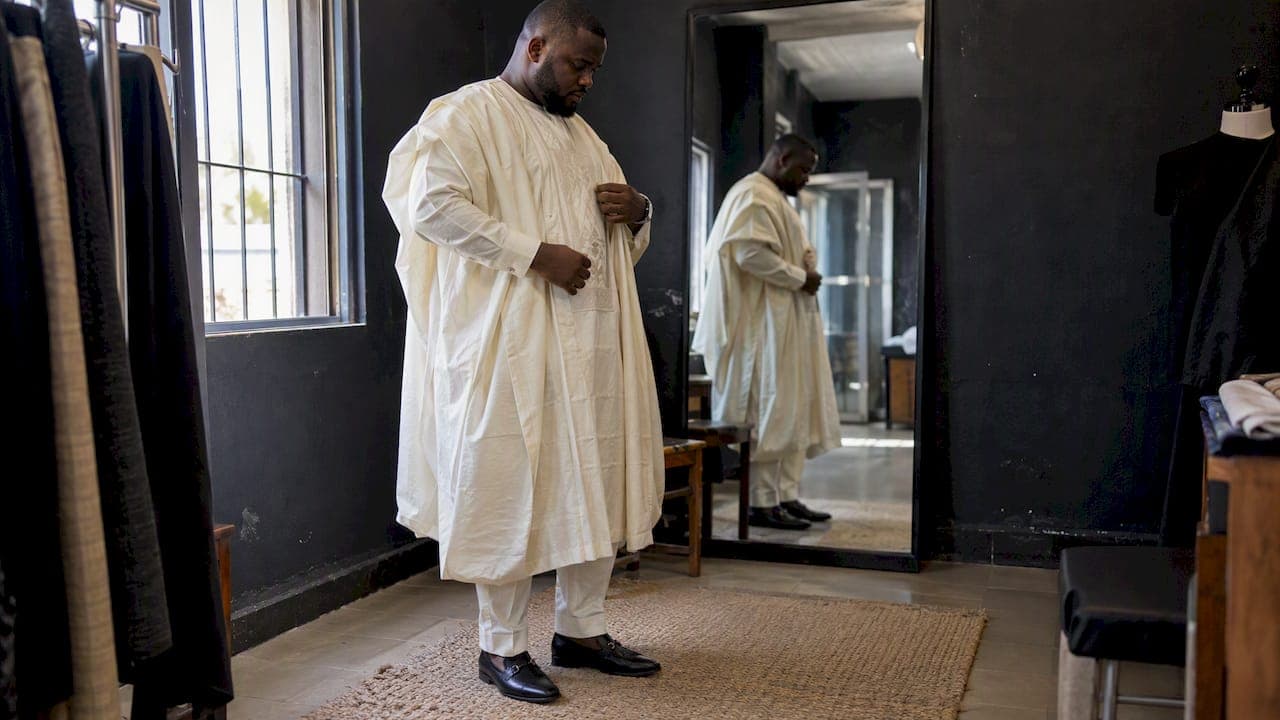
The best fabric for an agbada depends on where you will wear it and what you want it to say. Aso oke and rich brocade carry ceremony and legacy, cotton and linen keep you comfortable in warm rooms, and silk-like finishes bring a soft, polished drape. Below, we walk you through each cloth, how it behaves, how to care for it, and how an agbada compares with a kaftan or a senator set.
TL;DR
- Aso oke is the most valued cloth for ceremonial agbada. Brocade, damask and velvet joined it in the twentieth century.
- Cotton and linen breathe best for warm weather. Linen wrinkles easily, and cotton can shrink or stretch with humidity.
- Match the fabric to the embroidery. Heavy stitching needs a cloth with enough structure to hold it.
- An agbada is a layered robe worn over a top and trousers. A kaftan and a senator set are simpler, one-layer looks.
- Brocade is usually dry-cleaned. Plain cotton can be washed gently, inside out, and dried in shade.
Table of Contents
- Why fabric decides everything in an agbada
- The traditional cloths: aso oke and its heirs
- Everyday fabrics: cotton, linen, wool and silk
- Fabric and embroidery have to be chosen together
- How to care for an agbada by fabric
- What to look for in a men's agbada set
- Agbada vs. kaftan vs. senator style
- Our perspective
- Find your agbada at Senanukunu
- Frequently asked questions
- Sources
Why fabric decides everything in an agbada
An agbada is not a single garment. It is a flowing robe traditionally worn by Yoruba men across West Africa, layered over an inner top and native trousers called shokoto, and often finished with a cap such as the fila, as described in this overview of the garment. Because the robe is wide and falls from the shoulders, the fabric does three jobs at once: it sets the silhouette, it carries the embroidery, and it decides how you feel after four hours at a wedding.
A stiff cloth makes the sleeves stand out like wings. A soft cloth falls in long, quiet folds. A heavy cloth keeps its shape but can feel warm in a crowded hall. That is why we encourage you to choose the fabric before you fall in love with a color or an embroidery pattern.
The traditional cloths: aso oke and its heirs
Aso ofi, also known as aso oke, is the most valued fabric for ceremonial agbada, according to an encyclopedia entry on the garment. The same entry notes that since the beginning of the twentieth century, brocade, damask and velvet have also been used. In other words, the agbada has always absorbed new cloth while holding on to its meaning.
The weight of that tradition is real. A museum record describes the agbada as a hand-woven and embroidered, loose-fitting robe worn by Nigerian elites, and notes that fine old robes became family heirlooms, worn with pride at major celebrations such as weddings and funerals. When you choose a cloth for an agbada, you are choosing something that can be photographed, remembered and, one day, passed on.
Aso oke
Aso oke is a hand-loomed cloth, woven in strips that are joined together. It has body, a slightly textured surface and a presence that photographs beautifully. It is the natural choice for a groom, an elder or a family head at a naming ceremony, wedding or milestone celebration.

The trade-off is warmth and weight. If your event is in a heated hall in January, aso oke is a joy. If it is an outdoor August celebration in Florida or Texas, you may prefer a lighter robe over a breathable inner layer. Our guide to planning aso oke outfits with yardage and lead times covers how much cloth to plan for and how early to order.
Brocade
Brocade has a woven-in pattern and a firm hand, which makes it a favorite for agbada that need to look regal without extra decoration. It holds a sharp shape, takes embroidery at the neckline and cuffs well, and reads as formal across every community. It is also a cloth to treat with respect: brocade is generally dry-cleaned, not tossed in the washing machine.
Damask and velvet
Damask is a woven cloth with a subtle self-pattern that shifts with the light. It brings quiet richness, a good choice if you want an agbada that looks understated in daylight and glowing in the evening. Velvet is the boldest of the group: deep, warm and dramatic. Reserve it for cool-weather ceremonies, and expect it to command the room.

Everyday fabrics: cotton, linen, wool and silk
Not every agbada is a once-in-a-lifetime robe. Many men want a set they can wear to a church service, a graduation, a cultural gala or a business dinner. Here, familiar fibers matter, and their care needs differ.
| Fabric | How it feels and drapes | Comfort | Care notes | Best for |
|---|---|---|---|---|
| Cotton | Soft, absorbent, relaxed fall | Breathes well | Can shrink or stretch with humidity and wrinkles | Warm-weather events, daytime ceremonies |
| Linen | Crisp at first, softer with every wash | Highly breathable | Wrinkles easily and has poor elasticity | Summer weddings, relaxed celebrations |
| Wool | Shape-retaining, naturally elastic | Insulating | Hand-wash or use a wool cycle, dry flat | Cold-weather events, winter weddings |
| Silk | Fluid, polished drape | Light, smooth | Professional dry cleaning recommended | Evening events, special occasions |
| Brocade, damask, velvet | Structured, rich, formal | Warmer, heavier | Generally dry-clean | Weddings, titles, major ceremonies |
The fiber details above come from two sources. A fashion school's textile overview explains that linen is highly breathable and becomes softer with washing, though it wrinkles easily, while wool is insulating, naturally elastic and shape-retaining, and should be hand-washed or washed on a wool cycle and laid flat to dry. A textile reference guide adds that linen is one of the strongest natural fibers but has poor elasticity, and that silk is durable and best handled by a professional dry cleaner. Another guide to native wear fabrics notes that linen and cotton are absorbent and can shrink or stretch with humidity.
Which one should you pick?
Start with the season and the room, then the occasion:
- Warm climate or outdoor event: cotton or linen, with the robe cut generously so air moves under the sleeves.
- Cool or indoor event: wool, brocade, damask or velvet, where the extra body adds presence.
- Evening ceremony: silk-like finishes or damask, which catch the light.
- Heritage moment, such as a wedding or title: aso oke or a rich brocade, because the cloth itself tells the story.
Fabric and embroidery have to be chosen together
Embroidery is the signature detail of the agbada, and it behaves differently on every cloth. One native wear guide points out that brocade, lace and aso oke each react differently under a needle, so designs and settings should be tested on each cloth. The practical lesson for a buyer is simple: dense, heavy stitching needs a cloth with structure, while a delicate fabric looks best with lighter, more open patterns.
Here is what we look for when we judge a set:
- Flat, even stitching with no puckering around the neckline or cuffs.
- Balanced weight, so the embroidery does not drag the cloth downward.
- Clean backing on the reverse, which also makes pressing easier.
- Placement that follows the robe, with the neckline, chest and sleeve edges framed rather than crowded.
How to care for an agbada by fabric
Good care is what turns a robe into a keepsake. One care guide for embroidered sets suggests that brocade be dry-cleaned, while plain cotton can be washed inside out on a gentle cycle, dried in shade and pressed from the reverse so the embroidery stays raised. Always check the care label on your own garment first, since dyes, trims and linings vary.
A few habits protect any agbada:
- Hang the robe on a wide, padded hanger so the shoulders keep their shape.
- Store the matching top and trousers with it, so the set ages evenly.
- Keep it out of direct sun, which can fade rich colors over time.
- Press embroidery from the back, never directly on top of the stitching.
- Let a professional handle silk and heavily embellished robes.
Fit matters as much as fabric. Even the finest cloth hangs badly on a poorly sized robe, so read our three measurements that decide agbada size before you order, and our note on the shoulder seam and how to wear an agbada for the finishing touches.
What to look for in a men's agbada set
When you compare sets online, the photos can hide as much as they show. These are the checks we suggest:
- Fabric description. Look for a clear name for the cloth, not just a color and a pattern.
- Number of pieces. Many sets include the outer robe, the inner top, the trousers and a cap. Our piece on the four-piece agbada explains how to spot fabric, fit and cap quality.
- Sleeve and length proportions. The robe should fall cleanly, with sleeves wide enough to drape but not overwhelm your frame.
- Embroidery quality. Even stitches, tidy edges and a pattern that suits the cloth.
- Occasion fit. A wedding robe and an office-event robe are not the same. Browse 12 men's agbada looks for U.S. buyers for ideas by setting.
Agbada vs. kaftan vs. senator style
These three are often mixed up, so here is a simple way to tell them apart.
| Agbada | Kaftan | Senator style | |
|---|---|---|---|
| Structure | Wide, flowing outer robe worn over an inner top and trousers | A single long tunic or loose garment | A tailored tunic-style top with matching trousers |
| Layers | Multiple, usually three or four pieces | One | Two pieces |
| Formality | Highest, for weddings, titles and major celebrations | Relaxed to dressy | Smart, suited to church, work events and gatherings |
| Fabric choices | Aso oke, brocade, damask, velvet, cotton, linen | Cotton, linen, silk-like fabrics | Plain or textured cloth, often in solid colors |
| Comfort in heat | Depends on the cloth and layers | Easy and airy | Moderate |
Think of it as a ladder of ceremony. The senator set is polished and practical, the kaftan is easy and elegant, and the agbada is the full statement. If you are not sure which fits your event, ask what the other men in your family or wedding party will wear, then match or complement that level of formality.
Our perspective
We believe an agbada should feel like a legacy you can wear. That begins with cloth. When we think about every piece, we think about the hands that shaped it, the weaving traditions behind it and the person who will step into a room wearing it.
Our approach is to pair authentic West African heritage with ethical production and limited-quantity craftsmanship. A robe made in small numbers, with care for its fabric and its embroidery, simply carries itself differently. It drapes with intention, and it tells a story before you say a word.
That is why we encourage you to treat fabric as the foundation, not an afterthought. Choose the cloth that suits your climate, your occasion and your sense of self, then let the embroidery and the cut do the rest. Wear it with pride, because every stitch carries the spirit of a culture that has always dressed with purpose.
Sena
Find your agbada at Senanukunu
If you are ready to see these ideas in real garments, explore our Men's Agbada Ensembles and Heritage pieces. Each is made in limited quantities with ethical production and artisanal craftsmanship, and designed to blend traditional artistry with modern fashion.
You can also browse our full collections, including Woven Nobility: Kings' Robe, for statement pieces that honor West African heritage. Planning for a wedding or a family celebration? Our guide on what to wear as a West African wedding guest can help you coordinate.
Frequently asked questions
What is the best fabric for an agbada?
For ceremony and heritage, aso oke is the most valued cloth, with brocade and damask close behind. For comfort in warm weather, cotton or linen is easier to wear for long hours. The right choice depends on the season, the venue and how formal the occasion is.
Is linen a good choice for agbada?
Yes, especially for warm-weather events, because linen is highly breathable and softens with washing. It does wrinkle easily, so many people embrace a relaxed, lived-in look or press it just before the event. Choose a generous cut so the fabric can move freely.
How do I wash an embroidered agbada?
Always follow the care label first. As a general rule, brocade and silk are dry-cleaned, while plain cotton can be washed gently inside out and dried in shade. Press the embroidery from the reverse side so the stitching stays raised.
Can a woman wear an agbada?
Yes. Many women wear agbada-inspired looks, and tailoring is the key to a flattering fit. Our article on tailoring fixes for women's agbada shares practical ideas.
Sources
- Agbada, overview of the garment
- Agbada, Encyclopedia.com
- Agbada (man's robe), The Met Museum collection
- 10 Types of Fabric and Textiles, Miami School of Fashion
- Textile Reference Guide, Maxwell Fabrics
- Digitizing Native Wear: Agbada and Kaftan
- Men's Boubou and Agbada Guide