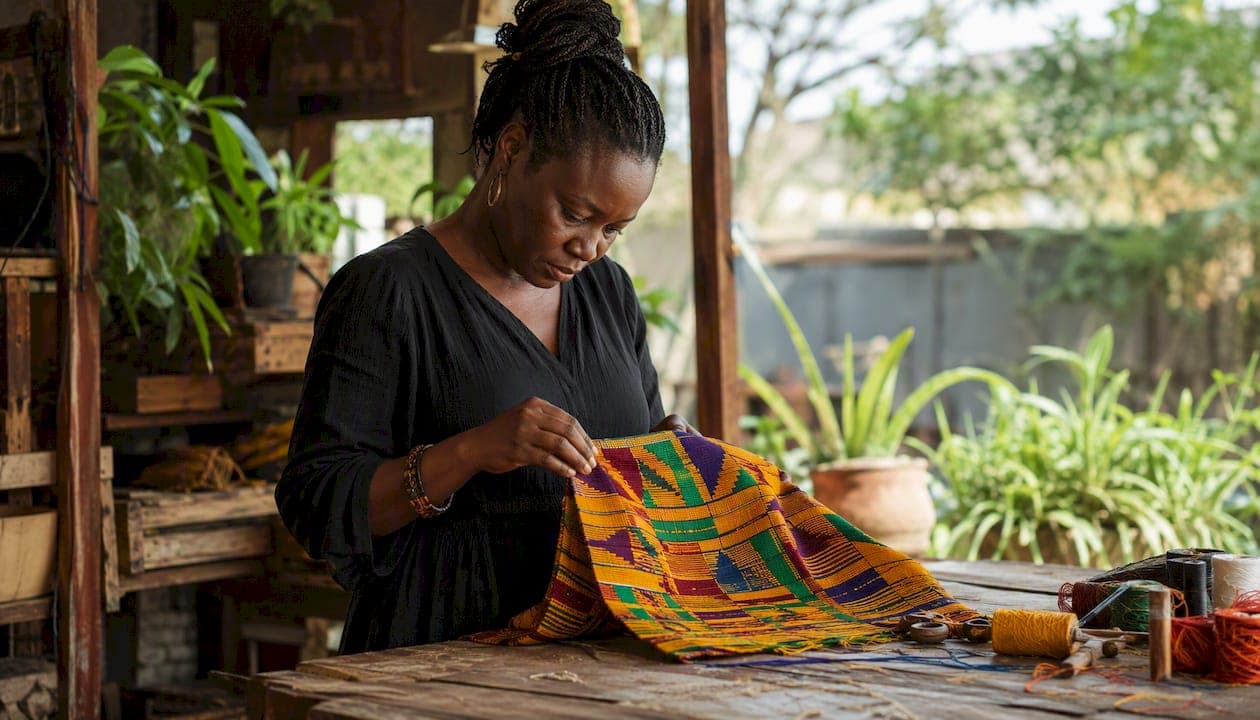
TL;DR:
- Authentic West African textiles are characterized by narrow-strip weaving, resist-dye irregularities, and labor-intensive production that mass manufacturing cannot replicate. Supporting artisans involves asking questions about loom type, dye methods, and garment assembly, ensuring ethical purchase choices. Wearing these textiles highlights their cultural significance and craftsmanship, and recognizing authentic techniques helps preserve these living traditions.
The core West African textile and garment-making techniques every ethical buyer should know are: Kente (narrow-strip silk or cotton weaving from Ghana), Aso Òkè (Yoruba strip-woven ceremonial cloth), strip-weaving and hand-assembly (the foundational narrow-band loom method behind both), Adire Oniko (raffia-tied resist dyeing), Adire Eleko (cassava-paste resist), batik adaptations (wax-resist on cotton), bogolanfini/mud cloth (Mali's iron-mud discharge dyeing), indigo dyeing (repeated dip-and-oxidize cycles for deep blue tones), ikat-style resist (yarn-dyed before weaving), hand-loom weaving (the broad category covering horizontal narrow-strip looms), hand-embroidery and tailoring (needle-worked surface decoration and hand-stitched finishing). Each technique carries a distinct visual signature, a specific set of raw materials, and a production pace that mass manufacturing simply cannot replicate.
For U.S. shoppers, the guiding principle is this: authentic artisan-made West African garments show their labor. Irregular dye edges, narrow seam lines, and subtle tonal variation are not flaws; they are proof.
Table of Contents
- What each technique is and how it's made
- How to spot authentic artisan work on a finished garment
- Why artisan-made pieces are worth the investment
- How to buy ethically and support artisans
- How to wear West African artisan textiles in a modern wardrobe
- Why trust this guide — Sena Nukunu's sourcing and expertise
- Key Takeaways
- Why these techniques matter more than ever
- Senanukunu — authentic West African ready-to-wear, curated for you
- Useful sources and further reading
What each technique is and how it's made
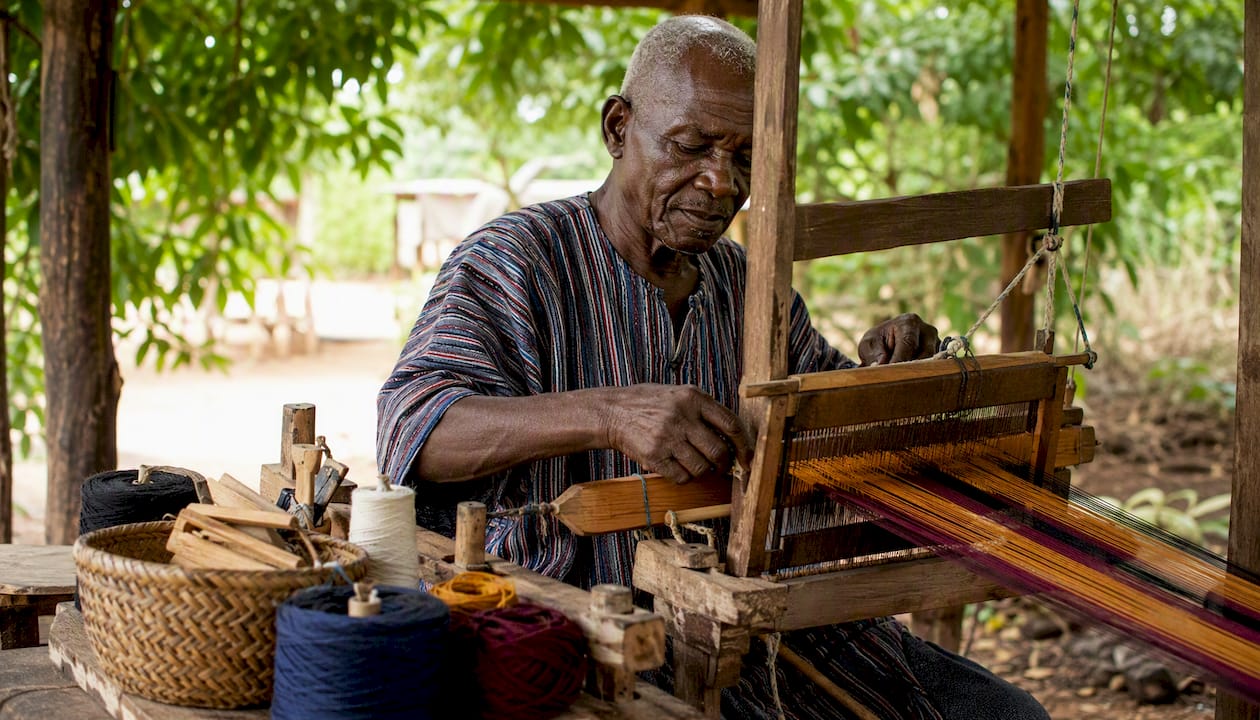
Strip-weaving is the structural backbone of West African textile tradition, documented as far back as the 11th century at the Bandiagara Escarpment in Mali. Weavers work on horizontal narrow-strip looms, producing bands roughly 4 inches wide, then hand-sew those strips side by side into a full-length cloth.
| Technique | Typical strip or unit width | Key material | Production pace |
|---|---|---|---|
| Kente | approximately four inches per strip | Silk, cotton, or rayon | about five yards per three-week period in traditional domestic weaving settings |
| Aso Òkè | approximately four inches per strip | Cotton, aso-oke thread | Labor-intensive; pre-weaving prep adds days |
| Adire Eleko | Full cloth width | Hand-spun cotton, cassava paste | many indigo dips to reach deep blue-black tones |
| Bogolanfini | Full cloth width | Hand-spun cotton, iron-rich mud | Multi-stage discharge process |
Kente, woven by the Asante and Ewe peoples of Ghana and Togo, uses high-intensity reds, blues, yellows, and greens in warp-faced strips with weft-float sections. The finished cloth is a composition of many strips, not a single woven panel.
Aso Òkè production begins long before the loom: cotton ginning, hand-spinning, and loom setup are all part of the labor-intensive process that ethnographers frame as the reason these textiles function as heirloom investments.
Adire is Yoruba resist-dyeing in three main forms. Adire Oniko uses raffia or thread to tie sections of cloth before dyeing. Adire Eleko applies cassava-starch paste by hand to block the dye. Both are then submerged in indigo vats, where the dip-and-oxidize cycle repeats many repeated times for deep blue-black tones. The fabric darkens not in the vat but in the air, as indigo oxidizes on contact with oxygen.
Bogolanfini (mud cloth) begins as yellow-dyed cotton, painted with iron-rich mud that reacts with tannins to form dark patterns. Excess mud is removed, and the background may be bleached back to reveal the design in reverse. The layered application leaves a subtle surface texture no screen print can mimic.
Pro Tip: Mass-produced "African wax print" (Ankara) is factory-printed, not hand-resist-dyed. The V&A's textile research notes that factory substitutions are widespread; if the dye edges are perfectly uniform on both sides of the cloth, you are almost certainly looking at a machine print.
How to spot authentic artisan work on a finished garment
Art historians confirm that many apparently single-piece West African cloths are masterful compositions of narrow strips, and seam alignment is the clearest quality indicator a buyer can check without handling the cloth in person.
Visual and construction checklist:
- Seam lines: Look for evenly spaced, parallel seam lines running the length of the garment, spaced roughly 4 inches apart on Kente or Aso Òkè pieces.
- Pattern continuity: Motifs should align or deliberately offset across strip seams. Rushed manufacturing skips this matching entirely.
- Dye edges: On Adire and indigo-dyed pieces, resist edges are slightly soft and irregular. Machine prints have crisp, identical repeats.
- Tonal layering: Repeated indigo dipping creates subtle depth, darker in some areas than others. Uniform flat blue signals a single machine-dye bath.
- Mud-cloth texture: Authentic bogolanfini has a faint raised texture where mud was applied; the pattern feels slightly different from the background.
- Hand-stitched hems: Interior seams on artisan-made ready-to-wear often show hand-finishing rather than serged edges.
Photo-request template for online shopping:
Pro Tip: Pattern continuity at strip seams is the single strongest signal of careful hand assembly. If the motif flows uninterrupted across a seam, a skilled artisan planned and executed that join deliberately.
Why artisan-made pieces are worth the investment
Hand-prepared cloth takes time at every stage: cotton ginning and spinning before the loom, repeated indigo dips before cutting, careful strip-matching before sewing. That accumulated labor produces a garment with structural integrity that fast-fashion construction cannot match. The Aso Òkè research from Iseyin explicitly frames these textiles as investments because of the durability that intensive pre-weaving work produces.
Production pace: Traditional narrow-strip weaving in domestic settings produces cloth at a slow pace over several weeks. A single dress may represent weeks of weaving alone, before tailoring begins.
Basic care rules:
- Hand-wash in cold water with a pH-neutral soap; never machine-wash strip-sewn pieces on a hot cycle.
- Air-dry flat, away from direct sunlight, which fades natural indigo faster than synthetic dyes.
- Store folded, not hung, to prevent strip seams from stretching under the garment's own weight.
- For indigo-dyed pieces, expect some initial color transfer; wash separately the first two times.
- Re-dyeing faded indigo pieces is possible with natural indigo kits, and it deepens rather than masks the cloth's history.
Understanding why handmade fashion holds its value over years of wear comes down to that labor density. Choosing investment pieces from quality fabric sources also helps you recognize what genuine hand-prepared cloth feels like against machine-finished alternatives.
Pro Tip: Re-seam narrow strips at the first sign of thread wear, before the seam opens. A tailor familiar with strip-sewn construction can reinforce the join in under an hour, extending the garment's life by years.
How to buy ethically and support artisans
The difference between buying artisan-made and buying artisan-inspired comes down to the questions you ask before checkout. These are the best artisan practices for vetting a seller:
- Ask about the loom type: Narrow horizontal strip loom (authentic) vs. wide industrial loom (mass production).
- Confirm the dye method: Hand-paste resist, tied resist, or natural indigo vat (authentic) vs. screen print or digital print.
- Ask where sewing occurred: Garments assembled in the same community as the weaving are more likely to support the full artisan supply chain.
- Request studio photos: A seller with nothing to hide will share images of the weaving or dyeing space.
- Check pricing: Authentic artisan pieces cost more because they take longer. A Kente-panel dress priced at fast-fashion rates is almost certainly not hand-woven.
- Watch for "inspired by" language: This often signals machine-printed fabric styled to look traditional.
Buyer questions to copy:
For U.S. buyers, factor in shipping and potential import duties when comparing prices. A slightly higher landed cost from a verified artisan source is still a better value than a cheaper piece that funds mass production. Small initial orders build trust with sellers and open the door to direct relationships, custom sizing, and future pre-orders that support artisans before production begins.
Pro Tip: Starting with a single statement piece, rather than a full outfit, lets you evaluate a seller's quality and communication before committing to a larger order.
How to wear West African artisan textiles in a modern wardrobe
A Kente-panel jacket worn over a cream linen shirt and tailored trousers reads as elevated daywear without requiring any other artisan piece in the outfit. The panel does the work; everything else stays neutral.
For celebration wear, an Aso Òkè matching set, a cropped top and wide-leg trouser in the same strip-woven cloth, carries its own formality. Pair it with simple gold jewelry and let the textile's geometric structure be the focal point.
Adire wrap skirts work beautifully in elevated casual contexts. The resist-dye pattern has enough visual movement that a plain white fitted top is all the balance it needs. Avoid pairing two busy artisan patterns in the same outfit unless the color palettes are closely related; the goal is harmony, not competition.
For West African styles suited to U.S. wardrobes, the principle is the same: let the artisan textile lead, and let everything else support it.
Why trust this guide — Sena Nukunu's sourcing and expertise
Senanukunu is a Florida-based e-commerce platform focused on authentic West African ready-to-wear, curating limited-quantity pieces made with ethical manufacturing and artisanal craftsmanship. The technique descriptions in this guide draw on museum curatorial research (V&A Africa Fashion), peer-reviewed ethnographic studies (University of Nebraska-Lincoln digital commons, J-STAGE comparative loom research), and university textile archives (University of Georgia, University of Northern Colorado).
Readers can verify product claims by requesting technique documentation directly through the Senanukunu platform, and by cross-referencing the sources listed at the end of this article. The social impact of buying artisan-made extends beyond the garment itself; it sustains the weavers, dyers, and tailors whose skills represent centuries of accumulated knowledge.
Key Takeaways
West African artisan textiles are identifiable by their narrow-strip construction, resist-dye irregularities, and labor-intensive production pace, and verifying these cues before purchase is the most reliable way to support authentic craft.
| Point | Details |
|---|---|
| Strip width is your first cue | Authentic Kente and Aso Òkè strips run approximately 4 inches wide; check for parallel seam lines on the finished garment. |
| Indigo depth signals labor | Deep blue-black tones require many repeated dip-and-oxidize cycles; uniform flat blue usually indicates a machine dye bath. |
| Ask three questions before buying | Confirm loom type, dye method, and where the garment was assembled to verify artisan provenance. |
| Care preserves the investment | Hand-wash cold, air-dry flat, and re-seam strip joins at first wear to extend garment life significantly. |
| Senanukunu curates verified pieces | Every Senanukunu piece is selected for authentic construction and ethical production, making it a vetted starting point for U.S. buyers. |
Why these techniques matter more than ever
The conventional wisdom in ethical fashion circles tends to focus on certifications and supply-chain audits. Those matter, but they miss something more immediate: the techniques themselves are the evidence. A garment that shows its strip seams, its resist irregularities, its tonal indigo depth, is carrying its own provenance documentation in plain sight. You do not need a certificate to read it; you need to know what to look for.
What concerns me most is the growing market for "artisan-inspired" pieces that borrow the aesthetic of West African handcraft without any of the labor. The visual language of Kente or Adire is being reproduced by machines at a fraction of the cost, and buyers who do not know the difference are funding that substitution. Every purchase of an authentic piece is a small act of preservation, keeping the skills of weavers and dyers economically viable for the next generation.
The techniques in this guide are not historical artifacts. They are living practices, and the artisans who hold them deserve buyers who can tell the difference.
Senanukunu — authentic West African ready-to-wear, curated for you
Knowing the techniques is one thing; finding pieces that actually reflect them is another. Senanukunu's collections are built around exactly the artisan methods described in this guide: strip-woven Kente-inspired panels, Adire-dyed statement pieces, and mud-cloth-textured sets, all produced in limited quantities with ethical manufacturing at every step.
You will not find fast-fashion mimics here. Each piece in the Senanukunu collections is selected for authentic construction, and the platform's ready-to-wear dresses bring these centuries-old techniques into contemporary silhouettes you can wear now. Browse the full range at Senanukunu and find the piece that carries the legacy you want to wear.
Useful sources and further reading
These are the primary sources used to compile this guide, annotated by what each one supports.
- Àdìrẹ – 'tied and dyed' indigo textiles (V&A) — Supports Adire variant descriptions, the 25-dip indigo figure, and oxidation chemistry.
- Cloth of a Continent: Africa Fashion (V&A) — Supports regional variations, strip-seam alignment as an authenticity cue, and factory-imitation warnings.
- Kente cloth (Smarthistory) — Supports the ~4-inch strip width figure and Kente production overview.
- Aso Òkè weaving techniques and perception, Iseyin research (University of Nebraska-Lincoln) — Supports Aso Òkè labor intensity, pre-weaving process, and investment framing.
- A Description of the Ceremonial Cloth of the Ewe and Asante People (J-STAGE) — Supports the five-yards-per-three-week production pace and loom width documentation.
- The art of kente: history, designs, and drafts (University of Northern Colorado) — Supports Kente material choices (silk, cotton, rayon) and Asante/Ewe weaving traditions.
- African textiles (Wikipedia) — Supports strip-weaving history and the Bandiagara Escarpment dating.
- West African Textiles (University of Georgia) — Supports general West African textile context and regional technique overview.