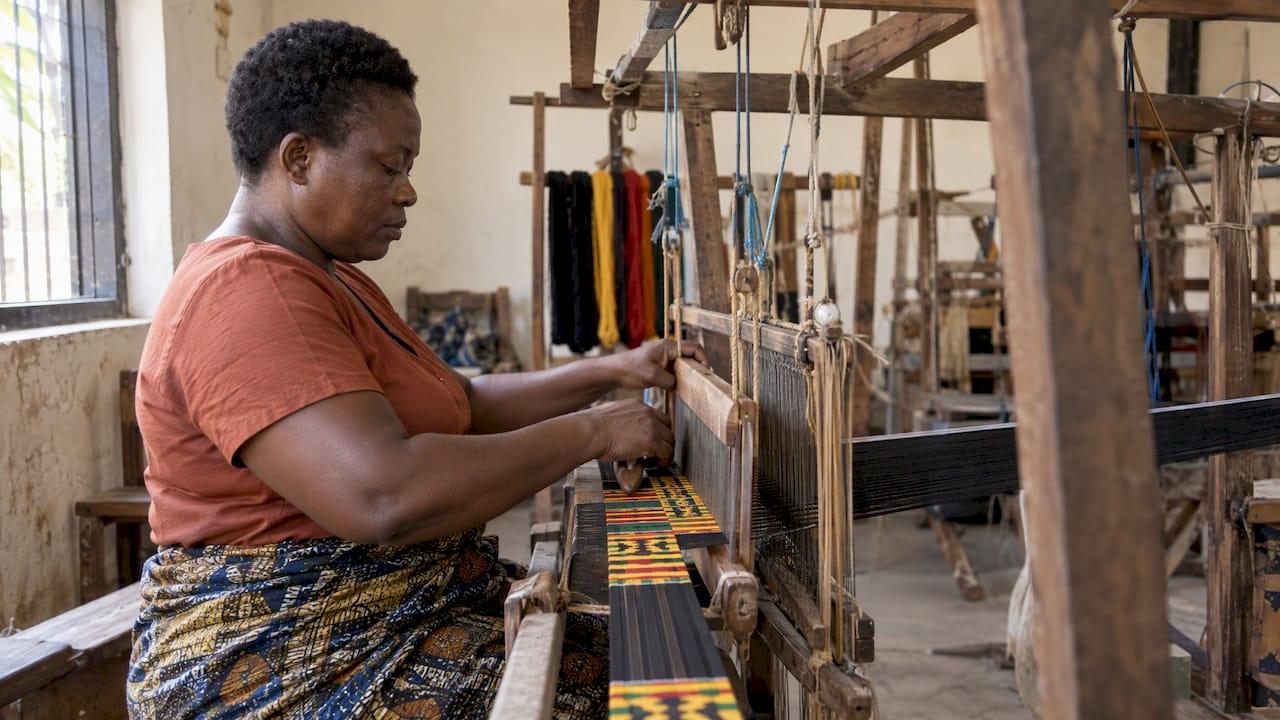
Real kente is a cloth woven by hand in narrow strips and sewn edge to edge, and most fakes give themselves away in the first minute: the pattern is printed on the surface, the back is blank or blurry, and the "strips" are only a design. Check the seams, turn the cloth over, look at the edges, feel the weight, and ask where it was woven. If a seller cannot answer, you have your answer.
This matters more than it used to. In September 2025, Ghana secured Geographical Indication (GI) status for kente, which means only authentic handwoven cloth from designated Ghanaian communities can legally carry the name. For a buyer in the United States, that turns an old question of pride into a practical one: what exactly am I paying for?
TL;DR
- Genuine kente is woven in narrow strips on a horizontal loom and sewn together, so look for seams running the full length of the cloth at regular intervals.
- Turn it over. Handwoven kente shows the pattern in reverse with floating threads; printed cloth has a pale, blurry or blank back.
- Hand weaving is never perfectly identical from repeat to repeat. A pattern that repeats exactly points to a machine or a print.
- A price that seems too low for weeks of labor is a signal to ask questions, and the surest purchase comes from weavers or weaving centers in the GI communities.
- Kente-inspired fashion is a different, honest category. Wear it with the story it comes from, and keep the word "kente" for cloth that earned it.
Table of Contents
- What real kente actually is
- Seven checks to spot fake kente
- Quick comparison: handwoven kente versus printed imitation
- Why fakes are everywhere, and why it matters
- What the 2025 GI protection means for you in the U.S.
- Kente, kente-inspired and "African print": know which one you are buying
- Colors and symbols: a quick way to read what you see
- Where to buy with confidence
- Our perspective
- Wear West African heritage with confidence
- FAQ
- Sources
What real kente actually is
You cannot spot a fake until you know the real thing, so start with how it is made. According to UNESCO's listing, kente in Ghana is a fabric of strips woven from silk, cotton or rayon on horizontal looms, with the knowledge passed down through families, master-weaver apprenticeships and educational institutions. UNESCO inscribed the craft on its Representative List of the Intangible Cultural Heritage of Humanity in 2024.
The Metropolitan Museum of Art explains that Asante kente is woven on a horizontal double-heddle loom, producing a narrow band roughly four inches wide. A completed cloth is made of roughly twenty strips sewn edge to edge, and locally woven silk and cotton kente have marked status in the Asante kingdom since at least the seventeenth century.
That construction is the whole secret to spotting fakes. A real cloth is a stack of narrow woven bands. A fake is usually one wide piece of fabric with a design on top.
Two things are worth knowing before you shop:
- Silk, cotton and rayon are all legitimate. Princeton University Art Museum notes that older cloths were woven from silk thread unraveled from imported cloth, and as silk grew costly, more recent cloths used cotton and rayon. A rayon kente is not a fake.
- There is more than one tradition. Ghana's National Commission on Culture notes that Asante weavers in places such as Bonwire and Adanwomase and Ewe weavers in Agotime and Kpetoe share strip-weaving methods, yet their patterns, naming systems and colors differ. If you want to go deeper, our guide to telling Ashanti and Ewe kente apart covers it.
Seven checks to spot fake kente
These checks combine what Ghana's heritage bodies describe with a buyer's guide on kente and Ghanaian cloth. Use several together. No single sign settles it, much as with any counterfeit: the same principle runs through this guide to spotting counterfeit products, where it is the combination of signals that gives a fake away.
1. Look for strip seams
Hold the cloth up to the light. Real kente shows stitched seams running the full length of the cloth at regular intervals, because narrow strips were joined side by side. On a printed imitation, the "seams" may be part of the artwork. Run a fingertip across one: a real join has a physical ridge and visible thread, while a printed line is flat.
2. Turn it over
This is the fastest test. On handwoven kente, the pattern shows on the reverse, and you can often see floating weft threads, the colored threads that travel behind the design between motifs. Printed cloth tends to have a pale, blurry or blank back, because the ink sits on the surface instead of being woven in.
3. Inspect the edges
Each strip has its own selvedge, the finished edge a weaver leaves so the fabric does not unravel. On handwoven cloth, the selvedge is genuine, with small irregularities. A cloth with a perfectly uniform, machine-clean edge along a printed design deserves a second look.
4. Check whether the pattern repeats exactly
Printing repeats exactly. Hand weaving never quite does. Compare two motifs that should match: tiny differences in width, tension or alignment are a good sign. Perfect copies down the cloth are not.
5. Feel the weight and texture
Handwoven kente has a dense, ridged weight. A printed copy usually feels lighter and smoother, with a flowing drape, because it is a thin industrial fabric. You will feel the difference in the first few seconds, especially if you have handled a real piece before.

6. Ask where, who and how long
Since the GI was granted, cloth woven in designated communities such as Bonwire, Adanwomase, Kpetoe and Agbozume is the cloth that can legally be called kente. Ask the seller where the cloth was woven and by whom. Ask the loom type and the yarn: you are listening for a horizontal loom and silk, cotton or rayon. Ask how long the piece took. A weaver in Ghana's Agotime-Kpetoe district told 3News that a complex design can take four to six weeks for a full set, so a price that looks too low for that labor is a reason to ask questions.
7. Read the label and the story
Ghana's National Commission on Culture names the sale of industrial prints as though they were handwoven originals as one of the main risks facing the craft, and calls for stronger action against deceptive labeling. A trustworthy seller names the community, the weaving tradition and, ideally, the maker. A vague "African print" or "kente style" tag next to a premium price is the pattern to watch for.
Quick comparison: handwoven kente versus printed imitation
| What you check | Handwoven kente | Printed imitation |
|---|---|---|
| Construction | Narrow strips sewn edge to edge | One wide piece of fabric |
| Back of the cloth | Pattern visible in reverse, floating threads | Pale, blurry or blank |
| Edges | Genuine selvedge with small irregularities | Uniform, machine-clean |
| Pattern repeats | Never quite identical | Exactly identical |
| Feel | Dense, ridged, weighty | Light, smooth drape |
| Origin | Named weaving community | Vague or unstated |
Why fakes are everywhere, and why it matters
Kente's popularity in the United States is deep. The New York Times, in a piece reproduced by The African Dream, described it as reflecting the place Ghana and Ghanaian culture hold in the Black American psyche, and noted that many imitations come from China and are sold worldwide. Black Enterprise reports that variations of the design appear on graduation stoles, bags, T-shirts and other clothing across the diaspora.
That demand is the opening for copies. A printed stole costs a fraction of a handwoven one, and the buyer, often a student or a parent shopping for a graduation, may never be told the difference.
The human cost is real. The National Commission on Culture lists falling apprenticeship numbers and imitation without attribution among the threats to the craft. At a roundtable in Ho, reported by the Ghana News Agency, master weaver Paul Franklin Gbortsyo said cheap machine-printed imitations will not collapse the craft, and participants resolved to push for proper labeling of authentic hand-woven kente and for training a new generation of weavers. When you buy carefully, your money supports exactly that.
What the 2025 GI protection means for you in the U.S.
A Geographical Indication works a little like a trademark that belongs to a place and its makers. Per BellaNaija's report, kente is Ghana's first GI product, announced by Ghana's Registrar-General's Department with WIPO, the World Intellectual Property Organization, and it gives the cloth legal protection worldwide.
For shoppers, the practical effect is a clearer standard. Cloth called kente should be handwoven in the designated communities. Fashion Law Institute founder Susan Scafidi told the New York Times that enforcement depends on public pressure and governmental coordination, so informed buyers are part of how the protection works. Your questions at the point of sale are the pressure.
For a fuller account of why the 2024 UNESCO listing and the 2025 GI matter now, see our piece on kente cloth history.
Kente, kente-inspired and "African print": know which one you are buying
Not every beautiful garment in a kente palette is trying to be kente, and not every one is a fake. The honest distinction is labeling.
- Handwoven kente is cloth woven in strips by Ghanaian weavers. Expect a higher price and a named origin.
- Kente-inspired fashion is clothing that draws on West African heritage in color, geometry and spirit, and says so. It does not claim to be the woven cloth.
- Printed imitation sold as kente is the problem: the label, the price or the seller's story suggests the cloth is something it is not.
Smithsonian Magazine quotes Diana Baird N'Diaye of the Smithsonian Center for Folklife and Cultural Heritage saying it is fine for Americans, especially those of African ancestry, to wear appropriate kente patterns at events such as graduations and funerals, as long as the cloth was handwoven in Africa. She adds that designers making abstract patterns based on kente's look should make clear where they get their inspiration, and should not copy actual kente patterns.
If you are buying for a graduation, our guide to a graduation kente outfit worn respectfully walks through it step by step.
Colors and symbols: a quick way to read what you see
Meaning is part of authenticity, because kente is a language as much as a fabric. Ghana's National Commission on Culture describes the colors this way, per its Royal Legacies page:
- Gold signifies royalty, wealth and spiritual purity.
- Blue represents peace, harmony and love.
- Black embodies maturity and ancestral strength.
- Green symbolizes renewal, growth and fertility.
- Red stands for sacrifice and struggle.
- White reflects purity and victory.
The same page notes that the cloth was once a royal treasure worn at sacred ceremonies, festivals and state functions, and that the pattern Adweneasa stands for creativity, excellence and mastery. A seller who can explain the meaning of the pattern on your cloth is usually a seller who knows where it came from.
Where to buy with confidence
The National Commission on Culture argues that heritage tourism and commerce work best when built around real production communities, where buyers can observe weaving, learn design meanings and purchase verified products, and where income returns to the makers. The same logic applies online. Look for:
- A named community and weaving tradition, not just "Ghana" or "Africa."
- Straight answers about loom, yarn and weeks of work.
- Photos of the reverse side and the strip seams.
- A price that reflects hand labor.
- Clear language about whether a garment is woven kente or kente-inspired design.
If you would rather see how to read craftsmanship across all African fashion, our guides on identifying authentic African craftsmanship and West African textile traditions give you the wider picture.
Our perspective
We built Sena Nukunu on a simple belief: heritage should be worn with respect, and respect begins with knowing what you are holding. Every stitch, every strip and every color in West African cloth carries the spirit of a legacy, and it deserves to be named honestly.
That is why we care about craftsmanship, ethical production and limited quantities. A garment made with care, in small numbers, by people who are treated fairly, tells a truer story than something mass-printed to look like it. When you learn to turn a cloth over and read its back, you are doing more than avoiding a bad purchase. You are standing with the weavers, the families and the apprentices who keep this tradition alive.
Our collections are inspired by West African heritage and designed so you can wear that pride every day, from agbada sets for men to statement dresses and matching sets for women. Wear the change, and wear it with understanding.
Sena
Wear West African heritage with confidence
If you are looking for ready-to-wear pieces rooted in West African heritage, our collections are crafted in limited quantities with ethical manufacturing and artisanal care. Explore Men's Agbada Ensembles and Heritage pieces, browse the Women's shop, or see every line on the collections page, from Woven Nobility: Kings' Robe to Woven Crowns: Radiant Rise.
Planning a celebration? Our guide to graduation party African outfits helps grads and guests dress the part.
FAQ
Is a cheap kente stole always fake?
Not always, but a very low price is a reason to ask questions. A complex handwoven design can take weeks to produce, so a price far below that labor suggests a print or machine-made copy. Check the back of the cloth and ask where it was woven.
Can African Americans and others wear a kente stole?
Yes. Smithsonian cultural specialist Diana Baird N'Diaye says it is fine for Americans, especially those of African ancestry, to wear appropriate kente patterns at events such as graduations, provided the cloth was handwoven in Africa. Choosing genuine cloth is the respectful part.
Is rayon kente real?
Yes. UNESCO describes kente in Ghana as woven from silk, cotton or rayon on horizontal looms. What makes it kente is the hand weaving in strips by Ghanaian weavers, not the fiber alone.
What does the 2025 GI mean for buyers?
Only authentic handwoven cloth from designated Ghanaian communities can legally be called kente. As a buyer, you can ask a seller to name the weaving community and expect a clear answer.
What is the difference between kente and kente-inspired clothing?
Kente is the handwoven strip cloth itself. Kente-inspired clothing borrows color, geometry and spirit from West African tradition and is honest about it. Both can be beautiful, as long as the label tells you which one you are buying.
Sources
- Craftsmanship of traditional woven textile Kente, UNESCO
- Asante-Akan artist, Royal man's kente, The Met
- Man's wrapper (kente), Princeton University Art Museum
- Woven Identity: Kente, Fugu, Adinkra, National Commission on Culture
- Royal Legacies: Kente and Symbolic Cloths, National Commission on Culture
- Kente, Adinkra and Ghanaian Cloth: A Buyer's Guide
- Real kente or printed copy? 3News
- Foreign imitations cannot collapse kente, Ghana News Agency
- Ghana Secures Historic Protection for Kente Cloth, BellaNaija
- Cracking down on what can be called kente cloth, The African Dream
- Ghana Cracks Down On Misuse Of Kente Cloth Name, Black Enterprise
- When Is Kente Cloth Worn, Smithsonian Magazine
- Spotting counterfeit products