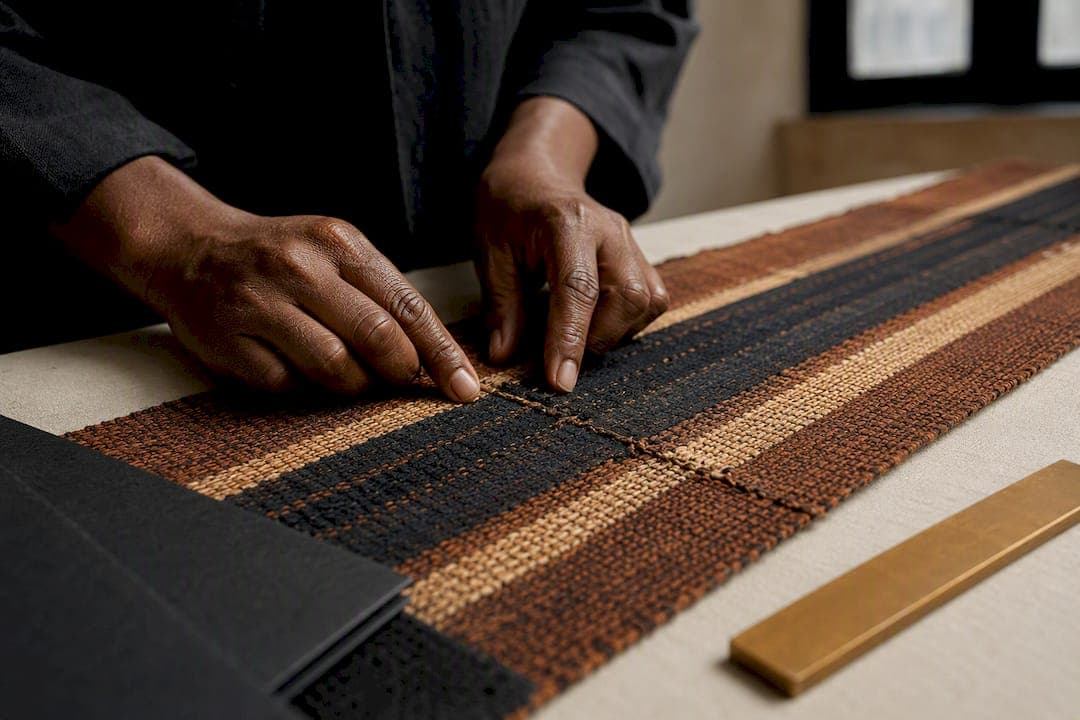
Authentic African fashion carries a name, a place, and a fair paycheck attached to it: a maker you can identify, a community that consented to share its craft, and compensation that reaches the hands that wove or dyed the fabric. Inspired African fashion borrows the silhouette, the colors, or the print without any of that trail. The line between appreciation and appropriation lives in that trail, and this article gives you the tests, the questions, and the shopping habits to find it.
TL;DR:
- Authentic African fashion must be directly linked to a specific community or artisan, with clear proof of credit and fair compensation.
- Material and technique markers, such as natural fibers and traditional weaving methods, help verify the authenticity of textiles and craftsmanship.
- Provenance can be confirmed through documentation, artisan photos, and direct communication with sellers asking about the origin and community behind the piece.
- Buying from verified designers, artisan cooperatives, or ethical boutiques ensures transparency, while vague marketing or suspiciously low prices signal potential appropriation.
- Supporting ethical brands like Senanukunu demonstrates a commitment to cultural integrity, community benefit, and genuine craftsmanship in African-inspired fashion.
Table of Contents
- What Do "Authentic" and "Inspired" Actually Mean in African Fashion?
- How Can You Tell If a Piece Is Authentically Made?
- What's at Stake When Provenance Gets Ignored?
- How Do You Shop for Authentic African Fashion Without Guessing?
- How Sena Nukunu Puts Provenance Into Practice
- A Reflection on Wearing African-Inspired Fashion Well
- Where to Shop Authentic West African Fashion With Confidence
- Sources
What Do "Authentic" and "Inspired" Actually Mean in African Fashion?
Every conversation about authentic African fashion eventually runs into the same three words: power, profit, and permission. Cultural researchers use that framework to separate ethical appreciation from extraction, and it holds up better than any checklist based purely on how a garment looks. Who holds the power to tell the story? Who profits when the piece sells? Did anyone ask permission before the pattern left its community?
Authentic means the garment has a documented connection to a specific heritage, region, or artisan group, and that group shares in the credit and the money. A kente cloth woven by a named artisan in Ghana's Bonwire region, sold with that artisan's name attached, is authentic. Inspired means a designer drew visual influence from African aesthetics, prints, or silhouettes, but the finished product has no direct line back to the source community. Inspiration on its own is not a violation. A lot of beautiful, respectful design starts as inspiration.
The trouble starts with appropriation: taking a cultural expression, a pattern, a technique, or a symbol without consent and without giving anything back to the people who created it. Cultural commentary frequently draws the same distinction: appropriation happens when power and profit flow one direction while credit and consent never flowed the other. Appreciation, by contrast, involves acknowledgment, usually a relationship with the source community, and often direct economic benefit to the people whose tradition inspired the work.
A short taxonomy makes the distinction easier to apply in a fitting room or on a checkout page:
- Authentic: made by or in direct partnership with the origin community, with credit and compensation flowing back to them.
- Inspired, done well: visually influenced by African design, openly labeled as such, and not marketed as traditional or handmade when it isn't.
- Inspired, done poorly: African-sounding names or prints slapped on mass-produced goods with no acknowledgment of where the aesthetic came from.
- Appropriation: a pattern, technique, or symbol lifted without consent, credit, or compensation, often stripped of its original cultural meaning entirely.
Legal scholars studying this space describe the worst version of the pattern as a form of neo-colonial extraction, where global brands profit from African design traditions while the originating communities see none of the revenue and little of the recognition. That framing matters because it shifts the question away from "does this look African" and toward "who benefits from this looking African." Once you start asking that second question, shopping gets a lot more interesting.
How Can You Tell If a Piece Is Authentically Made?
You don't need a textile degree to spot the difference between a piece rooted in tradition and one that just borrows the look. You need your hands, your eyes, and a willingness to ask a few pointed questions before you buy.
Material signals come first. Authentic African textiles, particularly hand-loomed kente, aso-oke, and traditional wax-resist dyed cotton, tend to use natural cotton or cotton blends because those fibers hold dye and structure the way the technique requires. Run your fingers across the fabric. Natural cotton has a slightly crisp hand and breathes; polyester blends feel slicker and trap heat. A useful, low-tech test: press the fabric with a warm iron for a few seconds. Cotton responds evenly and smells faintly earthy when warmed; synthetic blends can feel plastic-like under heat and may even shine or stiffen where cotton would simply relax.
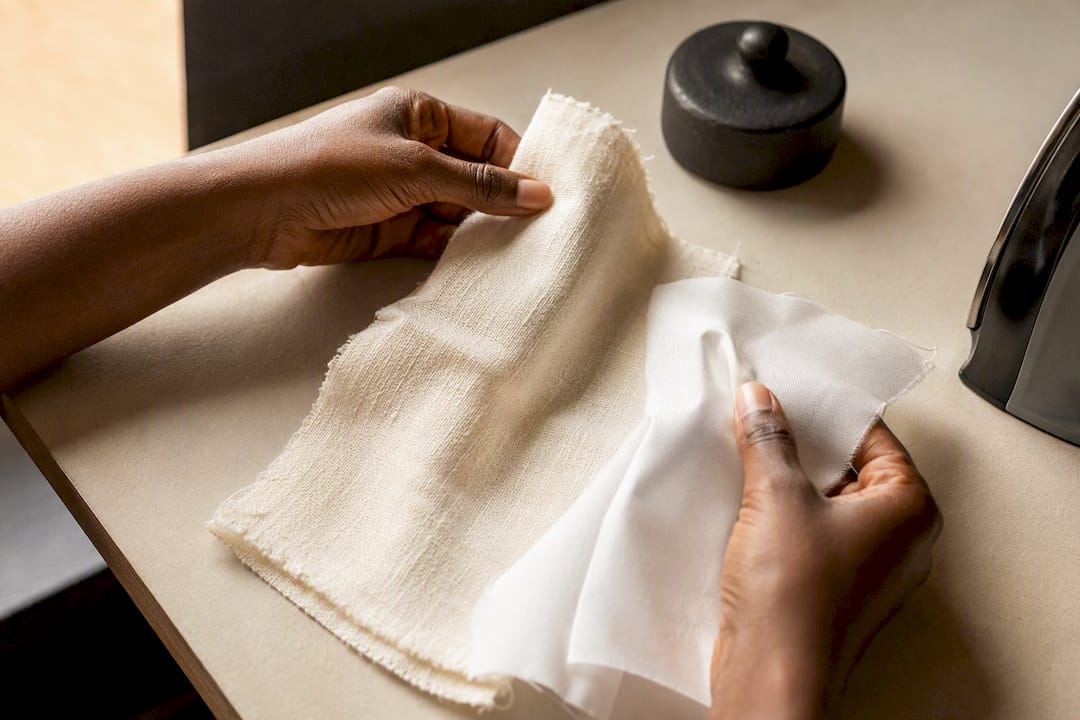
Technique markers tell the second half of the story. Kente cloth is traditionally woven in narrow strips on a horizontal loom, then hand-sewn together, so look for visible seam joins rather than one continuous woven sheet. Aso-oke, the strip-woven cloth from southwestern Nigeria, has a denser, heavier hand than printed imitations. Genuine hand-dyed textiles show irregularities: slight color variation, a soft bleed at the edges of a pattern, small inconsistencies in the weave width. Machine printing produces flawless repetition, which is precisely what gives it away.
Documentary signals matter as much as anything you can touch. Look for maker or designer credit on the product page, not just a country tag. A "made in" label naming an actual country of manufacture is worth far more than a marketing phrase like "African-inspired print" with no origin listed at all. Reputable sellers increasingly include artisan photos, short provenance statements, or details about which weaving community produced the cloth. Provenance is the single most important question a shopper can ask, because a huge share of wax-print fabric sold internationally is actually manufactured outside Africa entirely, despite looking indistinguishable from traditionally produced cloth. Understanding how to identify authentic African craftsmanship starts with learning to ask for that paper trail before you ask about the price.
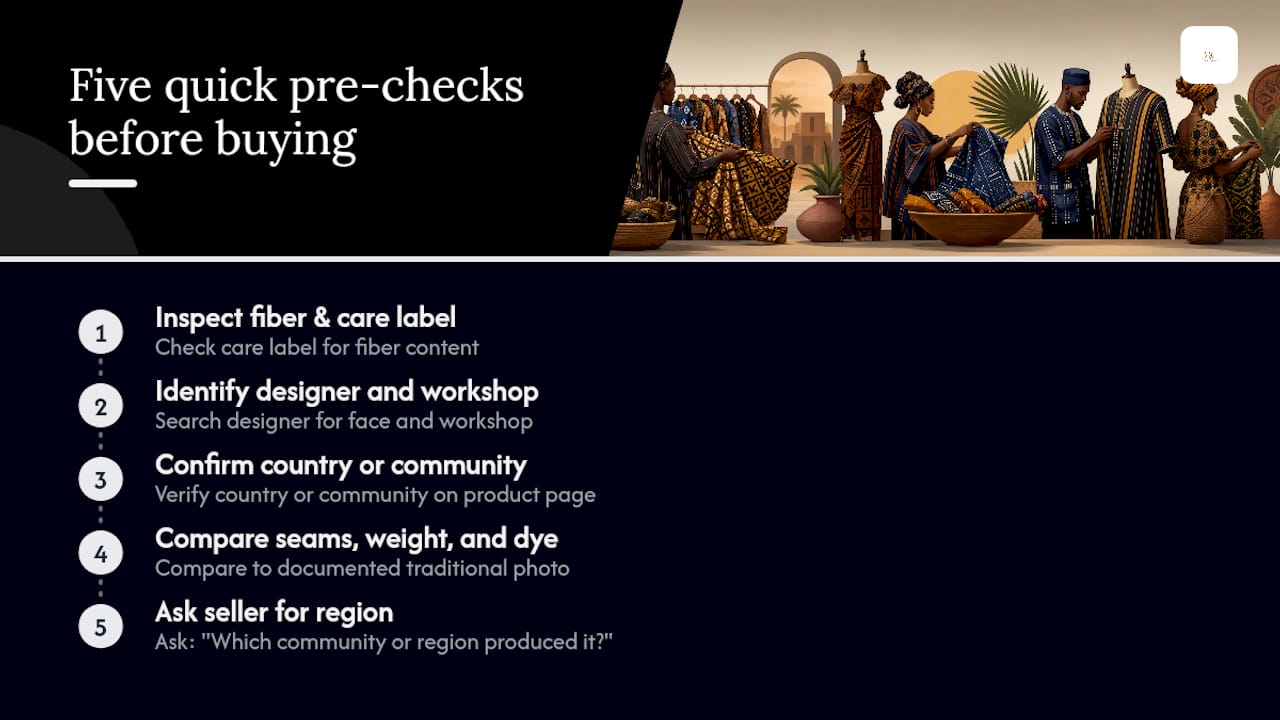
Pro Tip: Email the seller and ask one specific question: "Which community or region produced this textile?" A seller with real provenance answers in a sentence. A seller without it usually deflects with a generic marketing phrase.
Quick verification before checkout: examine the care label for fiber content, search the designer's name to see if a face and a workshop show up, and compare the finish against a photo of a documented traditional piece from the same tradition. If the seams, weight, and dye pattern don't line up, ask why.
What's at Stake When Provenance Gets Ignored?
The economic damage from uncredited borrowing is not abstract. When a global brand replicates a traditional pattern without paying the community that developed it, that revenue never reaches the weavers, dyers, and designers who built the tradition in the first place. Legal researchers describe this dynamic as a direct transfer of profit away from origin communities and toward companies with no connection to the craft, a pattern documented in analysis of intellectual property gaps affecting African cultural expressions.
Part of the problem is structural. Traditional Cultural Expressions, the legal term for patterns, motifs, and techniques passed down within a community, mostly fall outside conventional copyright and trademark law. A kente pattern developed over generations typically has no single living "author" to sue for infringement, which leaves artisan communities with little formal recourse when their designs get copied at scale. Scholars pushing for reform recommend sui generis national laws, meaning legal protections designed specifically for these communal cultural assets rather than borrowed from individual-author copyright frameworks.
Until that legal gap closes, two forces do most of the real work: ethical business models and public pressure. Co-creation partnerships, where designers work directly with artisan cooperatives, negotiate consent up front, and share revenue based on actual sales, offer a working alternative to extraction. These arrangements protect the community's authority over how its own imagery gets used, and they put money back into the hands that made the craft possible.
Public accountability has become one of the more effective enforcement tools available right now. Social media call-outs have pushed several major brands to publicly acknowledge origins or negotiate collaborations after facing visibility they didn't ask for, a shift documented in coverage of appropriation controversies in the fashion industry.
None of this means buyers are powerless while the law catches up. Every purchase decision that demands documentation sends a signal, and demand for provenance is exactly the pressure that pushes brands toward co-creation instead of extraction.
How Do You Shop for Authentic African Fashion Without Guessing?
Turning everything above into a habit takes about five minutes per purchase. Here's the workflow worth building into your shopping routine.
- Ask for provenance before you ask about sizing. Request the specific region, country, or weaving community behind the piece. A vague "Africa" answer is a red flag on its own.
- Request artisan or workshop photos. Sellers with real relationships to makers usually have images ready to share, sometimes already posted on the product page.
- Confirm the material in writing. Ask directly whether the fabric is natural cotton, a cotton blend, or synthetic, and compare that answer to the touch test described earlier.
- Check for named designer or maker credit, not just a brand name. A collection built with a named designer or cooperative behind it tends to carry more accountability than an anonymous "African print collection."
- Prefer direct-designer sites or verified diaspora boutiques over marketplace listings with dozens of unrelated sellers and no consistent sourcing story.
Watch for these red flags before you commit to a purchase:
- Listings tagged simply "African print" or "tribal print" with no country, region, or maker named anywhere.
- A price so low it couldn't possibly cover fair wages for hand-weaving or hand-dyeing, paired with claims of handmade craftsmanship.
- Stock photos that look identical across dozens of unrelated sellers, suggesting a shared drop-shipped source rather than a documented maker.
- No return policy or customer service contact, which usually signals a storefront with no real accountability behind it.
- Marketing copy heavy on words like "tribal," "exotic," or "authentic" with zero specifics to back the claim up.
As for where to actually look, editorial guides for culturally literate shoppers consistently point toward the same three categories: direct-designer websites where you can see the person behind the label, established diaspora-owned boutiques that publish sourcing information as a matter of course, and curated ethical marketplaces that vet sellers before listing them. Reputable artisan clothing brands tend to share a common trait regardless of category: they make it easy, not hard, to find out who made your clothes. If a seller's answers get vaguer the more specific your questions get, that tells you everything you need to know before you add the item to your cart.
How Sena Nukunu Puts Provenance Into Practice
Senanukunu builds every collection around the same standard this article just laid out. Pieces are made in limited quantities, sourced with attention to material integrity, natural cotton where the technique calls for it, and produced through ethical manufacturing partnerships rather than anonymous mass production. As a U.S.-based platform rooted in West African heritage, Senanukunu treats provenance as a design requirement, not a marketing afterthought.
That commitment shows up in the details: fabric information disclosed rather than buried, limited runs that respect the labor behind each piece, and a brand story built on cultural pride rather than borrowed aesthetics. Reading about celebrating West African heritage through ethical fashion gives a fuller picture of that approach. Whatever seller you shop with next, run them through the same checklist Senanukunu is built to pass.
A Reflection on Wearing African-Inspired Fashion Well
Clothing carries meaning long after it leaves the rack, and West African textiles carry more than most. A kente pattern isn't just decoration. Certain motifs historically signaled status, occasion, or clan identity, and treating that history as a costume flattens generations of intention into a photo prop.
Wearing these pieces respectfully doesn't require avoiding them. It requires curiosity. Know the name of the pattern you're wearing if you can find it. Buy from sellers who can tell you where a piece came from, and mention that origin when someone compliments it. If a design has ceremonial or symbolic weight, save it for contexts where that weight is honored rather than casual settings where it gets ignored entirely. Understanding what makes culturally inspired fashion meaningful rather than hollow starts with that same habit: asking questions before you wear the answer.
— Sena
Where to Shop Authentic West African Fashion With Confidence
Plenty of retailers sell African-print clothing, but far fewer can answer the provenance questions this article just walked you through. Senanukunu was built specifically to pass that test: limited-run pieces, ethical manufacturing partnerships, and a U.S. base in Florida that keeps production accountable rather than anonymous.
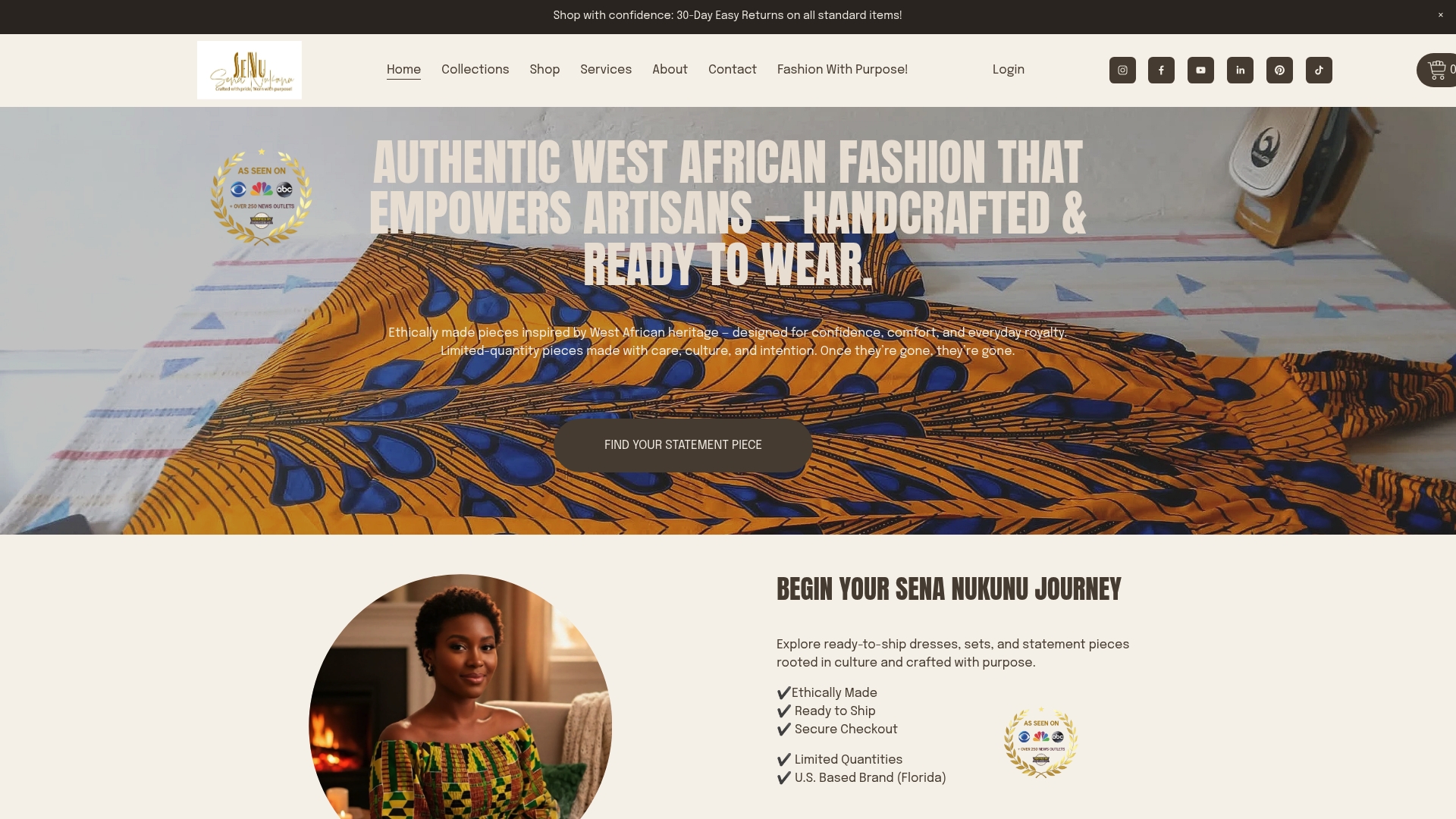
Every collection reflects the same checklist covered above, material transparency, credited craftsmanship, and small-batch production instead of mass runs designed to move fast and disappear. Browse the full collection at Senanukunu to see how those standards translate into ready-to-wear pieces, or head straight to the dress collection for statement pieces built around the same provenance-first approach. When you're ready to see the details up close, a piece like the Elegance Ruched Sleeve style shows exactly the kind of craftsmanship information this guide encourages you to look for before you buy.
Sources
- FROM INSPIRATION TO APPROPRIATION: RETHINKING INTELLECTUAL PROPERTY PROTECTION FOR AFRICAN CULTURAL EXPRESSIONS IN THE GLOBAL FASHION INDUSTRY
- How to Shop African Fashion: The Complete Guide for the Culturally Literate Consumer | OMIREN STYLES
- Cultural Appropriation vs. Appreciation — Who Owns African Style? - Ajoke Brown Media