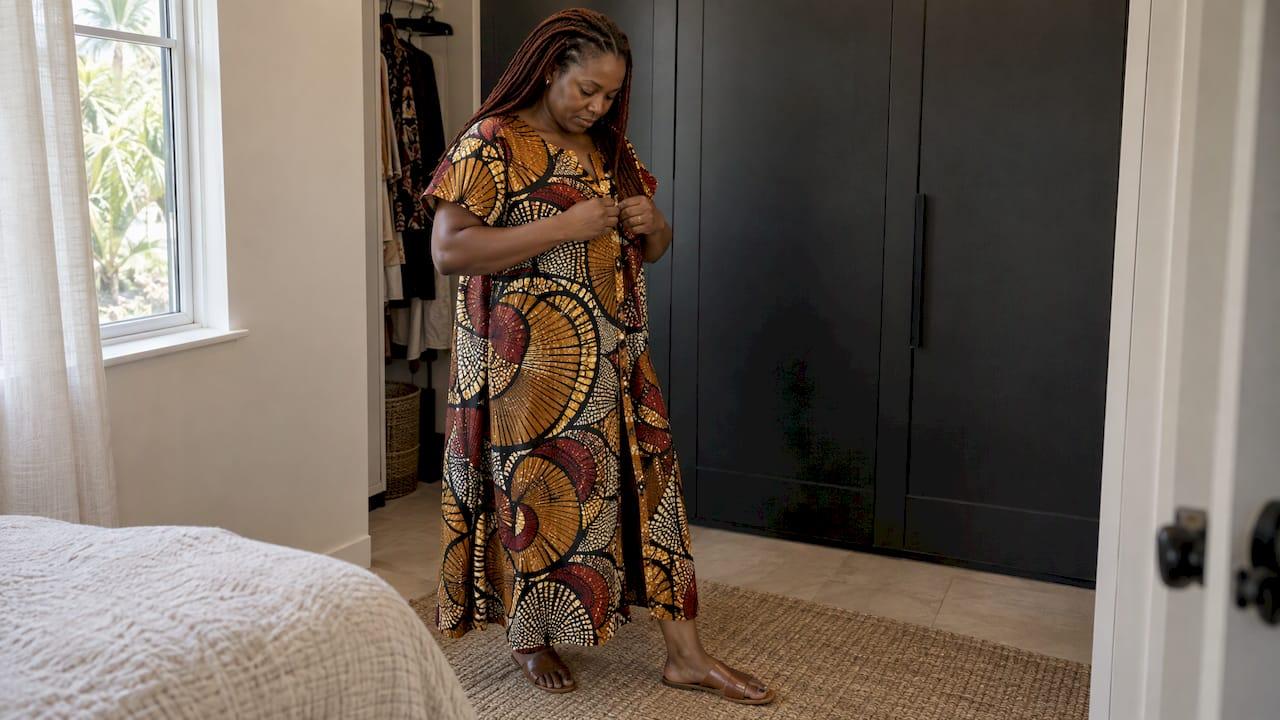
A nursing-friendly African dress gives you quiet, one-handed access to feed your baby while keeping the color, structure and cultural pride that made you choose it. The access is usually a front zipper, a hidden bust opening, a wrap front or a layered panel. The rest is fabric, fit and finish. Once you know which features to look for, you can wear West African style through feeding, work, worship and celebration without giving up either comfort or presence.
We are Sena Nukunu, a Florida-based label for West African ready-to-wear and custom fashion, and we wrote this guide so you can shop with confidence. When you are ready to browse, start with our dresses collection.
TL;DR
- A nursing dress has a built-in way to reach the breast: a front zipper, hidden bust opening, wrap front or layered panel. A maternity dress only has room for a bump, and many dresses are made to do both.
- In a study of 360 nursing mothers in Nigeria, the most wanted features were inconspicuous zippers at the princess lines, concealed bust openings and centre-front zippers.
- Choose an opening you can work with one hand, a breathable fabric with some give, and a bust that is not tight.
- Wrap dresses, kaftans and loose gowns suit nursing because they already move with the body, and they dress up easily for church, work and weddings.
- Wash African prints cold and gently so the color lasts through months of feeding, spit-up and laundry.
Table of Contents
- What makes an African dress nursing-friendly
- Traditional silhouettes that already work for feeding
- The features mothers actually ask for
- Fabric, fit and size through pregnancy and postpartum
- A worked example: choosing a dress for a Sunday service
- Styling nursing-friendly African dresses for work, weddings and everyday life
- Where Sena Nukunu fits
- Caring for African print dresses so the color lasts
- FAQ
- Sources
What makes an African dress nursing-friendly
The phrase is simple, but shoppers often use it loosely. A maternity dress is cut with room for a growing belly. A nursing dress is built so you can feed without undressing. Many dresses are sold as both, which is why the description matters more than the label.
Three questions sort a dress quickly:
- Where is the access? Look for a front zipper, buttons, a wrap front, side-seam openings or a double layer with slits.
- Does the access keep you covered? The best designs open under an outer layer, so nothing is exposed while your baby feeds.
- Does the dress still look complete when it is closed? You should not be able to tell it is a feeding dress from across the room.
That third point is where African design has a long head start. Many traditional garments were never cut close to the body, so ease and access come built in.
Traditional silhouettes that already work for feeding
Reporting from Tribune Online in Nigeria points to garments that mothers have long found practical: the Hausa Hula, a loose gown, the Igbo waist wrapper worn with a blouse, and the Yoruba Iro and Buba, a wrapper with a loose top. The same piece lists the essentials of breastfeeding-friendly clothing as button-up or zip-front stretchy pieces, wrap tops and dresses, and front zippers around the bust.
Kenya offers another example. According to the Eastleigh Voice, the dera dress, made in heavy cotton, chiffon or silk, has been adapted for nursing mothers by tailors who add a zip line down the front so the baby can feed freely. The same dress can be worn plain for daily life or dressed up with jewelry.
The lesson for your own wardrobe is that you do not need a separate "nursing category." You need silhouettes with room, and openings that sit where your body needs them.
Wrap dresses and wrapped fronts
A wrap dress opens from the front by design. You can adjust the neckline for feeding, then close it again, and the tie lets the fit change as your body does. It is also forgiving across postpartum sizes.
Kaftans and loose gowns
A kaftan skims rather than clings, so nothing presses on the bust. That matters for comfort, and it matters for health: tight clothing and tight bras are on the NHS list of things to avoid when you are dealing with blocked milk ducts or mastitis, an inflammation of the breast tissue. If you have a hard, painful or red area on the breast, or a fever, call your doctor or midwife rather than relying on clothing changes.
Smocked and high-low styles
Smocking gives stretch through the bodice, and a high-low hem keeps the look lively without adding bulk at the waist. Both are comfortable through the months when your size is still shifting.
The features mothers actually ask for
It helps to rely on evidence from mothers rather than guesses. A study of 360 nursing mothers in Ondo City, Nigeria rated desired features on a scale. The top three were:
| Feature | Mean rating |
|---|---|
| Inconspicuous zippers at the princess lines | 3.72 |
| Concealed openings at the bust region | 3.58 |
| Centre-front zippers | 3.55 |
The same study named the biggest challenges: the unavailability of desired designs (2.74) and a lack of private space (2.59). In other words, mothers wanted clothes that look like the dresses they already love, and they wanted coverage when privacy was hard to find.
A separate study in the Journal of Human Ecology and Research (2017), also on lactating mothers in Nigeria, found that openings with closures support both easy feeding and modesty. It also found that aesthetic details such as tucks, pleats and motifs help a garment stay beautiful and elegant. Its list of what mothers need from clothing runs from coverage, comfort and fit to easy access, absorbency, ease of washing and affordability.
Here is how to turn that into a shopping checklist.
Princess-seam zippers
Princess seams are the vertical seams that run from the shoulder or armhole down over the bust. A hidden zipper in that seam disappears into the print, so the dress looks like any other. If you sew or have a tailor, this is the classic adaptation point.

Concealed bust openings and layered panels
An outer layer sits over a slit or opening beneath it. You lift the top layer, feed, and let it fall back. This gives extra coverage, which is useful at a family gathering or in a pew.
Centre-front zippers or buttons
The simplest option. A zipper that runs from the neckline to the waist or hem gives you full control, and you can unzip only as far as you need. Check that the pull is easy to find and the zipper runs smoothly, because you will use it with one hand.
Side-seam and front-panel openings
These keep the outline of the dress unchanged. They suit structured pieces where a front zipper would interrupt the pattern.
Fabric, fit and size through pregnancy and postpartum
Feeding dresses are worn for hours, against sensitive skin, often with a warm baby on your chest. Fabric decides how that feels.
Choose breathable fibers. Cotton, including African wax print cotton, breathes well and holds color. A US blogger documenting a Mother's Day project described installing invisible zippers along the bust princess seams of a wax-print cotton dress, and noted that wax print is a light fabric well suited to spring and summer.
Look for a little give. A smocked bodice, a wrap tie or an elastic panel lets the dress move as your bust changes through the day.
Keep the bust relaxed. Snug seams at the chest are the first thing to rule out. Go by how the dress feels when you lift your arms and when you lean over a crib.
Size for the body you have now. Postpartum bodies change week to week. A forgiving cut such as a kaftan, a wrap or a flowing tunic is easier to live with than a fitted sheath. If you are shopping across pregnancy and feeding, a stage-by-stage plus-size maternity guide can help you check which garment features carry over from one stage to the next.
Test the one-handed rule. Before you commit to any dress, practice the opening with one hand, the way you will use it. If it takes two hands and a mirror, it will frustrate you at 3 a.m.

A worked example: choosing a dress for a Sunday service
Say you are three months postpartum and want something for church that feels celebratory but lets you feed in the nursery or the car.
- Pick the silhouette. A midi or maxi wrap dress or a flowing kaftan gives coverage and room.
- Pick the access. A front zipper hidden under a panel, or a wrap front you can open and close, keeps you covered.
- Pick the print. A bold pattern hides small marks from the day, and a deep background color is more forgiving than white.
- Pick the finish. Add a head wrap or simple earrings and you look dressed for the occasion, not adapted for the baby.
For outfit ideas that hold up through a long service, see our guide to African church attire. A relaxed take on the same day is covered in this piece on church casual outfits.
Styling nursing-friendly African dresses for work, weddings and everyday life
A dress built for feeding should still be the dress you want to wear.
Everyday
A breathable cotton print with an easy front opening works for errands and play dates. Pair it with flat sandals and a crossbody bag. Our guide to wearing African prints casually shows how.
Work
Choose a structured wrap dress or midi in a darker base, add a blazer, and keep accessories simple. Fashion Policy NG advises that bold Ankara prints pair best with understated accessories, such as small metal earrings, a simple leather bag and solid shoes. We cover professional looks in our business casual African wear guide.
Weddings and celebrations
A stylist quoted by GlossWardrobe says formal dressing benefits from clothing that looks resolved from every angle, and that gowns and sheath shapes do this more naturally than everyday separates. For a feeding mother, that means choosing a gown with a seam or panel that hides the opening, so the back, front and sides all look finished. See our guide to African evening gowns for fabrics and cuts.
Where Sena Nukunu fits
We make authentic West African ready-to-wear and custom fashion, including dresses, kaftans, jackets and matching sets, with ethical manufacturing and artisanal craftsmanship, in limited quantities. Our pieces are ready to ship, and each one is designed to blend traditional artistry with modern style.
If you are building a wardrobe for the months ahead, our Woven Stride: Queen In Comfort collection is a good place to begin looking at comfortable, flowing silhouettes. For the full range, see the women's shop or our collections. Our services page explains how custom garments work.
When you shop any dress for feeding, read the product description for the opening, the fabric and the cut, and check the sizing details before you order.
Caring for African print dresses so the color lasts
Feeding means frequent washing. A few habits keep prints bright:
- Wash in cold water, gently. Hot water opens fibers and can release dye.
- Wash dark and bright prints separately for the first few washes.
- Turn the dress inside out before washing and before ironing, to protect the surface color.
- Use a pressing cloth over beading, stones or sequins.
- Store on a hanger or folded in a breathable bag, never sealed in plastic, which traps moisture.
- Zip every zipper closed before washing so teeth do not snag the fabric.
Always follow the care label on your own garment first.
Our perspective
We believe a dress should honor the woman wearing it in every season of her life, including the season when she is feeding a child. West African clothing has always understood this: its silhouettes make room for movement, for family and for celebration, and its prints carry stories that belong to you whether you are in a boardroom, at a naming ceremony or in a nursery chair.
That is why we design around comfort and craft together. Each piece is made in limited quantities with ethical manufacturing and artisanal care, so what you wear has a human story behind it. When you choose a flowing kaftan, a wrap silhouette or a smocked dress, you are choosing a legacy of ease, and you are also supporting the artisans who make it.
Look for the features that serve you: an opening you can work with one hand, breathable fabric, a relaxed bust, and a finish that makes you feel like yourself. Then wear it proudly.
Sena
FAQ
Is a maternity dress the same as a nursing dress?
No. A maternity dress has room for a bump, while a nursing dress has a built-in way to reach the breast, such as a zipper, wrap front or layered opening. Many dresses are designed for both, so read the product description for the access feature.
Which African dress styles are easiest for breastfeeding?
Wrap dresses, kaftans, loose gowns and dresses with front zippers or hidden princess-seam openings are the easiest. Traditional garments such as the Hausa Hula and the Yoruba Iro and Buba are cited for easy access, and the Kenyan dera has been adapted with a front zip line.
Can I wear a nursing-friendly African dress to a wedding?
Yes. Choose a gown, maxi or sheath cut with a concealed opening, so the dress looks finished from every angle. Keep accessories restrained and let the print lead.
What fabric is best for feeding?
Breathable cotton with a little stretch is a comfortable choice, and a relaxed bust matters more than a close fit. Tight clothing is on the NHS list of things to avoid with blocked ducts and mastitis. If you notice pain, redness or fever, contact your doctor or midwife.
Sources
- Functional Apparel Solutions to Breastfeeding Challenges Among Nursing Mothers in Ondo City
- Functional Apparels Design Features for Lactating Mothers, Journal of Human Ecology and Research
- Tribune Online: When functionality meets the fashion style of mothers
- Eastleigh Voice: Dera dress, a timeless staple
- NHS: Mastitis
- Motherland Mother's Day
- How to Style Ankara Dresses for a Modern Look, Fashion Policy NG
- Modern Ankara Style for Weddings, Work, and Weekends