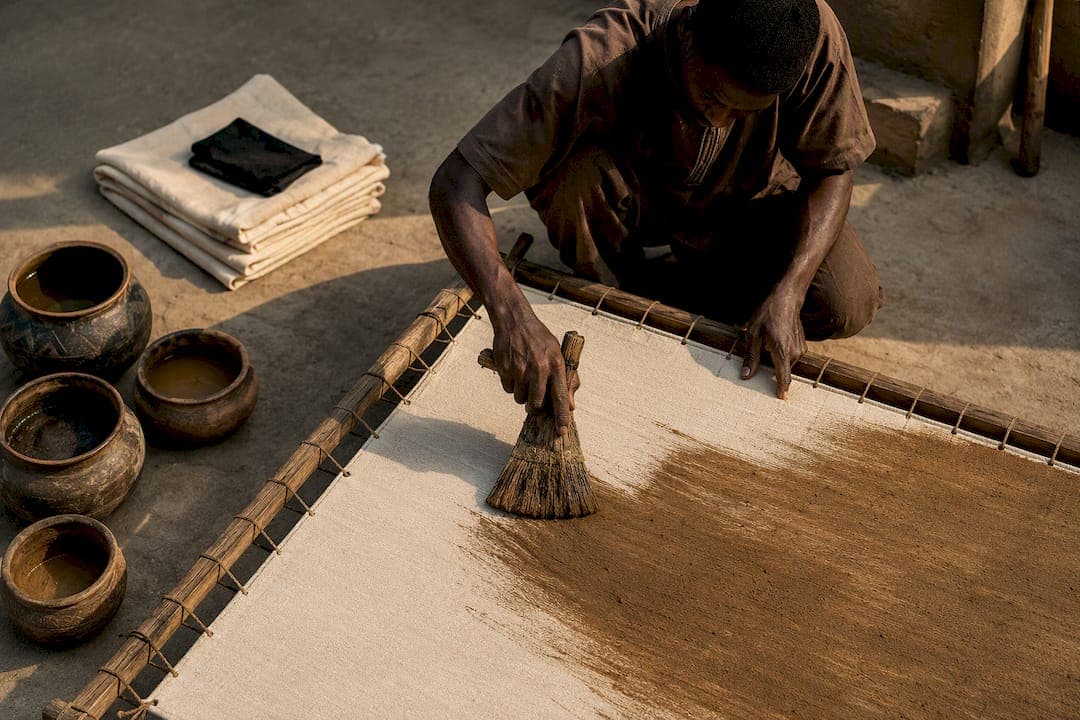
Bogolan, also called mud cloth or bogolanfini, is a handmade Malian cotton fabric dyed through a layered process of plant-based pre-dye baths and fermented river mud, painted by hand into motifs that carry protective, medicinal, and social meaning. It is not a print or a pattern style. It is a centuries-old craft rooted in the Bamana people of Mali, and today it lives everywhere from museum vitrines to runway collections.
TL;DR:
- Authentic bogolan relies on natural, fermentation-based mud dyeing, which can take several weeks and involves multiple hand-applied layers for deep coloration.
- The process includes weaving narrow cotton strips by hand, soaking in leaf dye, fermenting river mud for months, and painting using negative-space techniques.
- Genuine mud cloth features irregular mud application, visible seam lines from hand-sewn strips, and a unique layered symbolism in geometric motifs.
- Commercial "mud cloth" often uses stencils or chemical dyes, resulting in lower prices, uniform patterns, and lack of cultural or ritual significance.
- To verify authenticity, examine seams, mud application irregularities, backside seepage, and inquire about the maker's process and provenance.
Table of Contents
- What Does Bogolan Mud Cloth Actually Mean?
- How Is Traditional Mud Cloth Made by Hand?
- What Materials and Symbols Make Up a Bogolan Design?
- Why Did Communities Wear and Display Mud Cloth?
- Mass-Produced "Mud Cloth" vs. Handmade Bogolan: What's the Difference?
- How Can You Tell If a Piece of Bogolan Is Authentic?
- How Do You Properly Care for Mud Cloth Fabric?
- A Publisher's View on Selling West African Style Responsibly
- Bring West African Heritage Into Your Wardrobe the Right Way
- Where to Read More About Bogolan and Malian Textile History
- Sources
- FAQ
What Does Bogolan Mud Cloth Actually Mean?
The word itself tells you exactly what you're looking at. Bogolan comes from three Bambara words: bogo (mud or earth), lan (meaning "with" or "made by"), and fini (cloth). Put together, it translates roughly to "cloth made with mud," which is about as literal a name as any textile tradition has ever earned. The fuller term bogolanfini is often used interchangeably, referring specifically to the finished, mud-dyed product rather than the raw process.
This is not a decorative flourish borrowed from nature imagery. The Bambara etymology describes exactly what artisans do: they paint cotton cloth with river mud that has been aged and fermented for months, sometimes up to a year, in clay jars. The name is the process.
Geographically, the tradition is anchored among the Bamana (also spelled Bambara), an ethnolinguistic group centered in Mali. Within that broader community, the Beledougou region north of Bamako has long been recognized for producing some of the finest cloth, a reputation built over generations of women passing down technique from mother to daughter. Historically, bogolan wasn't a craft made for outsiders or export. It served ritual, ceremonial, and everyday functions within Bamana communities long before it appeared in a Western textile shop.
A few things worth knowing about where the tradition sits culturally:
- Bogolan is specific to Mali and the Bamana people, distinct from other West African resist-dye traditions like adire, which originates with the Yoruba in Nigeria and uses indigo rather than mud.
- The craft historically belonged to women, who controlled the dyeing and painting stages, while men often handled the weaving of cotton strips.
- Regional variation exists. Cloth from Beledougou, San, and other areas can differ in motif density, color depth, and finishing technique.
- The tradition predates any commercial market for it. Ceremonial and status uses came first; global fashion demand came much later.
Understanding that origin matters because so much of what gets sold as "mud cloth" internationally has drifted far from this Bamana root. Knowing the name's literal meaning is the first step toward recognizing the real thing.
How Is Traditional Mud Cloth Made by Hand?
Authentic bogolan production is slow by design, and that slowness is part of what gives it value. A single large cloth can take roughly 48 hours of active hands-on work, spread across two weeks or more of soaking, painting, and drying cycles. Here is how the process typically unfolds.
- Weaving the base cloth. Cotton is hand-spun and woven on narrow-strip looms into bands roughly 15 centimeters (about 5.9 inches) wide. These strips are then hand-sewn edge to edge to form a full-sized cloth, commonly around 1 by 1.5 meters, though larger ceremonial pieces exist.
- The leaf pre-dye bath. Before any mud touches the fabric, the cotton is soaked in a dye made from crushed n'gallama leaves, harvested from Anogeissus leiocarpa, a tree common across the Sahel. This bath turns the cloth a warm yellow-brown and, critically, primes the fibers to bond with the tannins that come later. The cloth is sun-dried between soakings.
- Fermenting the mud. Iron-rich mud is collected from riverbeds and left to ferment in clay jars for months, sometimes close to a year. Fermentation transforms the mud chemically, letting it react with the tannin-treated cloth to produce deep black and brown tones rather than simply staining the surface.
- Painting the design. Using tools as simple as a metal spatula or a stick, the artist paints the mud directly onto the yellowed cloth. Here is where technique diverges: rather than painting the motif itself, many artisans paint the background around a design, a method called negative-space painting. The motif emerges as the untouched yellow shape against a mud-darkened field.
- Repeat and wash. The cloth undergoes several rounds of mud application and drying to deepen the color, followed by washing that strips away the underlying yellow leaf dye, leaving the crisp dark motifs standing against a lighter ground. Historically, a final treatment with millet-bran soap, and in some cases caustic soda, sharpened the contrast further.
This entire sequence is typically taught through apprenticeship, often within families, with girls learning dyeing and painting from mothers and grandmothers over years, not weeks. That transmission model is part of why naming an individual artisan, such as Nakunte Diarra, carries real weight in the world of textile scholarship. Diarra has produced bogolanfini for nearly fifty years, and her studio process, harvesting her own soil, fermenting it herself, applying leaf baths by hand, is cited by museum curators as a benchmark for what artisanal production actually looks like.
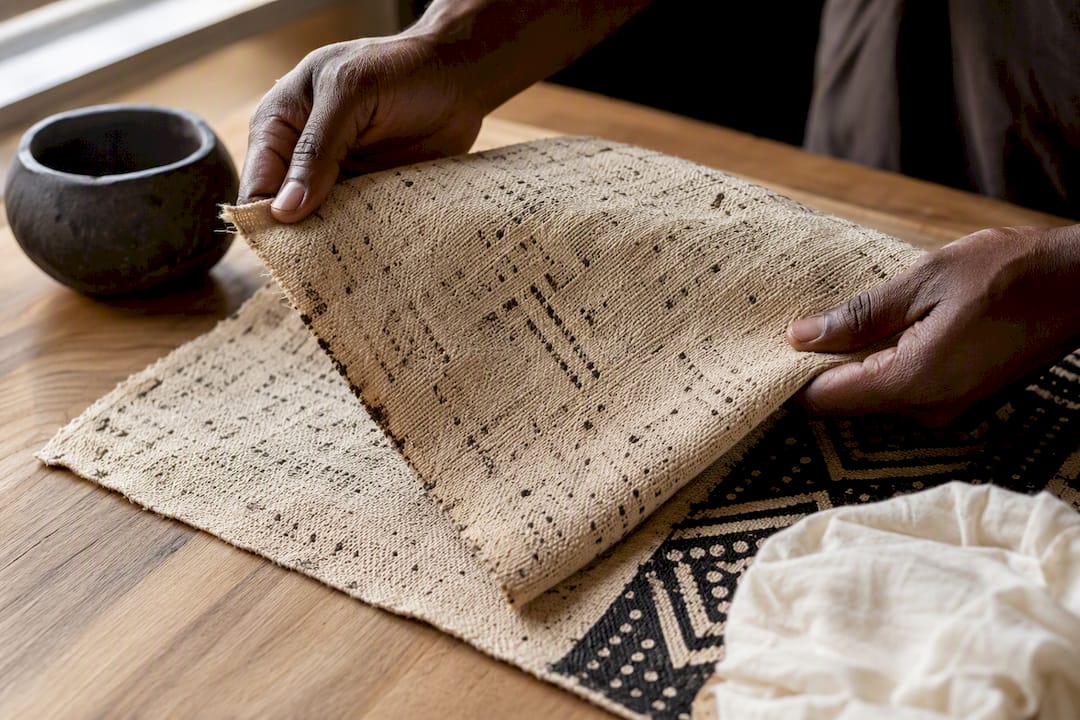
Pro Tip: If you're evaluating a piece of mud cloth for authenticity, look at the back side of the fabric. Hand-applied mud tends to seep unevenly through hand-woven cotton, leaving faint irregular marks on the reverse. A perfectly clean back often signals a printed or stenciled reproduction rather than a hand-painted original.
What Materials and Symbols Make Up a Bogolan Design?
Three natural materials define traditional bogolan: handwoven cotton, n'gallama leaf dye, and iron-rich river mud. Some ateliers add other local leaves or bark for supplementary color depth, but those three form the essential palette. Cotton itself is worth pausing on. It's a durable, breathable fiber that holds dye well over repeated soak cycles, which is part of why it remained the material of choice across centuries. If you're curious how cotton compares to other natural fibers used in garment-making more broadly, Maronko Fashion's comparison of linen and cotton is a useful reference point.
Finished cloths are assembled from those narrow 15-centimeter strips, meaning a single wrapper-sized piece might require six to eight strips sewn together by hand. The width of the strip is itself a signature of hand-loom production. Machine-woven fabric marketed as mud cloth almost never carries that seamed, strip-built structure.
Beyond materials, bogolan carries a symbolic vocabulary. Motifs are not random geometry. According to textile historians at FIT, specific patterns are learned and repeated across generations, each tied to a concept, proverb, or piece of practical knowledge:
- Turusina references Mount Sinai and carries associations with spiritual protection.
- Sungurun sen kelen translates to "one-legged girl," a motif tied to social commentary on hardship or resilience.
- Tigafaranin, meaning "little peanut shell," often appears in patterns referencing fertility and abundance.
- Zigzag and crosshatch patterns frequently encode more generalized protective or medicinal meanings, varying by region and individual artisan.
A single cloth often layers several of these symbols together, functioning less like a single image and more like a sentence built from a shared visual vocabulary. That layering is why two cloths can look similar to an untrained eye yet mean entirely different things to someone who reads the pattern.
Why Did Communities Wear and Display Mud Cloth?
Bogolan was never purely decorative in its home context. Hunters historically wore bogolan shirts believed to offer protection during dangerous excursions into the bush, tied to a concept called nyama, a kind of spiritual energy or life force that Bamana cosmology associates with danger and transformation. Cloth painted with the right motifs was thought to help absorb or manage that energy.
Bogolan also marked major life transitions. Girls undergoing puberty rites wore specific wrappers, as did women recovering after childbirth, and cloths were sometimes used as burial wrappings, tying the fabric to birth, maturity, and death across a single lifespan. This wasn't fashion in the modern sense. It was closer to a form of protective and social technology, worn at moments when a person was considered vulnerable.
That symbolic weight explains why traditional owners guarded the transmission of motifs so carefully. Because patterns encoded medical and protective knowledge, cloths were treated as powerful objects, and the right to make or interpret certain designs stayed within specific families or apprenticeship lines.
The role of bogolan has since expanded well beyond ritual use:
- It became a national symbol for Mali following independence, embraced by artists and designers as a marker of cultural identity.
- Institutions including the Met Museum and the Smithsonian's National Museum of African Art hold bogolan pieces as art objects worthy of scholarly study, not just craft artifacts.
- Contemporary fashion designers, both in Mali and internationally, have adapted bogolan motifs into clothing, accessories, and home textiles, sometimes preserving traditional technique and sometimes not.
That last point is where the story gets complicated, and where shoppers need to pay close attention.
Mass-Produced "Mud Cloth" vs. Handmade Bogolan: What's the Difference?
Walk into most home decor stores or browse a general marketplace for "mud cloth," and what you'll find is almost never bogolan in the traditional sense. It's a stenciled or chemically printed imitation designed to evoke the look at a fraction of the cost and time.
The technical gap is significant. Traditional bogolan relies on fermented mud reacting slowly with tannin-treated cotton over multiple painting and drying cycles. Commercial production instead uses stencils, screen printing, or chemical dyes that mimic the visual pattern without any of the underlying material process. Museum researchers at the Smithsonian note that this kind of stencil-based reproduction can run six to seven times faster than authentic fermentation-based dyeing, and it produces a fundamentally different object, materially and symbolically, even when the surface pattern looks similar.
A few signs typically separate the two:
- Speed and cost. Genuine bogolan involves weeks of labor; mass-produced versions can be printed in a single production run, which shows up in a dramatically lower price point.
- Pattern precision. Hand-painted motifs carry small irregularities, slight asymmetries in line width, minor bleed at edges, that machine printing eliminates entirely.
- Loss of meaning. Motifs on commercial goods are frequently chosen for visual appeal alone, disconnected from the proverbs or protective associations they carry in traditional use.
- Absence of apprenticeship transmission. Mass production skips the generational teaching model entirely, meaning the person applying the design often has no connection to the symbolic tradition behind it.
None of this means commercially made, mud-cloth-inspired textiles are worthless or shouldn't exist. Adaptation and inspiration have always moved between cultures and markets. But there's a real ethical difference between a garment that draws visual inspiration from bogolan and one marketed as if it were the genuine, hand-fermented article. Encyclopedic sources tracking the global export of bogolan note that commercialization has often stripped the cloth of its original ritual context, turning a spiritually loaded object into pure home decor.
How Can You Tell If a Piece of Bogolan Is Authentic?
If you're evaluating a piece, whether for a collection, a gift, or simple curiosity, a handful of checks can tell you a lot before you ever ask the seller a question.
- Examine the seams. Authentic cloth is built from narrow woven strips, roughly 15 centimeters wide, hand-sewn together. Visible seam lines running the length of the fabric are a strong indicator of traditional strip-loom construction.
- Check the mud application for irregularity. Hand-painted mud rarely produces perfectly uniform coverage. Look for subtle variation in tone, slight bleeding at motif edges, and asymmetry between repeated shapes.
- Look at the back of the fabric. Layered mud application often seeps through unevenly on hand-dyed cloth, something flat printing can't replicate.
- Ask about the maker. Reputable sellers of authentic pieces can usually name the artisan, cooperative, or region of origin. Attribution to a known name, in the way museum collections credit artisans like Nakunte Diarra, is a strong trust signal.
- Request a process description. Sellers who understand what they're selling can explain the leaf bath, fermentation, and negative-space technique in at least broad terms. Vague or evasive answers are a red flag.
Watch for these warning signs in particular: perfectly symmetrical, machine-regular repeats across the whole cloth; a synthetic sheen or unusually stiff hand-feel to the fabric; a price so low it couldn't plausibly cover weeks of hand labor; and sellers who can't describe the dyeing process at all. For a broader framework on spotting hand-craftsmanship signals across textile categories, this guide to recognizing artisanal work covers principles that apply well beyond bogolan.
Pro Tip: Ask a seller directly whether the cloth was dyed with fermented mud or printed with a stencil. A seller with real provenance knowledge won't hesitate on that question.
How Do You Properly Care for Mud Cloth Fabric?
Mud cloth is more delicate than its earthy, rugged appearance suggests, especially the natural mud pigment, which can lift or fade under harsh handling. A few conservative habits go a long way toward keeping a piece intact for decades.
- Hand-wash only, in cool water, using a mild, pH-neutral soap. Avoid standard laundry detergents, bleach, and enzyme-based stain removers, all of which can strip or discolor the mud dye.
- Never wring the cloth. Press out excess water gently between towels instead.
- Dry flat, away from direct sunlight, which can fade both the mud tones and any residual leaf-dye undertones over time.
- Store folded in breathable cotton or acid-free tissue, not plastic, which traps moisture and encourages mildew.
- If a piece shows fraying seams, tears, or significant pigment loss, consult a textile conservator rather than attempting a home repair. Amateur stitching or spot-cleaning can permanently damage the fiber structure or the mud layer.
- For display pieces, keep them out of direct light exposure and rotate them periodically if hung, since constant tension and UV exposure accelerate fading.
More detailed maintenance guidance, including seasonal storage tips for handmade African textiles, is available in Senanukunu's fabric preservation guide and in this cultural fashion preservation resource.
A Publisher's View on Selling West African Style Responsibly
There's a real tension in the marketplace for anything described as "mud cloth inspired," and it's worth naming plainly. Traditional bogolan is a specific, labor-intensive craft belonging to Bamana artisans in Mali. It is not a generic aesthetic to be lifted freely, and it's not interchangeable with adire, kente, or any other West African textile tradition, even though they get lumped together constantly in Western retail.
We think the honest path forward is transparency, not appropriation dressed up as appreciation. When a garment draws visual inspiration from bogolan motifs without being hand-fermented, hand-painted cloth, that distinction should be stated clearly, not blurred to imply an authenticity the piece doesn't have. Shoppers deserve to know exactly what they're buying and why it costs what it costs. Museum and academic sourcing exists precisely so this history doesn't get flattened into a decorating trend, and we'd rather point readers toward that scholarship than pretend a printed pattern carries the same weight as decades of apprenticeship.
— Sena
Bring West African Heritage Into Your Wardrobe the Right Way
This article is written for shoppers who want garments rooted in authentic West African craftsmanship, not a diluted print run. Where bogolan itself is a specific Malian tradition we've explained in detail above, The curated pieces discussed draw on a broad spectrum of West African design heritage, made in limited quantities with ethical production practices rather than mass manufacturing.
If you're drawn to bold, symbolic textile aesthetics, browse the Women's Collections for statement dresses and sets, or explore Woven Nobility: Kings' Robe and the rest of the collections page for pieces built around heritage-driven design. When evaluating any West African-inspired garment, ask the same questions this guide walks through: who made it, what tradition it draws from, and how transparently that story is told. You can start browsing current pieces, including the dress collection, and see for yourself how craftsmanship and clear sourcing show up in the details.
Where to Read More About Bogolan and Malian Textile History
For readers who want to go deeper than any single article can cover, these institutions hold primary source material worth exploring directly.
- The Smithsonian's Folklife program documents the full artisanal process and distinguishes it from commercial imitations.
- The Metropolitan Museum of Art holds bogolanfini pieces with detailed object notes on motifs and cultural function.
- FIT's Fashion History project offers a scholarly breakdown of specific motifs and their meanings.
- The Smithsonian's National Museum of African Art object records include detailed documentation of Nakunte Diarra's studio practice.
Sources
- Smithsonian Folklife: Malian bogolan
- Smithsonian object: Square mud-resist dyed wrapper (NMAFA)
- Bògòlanfini (mud-dyed cloth) — The Metropolitan Museum of Art
- Bogolanfini — Fashion History (FIT)
FAQ
Where Is Bogolan Cloth From?
Bogolan originates with the Bamana people of Mali, with the Beledougou region historically recognized for particularly high-quality production.
Why Do They Call It Mud Cloth?
The name reflects the literal dyeing process: cotton fabric is painted with fermented, iron-rich river mud, and the Bambara name itself, bogolan, translates to "cloth made with mud."
What Is Another Name for Mud Cloth?
The traditional Bambara term is bogolanfini, often shortened to bogolan; both refer to the same handmade, mud-dyed cotton textile.
Where Can I Buy Mud Cloth?
Authentic artisanal bogolan is best sourced through sellers who can name the artisan or cooperative and describe the fermentation and painting process. For West African-inspired ready-to-wear pieces made with ethical, limited-quantity production, Senanukunu's collections are available directly on its shop page.
How Long Does It Take to Make Authentic Bogolan?
A large hand-painted cloth typically requires around 48 hours of active labor spread across two weeks or more, accounting for repeated leaf-dye baths, mud application, and drying cycles.