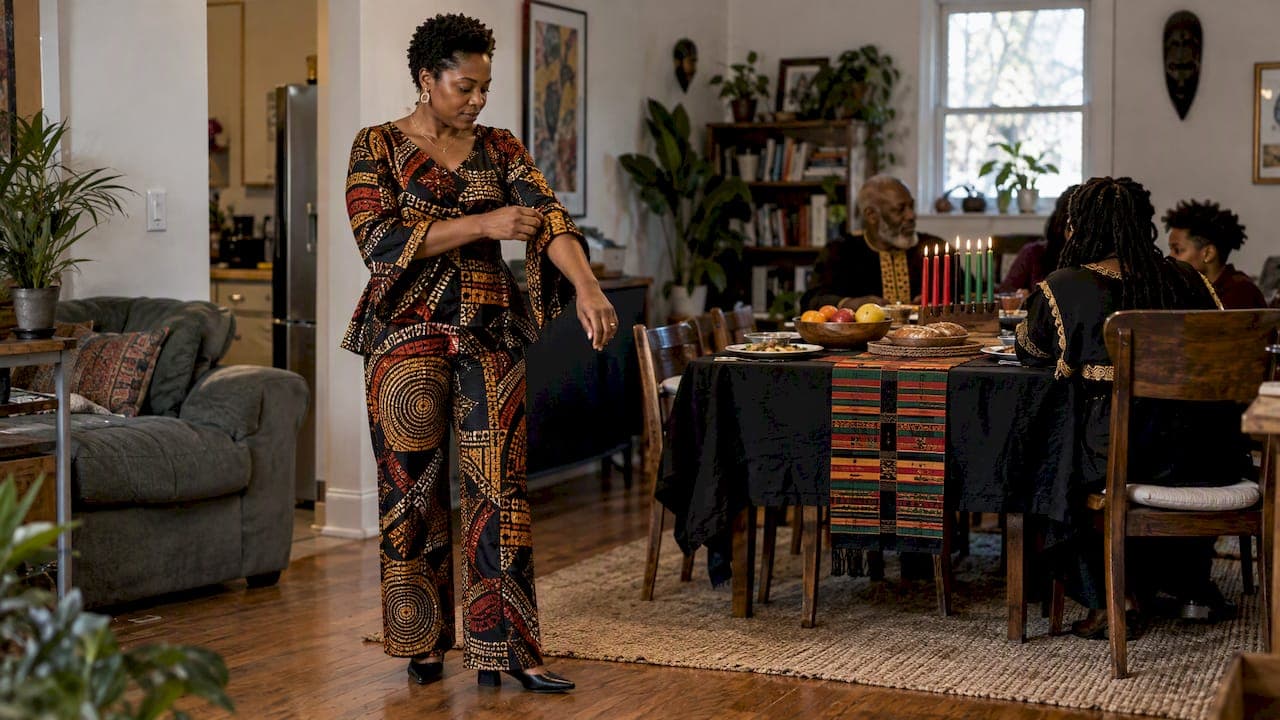
For Kwanzaa, choose traditional West African garments such as a dashiki, kaftan or agbada, or a modern outfit that leans on black, red and green. Match the formality to the day, easy and comfortable for a family evening, more polished for a community feast. We offer West African–inspired celebration wear for these moments.
TL;DR:
- A kaftan or boubou suits floor seating and long evenings, while an agbada should allow you to lift your arms and sit comfortably.
- Kente patterns carry specific meanings, so learn their significance before wearing them; cotton and linen blends also breathe well through long celebrations.
- Families can coordinate through a shared black, red, and green palette without matching outfits, while children need washable fabrics and sleeves kept clear of candles.
- Since Kwanzaa begins December 26, measure chest, waist, hips, and length early, check sizing charts, then confirm shipping dates and return terms before ordering.
Table of Contents
- 1. Ten Kwanzaa outfit ideas you can copy this week
- 2. Dashikis, kaftans, agbada and kente: choosing the right silhouette
- 3. Using black, red and green with meaning
- 4. Styling, accessories and winter layering
- 5. Dressing the whole family, kids included
- 6. How to buy and fit your outfit in time
- 7. Why cultural care shapes how we make celebration wear
- 8. Find your Kwanzaa look with Sena Nukunu
- FAQ
- Sources
1. Ten Kwanzaa outfit ideas you can copy this week
There is no official dress code, so the right look is the one that fits your gathering, as commonly worn U.S. garments like dashikis, kaftans and agbada sets show. Here are outfit ideas, each with its best use.
- Dashiki with jeans or tailored pants: best for relaxed gatherings at home.
- Women's kaftan or flowing maxi in breathable fabric: best for the Karamu feast and dancing.
- Men's agbada or heritage set with a kufi cap: best for formal community events.
- Coordinated family kente sets or one shared palette: best for Umoja, the unity principle.
- Modern separates that echo the holiday colors: a blazer, scarf or jewelry works for the office or mixed company.
- Loungewear in red, black and green: best for multi-day celebrations at home.
- Accessories only: a stole, headwrap or necklace for a quiet, subtle observance.
- Children's rompers and modest dresses: easy-care fabrics that survive the feast.
- Statement outerwear: an embroidered jacket or wrap keeps winter climates festive.
- Minimalist color accents: one red scarf or green pocket square for people who prefer restraint.
2. Dashikis, kaftans, agbada and kente: choosing the right silhouette
Each garment does a different job, so pick the one that suits how you will sit, eat and move. Dashikis and kente grew more visible in the U.S. during the 1960s, when Black Power and Civil Rights movements reclaimed them as symbols of African identity.
- Dashiki: a loose, often embroidered shirt. Choose a size that skims your shoulders and wear it over trousers or jeans. Our dashiki styling guide covers the details.
- Kaftan or boubou: a flowing robe or dress that works well for floor seating and long evenings.
- Agbada: a layered, structured ensemble for men. Size for the outer robe, and test that you can lift your arms and sit comfortably.
- Kente: strip-woven cloth worn as a stole, wrap or full garment. Baylor University's kente history explains that the Ashanti and Ewe peoples of Ghana created it and that its named patterns carry meaning, so wear it with care.
- Fabric: cotton and linen blends breathe and move well through a long celebration.
3. Using black, red and green with meaning
The palette comes from the Pan-African flag: black for the people, red for their struggle, and green for the future that grows from that struggle. Knowing that helps you wear the colors on purpose rather than as decoration.
- Full-color look: a black dashiki trimmed in red and green, or a green kaftan with black and red embroidery.
- Accent look: a neutral outfit with one scarf, headwrap or belt in the holiday colors.
- Family palette: each person wears one of the three colors so the group reads as a whole.
- Avoid clichés: let pattern, texture and thoughtful accessories carry the symbolism instead of head-to-toe costume.
4. Styling, accessories and winter layering
Finishing touches turn a good garment into a complete look, and December weather means layering matters as much as the fabric.
- Headwraps: tie one in a color from the palette and buy from sellers who are open about who made it. Our guide to accessorizing cultural outfits ethically shows how.
- Jewelry: beadwork and statement necklaces suit bold looks, while a single pendant fits a quieter outfit. A kufi cap completes a men's set.
- Footwear: boots, flats and low heels hold up through a long evening of standing and dancing.
- Layers: add a structured jacket or wrap for outdoor segments. For ideas on cold-weather modesty and layering, see this casual outfit guide.
Pro Tip: Pair one standout traditional piece with modern neutrals so the garment gets the spotlight and the outfit still works for everyday wear.
5. Dressing the whole family, kids included
Matching does not have to mean identical. Give everyone a shared color or one patterned piece, and the group looks unified without strain.
- Shared palette: pick black, red and green as a family and let each person choose how to wear them.
- Kids' comfort: choose breathable, machine-washable fabrics and easy closures so children can play, eat and dance. Our guide to authentic kids' celebration wear helps you shop with confidence.
- Candle safety: keep children away from lit candles, and do not wear loose sleeves or hems near an open flame.
- Budget approach: let one person wear a statement piece while everyone else wears simple basics in the same colors.
6. How to buy and fit your outfit in time
Order early, because the holiday begins on December 26 and shipping gets tighter late in the month.
- Measure first: record chest, waist, hips and length, then check the sizing chart. Size up for a layered agbada or a relaxed kaftan.
- Check timelines: confirm production and shipping dates, and read the return policy before you buy.
- Look for transparency: clear information about artisans and production signals a brand that stands behind its work. Our festive African dress guide explains what to look for.
7. Why cultural care shapes how we make celebration wear
We focus on West African–inspired ready-to-wear. Learning the meaning behind a garment, and choosing pieces whose makers are openly described, honors the culture you are celebrating. Explore our styling guides for more outfit recipes.
— Sena
8. Find your Kwanzaa look with Sena Nukunu
Explore our Women's Collections, Men's Agbada Ensembles and curated dresses and sets. Explore the full collections, shop our dresses, or start at Senanukunu and choose an outfit that makes you feel regal. Browse the full collections, shop our dresses, or start at Senanukunu and choose the outfit that makes you feel regal.
FAQ
What do you wear to a Kwanzaa celebration?
There is no official dress code. Many people in the U.S. wear a dashiki, kaftan or agbada, or an outfit built on black, red and green, chosen for the day's activities.
What do black, red and green mean at Kwanzaa?
They come from the Pan-African flag. Black stands for the people, red for their struggle, and green for the future that grows from it.
Is it okay for someone who isn't Black to wear African prints at Kwanzaa?
Kwanzaa is a celebration rooted in African American culture, and respectful participation is welcome when it is guided by learning. Choose pieces from makers who are open about their craft, learn what the patterns and colors mean, and wear them with care rather than as costume.
What should kids wear for Kwanzaa?
Pick breathable, machine-washable fabrics with easy closures so children can move freely. Keep loose fabric away from candles and supervise them near the kinara.
Sources
- Kente History | Multicultural Affairs | Baylor University
- Yellowpages
- The Seven Principles of Kwanzaa | National Museum of African American History and Culture
- Fashion Statement or Political Statement: The Use of Fashion to Express Black Pride during the Civil Rights and Black Power Movements of the 1960’s