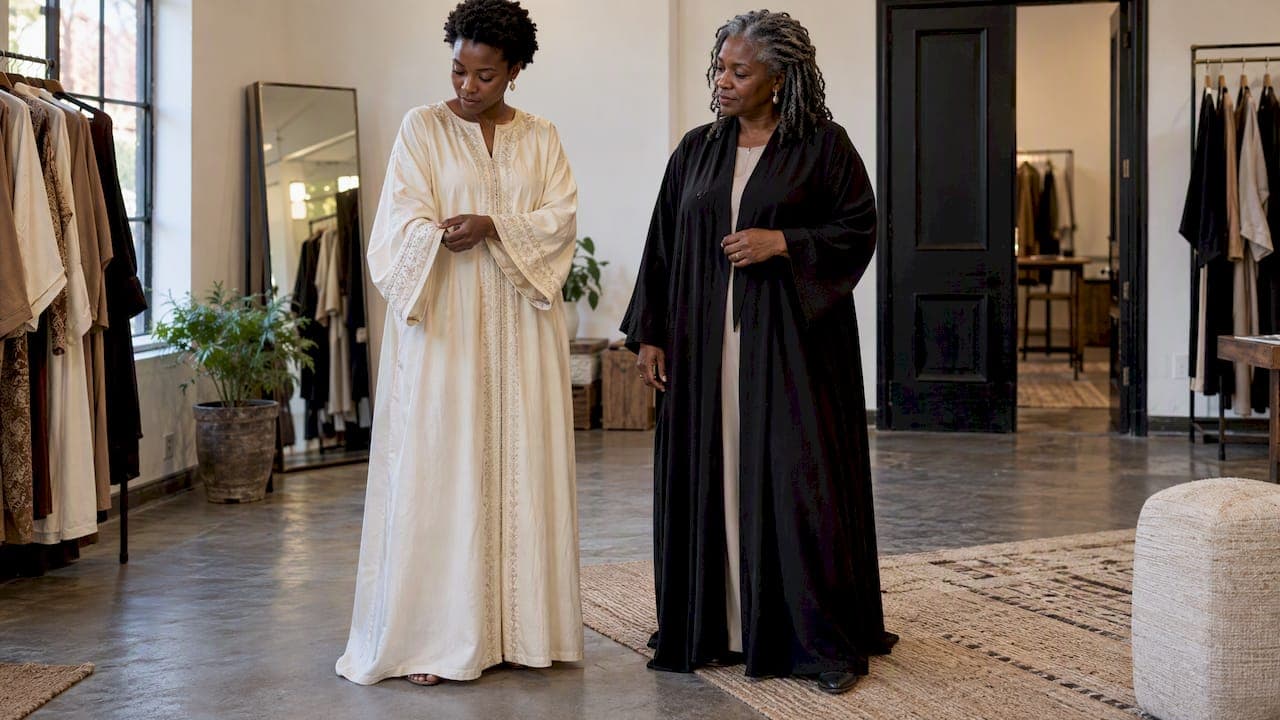
A kaftan is a loose, flowing robe or tunic that men and women have worn for centuries and that is now styled as everything from a beach cover-up to a wedding-guest dress. An abaya is a loose outer cloak, traditionally black, worn over everyday clothing and tied to the Arabian Peninsula and to modest dress. They look alike at a glance, since both are roomy and long, but they come from different traditions and do different jobs in a wardrobe. Here is how to tell them apart, where a tunic fits in, and how to wear each with respect.
TL;DR
- A kaftan is a robe or tunic worn as the garment itself, by men and women, in bold colors, prints, embroidery and rich fabrics.
- An abaya is an outer cloak worn over other clothes, traditionally black and associated with modest dress in the Gulf.
- A tunic is a shorter, simpler top. A kaftan runs from waist length to the floor and is usually cut fuller, with a more dramatic neckline and sleeves.
- The two have merged in "kaftan abayas," but the cultural roots are different, so use the right name and credit where each comes from.
- For West African style, look to the kaftan family: embroidered kaftans, agbada sets and matching sets made to be worn as the main statement.
Table of Contents
- What is a kaftan?
- What is an abaya?
- Kaftan vs abaya: the differences that matter
- What about the kaftan abaya?
- Kaftan vs tunic: where the line falls
- Why the kaftan crossed into Western wardrobes
- Wearing a kaftan or abaya respectfully
- Perspective: why we build around the kaftan family
- Find a kaftan made with intention
- How to style a kaftan
- Related garments you may be comparing
- FAQ
- Sources
What is a kaftan?
The kaftan is old. The Fashion Institute of Technology's fashion history timeline describes it as a robe or tunic worn by both men and women, with long, loose sleeves, and traces it to ancient Persia, from where it spread across Central and Western Asia. The American Heritage Dictionary defines it as a full-length garment with elbow-length or long sleeves worn chiefly in eastern Mediterranean countries, and adds that the westernized version is a loose, usually brightly colored tunic that can end at the waist or the ankle.
That range is why the word can feel slippery. A kaftan can be:
- a narrow-cut, long robe with full sleeves, which InStyle notes may have a deep open neck or open fully to the floor;
- a modern dress that is cinched at the waist, cut high-low, or finished with a handkerchief hem;
- a ceremonial or court garment. The Metropolitan Museum of Art explains that Ottoman palace workshops produced cloth of gold and silver for honorific garments given to courtiers and foreign ambassadors.
The thread running through all of them is that the kaftan is made to be seen. The cloth does the work: the weave, the embroidery, the dye, the drape.
You will also see the spelling variations kaftan, caftan and kuftan. They name the same family of garments, and you can search any of them when you shop.
What is an abaya?
The abaya is, at its root, a cloak. The Arabic word means exactly that, and The National describes it as a loose, flowing outer cloak worn over everyday clothing, most commonly in black and associated with the Arabian Peninsula. The same article notes that its origins are practical as well as cultural: among Bedouin communities the ample cut protected the wearer from sun and desert wind while allowing easy movement. Over time it became a marker of modest dress, particularly for women, although men historically wore similar outer cloaks.

Today's abayas are not all black. Designers across the Gulf work with color, embroidery and light fabrics, and the silhouette stays recognizable while the detail changes. What stays constant is the role: an abaya is a layer, worn over a dress, trousers or whatever the wearer has chosen for the day.
Kaftan vs abaya: the differences that matter
| Kaftan | Abaya | |
|---|---|---|
| What it is | A robe or tunic worn as the main garment | A cloak worn over other clothing |
| Who wears it | Men and women | Traditionally women, with similar cloaks historically worn by men |
| Typical color | Bright colors, prints, rich fabrics, embroidery | Traditionally black, with colored and decorated modern versions |
| Length | Waist length to floor length | Generally full length |
| Cultural roots | Ancient Persia, spread across Central and Western Asia, later adopted worldwide | Arabian Peninsula and the Gulf |
| Role in an outfit | The statement piece | The outer layer, often chosen for modesty |
| Opening | Pullover, deep neckline, or open to the floor | Commonly open at the front, worn like a coat, though cuts vary |
Three differences deserve a closer look.
Silhouette and construction
Both are loose, which is why people confuse them. The kaftan, though, is a complete garment with its own neckline, sleeves and decoration. The Met's essay on Western borrowing of Eastern dress points to the flat expanse of cloth, the looping and wrapping, and the integrity of untailored fabric as the heart of these traditions. A kaftan is often cut from simple rectangles so the textile can speak. An abaya is built to flow over what is underneath, so the cut is about drape and coverage.

Coverage and purpose
An abaya is chosen for modesty and is usually worn over clothing. A kaftan can be modest too, particularly in a long cut with full sleeves, but it is not defined by that. People wear kaftans for comfort, for ceremony, for the beach and for the red carpet.
Culture and context
This is the difference to respect most. The abaya is tied to the Gulf and to modest dress. The kaftan has a far wider geography, and in West Africa the kaftan family has its own living traditions, from men's flowing robes to embroidered sets for weddings and naming ceremonies.
What about the kaftan abaya?
If your search turned up "kaftan abaya," you found a hybrid. Retailers use the term for a garment that borrows the abaya's full-length, full-coverage cut and the kaftan's wide sleeves and flowing lines. It is loose, comfortable and modest, and it is a legitimate modern style.
If you wear one, use the name that fits: call a black cloak an abaya, call an embroidered robe a kaftan, and call a hybrid exactly what it is. We say more on that below.
Kaftan vs tunic: where the line falls
A tunic is the simpler cousin. The dictionary's description of the westernized kaftan as a loose tunic shows how close the words are, so the difference is often one of degree.
- Length. A tunic usually ends somewhere between the hip and the knee. A kaftan can be waist length, but the classic version reaches the ankle or floor.
- Fullness. A kaftan is cut fuller, with wide or dramatic sleeves, while a tunic is often closer to the body.
- Neckline and opening. Kaftans often have a deep V, a keyhole or a front that opens fully, which fits the InStyle description of an open neck or an opening down to the floor.
- Decoration. Embroidery around the neckline and cuffs, prints and rich fabrics are central to a kaftan. A tunic can be plain and still be a tunic.
- Role. A tunic is a top, worn with trousers, leggings or a skirt. A kaftan is usually the whole outfit.
A simple test: if you would put trousers under it, it is probably a tunic. If it stands alone and drapes to your ankles, it is a kaftan.
Why the kaftan crossed into Western wardrobes
The kaftan became a fixture of American closets in the twentieth century. The fashion history timeline notes that it was adopted in Western fashion as a symbol of comfort and exoticism, taken up by designers such as Halston and Rudi Gernreich as a unisex staple. Gernreich in particular used its simplicity to blur gender divisions through a garment that puts comfort ahead of body-accentuating tailoring.
That history is a gift and a reminder. The kaftan travels well because it is generous and easy. It also means that many kaftans sold in the United States are printed pieces detached from the traditions that shaped them. When you want the real thing, look for who made it, where, and how.
Wearing a kaftan or abaya respectfully
Wearing garments from other cultures is not wrong. Treating them carelessly is. A TED Ideas piece on borrowing clothing from another culture suggests practical habits: research the garment's cultural history, use its correct name, give credit where it is due, and think about whether wearing cultural items head to toe could make them look like a costume.
In practice:
- Learn the name and the origin. An abaya is not a kaftan, and an agbada is not either one.
- Credit the makers. If someone compliments your piece, say where it came from and who made it.
- Match the occasion. Wear a ceremonial piece to a celebration that suits it, not as a joke.
- Mix, don't mimic. Pair one meaningful piece with your own wardrobe instead of copying a full traditional look you have no connection to.
- Buy from people who share the story. Artisan-made, ethically produced pieces carry their origin with them.
Perspective: why we build around the kaftan family
At Sena Nukunu, we make and sell West African fashion, and the kaftan family sits close to our heart: kaftans, agbada sets, jackets and matching statement sets, made in limited quantities with ethical production and artisan craft. We are based in Florida, and we hear the same question from many of you: what is the difference, and which one should I wear?
Our answer is that a kaftan is a canvas. It asks you to notice the cloth, the embroidery, the way it moves when you walk into a room. An abaya has its own dignity and its own story, and we would never want to blur it into something it is not. Where our work lives is in the robes, kaftans and sets that carry West African heritage and are made to be the statement.
When you choose a piece, we hope you choose it for its story as much as its silhouette. Every stitch carries the spirit of the people who made it, and wearing it well starts with knowing that.
— Sena
Find a kaftan made with intention
If you are drawn to the flowing, regal shape of the kaftan, our collections bring together ready-to-ship pieces, from Woven Nobility: Kings' Robe for men to Woven Stride: Queen In Comfort for women. Each is made in limited quantities with ethical manufacturing and artisanal care.
You can also browse our women's dresses, see the Nyame Nti embroidered kaftan, or explore the men's agbada ensembles and heritage pieces for weddings and celebrations.
How to style a kaftan
Since the kaftan is the statement, everything else should support it. These are our own styling habits, offered as a starting point rather than rules.
Shoes
For daytime, flat sandals, leather slides or simple loafers keep the look relaxed. For evening or a wedding, a heeled sandal, a pointed flat or a wedge lengthens the line under a floor-length hem. Men's kaftans and agbada sets pair well with polished loafers or clean leather sandals. Check the hem first: sweeping lengths need shoes you can walk in.
Waist and shape
If the cut is voluminous, a slim belt or sash gives you shape without losing the drape. If the piece already has structure or heavy embroidery, leave it loose.
Jewelry and layers
With embroidered necklines, keep the necklace simple and let earrings do the talking. A fitted trouser or slim skirt underneath works well for shorter kaftans.
Work and everyday wear
A kaftan can sit comfortably in a professional setting with the right fabric and cut. Our guide to business casual African wear walks through how. For men, we break down four kaftan outfits and the fit and fabric rules behind them.
Getting the size right
Because kaftans are loose, shoppers often guess at size and end up with a piece that is too long or swallows their frame. Use our kaftan size guide and compare against garment measurements, not just a size letter. If you are weighing cost, our look at U.S. kaftan prices and craftsmanship explains what you are paying for at each level.
Related garments you may be comparing
People who ask about kaftans and abayas often meet a few other names:
- Agbada. A wide, flowing robe from West Africa, traditionally worn by men over matching inner pieces for weddings and ceremonies. It is a statement garment like the kaftan, though a distinct one. Our piece on tailoring women's agbada for U.S. shoppers shows how it can be adapted.
- Jalabiya, thobe and dishdasha. Long robes from the Arab world, mostly worn by men. They are close to the kaftan in cut but have their own regional traditions.
- Ankara sets. Matching tops and skirts in West African wax prints. Our Ankara skirt and blouse guide covers fit and styling.
If you wear a hijab with your outfit, we also wrote about hijab with African prints, which can be paired with kaftans and other loose silhouettes.
FAQ
What is the main difference between a kaftan and an abaya?
A kaftan is a robe or tunic worn as the main garment, by both men and women, usually in color, print or embroidery. An abaya is an outer cloak worn over other clothing, traditionally black and linked to the Gulf and modest dress. The kaftan is the statement; the abaya is the layer.
Can anyone wear a kaftan or an abaya?
Yes, but how you do it matters. Learn the garment's origin, use its correct name, and credit the culture it comes from. For an abaya in particular, be aware of its role in modest dress and avoid wearing it as a costume.
What is the difference between a kaftan and a tunic?
A tunic is generally a shorter, closer-fitting top worn with trousers or a skirt. A kaftan is cut fuller, often reaches the ankle or floor, and is usually worn as the whole outfit, with decoration at the neckline and sleeves.
What kind of shoes do you wear with a kaftan?
Flat sandals or slides suit a relaxed look, while heeled sandals, wedges or pointed flats dress up a long kaftan for evening. For men, loafers or leather sandals work well with kaftans and agbada sets.
Is a kaftan always modest?
Not always. A long kaftan with full sleeves can be very covering, but some are sleeveless, short or deeply open at the neck. Check the length, sleeve and neckline if modesty matters to you.
Sources
- kaftan, Fashion History Timeline
- 1970 Rudi Gernreich, Caftan, Fashion History Timeline
- American Heritage Dictionary entry for kaftan
- What Is a Caftan?, InStyle
- Silks from Ottoman Turkey, The Metropolitan Museum of Art
- Orientalism: Visions of the East in Western Dress, The Metropolitan Museum of Art
- Abaya: The Arabic word for cloak, The National
- When is it OK to wear an item from another culture, TED Ideas