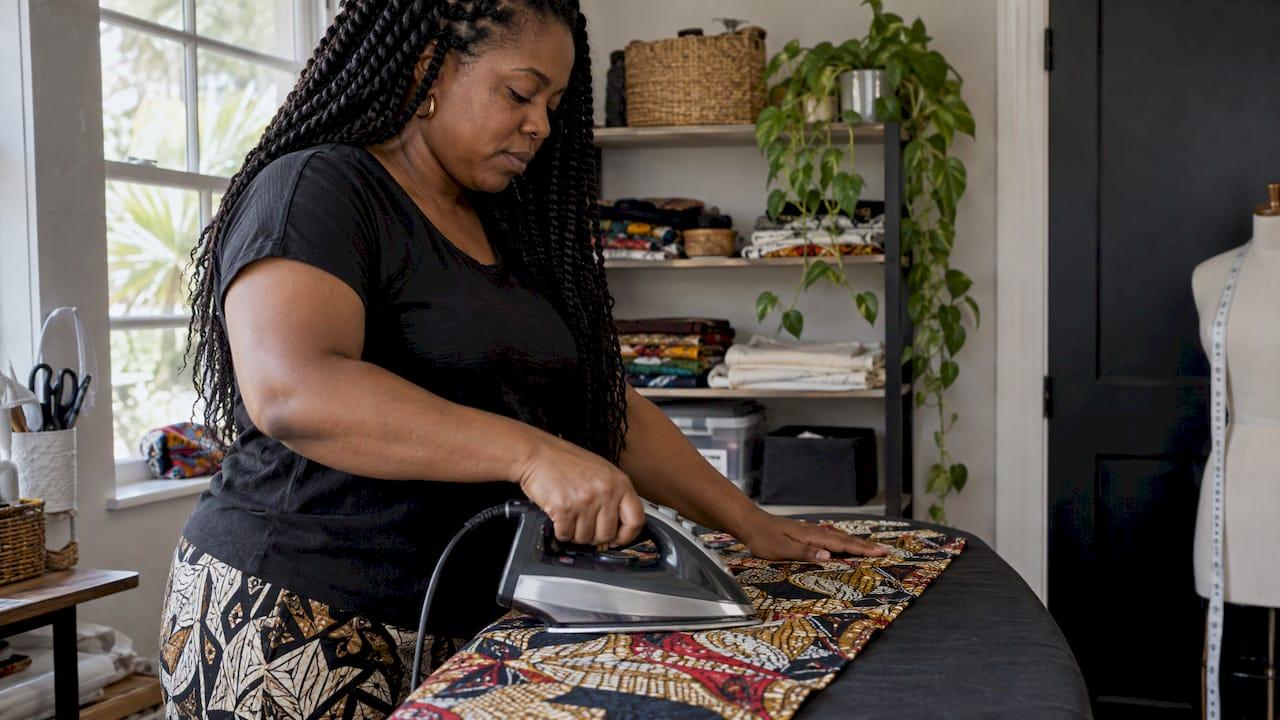
To iron wax print, turn the piece inside out, set the iron to the cotton setting (medium to high heat), press from the reverse side, and lay a thin pressing cloth between the iron and the fabric any time you work on the printed face. Lift and lower the iron rather than dragging it. That keeps the colors deep, the surface flat and the finish free of shine.
Wax print is one of the most vivid cloths in the world, and it deserves a little care. Whether you are pressing a length of yardage before it goes to your tailor, or freshening an agbada, kaftan or dress for a wedding or celebration, the steps below will help you do it with confidence.
TL;DR
- Iron wax print on the reverse side, with the fabric fully dry, using the cotton setting on your iron.
- Use a thin pressing cloth whenever you press the printed face, so the surface does not turn shiny.
- Press with a lift-and-lower motion instead of sliding the iron, which can stretch the cloth.
- Test a hidden spot first with a damp white cloth, so you know the color is stable before you press the whole piece.
- Stiffness in new cloth is normal and eases with washing and pressing.
Table of Contents
- Why wax print needs its own ironing routine
- Before you plug in the iron
- How to iron wax print, step by step
- Quick heat and technique guide
- How to soften stiff wax print while keeping the color
- Ironing a finished garment: dresses, kaftans and agbada
- Common mistakes to avoid
- Wear pieces made to be pressed and worn
- Our perspective
- A note on wearing wax print with respect
- FAQ
- Sources
Why wax print needs its own ironing routine
African wax prints, also called Ankara or Dutch wax prints, are cotton cloths printed with a batik-inspired technique. The V&A Museum traces the mechanized version to the Dutch industrialization of Javanese batik after Sir Thomas Stamford Raffles documented it in 1811. Machine-made prints were exported to the Dutch West Indies from 1850, found little demand there, and instead built a customer base in West Africa, where the cloth became a language of its own.
The printing process is the reason the cloth feels the way it does. Resin is applied to the fabric, the cloth is dyed, and the steps repeat to build the design. Because the color is worked deep into cotton fibers, a good wax print holds its brightness for years. It also means new cloth can feel stiff and slightly waxy out of the package. That stiffness is a finish, not a flaw, and a proper press is one of the best ways to relax it.
There is a practical reason to care about how you iron, too. In an interview with Al Jazeera, Accra designer Augustina Otoo described how good Ankara is soft to the touch and yields under an iron's heat, while some cheaper cloth stays stiff, crumples and carries a shiny finish that fades with washing. In other words, how your fabric responds to the iron tells you something about its quality.
Before you plug in the iron
A few minutes of preparation prevent most ironing mistakes.
- Make sure the fabric is completely dry. Pressing damp cloth with a hot iron creates steam you did not plan for, and wax print can show water marks when that happens.
- Read the care label on any finished garment. If a piece has a label, it outranks general advice. Handmade and limited-run garments often come with their own instructions, so keep them.
- Clean your soleplate. Residue from past projects can transfer onto a light print. Wipe the plate cool, then check it again once it is warm.
- Choose a pressing cloth. A plain white cotton handkerchief, a piece of muslin or a clean thin pillowcase works well. Avoid colored cloths, which can transfer dye when heated.
- Do a color test in a hidden spot. Dampen a small piece of white fabric, lay it over an inside seam allowance or hem, and press until both are dry. If color shows on the white cloth, wash that piece separately in cold water and do not press it over other light fabrics. For a garment that keeps shedding color, a professional cleaner is the safer next step.
The color test is especially worth doing on a brand-new piece, because the deepest reds, blues and blacks are the shades most likely to release a little dye on the first wash.
How to iron wax print, step by step
1. Set up a flat, padded surface
A firm ironing board with a clean cotton cover is ideal. A folded towel under a sheet works if you do not have a board. You want enough padding that the iron does not leave marks, and enough firmness that seams press flat.
2. Turn the piece inside out
Almost all pressing is best done from the wrong side. New Mexico State University's extension guide on pressing states that nearly all pressing is done from the wrong side of the fabric, and that when you must press the right side, a press cloth prevents shine. For wax print, whose surface carries the whole design, that advice matters even more. Pressing from the back keeps the printed face from picking up a glossy sheen.
3. Set the temperature for cotton
Wax print is cotton, so it takes cotton heat. Panasonic's ironing chart recommends high heat, setting 3, with steam if possible for cotton, and ironing on the reverse side to prevent shine. In practice, many people prefer to start at medium and raise the heat only if the creases stay put, especially on a vivid, dark or heavily saturated print. If your fabric is a polycotton blend or you are unsure of the fiber, start low. Synthetic fibers melt and scorch long before cotton does.
4. Decide on steam
Steam relaxes deep creases and helps soften a stiff new cloth. It can also leave water spots on some finishes. A sensible approach:
- For new yardage that needs softening: use a steam iron on the reverse side after the fabric has been washed and dried.
- For a finished garment with a delicate hand or a crisp finish: press dry from the reverse side, and use a light mist only on stubborn creases.
- For the printed face: always use a pressing cloth, and keep steam moderate.
Occasional gentle steaming can also help bring back luster. Over-pressing, on the other hand, can flatten texture, so stop once the crease has gone.
5. Press, do not scrub
There is a real difference between ironing and pressing. The NMSU guide describes pressing as a lower-and-lift motion that applies pressure without dragging, which helps avoid stretching the cloth, and warns that too much heat, steam or pressure can dull or flatten the surface. Set the iron down on one section, lift it, and move to the next. Work with the grain of the fabric, not across it, and take extra care on curves, bias edges and necklines where the cloth stretches easily.
6. Let it cool before moving it
Hang the piece or lay it flat until it has cooled and the fibers have set. If you fold or put it on a hanger while it is still warm, you can press new creases back in.
Quick heat and technique guide
| Situation | Side to press | Heat | Steam | Pressing cloth |
|---|---|---|---|---|
| New washed yardage, pre-sewing | Reverse | Cotton setting | Yes, to relax stiffness | Not needed on reverse |
| Finished dress or kaftan | Inside out | Medium to cotton setting | Light | Yes if pressing the face |
| Heavily embroidered or embellished area | Reverse, on a padded towel | Medium | Light mist only | Yes |
| Dark or deeply saturated print | Reverse | Start medium | Moderate | Yes |
| Unknown fiber or polycotton | Reverse | Low, then raise slowly | Minimal | Yes |
How to soften stiff wax print while keeping the color
New wax print can feel firm, almost papery. A few habits help it soften without dulling the design:
- Wash it before you cut or sew, using cool water and a mild detergent, and wash similar colors together. Our own guide on how to care for African fabrics walks through the routine.
- Dry it in the shade. Direct sun can bleach strong pigments over time.
- Press it while it is slightly dry to the touch, from the reverse side with steam, to remove leftover stiffness and the creases from folding.
- Be patient. The cloth softens with every wash and wear, and the color stays strong.
Expect some shrinkage on the first wash with cotton, which is why you wash before cutting a pattern. Our guide on whether Ankara shrinks explains what to expect and how to prevent it.
Ironing a finished garment: dresses, kaftans and agbada
Finished pieces behave differently from flat yardage, because seams, linings, trims and embroidery all react to heat in their own way.

Dresses and jackets. Turn the garment inside out. Press seams open or to one side as they were sewn, then do the body. Use the pressing cloth over any area you need to iron from the front, such as a collar or placket. Hang the piece immediately.
Kaftans and flowing sets. Long, loose pieces crease at the fold lines. Hang the garment from a sturdy hanger, then press it in sections, working from the top down, so you are not pulling a finished area across the board as you go.
Agbada and layered ensembles. An agbada is the wide, flowing robe worn over a tunic and trousers, and it has large panels that crease when stored or packed. Press each layer separately, starting with the inner tunic and trousers and finishing with the outer robe. Lay the wide sleeves flat on the board and press from the inside, so the face of the fabric stays untouched. If your outfit has embroidery or raised detailing, place a thick towel on the board, lay the piece face down, and press lightly from the back. The embroidery sinks into the towel rather than being flattened.

Travel creases. If you are packing for a wedding or celebration, fold along seams, roll the sleeves and put tissue between layers. When you arrive, hang the piece in a steamy bathroom first, then finish with a quick press.
If a spill or stain has set into your garment, read our guide to wax print stain care before you apply heat, because pressing can lock a stain in. For pieces that need more than a home wash, see whether you can dry clean Ankara.
Common mistakes to avoid
- Ironing the printed face directly on high heat. This is the fastest route to shine and flattened texture.
- Pressing a stain. Heat can set it permanently. Treat the stain first.
- Using a dirty iron or colored pressing cloth. Dye and residue can transfer.
- Dragging the iron. On bias edges and curves, this stretches the cloth out of shape.
- Skipping the hidden-spot color test. One minute of testing saves a favorite piece.
- Pressing damp cloth with a hot iron by accident. Let it dry first, then press with intention.
- Leaving the iron on one spot. Keep it moving or lift it, particularly with steam.
Wear pieces made to be pressed and worn
A well-made piece should come to life under a careful press: the creases fall away, the color sits deep in the weave, and the garment hangs the way its maker intended. At Sena Nukunu, our collections are inspired by West African heritage and crafted in limited quantities with ethical manufacturing. They include dresses, kaftans, agbada sets, jackets and matching statement sets for men and women.
If you are looking for something to wear to a wedding, a celebration or the office, explore our women's dresses, browse the full collections, or look at our Men's Agbada Ensembles and Heritage pieces. We also offer custom garments, and you can see how that works on our services page.
Whatever you choose, keep the care label, and use the pressing steps above to keep it looking its best.
Our perspective
We believe a garment is a story you wear, and caring for it is part of telling that story well. Every piece we offer is inspired by West African heritage, made with ethical manufacturing and artisanal craftsmanship, and released in limited quantities so each one carries intention.
A careful press is a small ritual that honors that work. When you turn a piece inside out, lower the iron slowly and let the cloth cool on a hanger, you are respecting the hands that shaped it. That is how a kaftan, an agbada or a dress stays vibrant for celebrations, for milestones and for everyday confidence.
We design for people who want to feel regal, comfortable and proud in what they wear, and we hope these steps help your pieces carry that feeling for years. If you are building a wardrobe that celebrates heritage, we would be honored to dress you.
Sena
A note on wearing wax print with respect
Wax print carries layers of history, from Indonesian batik to Dutch industry to West African identity. In her academic study, Manon van den Brekel concludes that wearing wax print is not completely off-limits for people outside Africa, and that appropriateness depends on where the fabric comes from, whether you know its history, and whether you genuinely care about Africa and Africans. Learning where your cloth was made, and who made it, is part of wearing it well. Our guides on what Ankara fabric is and how to verify authentic wax print are a good place to begin.
FAQ
Can you iron African wax print?
Yes. Wax print is cotton, so it handles a cotton-setting iron well. Iron it from the reverse side once it is fully dry, and use a pressing cloth if you need to press the printed face. Start lower on blends or if you are unsure of the fiber.
Should I use steam on wax print?
Steam helps soften stiff new cloth and release deep creases, especially when you press from the reverse side. Use it in moderation, because heavy steam can leave water spots on some finishes. On a finished garment, a light mist for stubborn creases is usually enough.
Why does my wax print look shiny after ironing?
Shine usually comes from too much heat, pressure or steam directly on the printed face. Turn the piece inside out, lower the heat slightly, and place a thin cloth between the iron and the fabric. Lift and lower the iron rather than sliding it.
Do I need to wash wax print before ironing it?
For yardage you plan to sew, washing first lets the cloth shrink and soften before you cut. Wash in cool water with a mild detergent, dry in the shade and then press. For a finished garment, follow its care label and press only when it is dry.
Sources
- Fabric of the African Diaspora, V&A Museum
- Fabric wars: Ghana's colourful prints face renewed Chinese competition, Al Jazeera
- Pressing Pointers, New Mexico State University
- Fabric ironing chart and recommendations, Panasonic
- Bringing African wax print to Africa, Manon van den Brekel