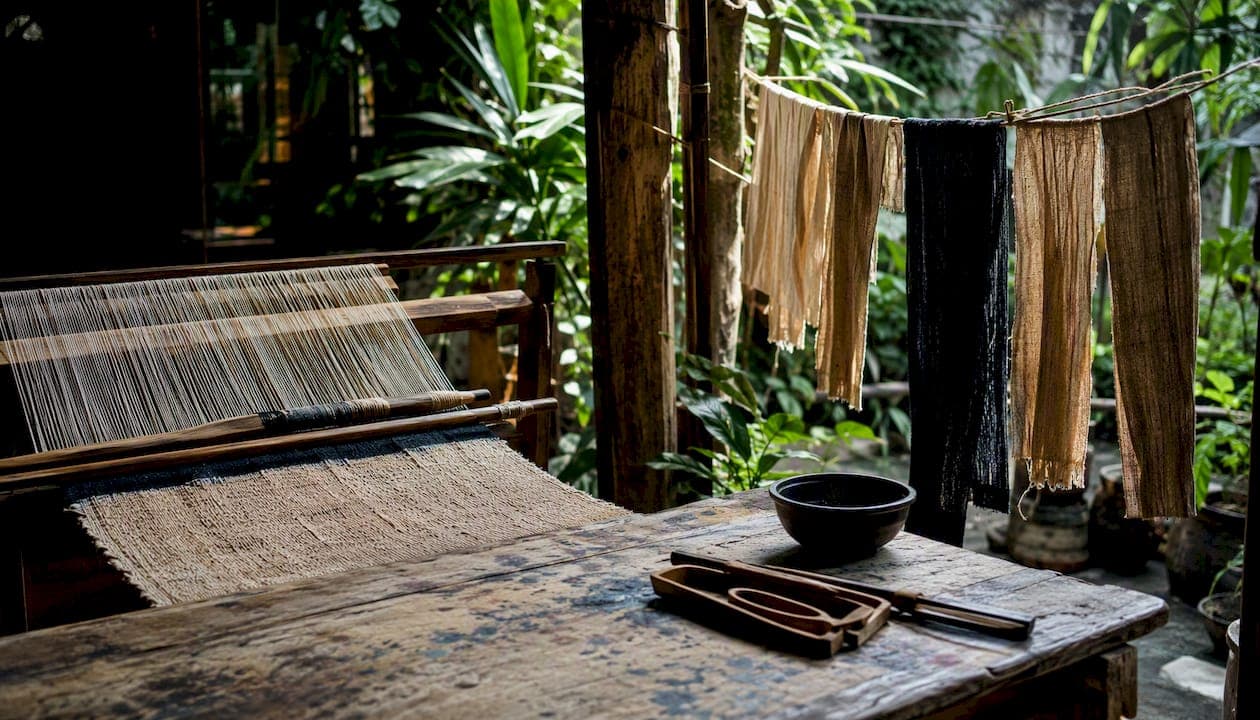
Artisan techniques are material-based, manually executed methods of making that pass from one generation to the next through apprenticeship, studio practice, or community tradition. The short answer: they are organized by the material they work with, and that material determines the tools, the process stages, and the cultural lineage behind every finished object. If you want to recognize, learn, or support these crafts, starting with material categories gives you the clearest map.
The major families you will encounter across this article:
- Textiles (weaving, dyeing, embroidery, batik)
- Ceramics and clay (hand-building, wheel-throwing, kintsugi repair)
- Metalwork and jewelry (lost-wax casting, forging, filigree)
- Wood, glass, paper, basketry, leather, and printmaking
Key Takeaways
Artisan techniques are organized by material, transmitted through practice, and distinguished from industrial methods by the presence of embodied human judgment at every stage.
| Point | Details |
|---|---|
| Material categories orient learning | Ten major families (textiles, ceramics, metal, wood, glass, paper, basketry, leather, jewelry, printmaking) each have distinct tools and processes. |
| Hands-on learning is most effective | Apprenticeships, studio classes at schools like Penland or Haystack, and maker spaces provide feedback that online courses alone cannot. |
| West African textiles are a living tradition | Aso-oke weaving, indigo resist dyeing, and hand-stitched embellishment are active craft systems with direct influence on contemporary fashion. |
| Preservation requires economic support | UNESCO frames safeguarding as protecting living skills and communities; buying directly from named artisans and supporting apprenticeships are the most direct actions. |
| Start with a beginner project | A hand-stitched patch, pinch pot, paper marbling sample, or raffia coaster can be completed in an afternoon with materials from any craft retailer. |
Table of Contents
- What makes a technique truly artisan?
- The main types of artisan techniques, organized by material
- Materials, tools, and the process stages most techniques share
- How you can actually learn these techniques
- West African textile techniques and what they mean for fashion today
- Why preserving artisan techniques matters more than you might think
- Beginner projects that let you try a technique this weekend
- How artisan techniques evolved from ancient trade routes to modern studios
- Where artisan techniques and contemporary craft innovations meet
- Why traditional methods still shape the objects that matter most
- Sources
What makes a technique truly artisan?
An artisan technique is defined by four core features: manual skill, low mechanization, material sensitivity, and a lineage of transmission. The maker's hand is the primary instrument, and the knowledge lives in that hand, not in a machine setting or a factory protocol.
Industrial processes optimize for uniformity and speed. Artisan methods do the opposite: they accept, even prize, the variation that comes from a human working with a responsive material. A wheel-thrown bowl will never be perfectly symmetrical, and that asymmetry is part of its value. Practitioner interviews and documentary footage consistently show that artisans in fields as different as kintsugi, calligraphy, and sign painting treat process-specific tools and visible human traces as integral to the object's meaning, not as flaws to correct.
Two examples illustrate the boundary well. Kintsugi, the Japanese practice of repairing broken ceramics with lacquer mixed with gold powder, treats the break itself as part of the object's history. The repair is not hidden; it is celebrated. Dhokra lost-wax casting, practiced in Odisha, India, begins with a beeswax model hand-formed by the artisan, encased in clay, and fired in a small furnace where the artisan reads flame color to judge when the pour is complete. Both techniques require embodied knowledge that no machine setting can replicate.
The main types of artisan techniques, organized by material
The categories below draw on the broad vocabulary of handcraft traditions worldwide. Each entry names the technique family, lists key sub-techniques, identifies typical materials and tools, and points to a regional example that grounds the category in a living tradition.
| Category | Key sub-techniques | Core materials | Essential tools | Regional example |
|---|---|---|---|---|
| Textiles | Weaving, batik, tie-dye, ikat, embroidery | Natural fibers (cotton, silk, wool), plant dyes | Loom, wax tjanting, resist clamps | Aso-oke strip weaving, Nigeria |
| Ceramics | Hand-building, wheel-throwing, kintsugi, raku | Earthenware, stoneware, porcelain, gold lacquer | Potter's wheel, kiln, rib tools | Kintsugi, Japan |
| Metalwork | Lost-wax casting, forging, filigree, repoussé | Bronze, silver, copper, beeswax | Crucible, hammer, chasing tools | Dhokra casting, Odisha, India |
| Woodwork | Carving, marquetry, joinery, turning | Hardwoods, softwoods, natural oils | Chisels, gouges, lathe | Yoruba wood carving, West Africa |
| Glasswork | Blowing, lampworking, fusing, mosaic | Silica glass, metal oxides | Blowpipe, mandrel, kiln | Murano glassblowing, Italy |
| Papercraft | Washi papermaking, marbling, origami, bookbinding | Kozo fiber, natural pigments, paste | Mould and deckle, burnisher | Washi, Japan |
| Basketry | Coiling, plaiting, twining, wickerwork | Reed, rattan, sweetgrass, willow | Awl, packing tool | Gullah sweetgrass baskets, South Carolina |
| Leather | Tooling, saddle stitching, burnishing, dyeing | Vegetable-tanned leather, natural waxes | Swivel knife, stitching pricking iron | Moroccan tannery leather, North Africa |
| Jewelry | Filigree, granulation, enameling, wire-wrapping | Gold, silver, gemstones, enamel | Soldering torch, burnisher, mandrel | Artisan jewelry traditions globally |
| Printmaking | Woodblock, screen printing, etching, linocut | Ink, linen, paper, acid-resistant ground | Brayer, press, etching needle | Ukiyo-e woodblock, Japan |
A few entries deserve a closer look. Aso-oke strip weaving from Nigeria uses a narrow-band loom to produce long strips of woven cloth, which are then sewn together into garments worn at celebrations and ceremonies. The geometric patterns carry social meaning that a mass-produced print cannot carry. Murano glassblowing in Italy requires a team working in coordinated silence around a furnace at roughly 2,000°F, each person's role timed to the glass's cooling curve. And handmade globemaking, as documented by National Geographic, uses hand-cut paper gores applied wet and stretched carefully onto a sphere, a process so sensitive to humidity and temperature that a shift in workshop conditions can ruin a day's work.
Materials, tools, and the process stages most techniques share
Many artisan techniques share a compact set of materials and a recognizable sequence of stages, even when the finished objects look nothing alike. Understanding this shared grammar helps you learn faster and assess craft objects more accurately.
Common raw materials across traditions:
- Natural fibers: cotton, wool, silk, linen, raffia
- Clays and slips: earthenware, stoneware, kaolin
- Metal alloys: bronze, brass, silver, copper
- Plant-based dyes and pigments: indigo, madder, turmeric, iron-rich mud
- Natural adhesives and finishes: beeswax, urushi lacquer, linseed oil, natural gum
Commonly used hand tools:
- Forming tools: potter's wheel, loom, carving chisels, blowpipe
- Joining tools: stitching awl, soldering iron, mortise chisel
- Finishing tools: burnisher, sandpaper, wax applicator, natural-hair brush
The process stages follow a reliable arc: preparation (sourcing and conditioning material), forming (shaping by hand or with a simple tool), joining or assembling, decorating, and curing or drying. Edo lacquerware in Japan illustrates how demanding that final stage can be. A single artisan often manages every step from raw urushi to finished surface, and the lacquer cures through a humidity-sensitive chemical reaction that requires controlled drying conditions and specialized tools, including brushes made from human hair, to achieve the right surface quality.
Safety notes: Kilns reach temperatures that require heat-resistant gloves and proper ventilation. Soldering and metal casting demand eye protection and fire-safe workspaces. Some natural dyes and mordants (alum, iron, tannin) require careful handling and proper disposal. Solvents used in printmaking etching baths are corrosive and need ventilation.
Pro Tip: *Humidity and temperature affect nearly every artisan process involving water, adhesive, or organic material. Keep a simple thermometer and hygrometer in your workspace.
How you can actually learn these techniques
The most reliable path into artisan practice is instructor-led studio learning or guild-based apprenticeship, where you get immediate feedback on your hand position, tool pressure, and material response. Online courses and hybrid programs have expanded access significantly, but they work best as supplements to hands-on time, not replacements for it.
Learning routes, roughly in order of depth:
- Apprenticeship or guild program: The deepest transmission. Look for craft guilds (the American Craft Council maintains directories), heritage programs at museums, or master-artisan studios that take on learners. Expect a commitment of months to years.
- Instructor-led studio class: Community colleges, art centers, and craft schools (Penland School of Craft, Haystack Mountain School of Crafts, Arrowmont School of Arts and Crafts) offer weekend intensives through semester-long courses. These give you kiln access, loom time, or metalworking equipment you cannot easily replicate at home.
- Maker spaces: Cities across the United States now have shared fabrication studios with ceramics wheels, screen-printing setups, and woodworking tools available by membership. Search the Fab Lab Network or local makerspace directories.
- Online courses: Platforms like Craftsy and Domestika offer video instruction in weaving, printmaking, and surface design. Pair these with a local studio for hands-on feedback.
- Museum workshops: The Smithsonian, the Metropolitan Museum of Art, and many regional craft museums run public workshops tied to their collections. These often connect technique to cultural context in ways a generic class does not.
Before you enroll, ask:
- What is the class-to-student ratio, and how much individual feedback will you receive?
- Are materials included, or do you need to purchase a kit separately?
- Does the studio have proper ventilation, safety equipment, and a first-aid protocol?
- What is the expected skill level, and does the curriculum include a finished project?
- Is there a continuation class if you want to go deeper?
Pro Tip: Start with a one-day or weekend workshop before committing to a multi-week course. A short session tells you whether the material and the instructor's teaching style suit you, and it costs far less if the fit is wrong.
West African textile techniques and what they mean for fashion today
West African textile traditions are among the most technically sophisticated and culturally layered handcraft systems in the world, and they are very much alive in contemporary fashion. Every stitch and pattern carries the spirit of a legacy that spans centuries of trade, ceremony, and community identity.
Three techniques stand out for their influence on modern apparel:
Indigo resist dyeing uses a fermented indigo vat and a resist substance (mud, wax, or tied fabric) to create patterns by blocking dye from reaching certain areas of the cloth. The process requires careful vat maintenance, precise timing, and repeated dipping to build depth of color. The resulting blues range from pale sky to near-black, and no two pieces are identical.
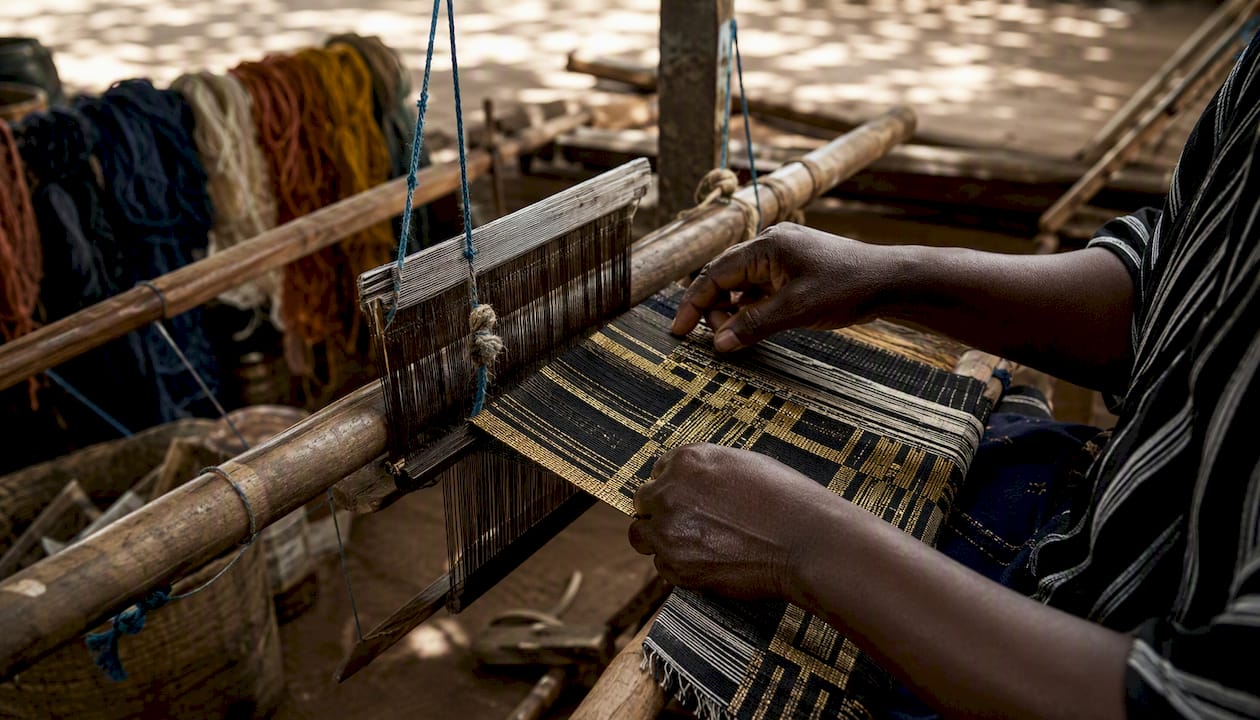
Aso-oke weaving is a Yoruba strip-weaving tradition from southwestern Nigeria. Weavers work on a narrow horizontal loom, producing long strips of cloth in cotton, silk, or lurex that are sewn together into wider fabric. The geometric patterns are encoded with social meaning: specific designs mark weddings, chieftaincy, and celebration. The loom itself is portable, and the craft has been passed through families for generations.
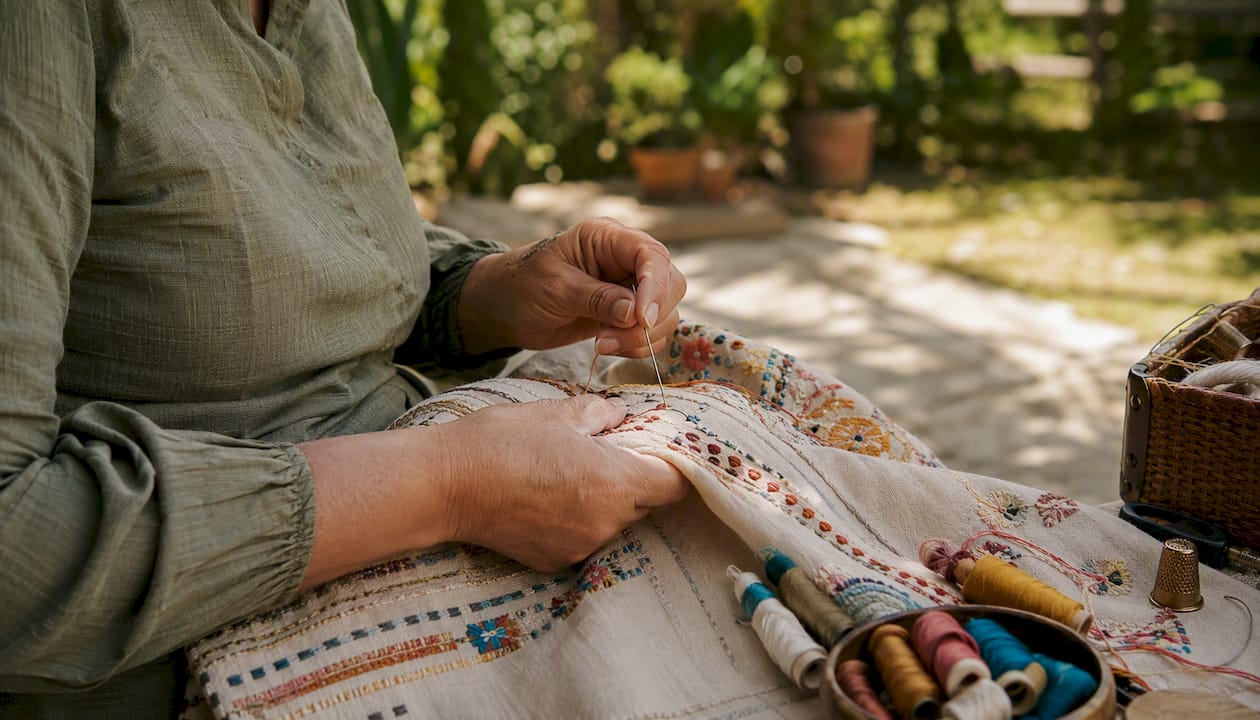
Hand-stitched embellishment, including couching and appliqué, adds dimension and narrative to fabric surfaces. Artisans use needle, thread, and sometimes beads or metallic cord to build up patterns that cannot be replicated by embroidery machines at the same level of intentionality.
For buyers, verifying handmade work means looking for slight irregularities in pattern repeat, natural dye variation across the cloth, and hand-finished edges. Ask sellers about the weaver or dyer by name, the region of production, and whether the artisan receives a fair share of the sale price. A West African artisan techniques list is a useful reference when you are evaluating a purchase. Senanukunu's handcrafted fashion checklist walks you through the specific signals of authentic, ethically produced West African garments.
Care for these textiles: Hand-wash in cold water with a gentle, pH-neutral soap. Avoid prolonged sun exposure, which fades natural dyes faster than synthetic ones. Store folded in breathable cotton, not plastic, to prevent moisture buildup.
Pro Tip: Natural indigo dye continues to oxidize and deepen slightly with wear and washing over the first few months. This is not a defect; it is the dye behaving as it should. Embrace the evolution.
Why preserving artisan techniques matters more than you might think
Safeguarding traditional craftsmanship is not about freezing techniques in a museum case. UNESCO's framework for intangible cultural heritage treats these skills as living practices that sustain communities, and it emphasizes that economic incentives and contemporary design collaborations are among the most effective tools for keeping them viable. The knowledge lives in people, not objects, and when the last practitioner of a technique retires without passing it on, that knowledge is gone.
The economic dimension is real. Craft traditions support livelihoods in communities where industrial employment is limited or absent. Dhokra lost-wax artisans in Odisha have adapted their designs for contemporary buyers through design intervention and patronage, demonstrating that tradition and market relevance are not opposites. Similarly, high-craft techniques like grand feu enamel and saddle stitching persist in luxury workshops precisely because they produce results that machines cannot replicate, which gives skilled practitioners a durable market position.
Practical ways you can support artisan traditions:
- Buy directly from artisans or from retailers who name and compensate their makers fairly.
- Commission custom pieces rather than buying mass-produced alternatives when your budget allows.
- Support apprenticeship programs through donations or by advocating for them at cultural institutions.
- Share documentation: photograph, record, and publish craft processes with the artisan's permission.
- Visit and fund craft museums, guild exhibitions, and heritage festivals.
- Choose handcrafted apparel that reflects ethical production over fast-fashion alternatives.
Beginner projects that let you try a technique this weekend
The fastest way to understand an artisan technique is to attempt it yourself, even at a small scale. These projects require minimal equipment and can be completed in an afternoon.
1. Hand-stitched fabric patch (textiles)
Skill level: Beginner. Time: 1–2 hours.
Materials: A scrap of woven cotton or linen, embroidery floss in two colors, an embroidery needle, a small embroidery hoop, scissors.
- Stretch the fabric in the hoop so it is taut but not distorted.
- Draw a simple geometric shape on the fabric with a water-soluble pen.
- Use a running stitch to outline the shape, then fill with satin stitch or cross-stitch.
- Finish by securing the thread on the back with two small knots.
Safety note: Needles are sharp; keep a pincushion nearby and work in good light.
2. Pinch pot (ceramics)
Skill level: Beginner. Time: 30–60 minutes, plus drying time.
Materials: Air-dry clay (available at most craft stores), a small bowl of water, a wooden rib or butter knife.
- Roll a ball of clay roughly the size of a tennis ball.
- Press your thumb into the center, stopping about half an inch from the base.
- Pinch the walls outward and upward, rotating the ball as you work.
- Smooth the rim with a damp finger and set on a wire rack to dry for 24–48 hours.
3. Paper marbling sample (papercraft)
Skill level: Beginner. Time: 1–2 hours.
Materials: A shallow tray, carrageenan size (prepared from powder), marbling inks or acrylic paints thinned with ox gall, a comb or toothpick, watercolor paper, alum solution.
- Soak the paper in alum solution for 30 minutes and let it dry completely.
- Float drops of ink on the size surface; they should spread into circles.
- Draw a comb or toothpick through the ink to create patterns.
- Lay the paper ink-side down onto the size for 20–30 seconds, then lift and rinse gently.
Disposal note: Carrageenan size is biodegradable; dispose of it down the drain with plenty of water. Acrylic paint residue should go in the trash, not the drain.
4. Sweetgrass-style coaster (basketry)
Skill level: Beginner. Time: 2–3 hours.
Materials: Raffia or paper reed, a blunt tapestry needle, scissors, a small bowl of water.
- Soak the raffia in water for 10 minutes to make it pliable.
- Coil a small bundle of raffia into a tight circle roughly 1 inch in diameter.
- Wrap a length of raffia around the coil and stitch through the previous row to bind each new coil to the last.
- Continue coiling and stitching outward until the coaster reaches 4–5 inches in diameter, then tuck and stitch the end to finish.
Starter kits for all four projects are available at most craft retailers (Michaels, JOANN, local art supply stores) or through community college craft departments that sell materials to the public.
How artisan techniques evolved from ancient trade routes to modern studios
Artisan techniques did not develop in isolation. They traveled along trade routes, spread through conquest and migration, and transformed when different material traditions met. The Silk Road carried not just silk but the dyeing, weaving, and embroidery knowledge of Central Asian, Persian, and Chinese workshops into Europe and Africa simultaneously. West African indigo traditions share structural similarities with Japanese resist dyeing not because of direct contact but because both cultures independently discovered that fermented indigo vats and wax or mud resists produce the most stable, saturated blues available from plant sources.
The Industrial Revolution of the 18th and 19th centuries is the sharpest inflection point in this history. Mechanized looms, cast-iron presses, and factory ceramics displaced thousands of artisan workshops across Europe and North America within a generation. What survived did so for one of two reasons: either the technique produced results that machines genuinely could not replicate (hand-stitched leather saddles, hand-blown glass), or it carried cultural meaning that made the handmade version worth more to its community than the machine-made substitute.
The Arts and Crafts movement of the late 19th century, led by figures like William Morris in Britain, was a direct response to industrialization. It argued that handmade objects carried moral and aesthetic value that factory goods lacked, and it seeded the studio craft movement that produced today's craft schools, maker spaces, and guild networks. The contemporary resurgence of interest in fermentation, natural dyeing, and hand-building ceramics follows the same logic: people reach for handcraft when they feel that speed and uniformity have cost them something real.
Where artisan techniques and contemporary craft innovations meet
The line between traditional artisan practice and contemporary craft innovation is genuinely blurry, and that is a sign of health, not confusion. The most interesting work happening in craft studios today sits exactly at that boundary.
Traditional techniques supply the material knowledge: how clay responds to heat, how indigo behaves in a vat, how beeswax flows into a mold. Contemporary innovation supplies new questions: What happens when a ceramicist uses 3D-printed molds to create forms that hand-building cannot achieve, then finishes them entirely by hand? What does natural indigo dyeing look like when applied to synthetic performance fabric? These are not betrayals of tradition; they are the same experimental impulse that produced kintsugi in the first place.
The overlaps are practical as well. Screen printing, which began as a hand-pulled process, now exists on a spectrum from fully manual studio practice to semi-automated production. A maker who pulls every screen by hand and mixes their own inks by eye is practicing an artisan technique. A studio that uses a computerized exposure unit but hand-pulls every print occupies a hybrid position. Neither is more legitimate; they serve different purposes and produce different objects.
What distinguishes artisan work at any point on that spectrum is the presence of embodied judgment: the maker's decision, in real time, about pressure, timing, and material response. That judgment is what craft practitioners describe as the irreplaceable core of their practice, and it is what gives handmade objects their particular quality of presence. Recognizing artisanal craftsmanship in a finished piece often comes down to reading those traces of judgment in the surface.
Why traditional methods still shape the objects that matter most
There is a reason makers return to traditional methods even when faster alternatives exist: the technique shapes the object in ways that cannot be separated from the material and the hand. A saddle-stitched leather bag will outlast a machine-stitched one because the two threads lock independently; if one breaks, the stitch holds. A kintsugi-repaired bowl carries its history visibly, which makes it more meaningful to its owner, not less. These are not sentimental arguments. They are material facts about how certain techniques produce certain results.
What often gets underestimated is how much the maker's identity is formed by the technique itself. Apprenticeship in a craft tradition is not just skills transfer; it is the transmission of a way of seeing and valuing material. A weaver who has spent years reading warp tension by touch perceives cloth differently than someone who has only bought it. That perceptual depth is what makes handmade variation legible as quality rather than inconsistency.
The communities built around craft traditions carry this knowledge collectively. Guilds, family workshops, and regional craft centers are not just economic units; they are the social structures through which embodied knowledge survives. Supporting them is not nostalgia. It is how the knowledge stays alive.
Sources
The sources below grounded this article's claims and offer deeper exploration for readers who want to go further.
- Watch artisans craft Nat Geo's enormous new handmade globe | National Geographic
- Traditional craftsmanship | UNESCO — Intangible Cultural Heritage
- Video: Almost Lost Arts: Traditional Crafts and the Artisans Keeping Them Alive | Peabody Museum of Archaeology & Ethnology
- “Lacquer Is Like a Child": The Philosophy Behind the "Living" Art of Edo Lacquerware | Artisan
- Inside Odisha’s Dhokra craft: The lost-wax tradition surviving against the odds | The Indian Express
- Handicraft — Wikipedia
Senanukunu brings the living tradition of West African artisanship directly to your wardrobe. Every piece in the collection reflects the same material care and cultural intention described throughout this article, from the indigo-influenced colorways to the hand-finished details that no factory run can replicate. Explore the full range of artisan-inspired dresses and statement sets and find the piece that carries a story worth wearing.