TL;DR:
- Cultural motifs in modern dresses embody traditional symbols and craft techniques that tell meaningful stories. These motifs enhance perceived value, support artisan economies, and honor heritage through careful technique and attribution. Ethical sourcing and authentic craftsmanship are crucial for respecting cultural significance and ensuring quality.
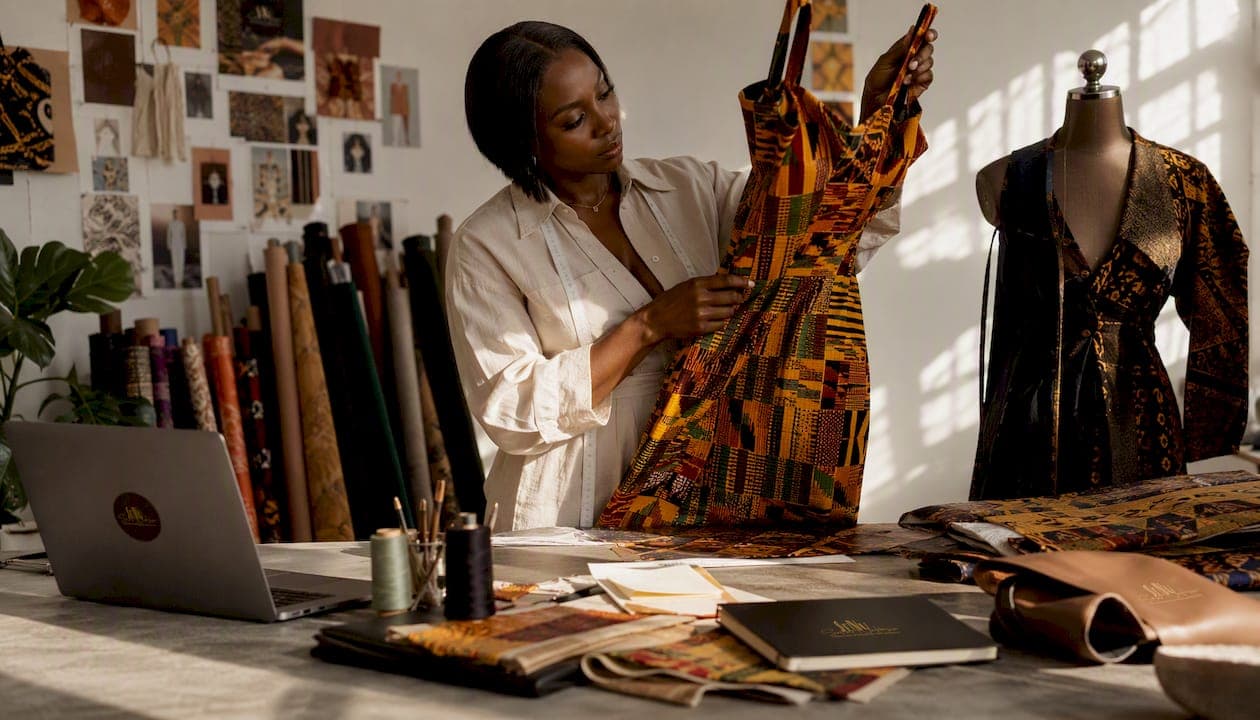
Cultural motifs in modern dresses are traditional patterns, symbols, and craft techniques — think kente stripes, Ajrak block-print borders, batik wax-resist designs, and mirror-work embroidery — reworked into contemporary silhouettes to carry heritage, identity, and design distinction into everyday wear. This is not a trend. It is a living conversation between past and present, where every stitch and printed repeat tells a story that mass-market fast fashion simply cannot replicate.
Why does it matter right now? Motifs function as storytelling devices that add perceived worth to a garment, differentiate ready-to-wear in a crowded market, and directly support artisan economies when sourced with intention. Consider three quick examples:
- A kente-stripe panel sewn into the front of a wrap dress, drawing on the Asante royal court tradition of named, symbolic weave patterns
- An Ajrak block-print border framing the hem of a midi shirt dress, its geometric precision achieved through carved wooden stamps pressed in indigo and madder
- A mirror-work sequined yoke reinterpreted on a relaxed cotton dress, echoing the reflective embroidery of Kutch artisans while fitting a modern, casual silhouette
Senanukunu was built around exactly this kind of intentional design, translating West African heritage motifs into wearable, ethically made pieces for today's style-conscious consumer.
Table of Contents
- What cultural motifs in modern dresses actually mean — and why they matter
- How designers put traditional motifs onto modern dresses
- 10 named motifs, their origins, and how they appear in modern dresses
- How to style motif-driven dresses for any occasion
- Cultural appropriation vs. appreciation: what designers and shoppers need to know
- How to choose authentic, well-made motif dresses
- Senanukunu: how one brand puts ethical motif design into practice
- Key Takeaways
- Why motifs matter more now than ever
- Senanukunu's West African-inspired dresses are worth exploring
- Useful sources for deeper reading
What cultural motifs in modern dresses actually mean — and why they matter
A cultural motif in fashion is any symbol, repeat pattern, color code, or craft technique that carries documented meaning within a specific community. That meaning might signal social rank, mark a life stage, invoke spiritual protection, or simply celebrate regional identity. What separates a motif from mere decoration is provenance: someone, somewhere, assigned it significance, and that significance traveled with the cloth.
Historically, motifs were inseparable from their social function. Indian printed and woven textiles, documented extensively by the Victoria and Albert Museum, show how wooden block printing and courtly silk weaving served both ceremonial and commercial purposes across centuries. Kente cloth, woven in silk and cotton by Asante weavers in Ghana, was reserved for royalty and worn only on occasions of high ceremony. Batik, with its wax-resist technique, marked regional identity across Java and beyond.
Globalization shifted these traditions. Since the early 2020s, heritage patterns have moved well beyond ceremonial boundaries into mainstream identity signals, worn as everyday statements while still carrying their original meanings. For consumers, the storytelling value of a culturally inspired garment increases its perceived worth — a motif transforms clothing into a purposeful statement rather than a commodity.
Fashion as self-expression through heritage is not new, but the precision with which designers are now honoring specific motif traditions — naming them, crediting their origins, and limiting production — marks a meaningful shift in how the industry treats cultural elements in clothing.
How designers put traditional motifs onto modern dresses
The toolkit is wide, and the choice of technique shapes everything: the texture, the price point, the care requirements, and the intimacy between garment and tradition.
Surface and transfer techniques designers use most:
- Hand embroidery: Thread-by-thread construction that preserves the irregularity and warmth of human touch; common in mirror work, Kantha stitch, and West African appliqué traditions
- Machine embroidery: Faster and more consistent, suited to geometric repeats; works well when the motif is bold and the fabric is stable
- Block printing: Carved wooden or metal stamps pressed by hand, producing the slight variation that distinguishes Ajrak and other heritage prints from digital reproductions
- Screen printing: Flat, repeatable, and cost-effective for larger runs; loses some of the texture of hand techniques but allows precise color registration
- Digital printing: Allows complex, photographic-quality motif reproduction on fabric; used to digitize tattoo-style motifs like Godna for narrative-driven contemporary collections
- Jacquard weaving: Motif is built into the fabric structure itself, not applied to the surface; produces the richest texture and the most durable result
- Ikat resist-dyeing: Yarn is dyed before weaving, creating soft-edged, blurred patterns with a characteristic depth
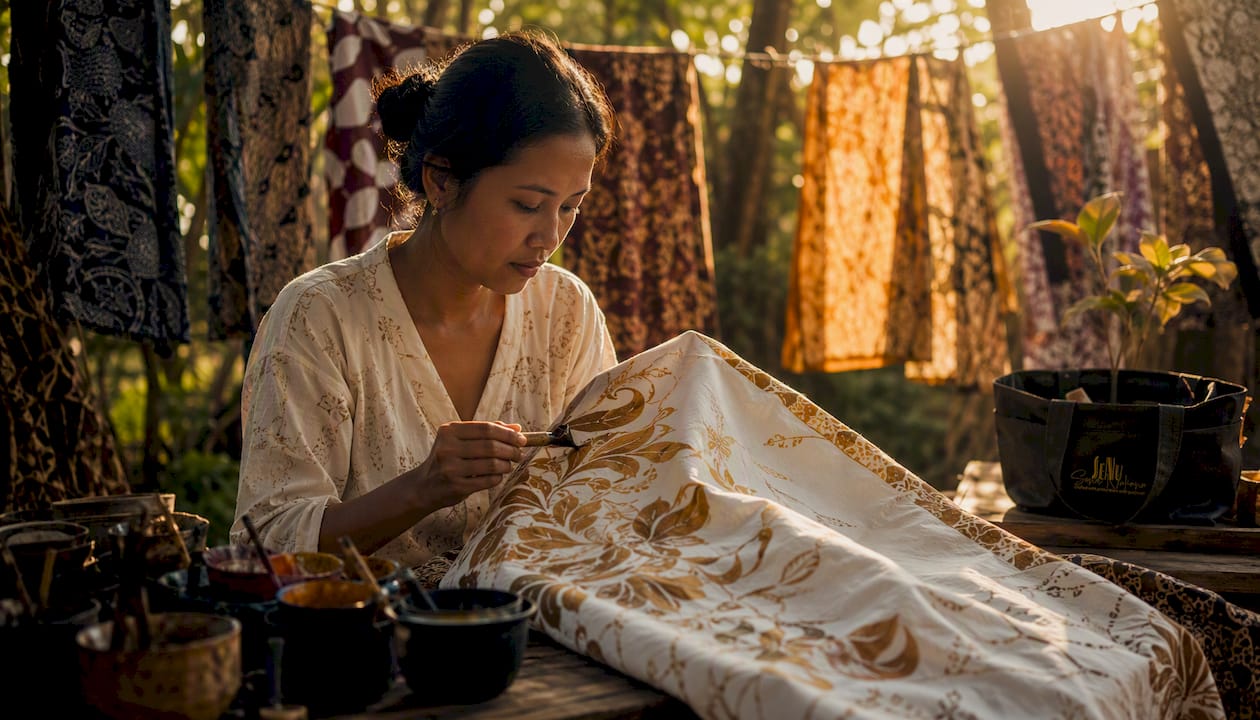
- Batik wax-resist: Hot wax is applied to cloth before dyeing, then removed to reveal the pattern; each piece is genuinely unique
Fabric choices follow the motif's demands. Ajrak block prints read best on cotton lawn or fine cotton, which absorbs natural dyes cleanly. Mirror-work embroidery needs a stable base — medium-weight cotton or silk dupion — so the mirrors lie flat. Ikat and jacquard weaves are self-contained and work on any weight appropriate to the silhouette. Digital prints perform well on rayon and sand-washed silk, which drape beautifully and let the motif move with the body.
Silhouette matters as much as technique. Large-scale motifs — a bold kente panel, a wide Ajrak border, an oversized batik repeat — read best on A-line skirts, wrap dresses, and panel constructions where the pattern has room to breathe. Small, repeating motifs suit shift dresses and sheaths, where the geometry creates an all-over texture rather than a focal point.
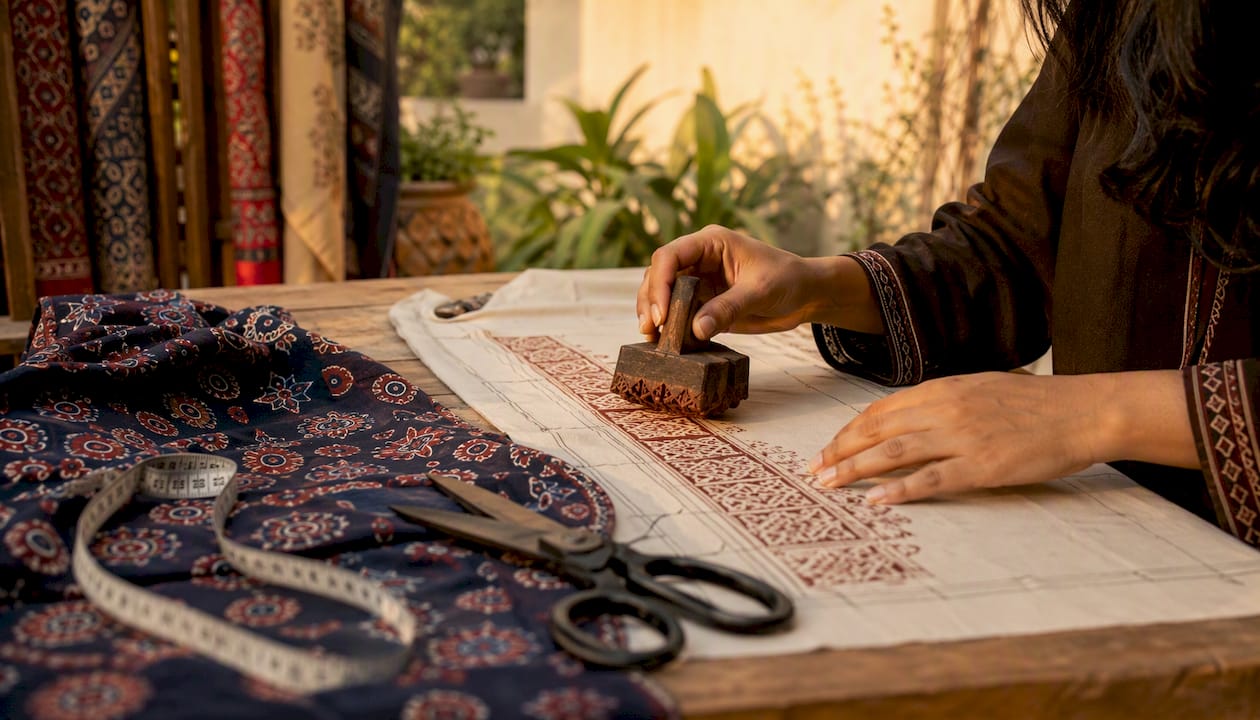
Pro Tip: Place motifs so they follow seam lines and garment movement rather than cutting across them at random. A kente stripe that aligns with a side seam or a block-print border that lands cleanly at the hem signals considered design — and is one of the clearest quality markers separating artisan-made pieces from mass-produced imitations.
10 named motifs, their origins, and how they appear in modern dresses
1. Kente (Ghana, West Africa)
Kente cloth originated as a court cloth of the Asante people, with each named strip pattern carrying specific symbolic meaning — wealth, royalty, or spiritual significance. In modern dress design, kente stripes appear as woven panels set into wrap dresses or as printed fabric used for full-skirt constructions, retaining the color geometry while adapting the scale for contemporary wear.
2. Ajrak block print (Sindh, Pakistan/India)
Ajrak is a centuries-old resist-printing tradition using natural indigo and madder on cotton. Its geometric medallion and border patterns are applied to modern midi dresses and shirt dresses, where the deep blue-and-red palette creates instant visual authority. Designers apply it to rayon and cotton lawn for everyday wear and to silk for occasion pieces.
3. Batik (Java, Indonesia — and broader Southeast Asia)
Batik's wax-resist technique produces organic, flowing patterns that vary from piece to piece. The Nantuapan motif of the Murut Tahol community of Sabah, for example, reflects stories of togetherness and cultural continuity, reimagined in sleeveless A-line dresses on soft rayon for daily wear. Each dress is, by nature, one of a kind.
4. Ikat (Central Asia, South Asia, Latin America)
Ikat's blurred, feathered edges come from dyeing the yarn before weaving, not after. The result is a pattern with depth and movement that no print can fully replicate. Modern ikat dresses often use the fabric as the hero — a simple wrap or shift silhouette that lets the weave speak without competition from structural detail.
5. Mirror work / Shisha embroidery (Kutch, Gujarat, India)
Small mirrors stitched into embroidered fields create a reflective, celebratory surface associated with Kutch artisans. On modern dresses, mirror work appears most powerfully as a yoke detail or a cuff accent on an otherwise minimal cotton dress, adding occasion-level drama without requiring a complex silhouette.
6. Godna / tattoo-art motifs (Jharkhand and Bihar, India)
Godna are traditional tattoo patterns used by Gondi and other tribal communities to mark identity and life stages. Researchers document how designers now digitize these motifs for modern garments, translating the fine line-work into printed or embroidered details on contemporary silhouettes to create narrative-driven collections.
7. Favorable-cloud and seawater-and-cliff patterns (China)
Traditional Chinese allegorical patterns — including favorable-cloud formations and the seawater-and-cliff motif — carry symbolic meanings tied to prosperity and cosmic order. Contemporary Chinese designers are reinterpreting these patterns in modern silhouettes, placing them as jacquard weaves or digital prints on structured midi and maxi dresses.
8. Adinkra symbols (Akan peoples, Ghana and Côte d'Ivoire)
Adinkra symbols are a system of visual icons, each encoding a proverb or philosophical concept — resilience, unity, adaptability. In modern dress design, they appear as embroidered or screen-printed accents, often placed at the hem, neckline, or cuff rather than used as an all-over repeat, so each symbol retains its individual meaning.
9. Ankara / African wax print (West and Central Africa)
Ankara fabric, produced through a wax-resist process, carries bold geometric and figurative patterns that have become one of the most recognizable ethnic prints in dresses globally. Designers use Ankara for full-skirted wrap dresses, fitted sheaths, and matching sets, where the fabric's graphic confidence does most of the design work.
10. Geometric tribal prints (various indigenous traditions)
Geometric tribal patterns — diamonds, chevrons, stepped frets — appear across cultures from the American Southwest to West Africa to the Andes. When integrated into modern A-line dresses, as seen in contemporary retail examples, they create a bold, everyday wearable that carries cultural resonance without requiring deep specialist knowledge from the wearer.
How to style motif-driven dresses for any occasion
The same heritage-print dress can move from a Saturday farmers market to a client meeting to a wedding reception. The key is in how you build around it.
Styling checklist:
- Balance motif scale with neutral accessories — a bold Ankara print needs clean gold jewelry, not layered statement pieces competing for attention
- Echo one color from the motif in your shoes or bag rather than matching the whole palette
- For work, layer a structured blazer or tailored jacket over a motif dress to ground the heritage piece in a professional context
- For evening, swap the blazer for a wrap or shawl in a complementary solid, and let the dress carry the visual weight
- Keep makeup focused: a strong lip in a color pulled from the motif, or a clean neutral that lets the fabric speak
Occasion-by-occasion:
- Casual daywear: A batik or ikat wrap dress with flat sandals and a minimal tote reads effortlessly cultural without feeling costumed
- Office styling: A Ankara sheath or a block-print midi with a blazer and block-heel mules is polished and distinctive
- Celebrations and events: Mirror-work or kente-panel dresses need almost no styling support — the fabric is the statement
Care tips for motif preservation:
- Hand-wash or use a gentle machine cycle in cold water for block-printed and hand-embroidered pieces
- Turn embroidered garments inside out before washing to protect the surface work
- Lay flat to dry rather than hanging, which can distort embroidered panels
- For significant handwork repairs, seek a specialist in textile restoration rather than a standard tailor
Cultural appropriation vs. appreciation: what designers and shoppers need to know
The line between honoring a tradition and exploiting it is not always obvious, but it is always worth finding. Here is a practical framework.
For designers and brands:
- Attribute the motif's origin clearly in product descriptions and marketing — name the community, the region, and the technique
- Pay artisans fairly and directly, not through intermediaries who absorb most of the margin
- Research a motif's social function before using it; some patterns mark royalty, marital status, or ritual use and carry obligations that decoration does not
- Avoid misrepresenting provenance — calling a digital print "hand-blocked" or a machine-embroidered piece "artisan-made" is a trust-destroying error
For shoppers, ask these questions before buying:
- Where was this made, and by whom?
- Is the artisan credited by name or community on the product page?
- Does a portion of the proceeds return to the artisan community?
- Is the motif's origin explained, or is it used as anonymous "ethnic" decoration?
Pro Tip: One of the most credible things a brand can do is publish artisan stories alongside product listings — a photograph, a name, a community, and a sentence about the technique. This kind of transparent storytelling is not marketing; it is accountability, and it is what separates ethical fashion from cultural extraction.
Senanukunu's approach to fashion storytelling is built on exactly this principle: every piece carries the story of its origin, and that story is part of what you are wearing.
How to choose authentic, well-made motif dresses
Quality in motif-driven dresses shows up in specific, observable ways. Train your eye on these signals before you buy.
Buyer checklist:
- Stitch quality: Hand embroidery shows slight irregularity and warmth; machine embroidery is more uniform. Both can be high quality — the red flag is loose threads, puckering, or embroidery that pulls the fabric out of shape
- Motif placement: Intentional layout that follows seams and garment movement indicates considered design; poorly aligned repeats that cut awkwardly across a bodice or hem suggest mass production
- Fabric weight: The fabric should suit the motif — a heavy embroidered yoke needs a stable base, not a flimsy jersey
- Seam alignment: Patterned fabrics should match at side seams; mismatched repeats are a production shortcut
- Care labels and origin notes: A garment with no country of origin, no fiber content, and no care instructions is a provenance red flag
- Artisan credit: Look for named artisans, community credits, or technique descriptions in the product listing
On price: Handcrafted block prints and hand embroidery take hours of skilled labor per piece. Expect to pay meaningfully more than you would for a digitally printed dress from a fast-fashion retailer — that premium is the cost of craft, fair wages, and limited production. A price that seems too low for the claimed technique almost always means something in that claim is not accurate.
Red flags: Vague phrases like "inspired by traditional patterns" with no further detail, identical multiples with poor finish, and listings that describe handwork without showing it in product photography.
Shopping channels: Artisan marketplaces offer direct access to makers but variable quality control. Ethical brand direct-to-consumer sites offer curation and provenance transparency. Curated boutiques sit in between. For qualities of handcrafted dresses and what to look for at each channel, the tradeoff is always price versus provenance clarity — the more transparent the sourcing story, the more you can trust the garment.
Senanukunu: how one brand puts ethical motif design into practice
Senanukunu, a Florida-based direct-to-consumer brand, was founded on a clear premise: West African heritage motifs deserve to be worn, not archived. The brand produces ready-to-wear dresses, kaftans, agbada sets, and statement pieces in limited quantities, each designed to translate the visual language of West African craft traditions into silhouettes that work for modern American life.
The sourcing approach is deliberate. Senanukunu works with artisans whose craft is named and credited, limits production runs to preserve the integrity of each piece, and uses ethical manufacturing practices that prioritize quality over volume. The result is a collection where motif placement, fabric choice, and silhouette decisions are made together — not as separate production steps.
The dresses collection shows this in practice: motifs appear in considered positions, fabrics are chosen for how they carry the design, and each piece is documented with enough detail that a buyer understands what they are purchasing and why it was made this way. The Ancestral Harmony Midi Dress is one example of how a signature motif translates into a wearable, occasion-ready silhouette without losing its cultural weight.
For designers and consumers who want to understand how tradition fuels empowerment in contemporary fashion, Senanukunu's model is a working answer to the question of what ethical, motif-driven design actually looks like at the product level.
Key Takeaways
Traditional motifs carry the most power in modern dresses when the technique, fabric, silhouette, and sourcing story are chosen together with intention and respect for origin.
| Point | Details |
|---|---|
| Motifs are storytelling devices | Symbols like kente, Ajrak, and batik carry documented cultural meaning that transforms a dress into a purposeful statement. |
| Technique shapes authenticity | Hand embroidery, block printing, ikat, and jacquard weaving each produce distinct textures that digital printing cannot replicate. |
| Placement signals quality | Motifs aligned with seams and garment movement indicate considered design; poorly cropped repeats signal mass production. |
| Ethics require attribution | Ask who made the motif, where, and whether artisans are credited and fairly paid before purchasing. |
| Senanukunu as a model | Senanukunu's limited-quantity, West African-inspired dresses demonstrate how provenance, craft credit, and contemporary silhouette work together. |
Why motifs matter more now than ever
What strikes me most about this moment in fashion is not the volume of culturally inspired pieces on the market — it is the growing demand for specificity. Consumers are no longer satisfied with "African print" or "ethnic-inspired." They want to know the name of the motif, the community it comes from, and the hands that made it. That shift in expectation is genuinely significant.
Motifs are not decorative shortcuts. They are living traditions that carry the weight of generations, and when a designer treats them that way — researching their function, crediting their origin, limiting production to preserve meaning — the garment becomes something a fast-fashion algorithm cannot generate. For anyone building a wardrobe with intention, that difference is worth paying for and worth asking about.
Senanukunu's West African-inspired dresses are worth exploring
If this article has shown you anything, it is that the most meaningful motif-driven pieces come from brands that treat sourcing, craft, and storytelling as inseparable. Senanukunu does exactly that: every dress in the collection is rooted in West African heritage, produced in limited quantities with ethical manufacturing, and designed to wear with confidence for years.
Whether you are looking for a statement piece for a celebration, an everyday dress that carries cultural pride, or a gift that means something, the Senanukunu collections are worth your time. Visit senanukunu.com to see the full range, read the stories behind each piece, and find the dress that speaks to you.
Useful sources for deeper reading
| Source | What you will find there |
|---|---|
| Indian textiles · V&A | Curatorial documentation of Indian block printing, courtly silk weaving, and the historical transmission of textile techniques — authoritative background for understanding how traditional methods inform contemporary design. |
| Kente cloth · Smarthistory | Scholarly overview of kente's origins in Asante royal culture, the symbolic naming of weave patterns, and how the cloth has evolved into a global identity signal. |
| Indo-Western fusion: tattoo art motifs · JETIR | Academic study on how Godna tattoo-art motifs are digitized and adapted for modern garment collections — useful for understanding the digitization pipeline from traditional craft to contemporary dress. |
| Chinese traditional patterns in contemporary fashion · Quan Y. | Research article examining how favorable-cloud, seawater-and-cliff, and other allegorical Chinese patterns are reinterpreted by contemporary designers in modern silhouettes. |
| Cultural motifs in modern Pakistani dresses · String N Thread | Practical overview of how Ajrak block printing, mirror work, and related techniques are applied to modern fabrics like rayon, silk, and cotton lawn for both everyday and occasion wear. |
| Fashion Design Inspired by Global Cultures · JD Institute | Broad survey of how global cultural traditions influence contemporary fashion design — useful context for understanding the cross-cultural design conversation. |
| Heritage Fashion Explained · Senanukunu Blog | Deep dive into craft, heritage, and empowerment in fashion — explains how traditional techniques translate into modern ready-to-wear with ethical intent. |
| Types of Contemporary West African Motifs · Senanukunu Blog | Design guide to West African motif traditions, their visual characteristics, and how they appear in contemporary dress collections. |
| Fashion trends and market context · QueenCompares | Fashion media resource covering trend analysis and marketplace context for culturally inspired fashion. |