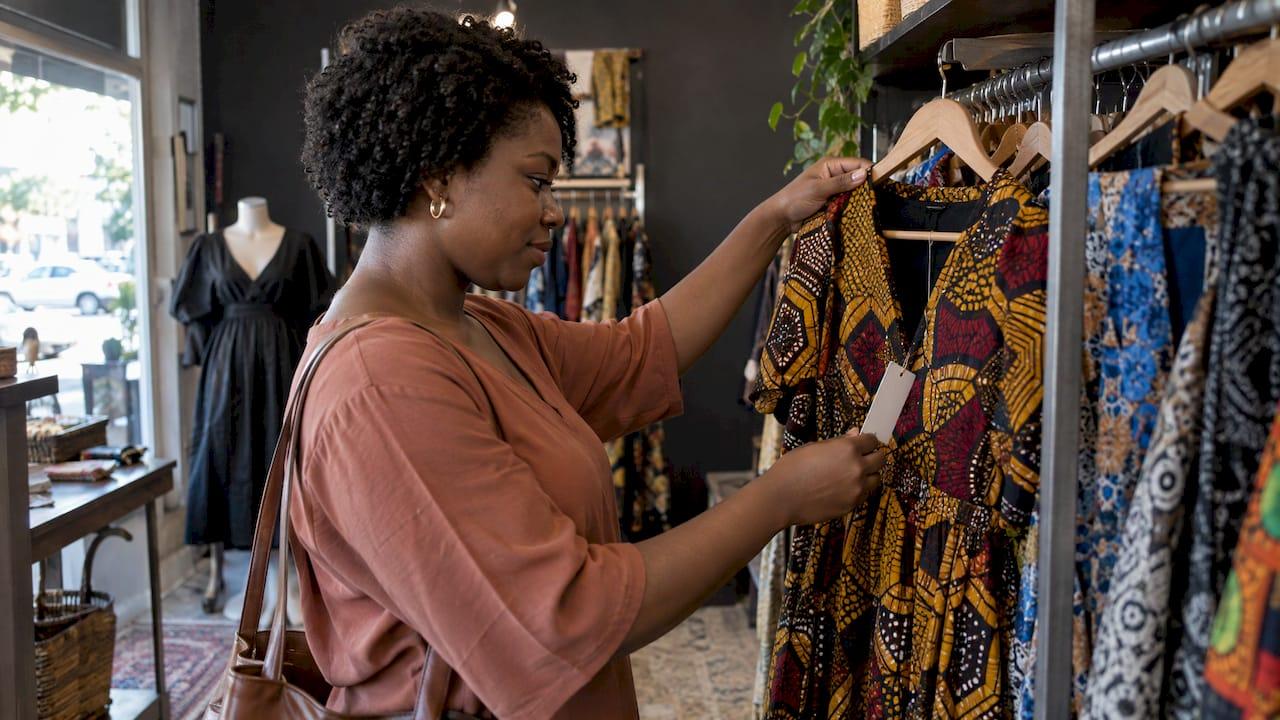
Most ready-to-wear Ankara dresses in the United States land between about $85 and $220, custom-sewn gowns run higher, and the cheapest listings online often come with a trade-off in fabric. The number on the tag matters less than what stands behind it: where the cloth came from, who sewed it, and whether the piece was made in limited quantities with care. At Sena Nukunu, we offer ready-to-ship West African dresses, sets and statement pieces made with ethical manufacturing and artisanal craftsmanship, so this guide shows you how to read any price, ours or anyone else's, and choose a dress you will wear for years.
TL;DR
- One 2026 buyer's guide puts ready-to-wear Ankara dresses at roughly $85 to $220, with mini and midi styles at $85 to $145.
- Custom boubous and gowns are benchmarked at $190 to $380 and need fittings and a lead time of several weeks.
- Mass-market listings can start at $25 to $80, but fabric content is inconsistent.
- Fabric, pattern matching, size and labor explain most price gaps between two dresses that look alike.
- For weddings and cultural celebrations, spend on provenance and craftsmanship. For everyday wear, a well-made cotton dress is enough.
Table of Contents
- What an Ankara dress costs in the US
- Why two similar dresses cost different amounts
- Ready-to-wear or custom: how the prices compare
- How to judge value, not just price
- Where Sena Nukunu fits in the price picture
- Promo: find your dress in the collections
- Our perspective
- FAQ
- Sources
What an Ankara dress costs in the US
Prices for Ankara, the bold wax-print cotton worn across West Africa and the diaspora, spread wide. The same print can appear on a $40 listing and a $180 listing, and both are called an Ankara dress. The ranges below come from published buyer's guides, so treat them as orientation rather than a quote. Retailers set their own prices, and every figure moves with fabric costs, size and season.
| Type of Ankara dress | Typical US range | What you get |
|---|---|---|
| Mass-market online listing | $25 to $80 | Fast availability, mixed or unclear fabric content |
| Everyday cotton dress for daily wear, office or travel | $65 to $140 | Practical cut, easy care |
| Ready-to-wear mini or midi dress | $85 to $145 | Pre-sewn, standard sizing, ships right away |
| Ready-to-wear overall | $85 to $220 | Wider range including gowns and statement cuts |
| Direct-from-Nigeria brands | $120 to $350 | Fabric traceability |
| Custom boubou or gown | $190 to $380 | Made to your measurements, fittings, 2 to 6 weeks |
| DIY kit (fabric and pattern) | $45 to $90 | You sew it yourself |
The ready-to-wear and custom ranges and the mass-market, direct-from-Nigeria and everyday-wear ranges both come from 2026 guides that benchmark US shoppers. A glance at search results confirms the spread: listings in the $40 to $60 band sit next to boutique pieces at $180 for a midi dress.
The practical reading is simple. If a dress is priced far below $85, ask what was cut: fabric weight, lining, finishing or the maker's pay. If it sits in the $85 to $220 band, you are in the zone where a real garment with real construction is usually possible.

Why two similar dresses cost different amounts
A dress is the sum of several lines. A costing guide for Ankara dresses breaks the price into six: fabric, lining and interfacing, trims and notions, labor, packaging and a share of overheads. Each one is a place where a price can rise or fall.
Fabric is the largest line
Fabric is usually the biggest cost in an Ankara dress. Bold prints add another wrinkle: the same guide notes that large motifs may need extra yardage so the pattern lines up across seams, and that larger sizes use more yards. A size 18 simply consumes more cloth than a size 8. If you are curious about what separates fine wax cotton from a printed look-alike, our guide to what Ankara fabric is and how to judge its quality walks through origins, meaning and quality.
Pattern matching and construction
When a maker aligns a stripe or a motif at the bodice seam, the dress looks intentional rather than assembled. That alignment takes cloth and time. Lining and interfacing, the hidden layers that give a neckline structure, add cost too, and you feel them in how a dress hangs after the third wear.
Labor
Sewing is skilled work. Where a maker is paid fairly, labor is a real line in the price, not an afterthought. This is the heart of ethical production: a fair wage is built into the cost of the garment, which is why a thoughtfully made dress and a rock-bottom listing rarely share a price.
Size and fit
Inclusive sizing is a real expense, since more fabric and more pattern work go into each size. Some US and UK based African fashion retailers deliver in 3 to 7 days with sizing up to UK 24. If you are tall or curvy, read our tips on adding 10 to 20 percent fabric for curvy Ankara styles and length and fit for tall women so you know what a good fit should involve before you compare tags.
Ready-to-wear or custom: how the prices compare
The choice shapes both cost and timing.
Ready-to-wear. The piece is already sewn. According to one 2026 guide, price transparency is the benefit: you see the figure, add to cart and the dress ships. Sizing is standardized, so check measurements against the size chart rather than trusting the letter on the label.
Custom. The same guide benchmarks custom boubous and gowns at $190 to $380, with three or more fittings, a lead time of 2 to 6 weeks, and fabric markups of 20 to 60 percent over wholesale. When fabric is bought separately and sewn by a tailor, returns on the fabric are generally not available. Custom makes sense when you need an exact fit or a one-of-a-kind look, and it asks for planning.
For a wedding, naming ceremony or other celebration, build the timeline backward from the event date. Allow weeks for custom work, and a few extra days for alterations on ready-to-wear. If the date is close, a ready-to-ship piece removes the risk entirely.

How to judge value, not just price
A fair price is one that matches what you receive and what you plan to do with the dress. Use these checks.
- Decide the occasion first. For weddings, naming ceremonies or cultural presentations, the guide advises investing in direct-from-Nigeria or certified African-owned retailers. For casual wear, a well-reviewed dress is sufficient.
- Ask about fabric. Look for a plain statement of fiber content and where the cloth came from. Silence on this point is a signal. Our four provenance tests for Ankara fabric give you specific questions to hold up against any listing.
- Study the construction photos. Check seam alignment at the center front, the lining, the zipper and the hem. Good photos at close range show confidence.
- Compare cost per wear. A $150 dress worn twenty times costs $7.50 a wear. A $45 dress that loses its shape after two washes is the costlier choice.
- Count the extras. Shipping, taxes, alterations and returns policy all belong in the final comparison. Delivery speed and terms differ widely, so it helps to read up on online shopping delivery options before you choose.
- Think about who made it. Limited quantities and named collections usually mean fewer pieces made with more attention, rather than thousands of identical units.
Where Sena Nukunu fits in the price picture
We are a US-based brand in Florida, selling authentic West African ready-to-wear and custom fashion for men and women, including dresses, kaftans, agbada sets, jackets and matching statement sets. Every piece is made with ethical manufacturing and artisanal craftsmanship, in limited quantities. That is the reason to look at us when your goal is a dress that carries heritage rather than a trend that fades by next season. Our own prices are shown on each product page, and you can read how we think about buying with confidence in our guide to authentic West African dresses.
If you are shopping for style as much as price, our look at modern Ankara dress styles and how to choose helps you narrow the field before you open a single listing. Buying for someone else? There are matching ideas in our men's Ankara outfits and our guide to kids' African celebration wear, so a whole family can dress for the same event.
Promo: find your dress in the collections
When you are ready to see real pieces, begin with our dresses and women's collections. Each named line, from Woven Stride: Queen In Comfort for easy everyday wear to Woven Crowns: Radiant Rise for statement moments, is made in limited quantities, so what you choose is not on everyone else's shoulders too.
For men, the Men's Agbada Ensembles and the Woven Nobility: Kings' Robe collection bring the same craftsmanship to celebrations and ceremonies. You can browse every line on our collections page, or explore what we offer beyond ready-to-wear on our services page.
Our perspective
When we talk about price, we start with the hands behind the garment. An Ankara dress is more than a print on cotton. It is a line of heritage that people have carried from West Africa across oceans and generations.
That is why we make our pieces in limited quantities, with ethical manufacturing and artisanal craftsmanship. Fewer pieces means more care in every seam, and it means the person who sewed your dress is treated as an artisan, not a number.
We believe the right question is not how little you can spend, but what your purchase supports. A dress you reach for again and again, for a wedding, a promotion, a family gathering or an ordinary Tuesday, repays itself in confidence. Wear the change, and let every stitch carry the story forward.
Sena
FAQ
How much does an Ankara dress cost in the US?
Ready-to-wear Ankara dresses are benchmarked at about $85 to $220 in one 2026 guide, with everyday cotton dresses at $65 to $140. Custom gowns run higher, since they add fittings and tailoring. Exact prices depend on the retailer, size and fabric, so always read the product page.
Why are some Ankara dresses under $50?
Mass-market listings can begin at $25 to $80, and the same guide notes inconsistent fabric content at that level. Lower prices often reflect lighter cloth, simpler finishing or lower labor costs. Read the fiber details and photos closely.
Is a custom Ankara dress worth it?
Custom suits you when you need an exact fit or a unique design for a major event. Plan for a 2 to 6 week lead time and several fittings. If your date is near, a ready-to-ship piece is the simpler path.
Do plus sizes cost more?
Sometimes, because larger sizes use more fabric and bold prints may need extra yardage for pattern matching, as one costing guide explains. Our curvy Ankara guide explains how yardage and tailoring work together for a flattering fit.
What should I spend on a wedding or celebration dress?
For a wedding, naming ceremony or cultural presentation, put your budget toward authentic sourcing and craftsmanship. The range of $120 to $350 for direct-from-Nigeria brands and $190 to $380 for custom work gives you a sense of the upper end, while ready-to-wear statement pieces often sit lower.
Sources
- Ankara Dress Designs Guide: How to Choose for Style & Fit
- Nigerian African Clothes Guide: How to Choose Authentic
- Costing Ankara Dresses: Fabric, Labor and Overheads