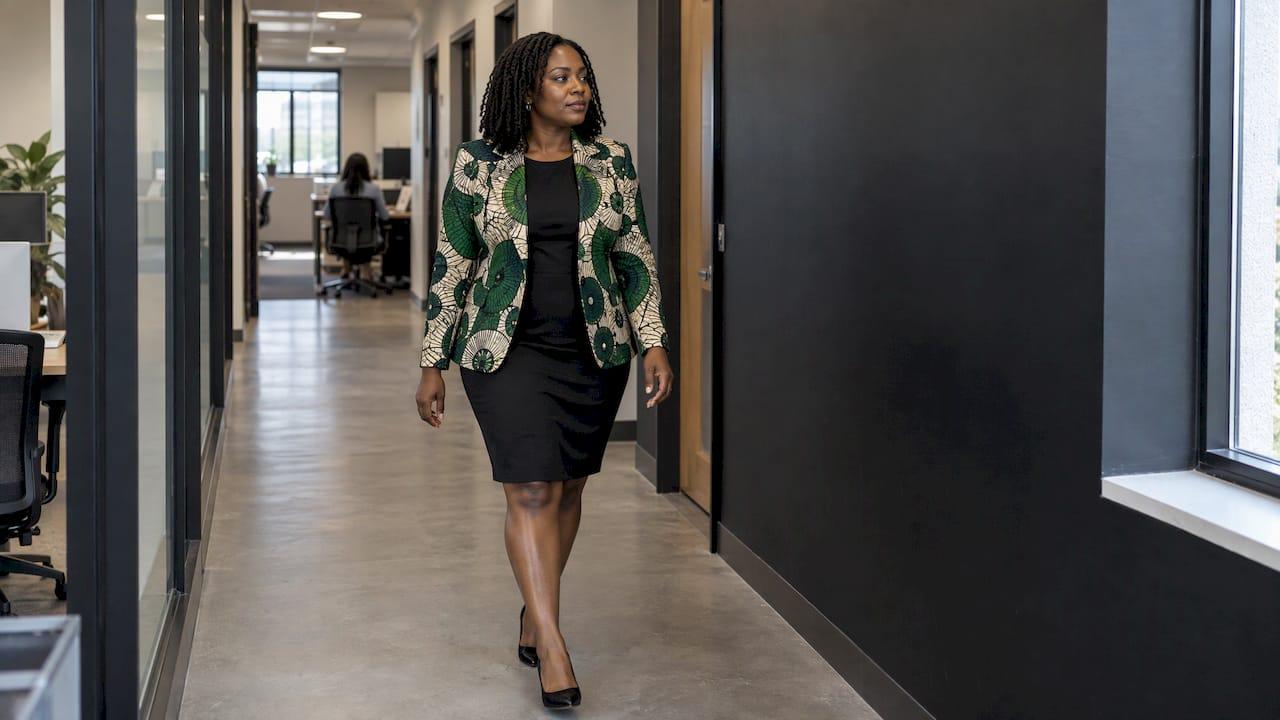
The best Afrocentric work outfit lets one piece carry your heritage and lets everything around it stay tailored and quiet. A West African print jacket over a solid dress, a well-cut kaftan set with leather shoes, wide trousers with a crisp white shirt and one kente detail: each shows that professionalism and cultural pride can sit in the same outfit. At Sena Nukunu we make jackets, kaftans, agbada sets and matching statement sets in limited quantities, and the principle behind all of them is the same: craftsmanship should be seen, not shouted.
TL;DR
- Put the print in one place (a blazer, a skirt, a collar or cuff) and keep the rest solid, so the look reads intentional and polished.
- Tailoring matters more than the fabric: a structured cut and a good fit turn a heritage piece into workwear.
- Men can build from a fitted kaftan set or a print shirt with tailored trousers and full, closed shoes.
- Scale up or down by office: print in a scarf or lining for very formal rooms, a full matching set for creative or business casual settings.
- Wear prints knowing what they mean, since some carry associations with royalty or mourning.
Table of Contents
- What makes an outfit Afrocentric and still right for work
- Five rules for building the outfit
- Afrocentric work outfits for women
- Afrocentric work outfits for men
- Match the outfit to the room
- Know the print, know your rights
- Where to find workwear that is made with care
- Our approach to dressing for work
- Shop Afrocentric pieces for your work wardrobe
- FAQ
- Sources
What makes an outfit Afrocentric and still right for work
An Afrocentric outfit draws on African textiles, silhouettes and craft traditions: Ankara and other wax prints, kente, adire, agbada and kaftan shapes. A work outfit adds a second test: does it look prepared, structured and appropriate for the room?
The two meet in one idea. One stylist's guide suggests concentrating the print in a single element, such as an Ankara pencil skirt with a solid blouse and blazer, an Ankara blazer with solid trousers and a white shirt, or an Ankara top under a solid suit. The print is clearly present and clearly chosen, without competing with the meeting. The same guide says head-to-toe print, very high-contrast geometric patterns and ceremonial combinations do not translate to professional settings.
That is also how many working professionals already dress. EBONY describes Black women blending structure with personal style as offices fill back up: wide-leg trousers, oversized blazers cinched at the waist, power suits in strong colors. It frames the tradition as a long line of wearable resistance, from the era of suffrage to the return of dashikis and Ankara, and argues that professionalism and self-expression can coexist.
Five rules for building the outfit
- Let one piece speak. Choose the print piece first, then build around it in solid colors pulled from the print. Black, white, cream, navy and camel never fight a pattern.
- Invest in the fit. A structured shoulder, a clean hem and sleeves that end at the right place do the professional work. RIA Magazine's advice on dressing for power puts tailoring among its four rules, alongside letting one piece speak, using print in linings, scarves or bags for very formal settings, and supporting designers who know the cloth.
- Choose structure over softness at the shoulders. Jackets, blazers and set-in sleeves anchor a print. Flowing pieces are lovely, but a structured layer makes them office-ready.
- Mind the length and the cut. A knee-length or longer skirt, trousers with a clean line, and tops that stay in place when you reach and sit.
- Finish plainly. Polished shoes and a simple bag let the textile be the statement. Our guide to accessorizing cultural outfits ethically covers jewelry and head wraps in more depth.
Afrocentric work outfits for women
Here are four combinations that follow the rules above. Each one starts with a single heritage piece.
The print blazer
A structured blazer in bold print over a simple black dress is one of the most reliable looks. RIA Magazine describes exactly this pairing, along with wide adire trousers and a crisp white shirt, and a kente detail on a collar or cuff for readers who want a quieter touch. In the same piece, a finance director's tailored Ankara blazer prompted two colleagues to ask for her tailor's number. The EnnYe Collection founders describe the same idea in an interview with Observer: a white dress with an African print jacket over it, where the print is an accent or a striking ensemble.
The print skirt with solid layers
An Ankara pencil skirt, a solid blouse and a neutral blazer give you the heritage fabric at the hem and a conventional silhouette above it. This works in offices where a suit is still the baseline.
Separates you can mix
Fashion entrepreneur Omoyemi Akerele told Vogue that separates are the backbone of her work wardrobe, mixed and matched under a blazer, and that her law-firm years mean there is always an element of structure. Two print separates and three solids can make a week of outfits without repeating the same look.
The formal uniform
Wie Suite CEO Dee Poku, who grew up around kente as the child of Ghanaian immigrants, built a work uniform of a floor-length denim skirt with heels, knee-length culottes, and a crisp blazer over tailored trousers. Fast Company reports she deliberately stays formal in a casual corporate world, as a way to stand tall in rooms where women of color historically have not held power. You can borrow that approach and add one heritage element to it.
Our business casual African wear guide goes further into everyday office combinations, and our Ankara styling tips help with confidence in the print itself.
Afrocentric work outfits for men
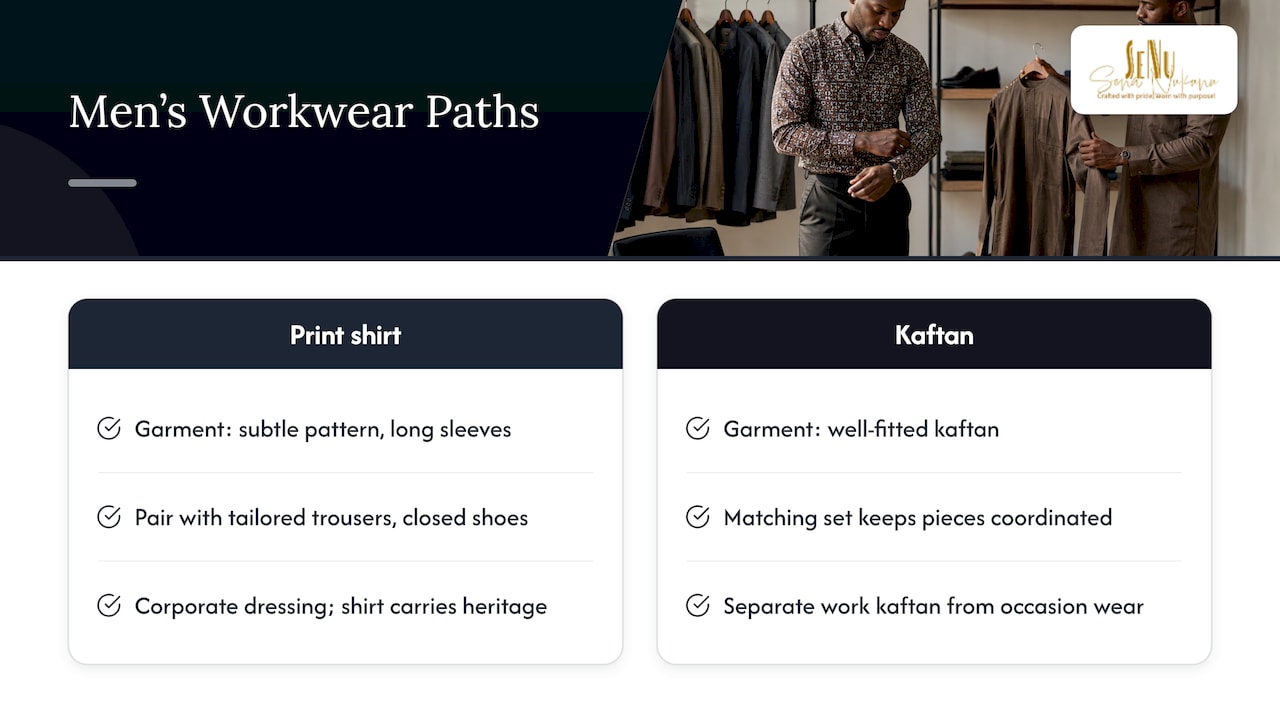
Men have two clear paths: the print shirt and the kaftan.
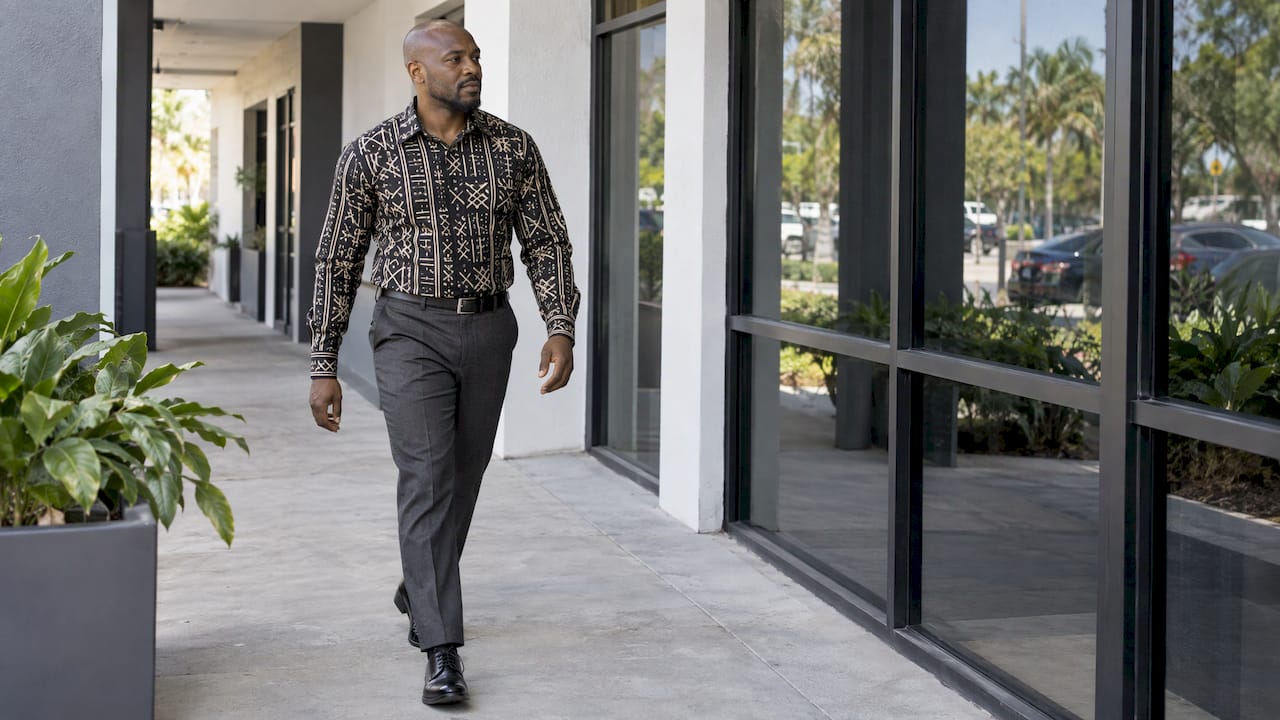
For the shirt, one Ghanaian style guide for corporate dressing suggests a subtle pattern and long sleeves, paired with tailored trousers and full, closed shoes rather than slippers or half shoes. The shirt carries the heritage, the trousers and shoes carry the formality.
For the kaftan, the same guide notes that a well-fitted kaftan can look confident and sharp, and recommends keeping a kaftan reserved for work, separate from the one you would wear to a religious or family occasion. A matching set is the simplest way to do this because the pieces already agree with each other. Our Midnight Prestige kaftan three-piece set is one of the men's kaftan sets in our collection, and our Woven Nobility: Kings' Robe collection gathers more men's heritage pieces.
Agbada ensembles are ceremonial in most settings. Keep them for the celebration after work, the wedding, the awards dinner or the gala, and read our black tie African attire guide when the invitation says formal.
Match the outfit to the room
The same wardrobe stretches across formality levels if you change how much print you wear and where it sits.
| Setting | Where the print goes | What stays solid |
|---|---|---|
| Very formal (law, finance, client-facing boardrooms) | Lining, scarf, bag, or a kente detail on a collar or cuff | Suit, shirt, shoes |
| Business professional | A blazer or a skirt | Everything else, in neutrals |
| Business casual | A top, a shirt or a kaftan set | Trousers or a plain layer |
| Creative or relaxed offices | A matching set or a statement dress | Shoes and accessories |
The very formal row follows RIA Magazine's suggestion to use print in linings, scarves or bags where settings are strict. For networking evenings and receptions, see our guide to African wear at networking events, and for seasonal parties our office holiday party outfit ideas.
Seasons. In colder months, a print jacket or blazer does the heavy lifting over a solid knit or dress. In warm months, a lightweight kaftan or a print top under a plain linen layer keeps you cool without losing structure. The rule about one print piece stays the same in every season.
Know the print, know your rights
Before you wear a print, it helps to know what it says. The EnnYe Collection founders told Observer that some prints carry specific meanings, such as royalty or mourning, and that those prints deserve care in how they are cut and worn. If you are buying from a maker who knows the story of the cloth, you can wear it with confidence.
On the legal side, in the United States Title VII of the Civil Rights Act protects employees from discrimination based on national origin, and the EEOC's enforcement guidance explains that this covers cultural characteristics of a national origin group. The same guidance includes an example of an employee who wears a sari. A dress code that is applied unevenly to your cultural dress is worth raising with HR or an employment attorney. Hair is covered separately where the CROWN Act has been enacted, which prohibits discrimination based on natural hair textures and styles associated with race. Check your state's law for the details.
Where to find workwear that is made with care
When you shop for structured, mix-and-match pieces, look at how a brand describes its makers, its materials and its fit. A good primer on what makes a great apparel brand gives you the criteria. Add to those questions the ones that matter to you: who made it, how many were made, and whether the print has a story you want to carry.
Our must-have African-inspired pieces article lists the pieces we would start a wardrobe with.
Our approach to dressing for work
We believe a workday is one of the places heritage belongs most. Every stitch of a West African garment carries a legacy, and when you walk into a room wearing it, you bring that legacy with you.
That is why we make jackets, kaftans, agbada sets and matching statement sets in limited quantities, with ethical manufacturing and artisan craftsmanship at the center. A piece made with care and purpose holds its structure, and it holds its meaning.
Our advice is simple: choose the piece that makes you stand a little taller, build the rest of the outfit quietly around it, and wear it as your own.
Sena
Shop Afrocentric pieces for your work wardrobe
Sena Nukunu is a US-based online store, rooted in Florida, for authentic West African ready-to-wear and custom fashion for men and women. You can explore dresses, jackets, kaftans and matching sets in our Women's Collections and Men's Heritage pieces, or browse collections such as Woven Stride: Queen In Comfort and Woven Shields: Queens in Motion. Each piece is made in limited quantities with ethical production.
For the full range, visit all of our collections.
FAQ
Is it professional to wear African print to work?
Yes, when the print is deliberate and the rest of the outfit is structured. A print blazer with solid trousers, or a print skirt with a solid blouse, reads as polished and distinctive. Very formal offices usually call for a smaller dose of print, such as a lining, scarf or collar detail.
Can I wear an agbada or full set to the office?
An agbada is usually kept for celebrations and ceremonies. For the office, a fitted kaftan set or a print shirt with tailored trousers is a better fit. Save the agbada for weddings, galas and cultural events.
What should I wear with an African print blazer?
Choose a solid dress or a white or cream shirt, and trousers or a skirt in a color taken from the print. Keep shoes and bags simple so the blazer is the one statement.
How do I avoid looking like I am wearing a costume?
Use one print piece, make sure it is well tailored, and style it with solids. Avoid combining several prints or wearing head-to-toe pattern in a professional setting.
Sources
- How to Style Ankara Without Looking Like a Costume, OMIREN STYLES
- Style as Resistance: The Power of Black Women's Fashion, EBONY
- Ankara in the Boardroom: Dressing for Power on Your Own Terms, RIA Magazine
- EnnYe Collection founders interview, Observer
- 9-to-5 Dress Code: Omoyemi Akerele, Vogue
- Dee Poku always dresses to impress, Fast Company
- African Wear Ideas to Inspire Your Corporate Fashion, The Accra Times
- EEOC Enforcement Guidance on National Origin Discrimination
- Who Decides What Looks Professional?, OMIREN STYLES
- What makes a great apparel brand