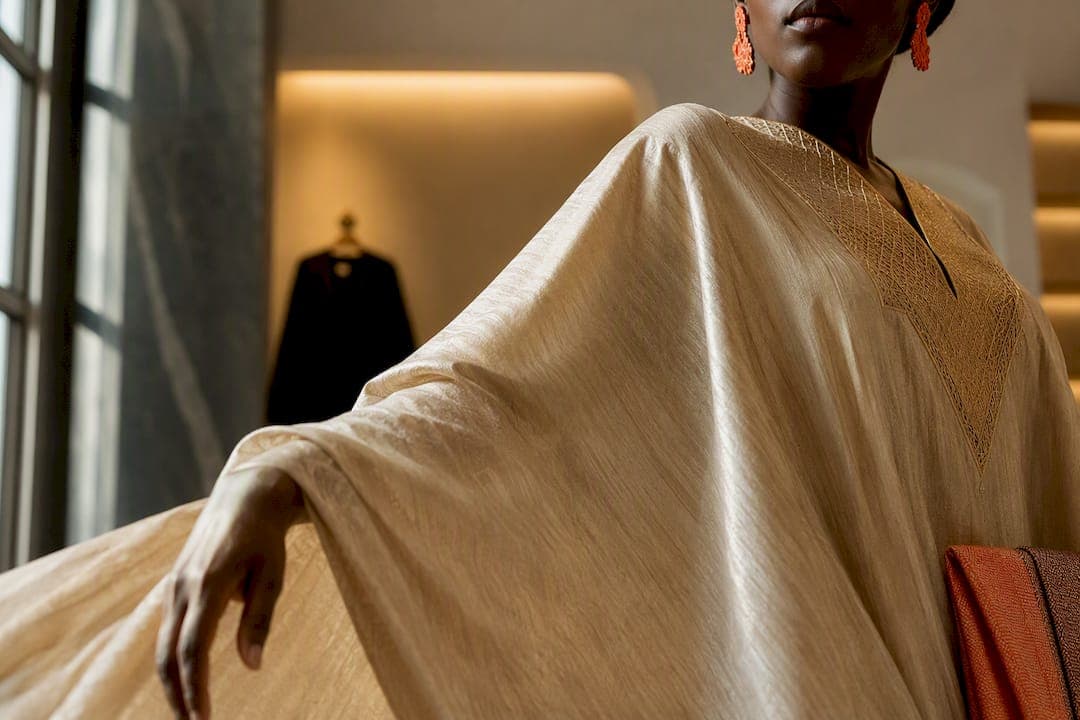
A Senegalese boubou is a flowing, wide-sleeved robe rooted in the Wolof word mbubb, worn by both men and women across formal, religious, and everyday occasions. It began as protective travel wear along Sahelian trade routes and became a marker of status, dignity, and craftsmanship. What follows traces that history, the fabrics that define it, and how to wear or choose one today.
TL;DR:
- Traditional grand boubous require up to 117 inches of fabric, making them substantial and suitable for ceremonial occasions.
- The most formal boubous are made from damask bazin riche, a heavyweight, shiny textile that signals wealth and status.
- Embroidery quality, especially dense and textured stitching, indicates higher craftsmanship and significantly impacts the garment's price.
- Modern styling often shortens or layers boubous for daily wear, but full-length with heavy embroidery remains reserved for special events.
- Authentic, ethically made boubou-inspired pieces are available in limited quantities, emphasizing craftsmanship over mass production.
Table of Contents
- What Is a Senegalese Boubou, Exactly?
- Where Did the Senegalese Boubou Come From?
- How Is a Traditional Boubou Constructed?
- What Fabrics Define a Senegalese Boubou?
- What's the Difference Between a Boubou, Kaftan, and Agbada?
- When and Why Do People Wear a Boubou?
- How Do You Style a Boubou the Modern Way?
- How Do You Choose, Fit, and Care for a Boubou?
- Why Senanukunu Understands This Garment
- How Has the Boubou Shaped Diaspora Fashion Worldwide?
- What Do the Colors and Embroidery Patterns Mean?
- Why This Garment Still Matters
- Where to Find Authentic, Ethically Made Boubou-Inspired Pieces
- Sources
- FAQ
What Is a Senegalese Boubou, Exactly?
The grand boubou is the full-length version most people picture: a loose, floor-sweeping robe with dramatically wide sleeves, worn over a matching undershirt and trousers by men, or as a standalone tunic by women. The term itself carries weight. It traces back to the Wolof word mbubb, and encyclopedic sources describe the garment as a flowing robe worn across West Africa), with regional names shifting depending on country and language.
What makes it distinct from a simple caftan or tunic is scale and intention. A boubou is not cut close to the body. It is built to drape, to move with the wearer, and to signal something about the occasion. That signaling function, more than any single fabric or cut, is what has kept the garment relevant for centuries.
Where Did the Senegalese Boubou Come From?
The boubou did not start as ceremonial wear. It began as functional clothing suited to Sahelian climate and travel, loose enough to allow airflow across the desert and versatile enough to double as protection from sun and wind. Its evolution ties directly to trans-Saharan trade routes and the rise of Sahelian empires, where the robe gradually shifted from utility garment to a marker of rank and religious standing.
Islamic scholarship played a role here too. As Islamic learning centers grew across the Sahel, modest, flowing garments aligned naturally with religious dress codes, and the boubou's ample cut fit that context well. Over time, the fabrics used to make it changed its status entirely.
- Early boubous were made from regionally woven cotton, valued for comfort over show.
- Trade introduced imported textiles, including damask, which elevated the garment into court and ceremonial territory.
- By the time damask became widely available, the boubou had shifted from everyday practicality to a visible marker of wealth and social position.
How Is a Traditional Boubou Constructed?
A traditional grand boubou is built from a single wide panel of fabric, cut and stitched to create dramatic sleeve volume and a long, unbroken drape from shoulder to ankle. That drape is not accidental. It takes real yardage to achieve.
Fabric fact: Authentic grand boubou construction can require up to 117 inches (300 cm) of fabric for the outer robe alone, especially when made from stiffened, high-quality cotton damask.
The traditional men's outfit is usually a three-piece set: the outer robe, a matching or coordinating undershirt, and drawstring trousers. Women's versions vary more, sometimes worn as a standalone tunic over a wrapped skirt, sometimes paired with a headwrap for formal events. A few features help you recognize a well-made piece regardless of gender:
- Wide, often winged sleeves that taper only slightly at the cuff.
- A neckline embroidered in a contrasting or metallic thread, usually the visual focal point of the garment.
- A drape heavy enough to hold its shape when the wearer moves, rather than clinging or collapsing.
What Fabrics Define a Senegalese Boubou?
Fabric choice tells you almost everything about a boubou's purpose before you even look at the cut. Bazin, a cotton damask prized for its sheen and weight, sits at the top of the hierarchy. Higher grades, sometimes called bazin riche, hold a crisp structure and a subtle shine that only improves with proper starching, which is exactly why it dominates formal and ceremonial wear. Interestingly, bazin arrived in West Africa through European trade rather than as an indigenous textile, yet it became so central to Senegalese ceremonial dress that most people now consider it inseparable from the tradition.
Wax prints, often called Ankara in West African fashion writing, sit at a more casual point on the spectrum. They read as vibrant and expressive rather than formal, making them common for daily wear, casual gatherings, or younger, fashion-forward takes on the silhouette.
- Bazin/damask: formal, ceremonial, most expensive, holds structured drape.
- Wax print/Ankara: casual to semi-formal, colorful, more affordable.
- Plain cotton or blends: everyday wear, valued for comfort over show.
Embroidery finish is the other giveaway. Dense, precisely stitched neckline and cuff embroidery signals hours of hand or machine artistry, and it is usually the single biggest driver of price on a finished piece.
Pro Tip: Run your hand across the embroidery before buying. Raised, textured stitching that feels substantial usually means it was worked in multiple thread passes, a sign of higher craftsmanship than flat, single-pass designs.
What's the Difference Between a Boubou, Kaftan, and Agbada?
These terms get used interchangeably online, which causes real confusion for shoppers. They are related but not identical.
- The men's grand boubou is typically worn as a three-piece set with matching trousers and an undershirt, cut wide through the body and sleeve.
- The women's boubou is usually a wide, flowing tunic worn alone or with a coordinating wrap skirt, with less emphasis on a fitted trouser pairing.
- The Senegalese kaftan tends to be a lighter, often shorter or more fitted variant, better suited to daily wear or warm-weather settings than the full ceremonial grand boubou.
- The agbada, associated with Yoruba tradition in Nigeria, shares the wide-sleeved silhouette but differs in draping technique and regional embroidery style, and shoppers researching women's agbada styling will notice the fit conventions diverge from the Senegalese cut.
The overlap in terminology exists because these garments share a common ancestry across West African trade and migration routes, not because they're interchangeable in construction.
When and Why Do People Wear a Boubou?
Occasion dictates fabric, color, and formality more than almost anything else. A wedding or naming ceremony calls for bazin in a rich, saturated color with dense embroidery. Friday prayers and religious holidays like Eid often call for clean, modest tones in high-quality fabric. Everyday wear leans toward lighter cotton or wax print in simpler cuts, and readers planning what to wear as a wedding guest will find fabric weight is usually the first clue to formality level.
- Weddings and naming ceremonies: bold color, bazin riche, heavy embroidery.
- Religious holidays: understated elegance, often white or muted tones.
- Daily wear: lighter fabric, simpler or no embroidery, easier movement.
Underlying all of this is a concept Senegalese culture calls jom, roughly translated as dignity or composure. A well-chosen, well-worn boubou is understood as a visible expression of that self-possession, which is part of why the same silhouette can read as humble or commanding depending entirely on how it's worn and finished.
How Do You Style a Boubou the Modern Way?
Tradi-moderne styling is exactly what it sounds like: honoring the traditional silhouette while adapting proportions, layering, and pairings for contemporary life. Designers have been shortening and tailoring the boubou for years, proving the garment was never as rigid as people assume.
- Shorten the hem for daily wear. A knee-length or midi-length boubou tunic paired with fitted trousers or denim keeps the silhouette recognizable, without the full ceremonial drape.
- Mix textures deliberately. Pair a structured bazin top with sneakers or minimalist accessories to soften the formality for casual settings.
- Layer for professional wear. A tailored, shortened boubou jacket over slim trousers translates the silhouette into office-appropriate fashion without losing its identity.
- Save full-length grand boubou for ceremonial occasions. The dramatic drape and heavy embroidery genuinely belong to weddings, religious events, and formal gatherings.
- Accessorize by formality. Simple gold jewelry and a headwrap elevate a casual piece; minimal accessories let a heavily embroidered ceremonial boubou speak for itself.
Readers building out a wardrobe around these pieces often find inspiration in African-inspired staple pieces that bridge both registers without feeling costume-like.
How Do You Choose, Fit, and Care for a Boubou?
Buying well starts with fabric weight. Good bazin should feel substantial in the hand, not flimsy or overly stiff from starch alone. Check the embroidery for even stitching and secure thread ends, and look at seam finishes on the inside. Clean, flat-felled seams usually indicate better construction than raw, unfinished edges.
- Fabric weight and feel: substantial, not paper thin.
- Embroidery: even, secure, no loose threads.
- Seams: finished cleanly on the inside, not raw edges.
- Yardage: enough fabric that the drape falls rather than clings, particularly through the sleeves.
Modern retail has simplified many boubous into single-layer dresses or kaftan-style pieces for convenience, so it's worth checking yardage and seam finish carefully, since a simplified cut uses noticeably less fabric than a traditional three-piece set.
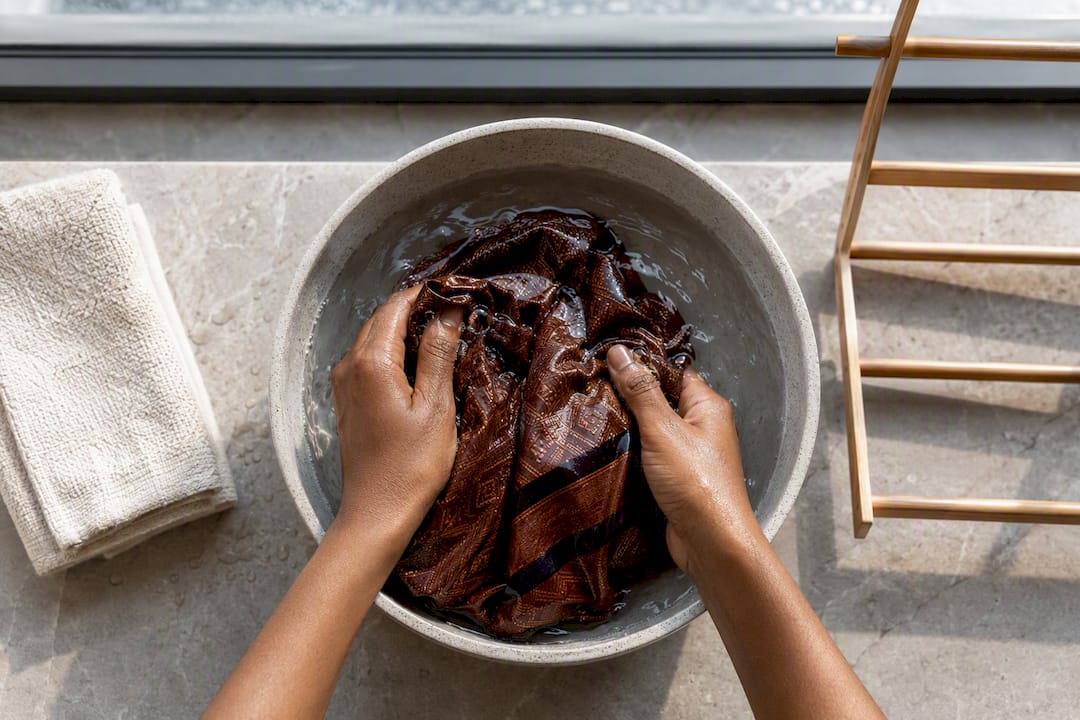
Pro Tip: Hand wash bazin in cool water and air dry away from direct sun to preserve its sheen. Professional starching restores the crisp structure if it goes limp after multiple washes.
Why Senanukunu Understands This Garment
Senanukunu exists to showcase authentic West African fashion with real cultural pride, not costume shortcuts. The brand's focus stays on craftsmanship and ethical production rather than mass replication.
- A curated, ready-to-ship selection of dresses, sets, and statement pieces inspired by West African heritage.
- Limited-quantity production that supports artisans instead of high-volume factory runs.
- A design philosophy built around empowerment and cultural storytelling, not generic "African print" trends.
That grounding matters when a garment carries as much history as the boubou does.
How Has the Boubou Shaped Diaspora Fashion Worldwide?
The boubou's influence has traveled far beyond Senegal's borders, largely carried by diaspora communities who kept the garment central to weddings, church services, and cultural celebrations even after relocating to Paris, London, New York, or Atlanta. That persistence turned the silhouette into a recognizable marker of West African identity in cities with no direct geographic connection to the Sahel.
Fashion weeks in Dakar, Lagos, and increasingly New York have picked up on wide-sleeved silhouettes and bold embroidery as a design language rather than a niche cultural reference. Western designers have borrowed elements, oversized sleeves, dramatic drape, contrast embroidery, without always crediting the specific tradition, which is part of why cultural context matters so much when discussing the garment's spread.
Within Black American communities specifically, the boubou has become a way to visibly claim West African heritage, often worn during Kwanzaa celebrations, graduations, and milestone events where cultural pride is the point. It sits alongside kente cloth and Ankara prints as a garment that signals connection to ancestry rather than just fashion preference.
Social media accelerated this further. Stylists and content creators showing tradi-moderne looks, shortened boubou dresses paired with sneakers, tailored boubou jackets worn over jeans, have introduced the silhouette to audiences who might never have encountered it through traditional retail. The garment now moves fluidly between runway coverage and everyday street style, which says something about how adaptable the original design always was.
What Do the Colors and Embroidery Patterns Mean?
Color and embroidery on a boubou rarely exist for decoration alone. White frequently appears at religious events and naming ceremonies, associated with purity and spiritual clarity. Deep blues, rich golds, and jewel tones tend to signal celebration and status, which is why they dominate wedding and formal event wardrobes.
Embroidery density itself functions as a kind of visual vocabulary. A boubou with embroidery concentrated only at the neckline and cuffs reads as more understated, appropriate for religious observance or daily elegance. Dense embroidery covering the chest panel and running down the sleeve signals a ceremonial or celebratory garment, often reserved for weddings or major life events.
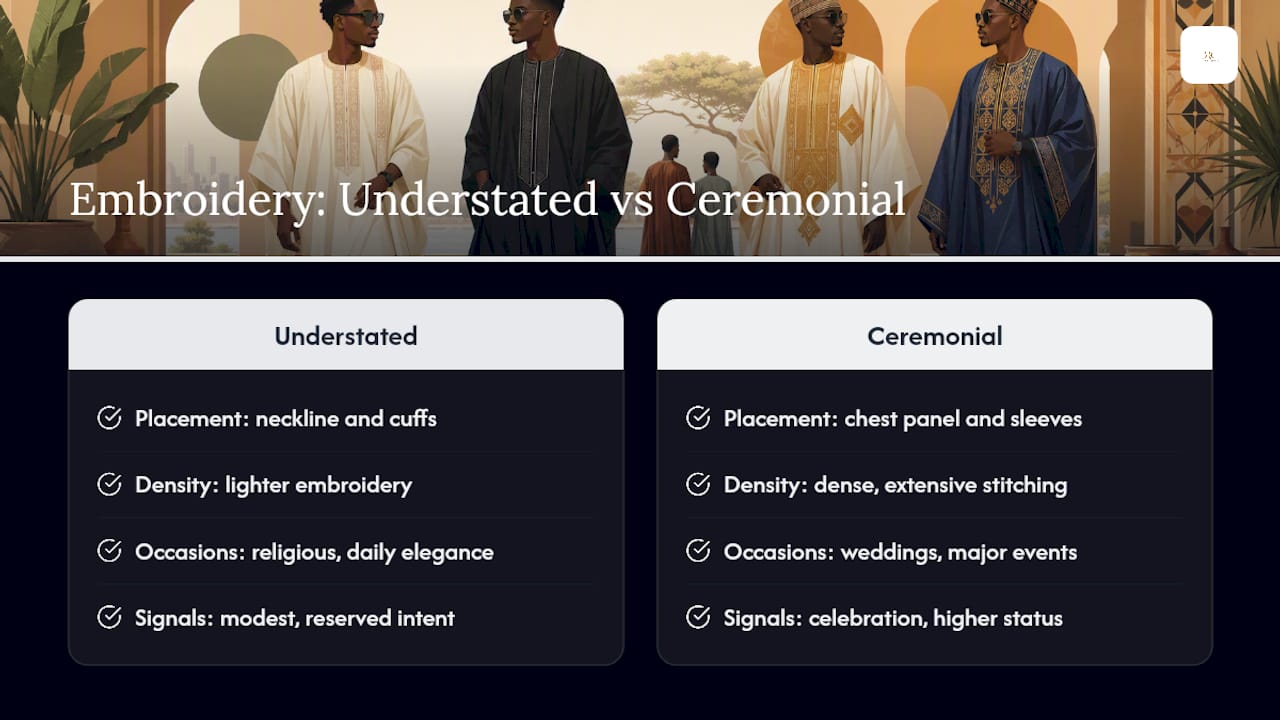
Specific motifs carry meaning too, though interpretation varies by region and even by individual tailor. Geometric patterns often reference balance and order. Some embroidery designs draw on Islamic calligraphic influence, reflecting the religious history tied to the garment's rise as formal wear. Metallic thread, gold or silver, historically signaled wealth, since it required more expensive materials and more skilled handwork to execute cleanly.
None of this is arbitrary decoration. A boubou's color and stitching choices tell people something about the occasion, the wearer's intent, and often their social standing, all before a single word is spoken. That's part of why buying or wearing one thoughtfully matters more than treating it as an interchangeable statement piece.
Why This Garment Still Matters
The boubou has survived centuries of change because its meaning was never fixed to one silhouette. It bends with each generation while carrying the same dignity forward. Wear it, and buy it, with respect for that lineage rather than as a passing trend.
— Sena
Where to Find Authentic, Ethically Made Boubou-Inspired Pieces
Finding a boubou-inspired piece that respects the garment's history shouldn't mean choosing between mass-produced fast fashion and hard-to-source imports. There are curated, ready-to-ship dresses, sets, and statement pieces inspired by authentic West African design, produced in limited quantities with emphasis on craftsmanship rather than volume.
The current collection spans tradi-moderne silhouettes, tailored pieces for professional settings, and full statement gowns suited to weddings and ceremonial events, all made with attention to fabric weight, embroidery quality, and finish rather than shortcuts. Because runs are limited, availability shifts as pieces sell out, so browsing early matters if a specific style catches your eye.
Ready to see what's currently available? Explore the full collection of ready-to-wear pieces or visit Senanukunu to check current styles and place an order.
Sources
- The boubou: a traditional African garment — AfroLegends
- Encyclopedia
- A look at Boubou, Senegal’s loose-fitting garment worn by both sexes — Face2Face Africa
FAQ
What Is an African Boubou?
An African boubou is a wide-sleeved, flowing robe worn across West Africa, known as mbubb in Wolof and often called grand boubou in francophone regions, used for formal, religious, and everyday occasions.
What Is the Difference Between a Kaftan and a Boubou?
A kaftan is typically lighter, shorter, or more fitted, suited to daily or warm-weather wear, while a traditional boubou is fuller, longer, and often reserved for ceremonial or formal occasions.
What Are the Differences Between Agbada and Boubou?
The agbada is a Yoruba wide-sleeved robe from Nigeria with its own draping and embroidery conventions, while the Senegalese boubou follows a distinct construction and cultural tradition tied to Wolof and Sahelian history, even though both share a common wide-sleeved silhouette.
What Is an African Kaftan Called?
Names vary by region and language, but in Senegal it's commonly referred to as a Senegalese kaftan, a lighter, more tailored relative of the full grand boubou.
Does Senanukunu Sell Authentic Boubou-Style Pieces?
Ready-to-wear dresses, sets, and statement pieces inspired by West African heritage are produced in limited quantities with emphasis on craftsmanship and ethical manufacturing.