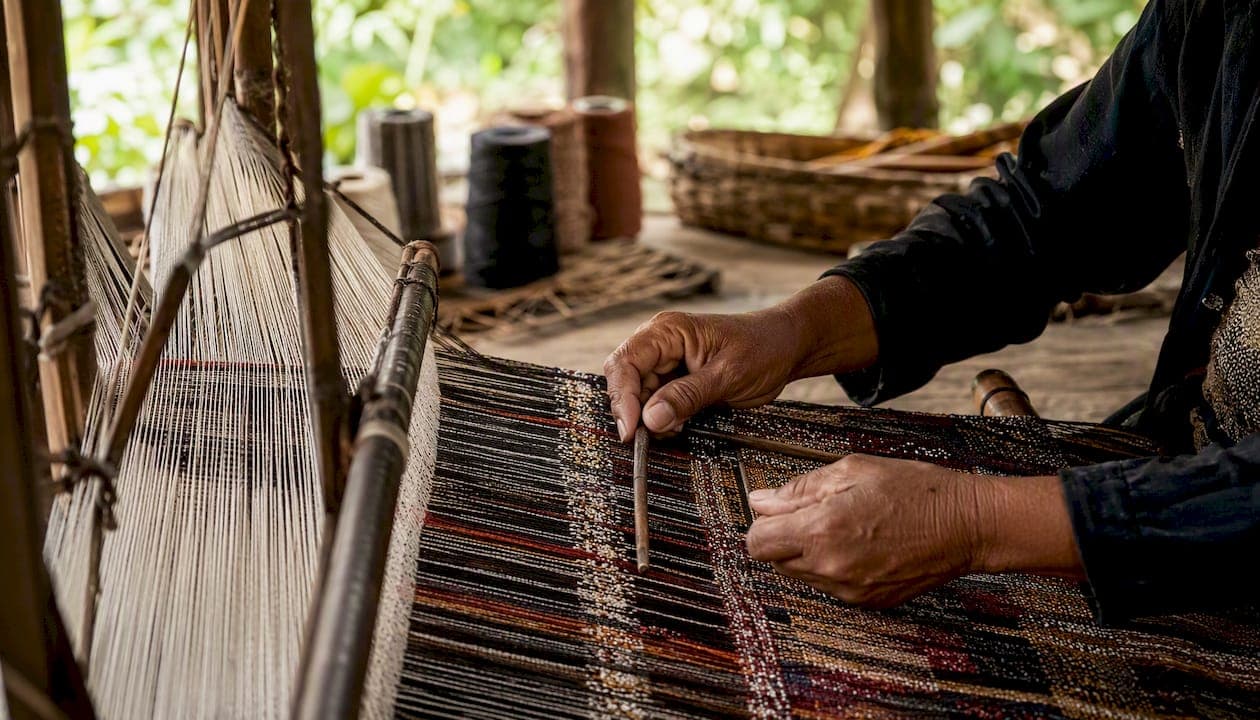
The most important handwoven fabric styles are plain (tabby), twill, satin, tapestry/flatweave families, ikat, brocade/supplementary-weft, pile weaves, leno/basket variants, and regionally named textiles like kente, kilim, and soumak. This guide lists each style in the complete list of handwoven fabric styles below, with visual cues to identify them, fiber guidance, typical uses, and care notes.
Here is what you will find in each entry:
- Plain (tabby) weave — the simplest interlace; foundation of homespun cloth and khadi
- Twill weave — diagonal rib; durable garments and structured textiles
- Satin weave — long floats; smooth, drapey surface
- Tapestry/flatweave — weft-faced pictorial or geometric designs
- Ikat — resist-dyed yarn patterned before weaving
- Brocade/supplementary-weft (jamdani) — extra weft threads build raised motifs
- Leno/basket weave — open, airy structures
- Dobby/jacquard patterns — loom-controlled geometric or figured designs
- Pile/rya — cut or looped weft creating texture and depth
- Kilim/soumak — flatweave rug traditions with wrapped or interlocked weft
- Kente and other named regional textiles — strip-woven, culturally coded cloth
- Double cloth — two interlocked layers woven simultaneously
Each entry includes identification cues, common fibers, typical uses, and care notes. A practical identification checklist, dye and color guidance, and a short Senanukunu brand example ground the information in real-world context.
Key Takeaways
Handwoven fabrics are defined by manual loom control, and the combination of weave structure, fiber, and regional technique determines every aspect of a cloth's appearance, durability, and care needs.
| Point | Details |
|---|---|
| Three foundational weaves | Plain, twill, and satin explain most differences in surface appearance, drape, and strength across all woven cloth. |
| Specialty techniques add motif | Ikat, soumak, brocade, and kente build pattern during weaving, not after — making them more time-intensive and culturally specific. |
| Fiber shapes care and drape | Wool needs cold water and flat drying; silk needs gentle handling; linen and cotton tolerate more agitation. |
| Selvedge and slubs are the fastest ID checks | Uneven selvedge, thread slubs, and slight pick-spacing variation are the clearest signs of handwoven cloth. |
| Natural dyes need gentler care | Cold water, pH-neutral soap, and UV protection extend the life of naturally dyed handwoven textiles significantly. |
Table of Contents
- What makes a fabric truly handwoven?
- The three foundational weave structures you need to know
- Specialty techniques and named regional styles worth knowing
- How fiber choice shapes every handwoven piece
- How to spot a handwoven fabric at a glance
- Matching handwoven fabric styles to your project
- Caring for handwoven textiles the right way
- How Senanukunu sources and uses handwoven textiles
- Dyes and coloring techniques in handwoven fabrics
- Reading pattern, color, and motif to identify regional cloth
- What most guides on handwoven fabrics get wrong
- Sources
What makes a fabric truly handwoven?
A fabric is handwoven when a person, not a power-driven machine, controls the interlacing of threads on a loom. The weaver passes the weft (horizontal thread) over and under the warp (vertical threads held taut on the loom) by hand or foot-operated treadle, beat by beat. That manual control is what gives handwoven textiles their characteristic slight irregularities, variable beat spacing, and tactile warmth that machine cloth rarely replicates.
The warp provides structure and determines the cloth's length; the weft builds width and carries color or pattern. How those two sets of threads interlace defines the weave structure, and weave structure shapes everything from drape to durability.
Common handloom formats include:
- Backstrap loom — body-tensioned, portable, produces narrow warp-faced cloth; common in Mesoamerican and Andean traditions
- Rigid-heddle loom — beginner-friendly, fixed heddle controls two sheds; good for plain weave and simple patterns
- Frame/floor/treadle loom — foot-operated, multiple shafts, wider cloth; used for twill, satin, and complex patterns
- Pit loom — weaver sits in a pit below the loom; traditional in South Asia for fine silk and cotton
Loom choice directly limits cloth width and patterning options. As Anni Albers wrote, a small change in loom setup or patterning approach expands expressive possibilities enormously — jacquard attachments, for example, enable elaborate figured designs while still depending on the weaver's manual skill for every pick.
The three foundational weave structures you need to know
Plain, twill, and satin are the three core weave families. Every other handwoven structure either belongs to one of them or combines elements of all three. Recognizing these three gives you a working vocabulary for almost any woven cloth you encounter.
| Feature | Plain (tabby) | Twill | Satin |
|---|---|---|---|
| Visual cue | Checkerboard interlace; no diagonal | Diagonal rib or herringbone | Smooth, lustrous surface; few visible interlacings |
| Handfeel | Firm, crisp | Supple, slightly textured | Soft, drapey, slippery |
| Common uses | Shirts, scarves, homespun cloth, canvas | Outerwear, denim-weight cloth, structured garments | Linings, ties, fine drapery, ceremonial cloth |
| Strength/drape | Strong, low drape | Strong, moderate drape | Moderate strength, high drape |
Plain weave interlaces every warp and weft thread alternately — over one, under one. The result is a balanced, firm cloth. Handspun cotton plain weave is the basis of Indian khadi, and it is the first structure most weavers learn because consistent beat and tension are visible immediately.
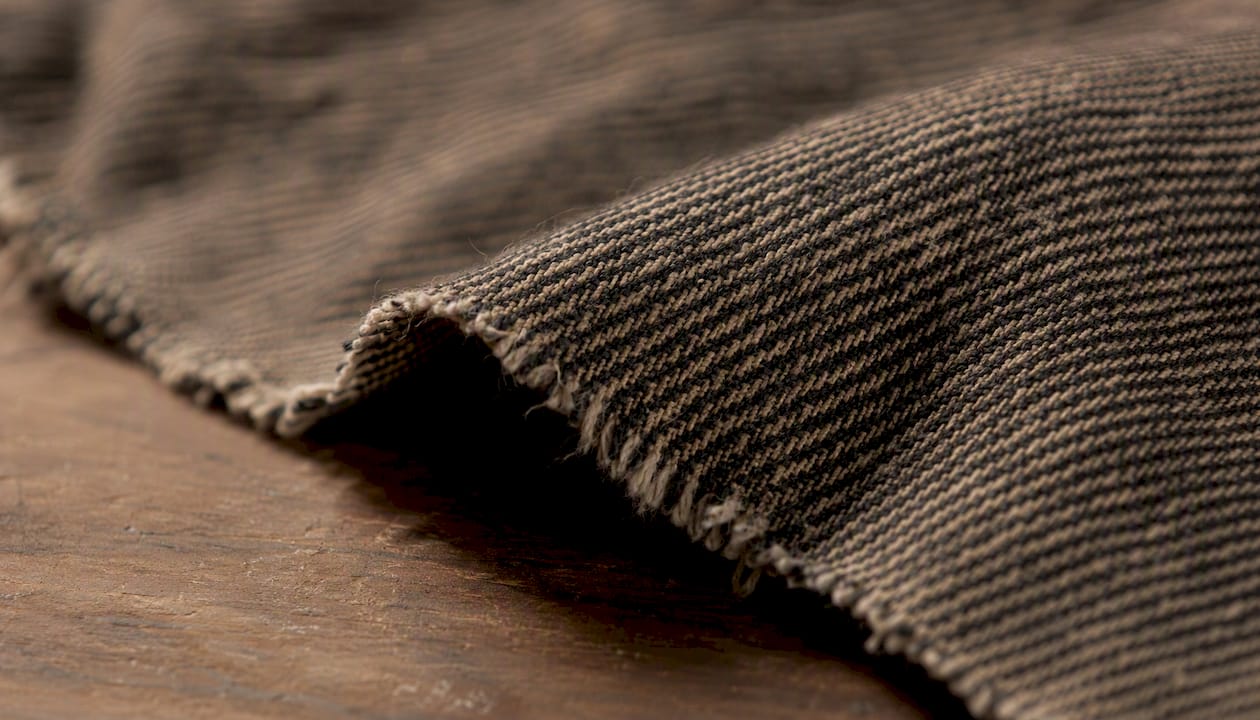
Twill weave passes the weft over two or more warps before going under, shifting one thread with each row to create a diagonal line. That diagonal is the quickest visual ID: look for a clear rib running at roughly 45 degrees. Twill produces a denser, more flexible cloth than plain weave at the same thread count, which is why it suits outerwear and structured garments.
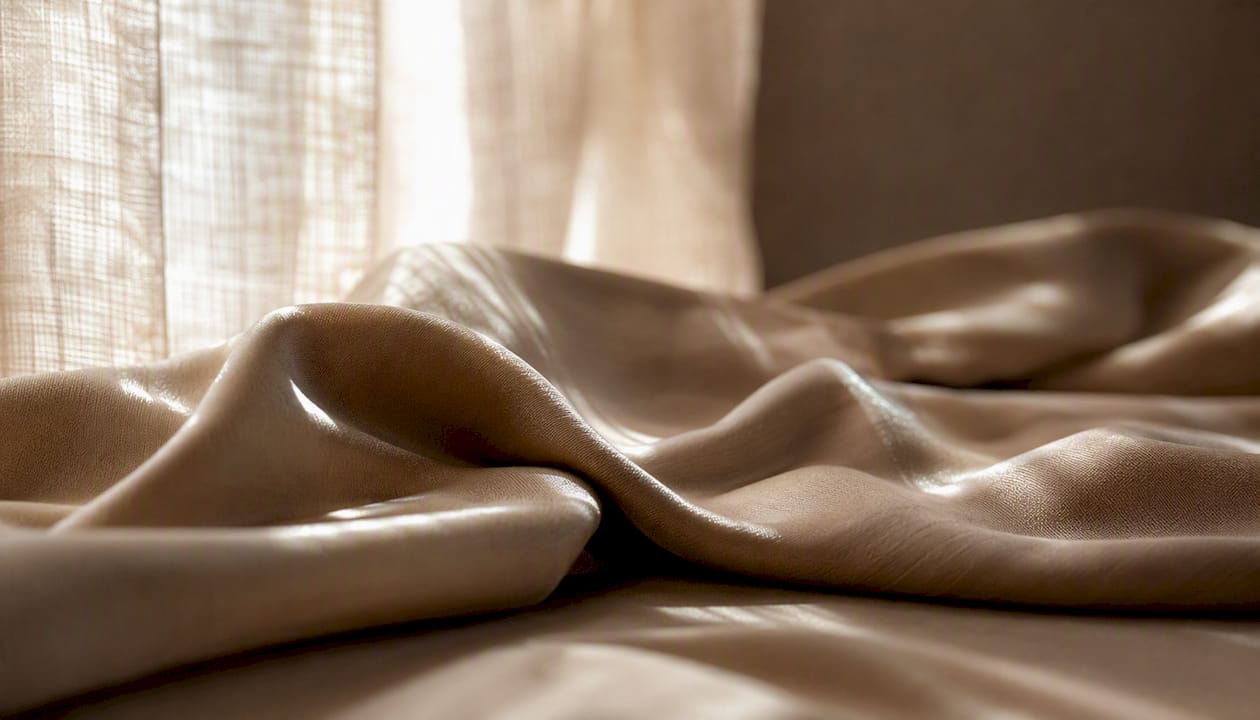
Satin weave floats the weft (or warp) over four or more threads before interlacing, spacing those interlacings so they are nearly invisible on the face. The long floats catch light uniformly, creating the characteristic sheen. Silk satin handwoven on a floor loom produces the kind of drapey, luminous cloth used in fine ceremonial garments across West Africa and East Asia alike.
Specialty techniques and named regional styles worth knowing
Handwoven textiles span a wide spectrum, from simple plain-weave homespun to complex tapestry, supplementary-weft brocade, and pile rugs. The specialty techniques below build on the three foundational structures by adding hand-manipulation, pre-dyeing, or loom attachments.
-
Tapestry/flatweave — weft-faced; the weaver uses discontinuous weft colors to build pictorial or geometric designs. No visible warp on the face. Used for wall hangings, decorative panels, and fine art cloth.
-
Ikat — yarn is resist-dyed in precise sections before weaving, so the pattern emerges as threads align on the loom. The telltale sign is a soft, slightly blurred edge on every motif. Found across Central Asia, Indonesia, and West Africa.
-
Brocade/supplementary-weft (jamdani) — extra weft threads are inserted by hand alongside the ground weft to build raised or contrasting motifs. The back of the cloth shows floating supplementary threads. Jamdani from Bangladesh is a UNESCO-recognized example; West African strip-woven brocade uses the same principle.
-
Leno weave — pairs of warp threads twist around each weft, locking it in place and creating an open, gauze-like structure. Lightweight and breathable; used for sheer curtains and summer garments.
-
Basket weave — two or more warp and weft threads interlace together as a unit, producing a looser, textured plain-weave variant. Common in natural-fiber bags and casual cloth.
-
Dobby/jacquard patterns — dobby attachments control small geometric repeats; jacquard attachments (punch-card or digital) enable complex figured designs. Both are loom-driven rather than hand-manipulated, but handloom jacquard still requires a skilled operator for each pick.
-
Pile/rya — cut or looped weft knots tied around warp threads create a raised surface. Scandinavian rya rugs use long, shaggy pile; Turkish and Persian pile rugs use shorter, denser knots. Wool is the dominant fiber.
-
Kilim — a flatweave rug technique where weft threads of different colors interlock or turn back at color boundaries, leaving no pile. Geometric motifs are the norm. Produced across the Middle East, Central Asia, and North Africa.
-
Soumak — a flatweave variant where the weft wraps around warp threads before moving forward, creating a braided, slightly ridged surface. Denser and more textured than kilim; used for bags and decorative rugs.
-
Kente — strip-woven silk or cotton cloth from Ghana, woven in narrow strips (roughly 4 inches wide) on a horizontal treadle loom, then sewn together. Bold geometric and symbolic patterns encode cultural meaning. West African artisan techniques like kente carry centuries of coded visual language.
-
Double cloth — two separate layers of cloth woven simultaneously on the same loom, interlocked at intervals. Reversible, warm, and structurally complex. Used for coats, blankets, and fine scarves.
Regionally named textiles like khadi, Chanderi, Uppada silk, and Kutch/Bhujodi weaving are each tied to specific loom types and local techniques that produce distinctive textures and motifs. Techniques like ikat and soumak build motifs during weaving rather than by printing afterward, which is why they typically require far more time and skill than surface-decorated cloth.
Pro Tip: Practical maker resources recommend mastering plain weave and twill before attempting ikat or soumak. Both of the latter require predictable warp tension and consistent beat — skills that plain weave builds naturally.
How fiber choice shapes every handwoven piece
The five fibers you will encounter most in handwoven cloth are cotton, linen, silk, wool, and hemp. Fiber choice shapes drape, sheen, warmth, and care needs as much as weave structure does.
| Fiber | Drape | Handfeel | Best uses | Care shorthand |
|---|---|---|---|---|
| Cotton | Moderate | Soft, breathable | Shirts, scarves, plain-weave cloth | Machine or handwash, low heat |
| Linen | Structured | Crisp, cool | Structured garments, table textiles | Handwash or gentle cycle, air dry |
| Silk | High | Smooth, lustrous | Fine drapery, ceremonial cloth, satin weaves | Dry clean or cold handwash |
| Wool | Low to moderate | Warm, textured | Rugs, outerwear, pile weaves, twills | Handwash cold, flat dry |
| Hemp | Moderate | Slightly coarse, softens with use | Bags, canvas, durable plain weave | Machine wash, air dry |
Linen's natural stiffness makes it ideal for structured garments where you want the cloth to hold its shape. Wool's natural crimp gives pile rugs their resilience and bounce. Silk brings a luminous quality to satin and supplementary-weft brocade that no other fiber matches at the same fineness.
Cotton-silk blends appear frequently in handwoven dress cloth because they combine cotton's stability and washability with silk's sheen and drape. Wool-cotton blends are common in handwoven twill for garments that need warmth without full wool weight.
How to spot a handwoven fabric at a glance
The single quickest check is the selvedge: a handwoven cloth typically has a slightly uneven, sometimes loopy selvedge edge rather than the perfectly uniform, machine-cut or heat-sealed edge of industrial cloth. Here is a full inspection sequence:
- Check the selvedge. Look for slight waviness, looping, or hand-finished edges. Many narrow-loom traditions produce cloth of narrow width, so larger pieces are pieced together — visible seams are a positive ID signal.
- Look for slubs and irregularities. Hold the cloth to light. Handspun or hand-thrown weft creates occasional thick-thin variations (slubs) in the thread. Perfectly uniform thread throughout suggests machine production.
- Examine pick spacing. The distance between weft rows (picks) varies slightly in handwoven cloth. Under a loupe or close-up photo, you can see the beat is not perfectly mechanical.
- Check pattern registration. In ikat or supplementary-weft cloth, motif edges are slightly soft or irregular. Machine-printed patterns have crisp, perfectly repeating edges.
- Look for hand-tied joins. Weavers tie off and join new weft threads by hand; small knots or tails tucked into the weave are a reliable handwork signal.
- Assess width and piecing. Cloth under 20 inches wide, or garments clearly assembled from narrow strips, points to a backstrap or traditional narrow loom.
- Inspect hems and finishing. Hand-rolled hems, hand-stitched edges, or raw selvedge used as a design element all indicate artisan finishing.
Selvedge construction, uneven pick spacing, characteristic slubs, and hand-finished hems are the strongest tactile and visual indicators that a cloth was woven on a handloom.
Pro Tip: When buying handwoven apparel, ask the seller for loom type, region of origin, and weaver information. A brand that can answer those questions specifically is far more likely to be offering genuinely handwoven cloth.
Matching handwoven fabric styles to your project
The right fabric family for your project depends on three things: the use-case's durability demands, the drape you need, and the cultural or aesthetic intention behind the piece.
For garments, plain-weave linen and cotton suit shirts, blouses, and lightweight dresses where breathability matters. Twill wool or cotton-wool blends work well for structured jackets and outerwear because the diagonal interlace resists abrasion. Satin-weave silk or silk-blend cloth is the natural choice for drapey occasion wear and ceremonial garments. Handmade garment traditions across West Africa often combine strip-woven kente or supplementary-weft brocade with plain-weave ground cloth for contrast and emphasis.
For home textiles, plain-weave cotton and linen are workhorses for table runners, napkins, and cushion covers. Double cloth in wool or cotton makes warm, reversible throws. Tapestry and kilim techniques produce decorative wall hangings and flat-woven rugs that hold geometric motifs with precision.
For rugs and floor coverings, kilim and soumak flatweaves in wool offer durability and easy cleaning. Pile weaves (rya, knotted pile) add warmth and texture but require more careful maintenance.
Choose handwoven specifically when texture, cultural authenticity, or small-batch colorfastness matter to you. Machine-made cloth is practical when you need perfectly uniform yardage at scale, but it cannot replicate the slight variation and tactile depth that handweaving builds into every inch of cloth.
Caring for handwoven textiles the right way
The general principle: treat handwoven cloth as you would a delicate, and test colorfastness before any wet process. Natural dyes in particular can bleed with heat or agitation.
- Spot-test first. Dampen a hidden corner and press with a white cloth. If color transfers, dry clean or use cold water only.
- Handwash gently. Use cool water and a mild, pH-neutral detergent. Submerge, press gently, and avoid wringing or twisting.
- For wool and pile weaves, cold water only. Hot water causes irreversible felting.
- Dry flat. Lay the piece on a clean towel, reshape while damp, and allow to air dry away from direct sun. Hanging wet handwoven cloth distorts the weave.
- Store with acid-free tissue. Fold loosely or roll stiff flatweaves (kilim, tapestry) around an acid-free tube to prevent crease lines from becoming permanent.
- Protect from light and dust. UV exposure fades natural dyes faster than synthetic ones. Store folded pieces in breathable cotton bags, not plastic.
- Mend pulled threads promptly. Use a blunt needle to work a pulled thread back into the weave structure from the wrong side. Small holes can be rewoven with matching yarn using a darning technique that follows the original interlace pattern.
How Senanukunu sources and uses handwoven textiles
Senanukunu sources authentic handwoven textiles to create limited-run West African–inspired garments that center craftsmanship, cultural storytelling, and ethical production. Every piece carries the weight of a tradition — and the intention of a maker who shaped it by hand.
- Ethical manufacturing is a core commitment: sustainable sourcing practices and transparent supply chains are built into how the brand operates.
When purchasing handwoven apparel from any brand, ask about the loom type, the weaver's region, and how the cloth was finished. A seller who can answer those questions with specificity — naming a technique, a community, or a tradition — is offering you something genuinely made, not merely marketed as handmade. Evaluating artisan craftsmanship before you buy protects both your investment and the artisans whose livelihoods depend on authentic demand.
Dyes and coloring techniques in handwoven fabrics
Color in handwoven cloth arrives in two fundamentally different ways: the yarn is dyed before weaving, or the finished cloth is dyed afterward. Each approach produces a different visual result and carries different care implications.
Pre-weave dyeing includes ikat (resist-dyeing yarn sections before weaving) and yarn-dyed warp or weft (solid or striped color built into the structure). Because the dye penetrates the fiber before weaving, the color is locked into the thread's core and tends to be more durable than surface application.
Natural dyes — derived from plants, minerals, and insects — have been used in handwoven traditions for millennia. Indigo (blue), madder (red-orange), and weld (yellow) are among the most historically significant. Natural dyes often produce colors with a depth and variation that synthetic dyes cannot replicate, but they can be more sensitive to UV light, alkaline detergents, and heat. Cold water and pH-neutral soap are non-negotiable for naturally dyed cloth.
Synthetic dyes (aniline and fiber-reactive dyes) offer greater colorfastness and a wider color range. Most commercially produced handwoven cloth today uses synthetic dyes, though artisan producers increasingly return to natural processes for cultural and environmental reasons.
Resist techniques beyond ikat include batik (wax resist applied to woven cloth before dyeing) and tie-dye variants. These are surface processes applied after weaving, so the dye sits on the cloth's face rather than penetrating the fiber uniformly. Care for resist-dyed cloth follows the same cold-water, gentle-agitation principle as naturally dyed textiles.
Colorfastness testing before washing is especially important for handwoven cloth because the open weave structure allows dye to migrate more readily than in tightly woven industrial fabric.
Reading pattern, color, and motif to identify regional cloth
Pattern and color use are as diagnostic as weave structure when you are trying to place a handwoven textile in its tradition.
Geometric precision vs. organic variation is the first split. Kilim and kente patterns are built on strict geometric grids — diamonds, chevrons, stepped triangles — because the weave structure itself imposes a grid. Tapestry and ikat allow more organic curves, though ikat's characteristic soft-edged blur distinguishes it from printed cloth immediately.
Color palette carries regional signatures. West African strip-woven cloth often uses high-contrast primaries and gold against dark grounds. Central Asian kilim traditionally favors deep reds, blues, and ivory. Guatemalan backstrap-loom textiles use saturated jewel tones in tight geometric bands. Scandinavian rya and tapestry work tends toward earthy naturals with occasional bold accent colors.
Motif vocabulary is the deepest layer of identification. Kente's specific pattern names encode social and spiritual meaning — each combination of color and geometry communicates status, occasion, or clan identity. Andean textiles use stepped fret and diamond motifs that appear across centuries of archaeological examples. Ikat from Uzbekistan and Indonesia shares a vocabulary of medallions and vine scrolls, though the regional execution differs in color and scale.
Symmetry and repeat offer practical clues. Machine-printed cloth repeats motifs with mechanical precision. Handwoven pattern repeats are consistent in structure but carry slight variations in color intensity, motif size, or spacing — the natural result of a human hand controlling each pick. That variation is not a flaw; it is the signature of the maker.
Handcrafted apparel carries these visual codes as living cultural expression, not decoration. Learning to read them transforms how you see and choose cloth.
What most guides on handwoven fabrics get wrong
Most articles about types of handwoven fabrics treat the subject as a taxonomy exercise: name the weave, describe the structure, move on. That approach is useful for reference, but it misses the thing that actually matters to anyone who wants to buy, make, or care for handwoven cloth. The weave structure is the beginning of the story, not the whole of it.
The more important insight is that handwoven cloth is a record of decisions. Every choice — fiber, loom, dye, technique — was made by a person with a specific tradition behind them and a specific intention in front of them. When you learn to read those choices, a piece of cloth becomes legible in a way that machine-made fabric never is. The slight blur on an ikat edge, the narrow strip seam in a kente garment, the loopy selvedge on a backstrap-loom textile: these are not imperfections. They are the maker's signature.
The conventional advice to "look for irregularities" is correct but incomplete. Irregularities tell you a cloth was made by hand. Pattern vocabulary, color logic, and motif structure tell you where and by whom — and that is the knowledge worth building. A buyer who can recognize a supplementary-weft brocade from West Africa, or distinguish soumak from kilim by the ridged surface, is not just better at shopping. They are participating in a tradition of appreciation that keeps those traditions alive.
For makers, the practical implication is this: start with plain weave and twill, not because they are simple, but because they teach you what tension, beat, and fiber actually do. Every specialty technique you attempt afterward will make more sense because you built it on a foundation you understand in your hands, not just in your head.