
TL;DR:
- Black fashion history reflects a tradition of clothing as a form of resistance, art, and cultural identity.
- Black designers and communities have continuously shaped global style through innovation, activism, and preserving textile traditions.
Black fashion history is the story of a people who turned clothing into language, resistance, and art across centuries. From the tailored suits of the Harlem Renaissance to the sculptural runway work of Kerby Jean-Raymond, Black creators have continuously shaped global style with intention and brilliance. This legacy lives in the more than 2,000 garments preserved by the Black Fashion Museum, founded in Harlem by Lois K. Alexander-Lane and later donated to the National Museum of African American History and Culture. Figures like Zelda Wynn and Donayle Luna carry that legacy forward, contributing to a history defined by resilience, creativity, and cultural pride.
At its core, Black fashion history encompasses:
- Political resistance through dress, from the Silent Protest Parade of 1917 to the zoot suit era
- Artistic authorship, with Black designers treating garments as sculpture, narrative, and cultural preservation
- African textile traditions, including kente, mud cloth, and Ankara prints, woven into a living diaspora identity
- Institutional preservation, led by visionaries like Lois K. Alexander-Lane and the National Museum of African American History and Culture
- Global influence, from street style to haute couture, shaped by Black communities without waiting for permission
How Black fashion history began: origins and early development
The roots of Black fashion history stretch back to the era of enslavement, where clothing was first a tool of control and then an act of defiance. Enslaved people who sewed wardrobes for their enslavers refashioned castoff garments, adding buttons, ribbons, and scraps to individualize what had been designed to erase them. That impulse, to claim the body through dress, became the foundation of everything that followed.
After Emancipation, Black communities in Northern cities created new fashion cultures with remarkable speed. Harlem became the most visible center of this energy during the 1920s and 1930s, when the Harlem Renaissance brought together artists, intellectuals, and tastemakers who dressed with deliberate elegance. Men promenaded in pinstripe suits of silk and wool, accessorized with fedoras and pocket squares, dressing not for white approval but for each other.
Black dandyism emerged from this moment as a formal cultural movement, using European tailoring to assert individuality and resist racial stereotypes. Figures like Frederick Douglass had already modeled this approach in the 19th century, using meticulous dress to challenge caricatures of Black people in the public eye. W.E.B. Du Bois took it further, wearing gloves, walking sticks, and top hats on international travels to convey dignity and demand the respect his intellect commanded.
- African textile traditions carried deep meaning long before Western fashion institutions existed
- Kente, mud cloth, and Ankara prints encoded lineage and philosophy through pattern
- Early Black urban communities in Harlem established fashion as a collective cultural practice
- Preservation of these origins owes much to Lois K. Alexander-Lane's decades of collecting
Pro Tip: If you want to understand Black fashion history at its deepest level, explore the Black Fashion Museum collection at the National Museum of African American History and Culture. The digitized archive spans garments from the 19th century through the 1990s, offering a direct window into how style evolved across generations.
Notable Black fashion icons and designers who shaped the culture
The history of Black fashion innovation is inseparable from the individuals who lived it, often at great personal and professional risk.
| Designer | Era | Key Achievement |
|---|---|---|
| Zelda Barbour Wynn Valdes | 1940s–1980s | First Black designer to open her own fashion shop in 1948, breaking racial barriers in business ownership |
| Lois K. Alexander-Lane | 1960s–1980s | Founded the Black Fashion Museum in Harlem; preserved more than 2,000 garments documenting Black fashion heritage |
| Dapper Dan | 1980s–present | Pioneered luxury streetwear in Harlem, fusing high-fashion logos with Black urban aesthetics |
| Kerby Jean-Raymond | 2000s–present | Founder of Pyer Moss; treated fashion as sculpture, storytelling, and cultural preservation |
| Donayle Luna | Contemporary | Recognized for blending cultural heritage with modern aesthetics, shaping current Black fashion narratives |
| André Leon Talley | 1970s–1980s | First Black creative director at US Vogue; understood dress as autobiography and cultural statement |
Zelda Barbour Wynn Valdes opened her own shop in 1948, a moment that carried enormous weight in an industry that routinely shut Black designers out of ownership and credit. She dressed celebrities and performers, proving that Black craftsmanship belonged at the highest levels of fashion. Donayle Luna represents the contemporary continuation of that legacy, weaving cultural heritage into designs that speak to both tradition and the present moment.
What unites these figures is authorship. They did not simply participate in fashion; they defined its direction, often without the institutional recognition their white peers received automatically.
Key moments and the cultural impact of Black fashion
The Silent Protest Parade of 1917 stands as one of the most powerful demonstrations of fashion as political speech in American history. Thousands of African Americans marched down New York's Fifth Avenue, the men in tailored black suits, the women and children in white, responding to racial violence with a display of calm, dignity, and collective power. No signs. No chants. Just clothing, speaking loudly enough to be heard across generations.
The zoot suit era of the 1930s and 1940s carried a different charge. Born in Harlem's dance halls and worn by performers like Dizzy Gillespie and Cab Calloway, the zoot suit's exaggerated proportions were a declaration of space and freedom. When wartime rationing made the style's fabric use a political flashpoint, white mobs in Los Angeles attacked zoot suit wearers in 1943, stripping and slashing their clothes. The violence only deepened the suit's meaning as a symbol of resistance.
"Black dandyism is the strategic and often subversive use of style by people of African descent to assert individuality, challenge stereotypes, and reimagine Black identity. It's not just about aesthetics; it's a profoundly political act." — Jonathan Michael Square, assistant professor of Black visual culture at Parsons Design School
Key cultural impacts of Black fashion across history:
- The Silent Protest Parade of 1917 established tailored dress as a form of peaceful political demonstration
- The zoot suit became a target of racial violence precisely because of its power as a symbol of Black freedom
- Black Panthers used the beret and leather jacket as a uniform of organized political identity in the 1970s
- Hip-hop culture in the 1980s and 1990s transformed sportswear and streetwear into a global aesthetic language
- The 2025 Met Gala theme, "Superfine: Tailoring Black Style," marked the first Met Gala theme dedicated to Black designers and raised $31 million, a record high in the event's history
How Black designers use fashion as cultural storytelling
Black fashion has always operated as fine art, even when institutions were slow to say so. Designers like Kerby Jean-Raymond approached the body as both canvas and site, using garments to carry narrative weight that went far beyond adornment. His Fall 2021 haute couture presentation for Pyer Moss blurred the line between runway and exhibition, collaborating with artists like Derrick Adams and Mickalene Thomas to embed Black visual art directly into his collections.
That lineage runs deep. Willi Smith in the 1980s fused art and fashion through performance-based runway shows and an artist T-shirt program featuring Keith Haring. Patrick Kelly and Stephen Burrows treated the body as a site of storytelling decades before the industry framed it that way. The Met Gala and recent museum exhibitions now recognize what Black creators have always expressed: fashion as a sophisticated cultural language with deep narrative weight.
"Fashion has long benefited from Black genius while minimizing its architects. Figures like André Leon Talley expanded fashion's intellectual and cultural scope, yet their influence is often sidelined. Black presence in fashion represents innovation and authorship across design, publishing, styling, photography, education, and curatorial work." — Kimberly Jenkins, Founder of the Fashion and Race Database
Pro Tip: When exploring contemporary Black fashion designers, look beyond the runway. Many, like Grace Wales Bonner, who became the first fashion designer invited to curate the Museum of Modern Art's Artist's Choice series in 2023, work across fashion and fine art institutions simultaneously.
Street style itself is a Black cultural invention, emerging from community improvisation and the refusal to wait for institutional validation. The industry arrives later, reframing what already existed as discovery. The origin, and the creative force, remains with Black communities.
How the African diaspora shaped regional Black fashion traditions
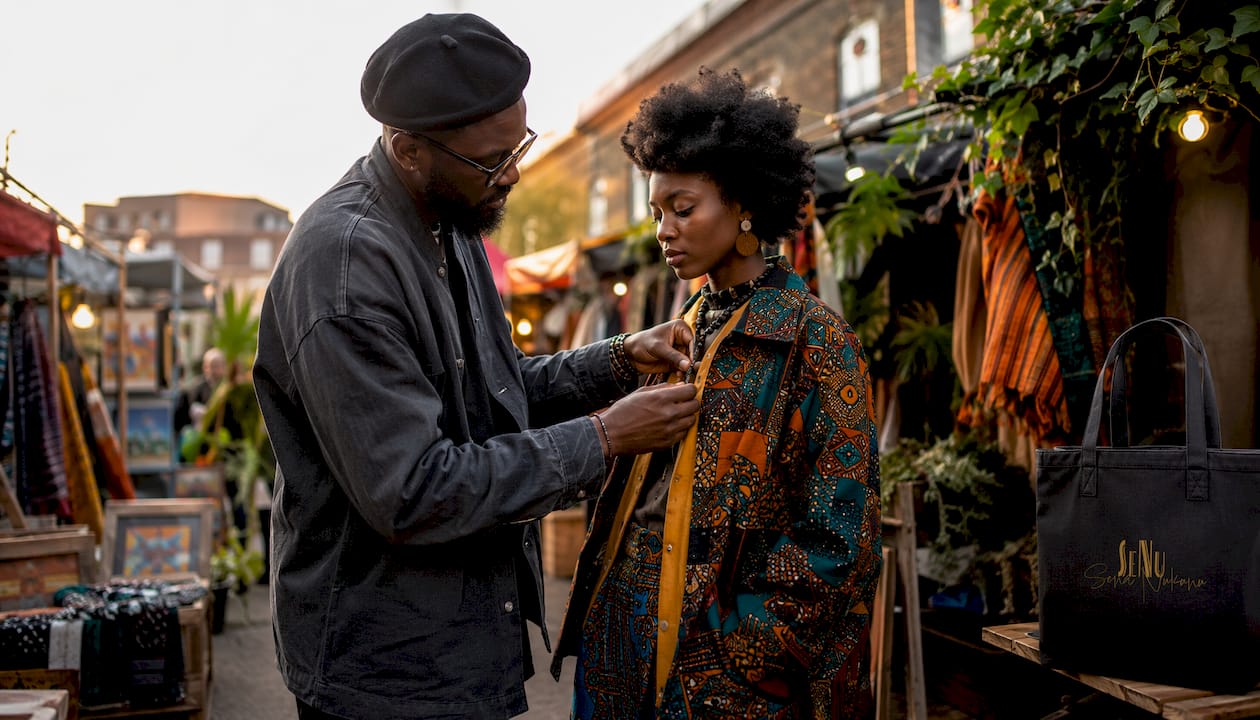
Black fashion history is not a single story told from one place. It is a chorus of regional voices, each shaped by geography, migration, and the specific textures of local culture. In West Africa, textile traditions like kente from Ghana and mud cloth from Mali carried meaning through pattern and color long before Western fashion categories existed. These were not decorative choices; they were systems of communication, encoding lineage, status, and philosophy into every thread.
The Great Migration of the early 20th century carried Southern Black aesthetic traditions into Northern cities, where they mixed with Caribbean and African influences brought by immigrants to neighborhoods like Harlem and Chicago's Bronzeville. The result was a genuinely new visual culture, one that drew from multiple diasporic streams at once. Caribbean communities contributed their own vibrant color traditions and tailoring sensibilities, while African immigrants brought textile knowledge that kept ancestral craft alive in new contexts.
Today, the African diaspora's style influence flows in multiple directions at once. Lagos, London, Atlanta, and Paris each host distinct Black fashion communities that reference each other while maintaining their own character. Ankara prints appear on runways in New York. Kente cloth inspires graduation stoles at American universities. The diaspora does not produce a single aesthetic; it produces a living conversation across borders, each community adding its own voice to a shared inheritance.
How Black fashion evolved decade by decade
Each decade of the 20th and 21st centuries added a distinct chapter to the story of Black fashion and cultural identity.
1920s–1930s: The Harlem Renaissance established Black fashion as a deliberate cultural practice. Pinstripe suits, fedoras, and zoot suits expressed a new sense of freedom and collective pride.
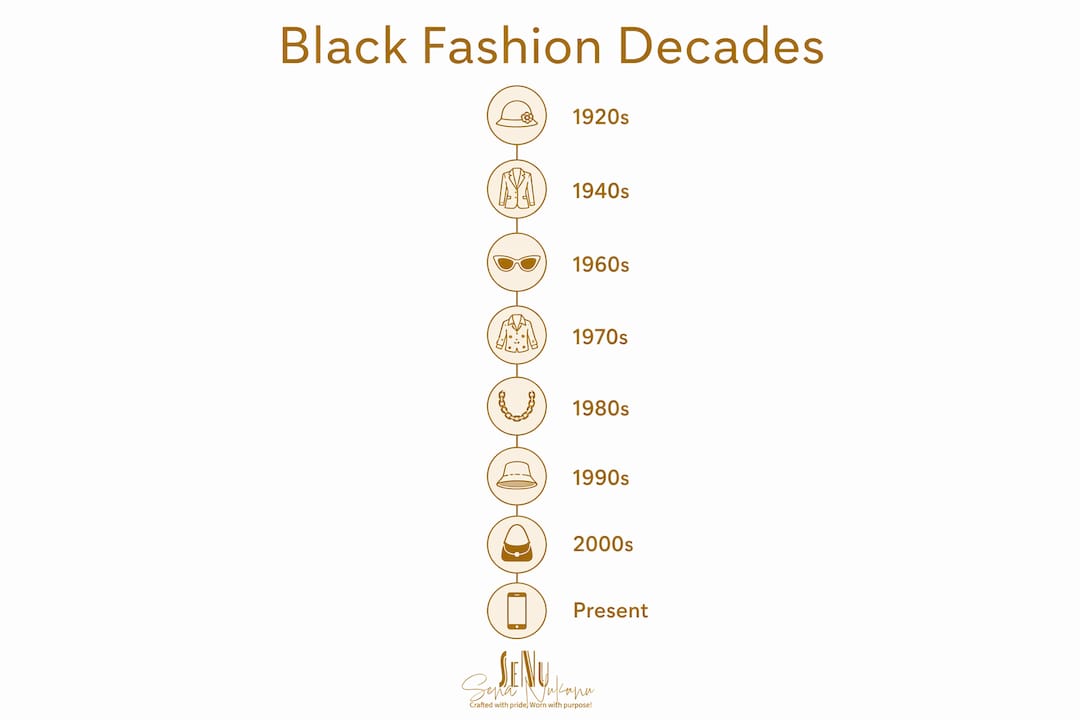
1940s–1950s: Zelda Barbour Wynn Valdes opened her shop in 1948, and Black designers began building business ownership in an industry that rarely offered it. Pill box hats and structured silhouettes reflected both elegance and aspiration.
1960s: Civil rights marchers wore Sunday best as a statement of dignity. Dresses and tailored clothing from this era, preserved in the Black Fashion Museum collection, document how dress functioned as protest during one of America's most turbulent decades.
1970s: Afrocentric fashion surged, with natural hair, dashikis, and bold prints asserting pride in African heritage. Costume design in film and television also became a site of Black creative expression.
1980s: Dapper Dan's Harlem atelier fused luxury logos with streetwear in ways the fashion industry had never seen, creating a template that major houses would eventually adopt decades later. Willi Smith's WilliWear made art-forward fashion accessible.
1990s: Hip-hop transformed global fashion. Brands like FUBU, founded on the principle of Black ownership and community, brought Black business fashion culture into mainstream retail. Baggy silhouettes, athletic wear, and bold branding became a worldwide visual language.
2000s–present: Virgil Abloh brought streetwear's codes to Louis Vuitton. Kerby Jean-Raymond made haute couture a vehicle for cultural memory. The 2025 Met Gala's "Superfine: Tailoring Black Style" theme confirmed what Black designers had always known: their work was never just fashion. It was art, history, and identity, all at once.
Key Takeaways
Black fashion history is a record of cultural authorship, political resistance, and artistic excellence that has shaped global style from the Harlem Renaissance to the present day.
| Point | Details |
|---|---|
| Preservation matters | The Black Fashion Museum's collection of more than 2,000 garments, now held by the National Museum of African American History and Culture, documents Black ingenuity across centuries. |
| Fashion as resistance | From the Silent Protest Parade of 1917 to the zoot suit era, Black communities used dress as a deliberate political statement. |
| Pioneering ownership | Zelda Barbour Wynn Valdes opened the first Black-owned fashion shop in 1948, breaking barriers in business ownership that shaped the industry. |
| Diaspora traditions | African textile traditions including kente, mud cloth, and Ankara prints form the cultural foundation of Black fashion across regional communities. |
| Ongoing authorship | Contemporary designers like Kerby Jean-Raymond and Donayle Luna continue a legacy of treating fashion as fine art, cultural storytelling, and community preservation. |
Every stitch in this history carries a story worth knowing. At Senanukunu, we honor that legacy through authentic West African fashion crafted with cultural pride and ethical care. Each piece in our collection connects you to a living tradition of artistry and resilience.
Explore our vibrant dress collection and wear the heritage that has always been worth celebrating.