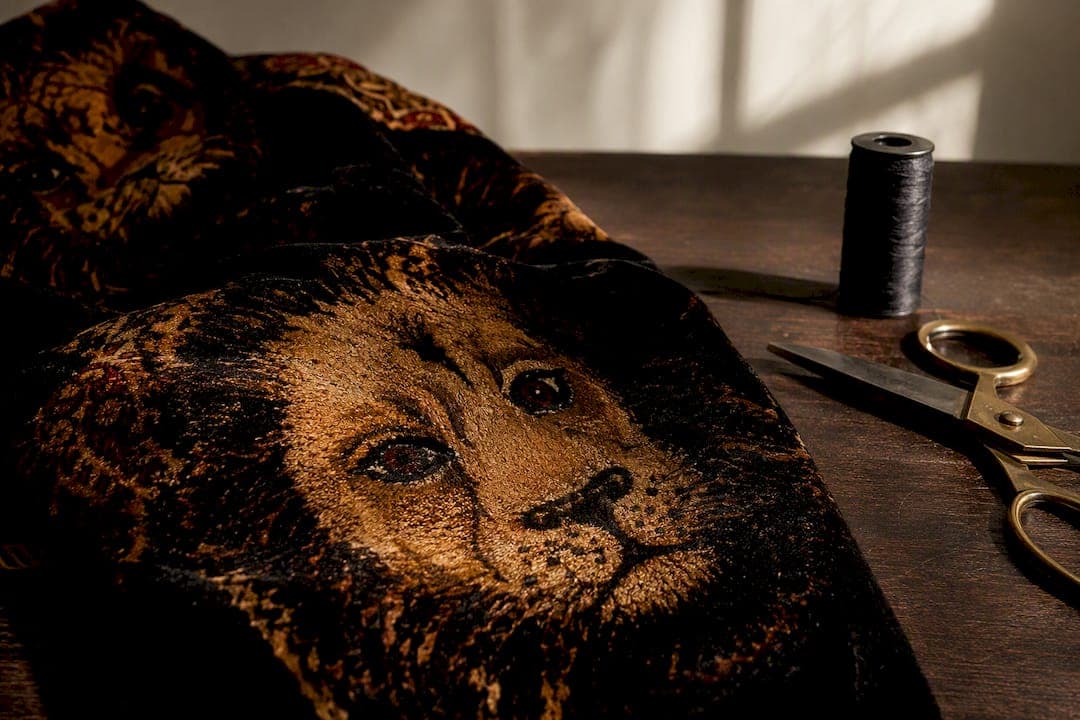
Isiagu means "head of leopard," and the shirt built around that image carries centuries of Igbo meaning about power, authority, and pride. It marks chieftaincy, wealth, and belonging within Igbo culture, even though the fabric usually shows a lion's head rather than a leopard's. That mismatch isn't a mistake. It's the first clue to how this garment actually came to be.
TL;DR:
- The lion motif on Isiagu shirts, originally imported from European textiles, came to symbolize authority and respect within Igbo culture, regardless of the animal depicted.
- Historically, Isiagu was an elite garment worn mainly for chieftaincy, ceremonies, and festivals, but it has expanded into everyday cultural expression, especially among the diaspora.
- Modern fabrics often mimic the traditional heavy velvet, but lighter materials and printing techniques have diversified the production, sometimes challenging authenticity.
- Wearing Isiagu still indicates social hierarchy in Igbo society, with royal or titled individuals traditionally maintaining the garment's ceremonial significance.
- The garment’s origins are rooted in colonial-era trade, but its enduring cultural meaning is reinforced by community endorsement and continued use over generations.
Table of Contents
- What Does Isiagu Shirt Meaning Actually Break Down To?
- What Does a Typical Isiagu Shirt Look Like?
- Where Did the Isiagu Shirt Come From?
- Who Wears Isiagu and For What Occasions?
- How Should You Wear, Style, and Care for an Isiagu Today?
- Senanukunu's View on Wearing Isiagu With Respect
- What Materials and Techniques Define Isiagu Fabric?
- Why Does Isiagu Still Signal Status Within Igbo Society?
- How Does Isiagu Compare to Other Igbo Traditional Attire?
- The Lion, the Leopard, and What This Garment Really Owes to History
- Sources
What Does Isiagu Shirt Meaning Actually Break Down To?
"Isi" means head, and "agu" means leopard, so Isiagu translates literally to "leopard head." Yet walk into almost any market stall in Igboland or scroll through diaspora wedding photos, and the embroidered or printed motif staring back at you is unmistakably a lion. Historians tracing the origins of the design point to Victorian-era British and Indian textile imports, where lion imagery was common and leopards were not. Igbo consumers adopted the fabric, kept their own word for the region's apex predator, and let the name and the picture drift apart. The leopard, not the lion, is the animal that actually roams Igbo forests and folklore, which is why the language never changed even as the printed image did.
What the shirt communicates matters more than which cat appears on it. In Igbo culture, both animals sit at the top of the food chain, and that's the point: Isiagu signals someone who commands respect, much like a predator commands its territory. Wearing it is a public claim to standing.
The symbolism clusters around a few consistent themes:
- Authority and chieftaincy: traditionally reserved for titled men, chiefs, and community elders.
- Bravery and leadership: the predator motif ties the wearer to courage and dominance.
- Social status: Isiagu is a prestigious Igbo attire historically associated with people who held or aspired to chieftaincy titles.
- Communal identity: scholarly work on Isi-agu attire situates the garment as a tool of political and ritual communication, not just decoration.
Interpretation still varies by town. Some Igbo communities treat the shirt as strictly ceremonial regalia, while others, especially in diaspora fashion circles, wear it as a general badge of heritage without the same title requirements.
What Does a Typical Isiagu Shirt Look Like?
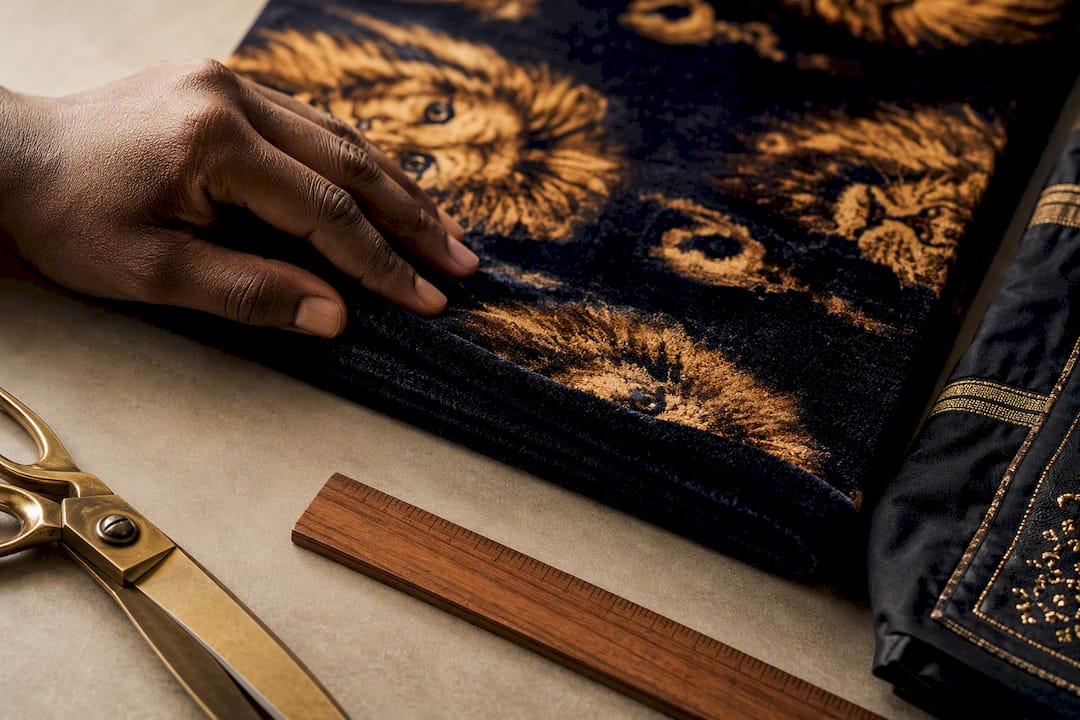
You can usually spot an Isiagu shirt at a glance, but the details separate a ceremonial-grade piece from a costume knock off. The lion-head motif dominates the fabric, repeated in a dense, almost tapestry-like pattern rather than a single centered image. Traditional versions favor velvet or heavier suiting fabric, materials chosen precisely because they're impractical in West Africa's heat. Wearing something that heavy in that climate has always been a quiet flex, a way of showing you don't need to dress for comfort.
Most shirts include:
- A breast pocket, often the only plain patch of fabric on the garment.
- Gold buttons connected by a short chain, positioned near the collar or pocket.
- Long or short sleeves, depending on the occasion and region.
- A tailored, slightly boxy cut meant to sit like formal regalia, not a casual top.
The full look rarely stops at the shirt. Pairing it with the red Okpu Ozo or Okpu Agu cap signals a titled status, while an agbada worn over the shirt elevates it further for weddings and coronations. Coral beads around the neck or wrist round out the traditional presentation, especially among Igbo chiefs and their wives.
Pro Tip: Run your hand across the fabric before buying. Genuine heavier velvet has visible weight and a slight resistance when you press it; thin, glossy polyester versions feel slick and light, a fast tell for a cheaper reproduction.
Where Did the Isiagu Shirt Come From?
The Isiagu shirt didn't originate as an ancient, unbroken Igbo tradition. It emerged from colonial-era trade. British and Indian textile merchants brought printed velvets into West African ports carrying lion motifs common in European heraldry, and Igbo elites, the chiefs, titled men, and wealthy traders with access to imported goods, began wearing them as markers of prestige. Owning something shipped from overseas, in a fabric too heavy for the local climate, was itself a statement of reach and resources.
Researchers studying this history describe it through the lens of "invented tradition," where a relatively recent adoption gets retroactively treated as ancient custom once it's been repeated across enough generations and endorsed by enough powerful people.
Analyses connect imported printed velvets and elite endorsement to the garment's prestige, showing how the visual codification with red caps, beads, and formal regalia hardened into what looks today like unbroken custom.
That framing, drawn from research into trade, totems, and the invention of Isi-agu, doesn't diminish the garment's meaning. It explains it. Traditions gain authenticity through sustained cultural practice and shared meaning, not necessarily through age. The Igbo Civil War era and the decades after saw the fabric spread beyond the elite, and by the time it reached diaspora closets, it had already been fully absorbed as an Igbo signature.
Who Wears Isiagu and For What Occasions?
Isiagu still carries weight in formal Igbo settings, but its reach has grown well past chieftaincy circles.
- Chieftaincy investitures: the traditional core use, worn by men receiving or holding a title.
- Weddings: grooms, groomsmen, and family elders wear it as part of traditional attire ceremonies.
- Coronations and festivals: community leaders wear it during New Yam festivals and similar public events.
- Diaspora gatherings: Igbo conventions and cultural association events in the United States and United Kingdom feature Isiagu prominently as identity clothing.
- Everyday cultural pride: younger wearers now put it on for photoshoots, church events, and personal celebrations, no title required.
Gender norms have shifted too. Designers now cut Isiagu-print fabric into fitted dresses, wraps, and blouses for women, extending a garment once coded almost exclusively male into shared cultural territory. That expansion tracks with what fashion writers describe as the shirt's growing role as a pan-Igbo identity marker rather than a title-restricted uniform.
How Should You Wear, Style, and Care for an Isiagu Today?
Buying one starts with the fabric. Heavier velvet or suiting material holds the lion motif with better definition and drapes with more structure than thin synthetic prints. Check the stitching around the collar and pocket; loose threads or uneven seams usually mean mass production rather than tailored craftsmanship. If gold buttons and a connecting chain are part of the design, look for buttons that sit flush and a chain that's actually functional, not glued decoration. Ask the seller where the fabric was sourced and who tailored the piece. A vendor who can answer both questions confidently is usually selling something closer to authentic.
Styling depends on the occasion. For chieftaincy or wedding events, pair the shirt with an agbada and the appropriate red cap. For everyday wear, a well-tailored Isiagu shirt works on its own with trousers, similar to how modern agbada looks have been adapted for contemporary occasions without losing their formality.
- Store velvet Isiagu pieces folded with acid-free tissue to protect the pile.
- Dry clean rather than machine wash to preserve gold hardware and embroidery.
- Steam instead of ironing directly on the motif to avoid flattening the texture.
Pro Tip: If the chain connecting the buttons feels overly light or bends easily, it's likely costume metal rather than the sturdier hardware used on traditional pieces, worth knowing before you pay a premium price.
Senanukunu's View on Wearing Isiagu With Respect
Senanukunu approaches garments like Isiagu the same way we approach every piece in our collection: cultural meaning first, craftsmanship second, never the reverse. A motif this loaded with history deserves designers who understand what they're reinterpreting, not just what sells. That means working with artisans who know the story behind the lion head, sourcing fabric ethically, and being transparent about production rather than mass-producing a symbol stripped of its context.
Reinterpretation isn't the problem. Careless reinterpretation is. Designers can absolutely modernize Isiagu motifs into dresses, jackets, or fitted sets, the way our Ivory Covenant ensemble reimagines formal West African silhouettes for today's occasions, as long as the craftsmanship and sourcing honor where the design came from. If you're shopping for culturally rooted pieces, ask who made it and how, the same way you'd ask about an Isiagu shirt's provenance. Slow, artisan-driven production, the kind explored in this look at handmade fashion, tends to respect a garment's history far better than fast fashion ever will.
What Materials and Techniques Define Isiagu Fabric?
Traditional Isiagu fabric started as imported velvet, dense and heavy, with the lion motif woven or embossed into the pile so the pattern had texture, not just color. That weight was never about comfort. It signaled that the wearer could afford fabric shipped from overseas and didn't need to dress for the climate.
Modern production has diversified considerably. Some manufacturers still use velvet, but much now produce the pattern on lighter suiting fabric, brocade, or even cotton blends to make the shirt more wearable in daily contexts. Printing techniques have also shifted from woven jacquard patterns to screen printing and digital textile printing, which lowers cost but can also flatten the motif's visual depth if done poorly.
Motif variety has expanded too. What started as a near-exclusive lion head has grown to include leopards, antelopes, and abstract geometric patterns, reflecting both changing taste and the fabric's democratization beyond elite circles. This matters for authenticity conversations: a shirt woven with genuine care in a modern motif can carry more cultural weight than a cheap, machine-printed lion pattern rushed to market. Production method and intention matter as much as the image itself.
Why Does Isiagu Still Signal Status Within Igbo Society?
Isiagu functions as a visible marker of where someone sits within Igbo social structure, and that role hasn't disappeared even as access to the garment has widened. Historically, only titled men and chiefs wore it regularly, which meant spotting the shirt in a crowd told you something concrete about the wearer's rank before a word was exchanged.
That hierarchy has loosened, but it hasn't vanished. Wearing Isiagu to a chieftaincy investiture still carries different weight than wearing it to a casual gathering. Community elders and titled men continue to treat the garment, paired with the red cap and coral beads, as formal regalia that outsiders shouldn't wear casually in ceremonial settings. The symbolism operates on two levels at once: broad Igbo identity for anyone who wears it, and specific rank signaling for those within traditional title systems.
For the diaspora, the hierarchy question often matters less than the identity question. Wearing Isiagu at an Igbo convention in Houston or London isn't usually a claim to chieftaincy status. It's a way of saying "I am Igbo," full stop, regardless of title. That dual function, hierarchy marker at home and identity marker abroad, is part of why the garment has stayed relevant across such different contexts.
How Does Isiagu Compare to Other Igbo Traditional Attire?
Isiagu sits alongside several other garments in Igbo traditional dress, and each communicates something distinct. The agbada, a flowing wide-sleeved robe worn over an inner shirt and trousers, signals formality and wealth through volume and fabric quantity rather than a specific motif. Isiagu, by contrast, communicates through its printed or embroidered image, making it identifiable even without the layered robe.
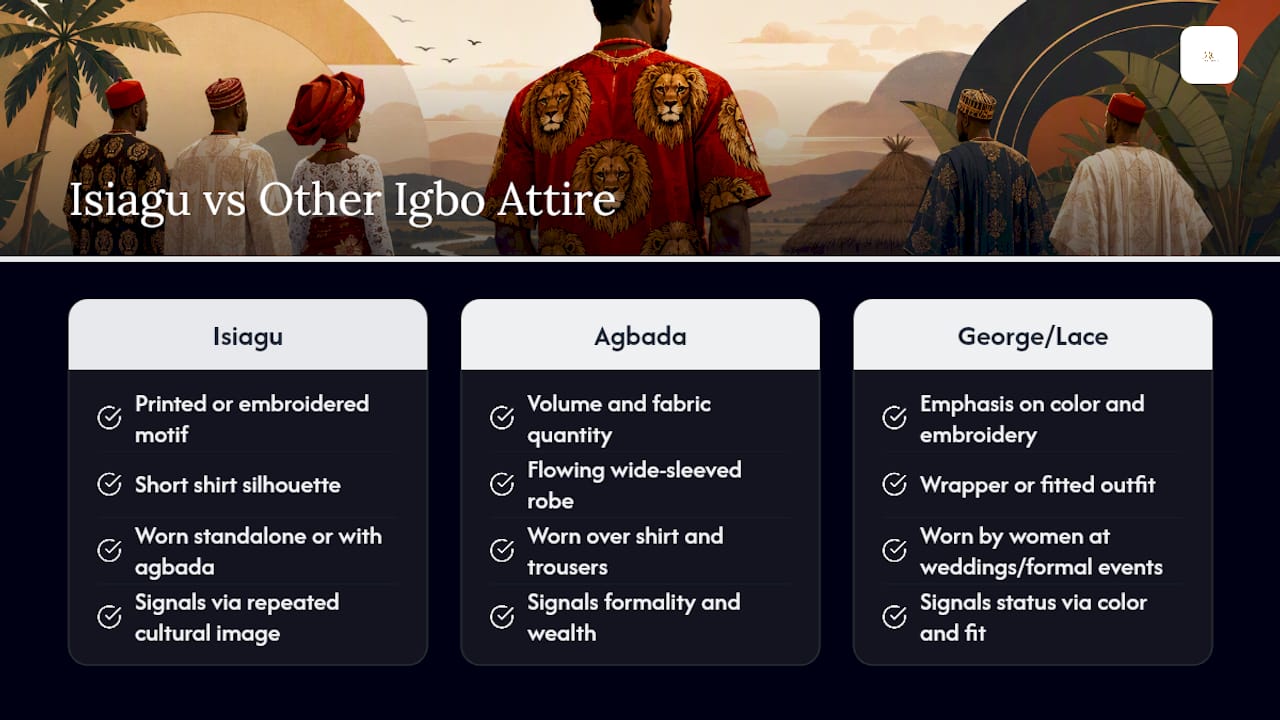
George wrapper and lace outfits, common for Igbo women at weddings and formal events, emphasize color, embroidery, and fit rather than a symbolic animal print. Where Isiagu leans on a single, repeated cultural image, George fabric relies on intricate stitched patterns and rich color combinations to signal status.
The Isiagu shirt can also stand alone, worn without an agbada for less formal occasions, something the flowing robe styles rarely do. That flexibility, formal when layered with an agbada and cap, casual when worn on its own, gives Isiagu a range that other traditional Igbo garments don't quite match. It explains why the shirt has traveled so easily from chieftaincy halls into everyday diaspora wardrobes.
The Lion, the Leopard, and What This Garment Really Owes to History
The lion-versus-leopard debate isn't a trivia footnote. It's the clearest evidence that Isiagu was never meant to be a static, ancient artifact. It's a garment that absorbed a foreign image, kept its own name, and let both survive side by side because the meaning mattered more than the literal picture. That's not a flaw in Igbo tradition. It's how living traditions actually work.
Where I think a lot of casual explainers get it wrong is treating "invented tradition" as a debunking, as if calling something colonial-era makes it less authentic. It doesn't. Colonial-era trade fabric became genuinely, deeply Igbo the moment titled men and communities decided it meant something and kept deciding that for generations. The origin story and the current meaning aren't in conflict.
What I'd prioritize for anyone buying or wearing Isiagu today: know the story behind the motif, choose sellers who can speak to sourcing and craftsmanship, and treat the red cap and coral bead pairings with the same respect you'd give the shirt itself. Meaning outlasts material, but only if the people making and wearing the garment keep choosing to carry it forward. You can browse Senanukunu's own collection of culturally rooted, ethically produced pieces if you want a starting point for wearing that history well.
— Sena
Sources
- Isiagu — Wikipedia
- Isi Agu: Bestows pride, authority | The Guardian Nigeria
- Trade, Totems and the Invention of Isi-Agu | Oriire
- The symbolism of isi-agu attire: monsignor — Nigerian Journal / NJP