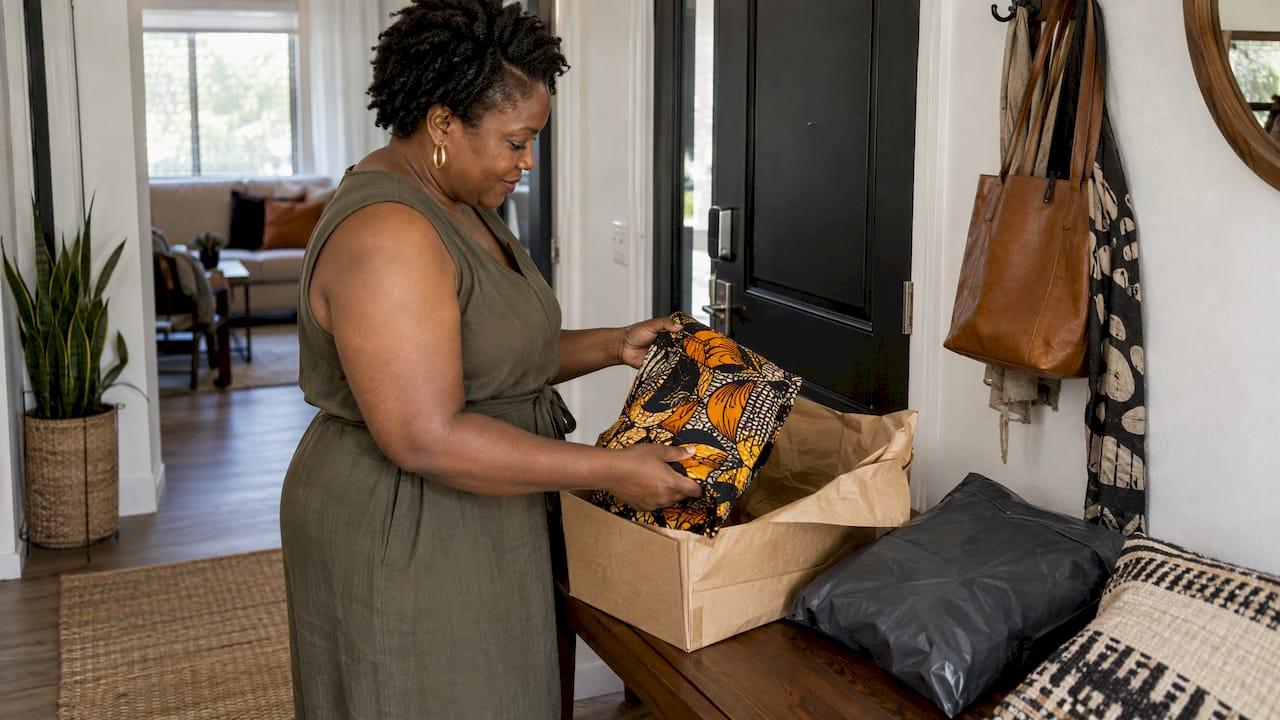
The smartest way to buy African clothing in the United States is to know, before you pay, where the parcel ships from, who pays duty, and how a return works. A piece that looks like a bargain can arrive with a customs bill, a long wait or a return label you cannot use. Sena Nukunu is based in Florida and offers ready-to-ship West African ready-to-wear, so the questions below are ones you can settle at checkout instead of at your front door.
This guide is for shoppers who want a dress for a wedding, an agbada for a celebration, or a statement piece for everyday wear, and who want it to arrive on time, as pictured, with no surprises.
TL;DR
- When you buy from a seller abroad, U.S. Customs and Border Protection (CBP) treats you as the importer. Duty is not included in the price you see at checkout unless the seller says so.
- The old $800 duty-free rule for small parcels has been suspended, so a low-value clothing parcel from overseas can now owe duty. Rates for apparel commonly run from about 12% upward, depending on material and country.
- Courier parcels (DHL, FedEx, UPS) usually bill duty before or at delivery. Postal parcels can be held until someone files the entry.
- Before ordering, confirm the ship-from country, who pays duty, the delivery window, tracking, and the return address and deadline.
- Choosing a U.S.-based seller with ready-to-ship pieces for events removes most of the customs guesswork, and it protects your date.
Table of Contents
- Why shipping matters more with African clothing
- What shipping from Africa to the U.S. typically costs and how long it takes
- Customs duties: the cost most buyers miss
- Questions to ask before you order
- Sizing, fabric and returns across a border
- If your shipment is late, lost or damaged
- Buying through a marketplace of Black-owned businesses
- Why a U.S.-based seller simplifies the whole process
- Our perspective
- Shop West African fashion ready to ship
- FAQ
- Sources
Why shipping matters more with African clothing
Most African fashion is made by tailors and artisans in West Africa, in small runs. That craft is the reason the clothing is special, and it is also why shipping is less simple than with a mass-market retailer. A garment may be sewn in Accra, Lagos or Dakar, packed by a small team, and sent across an ocean to a buyer in Atlanta, Houston or Chicago.
Three things then decide your experience:
- Where the parcel really starts. "Ships to the USA" can mean a domestic warehouse or an international flight.
- Who handles customs. Someone has to classify the garment, declare its value and pay the duty.
- What happens when something goes wrong. Sizing, delays and returns are harder across a border.
None of this should put you off wearing African heritage clothing. It simply means the order deserves five minutes of checking, especially when the piece is for a wedding, a graduation or a funeral with a fixed date.
What shipping from Africa to the U.S. typically costs and how long it takes
Shipping costs and speeds depend on the route, the weight and the carrier. One shipping-rate comparison for the South Africa-to-U.S. route lists rates from $15.45 per kilogram, with delivery ranging from 1 to 25 days by service, and puts express carriers such as DHL, FedEx and UPS at roughly 3 to 7 days. A September 2026 guide on shipping clothes from Nigeria reports DHL Express delivering in 3 to 5 business days.
A few practical points follow from this:
- Express is fast but priced by weight. A heavy agbada set or a multi-piece ensemble costs more to fly than a light top.
- Economy services are slower and less predictable. The range of 1 to 25 days is the reason you should never order an outfit for a fixed date on the cheapest service.
- Tracking is part of the product. Courier shipments generally come with a tracking number from pickup to delivery. If a seller cannot give you one, treat the delivery date as a guess.
These figures are published for specific routes and periods, and carrier rates change often. Use them to gauge what is reasonable, then compare against the quote at checkout.
Customs duties: the cost most buyers miss
This is the part that surprises people. The price on the product page is usually the price of the garment and sometimes the shipping. It is not always the full cost of getting the garment into the country.
You become the importer
CBP's guidance on internet purchases says that when you buy from a foreign source, you become the importer responsible for import rules. The same page explains that a purchase price including shipping and handling does not include duty or customs-clearing costs, and that for courier shipments the carrier will bill you for duty it paid on your behalf or ask for payment on delivery.
The $800 exemption is no longer the safety net
For years, parcels valued at $800 or less entered the U.S. without duty. That changed. A customs guide updated in October 2026 notes that the exemption was suspended for all countries on 29 August 2025, that CBP published interim final rules in June 2026 suspending it indefinitely, and that the statutory exemption is repealed from 1 July 2027. CBP's e-commerce FAQ describes the new mail informal entry process that took effect on July 24, 2026, and says duties, taxes and fees depend on the product's tariff classification, country of origin and dutiable value.
In plain terms: a $120 dress from overseas can now owe duty, where it once would have passed through untouched.

What the duty might be
There is no single rate, because it depends on the fiber, the garment type and the country where it was made. Published guides give a sense of the range:
| Origin and source | Reported rate for clothing |
|---|---|
| Nigeria, 2026 | 24.5% total effective tariff, made up of a 12% base rate plus a 12.5% additional duty |
| South Africa route, April 2026 | 12 to 32% for apparel in chapters 61 and 62 of the tariff schedule |
| European apparel above $800, May 2026 | 12 to 27%, higher for wool and lower for children's clothing |
A worked example: at a 24.5% effective rate, a $150 garment would carry about $36.75 in duty, before any carrier handling fee. At 12%, the same garment would owe $18. These are illustrations of the arithmetic, not a quote. Your actual charge depends on the classification and the rate in force when the parcel arrives, so compare your own invoice with the official tariff schedule.
Who collects, and when
With courier parcels, the carrier usually pays duty to CBP and bills you before or at delivery, with a handling fee. With postal parcels, the same guide explains, the owner or an appointed broker files the entry and pays CBP, and USPS does not collect duty at the door. That is why a postal parcel can sit in customs while you wait for a notice.
Can any African goods enter duty-free?
The African Growth and Opportunity Act (AGOA) is a U.S. trade program that gives duty-free treatment to qualifying goods from designated sub-Saharan African countries. CBP states that Congress passed H.R. 7148 on February 3, 2026, extending AGOA through December 31, 2026, and that eligibility requires the product to be wholly obtained or sufficiently made in the beneficiary country, with at least 35% value added, and imported directly. Because the program's status can change, check CBP's AGOA page for the current position rather than assuming a garment qualifies. Qualification is the importer's paperwork, not something a shopper can see on a product page.

Questions to ask before you order
Before you check out with any seller of African clothing, settle these:
- Where does it ship from? A U.S. address and an overseas address mean very different delivery and customs experiences.
- Is duty included? Look for wording such as "delivered duty paid" or a clear statement that the buyer pays duties on delivery.
- What is the delivery window, in business days, by service level?
- Do I get a tracking number, and when?
- What is the return address, the deadline and who pays postage?
- Is the piece ready-to-ship or made to order? Made-to-order work needs production time before shipping starts.
- Is the piece limited-quantity? If so, it may not be restocked.
If you are buying for an event, count backward from the date. Add production time if the piece is made to order, then shipping time, then a buffer of several days for customs. Our guide on avoiding customs and rush fees on African prom dresses in the U.S. walks through this timeline for a fixed-date occasion.
Sizing, fabric and returns across a border
Sizing is the other reason African clothing orders go wrong. Tailored West African garments are often cut differently from standard U.S. ready-to-wear, and a fabric such as a heavily embroidered or smocked cotton behaves differently from a stretch knit. Before ordering:
- Compare your own measurements, bust, waist, hip, shoulder and length, against the size chart, not against your usual size.
- Read the fabric description. Structured pieces such as agbada robes hang differently from soft kaftans.
- Check whether the listing is for a single piece or a matching set.
Returns deserve the same attention. Returning a garment across a border can mean paying international postage and, in some cases, customs paperwork in the other direction. Ask who pays return shipping, how long you have, and whether the refund covers the item only or the shipping too. A seller that ships within the United States spares you most of this, because a return is an ordinary domestic parcel.
Imported clothing must also carry a country-of-origin label. One import guide notes that the marking must be conspicuous, permanent and in English, such as a sewn-in label, and that mis-marking can bring a 10% marking duty. That is the importer's duty, but a proper label is also a quick sign that a garment came through the supply chain properly.
If your shipment is late, lost or damaged
Start with the seller, in writing, and keep the order number and tracking history. U.S. law gives you a baseline on timing. The Federal Trade Commission's Mail, Internet, or Telephone Order Merchandise Rule says that if a seller advertises no shipping time, it must have a reasonable basis for believing it can ship within 30 days, and it must ask your consent if it cannot meet its promised time. If you did not agree to a delay and the order has not shipped, you can cancel and ask for a refund.
A practical sequence:
- Check tracking and look for a customs hold or a duty notice from the carrier.
- Contact the seller with the order number and ask for a status update from the carrier.
- If the parcel arrives damaged, photograph the packaging and the garment before you throw anything away, and report it immediately.
- If the seller does not respond, contact your card issuer about a dispute.
For garments needed for a fixed date, a delay is more than an inconvenience. That is the strongest argument for ordering early and for choosing pieces that are already made and ready to ship.
Buying through a marketplace of Black-owned businesses
Some shoppers prefer to browse many sellers in one place. A marketplace of Black-owned businesses with a women's clothing section can be a convenient starting point for discovering independent brands. Whichever seller you choose, apply the same checklist: ship-from country, duty, delivery window, tracking and returns.
Why a U.S.-based seller simplifies the whole process
Every risk above, duty at the door, a postal hold, a cross-border return, a late parcel, comes from the distance between the maker and you. A seller based in the United States, with pieces ready to ship, shortens that distance. Sena Nukunu is based in Florida and presents a curated selection of ready-to-ship West African fashion, made with ethical manufacturing and artisanal craftsmanship in limited quantities. You can read how to judge authenticity in our guide to buying authentic West African dresses, and for celebrations, our piece on spotting authentic kids' African celebration wear covers the same checks for children.
Our perspective
We started Sena Nukunu because West African clothing deserves to be worn with pride, and to reach you without a maze of fees, forms and waiting.
Every piece we offer carries the work of artisans, and we believe the way a garment reaches you should honor that work. That is why we offer limited-quantity, ready-to-ship pieces from Florida, and why we want you to ask every seller the same questions you will find in this guide.
When you wear a kaftan, an agbada set or a smocked dress, you carry a legacy. Our hope is that the day it arrives feels like a celebration, not a customs notice.
Sena
Shop West African fashion ready to ship
If you are planning a wedding, a celebration or a wardrobe of statement pieces, explore our Women's Collections, Men's Agbada Ensembles and Men's Heritage pieces, or browse the full collections, including Woven Nobility: Kings' Robe and Woven Radiance: Queens in Bloom. For women, our dresses are a natural place to start, and our services page shows the custom designs we offer.
Each piece is made in limited quantities, so a design you love may not return. Order early, especially for a dated event.
FAQ
Do I have to pay customs duty on African clothing shipped to the U.S.?
If the clothing ships from abroad, you may. CBP explains that a buyer from a foreign source becomes the importer, and that a purchase price including shipping does not include duty. The amount depends on the garment's classification, country of origin and value, so check at checkout whether the seller has included duty.
How long does shipping African clothing to the USA take?
It depends on the origin and service. Published guides report express courier times of about 3 to 7 days from West and Southern Africa, and economy services that can take far longer. Add production time for made-to-order pieces and a buffer for customs.
Can USPS deliver a parcel from Africa without duty charges?
USPS does not collect duty at the door. For postal parcels, the owner or an appointed broker files the entry and pays CBP, which can delay delivery. Courier shipments are usually billed by the carrier before or at delivery.
What should I do if my order is late?
Contact the seller in writing with your order number and tracking. Under the FTC's 30-day rule, a seller must have a reasonable basis for its shipping promise and must ask your consent to a delay. If the order has not shipped and you did not agree to a delay, you can cancel for a refund.
Is it easier to return African clothing to a U.S. seller?
Generally yes, because a domestic return avoids international postage and customs paperwork. Always read the return deadline and who pays postage before you order.
Sources
- RateShips: Shipping from South Africa to United States
- How to Ship Clothes from Nigeria to America
- CBP: Internet Purchases
- CBP: E-Commerce Frequently Asked Questions
- CBP: African Growth and Opportunity Act (AGOA)
- ParcelsZen: US Customs Clearance: Holds, Duty and Timing
- Resendify: US Customs and Import Duties for European Packages
- How to Import Clothing: Customs and Labeling Rules
- FTC: Mail, Internet, or Telephone Order Merchandise Rule