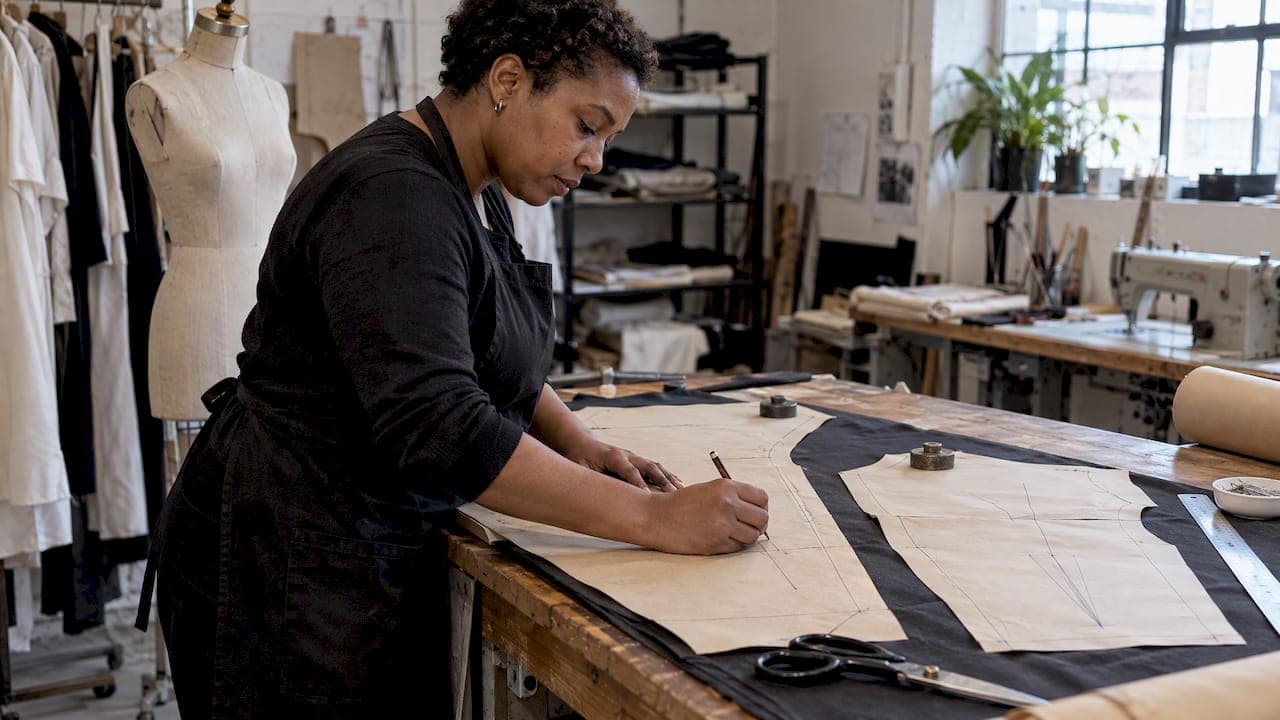
Bespoke garments are drafted from a new pattern for the individual and typically involve more handwork and fittings than made-to-measure garments, which can affect time and price. Made-to-measure adapts an existing standard pattern to your measurements, which makes it faster and more affordable. Choose bespoke when you want a one-of-a-kind fit and full creative control; choose made-to-measure when you want improved fit without the wait or the price tag.
TL;DR:
- If posture, limb length, or asymmetry creates fit challenges, ask whether the maker offers fittings on your body and how many adjustments the commission includes.
- When ordering made to measure, ask how the maker uses your measurements and what alterations are available; extra measurements do not guarantee a closer fit.
- For a fixed event date, get a delivery estimate in writing, since fabric sourcing, garment complexity, and requested fittings can extend either process.
- Fabric, construction, fitting count, and pattern drafting affect cost; inspect samples or construction photos and confirm the alteration policy before paying.
Table of Contents
- What Bespoke Really Means
- What Made-to-Measure Actually Involves
- Bespoke vs Made-to-Measure, Dimension by Dimension
- What to Expect Through the Process and Timeline
- What Drives the Cost and How to Judge Value
- A Decision Checklist Before You Order
- What Careful Craftsmanship Brings to Custom Fit
- Fit, Heritage, and the Craft Behind Every Piece
- How Our Services Match Your Custom Needs
- FAQ
- Sources
What Bespoke Really Means
Bespoke starts with a blank page. Rather than adjusting an existing template, a pattern maker drafts a completely new pattern shaped around your body, your posture, and the way you actually move. This is the tradition that grew out of Savile Row and couture ateliers, where garments are built through a series of on-body fittings that let the maker refine balance and proportion directly on you rather than on paper, a practice CFDA's industry perspective describes as central to how bespoke commissions are developed and how designers deepen client relationships through the process.
That hands-on approach can help a tailor refine fit and balance through on-body fittings. How well a garment addresses individual fit concerns depends on the maker and the process.
A few things define the bespoke experience:
- A pattern drafted from scratch for the individual.
- On-body fittings where the garment can be adjusted.
- Hand-finished details, from pad-stitched canvases to hand-sewn buttonholes, that add time and cost.
- A process that can involve substantial handwork and individualized fitting.
Pro Tip: Ask any bespoke maker what fittings are included and how adjustments are handled, so you can understand how the fit will be refined.
What Made-to-Measure Actually Involves
Made-to-measure takes a different starting point. Instead of drafting a new pattern, a maker adapts a standard block, a pre-existing template proven to fit a range of body types, to your specific measurements. Gentleman's Gazette's explanation of the terminology notes that this places made-to-measure a clear step above ready-to-wear while still falling short of a fully custom pattern.
Customization in this tier usually comes from a catalog of choices. Rather than the open-ended decisions bespoke allows, you select from preset options for lapels, linings, pockets, and silhouettes. That structure speeds up production and keeps costs down, since the heavy lifting of pattern drafting is already done.
Made-to-measure typically means:
- An existing block pattern adjusted to your body rather than built new.
- A curated menu of style options instead of unlimited customization.
- Fewer fittings and less hand-finishing than a bespoke garment requires.
- Noticeable variation in quality and fit accuracy depending on the provider.
Pro Tip: When ordering made-to-measure online, ask how the provider uses your measurements and what fitting or alteration options are available. More measurements alone do not guarantee a closer fit.
Bespoke vs Made-to-Measure, Dimension by Dimension
The clearest way to compare the two is to look at what actually changes at each stage of the process.
| Dimension | Bespoke | Made-to-measure |
|---|---|---|
| Fit | Refined through on-body fittings | Adapted to the client's measurements, but may not address every fit concern |
| Pattern | Drafted entirely new for the individual | Standard block adapted to the client's measurements |
| Customization | Broad scope for design decisions | Style options within preset choices |
| Time and fittings | Several sessions over a longer lead time | Fewer sessions, faster turnaround |
| Cost | Can involve more labor and new pattern drafting | Varies with the fabric and maker |
| Handwork and quality | Often extensive hand-finishing and individual tailoring techniques | Varies by maker, from mostly machine-made to partially hand-finished |
Fit can differ between the two approaches. On-body fittings can let a tailor refine balance and proportion, while made-to-measure adapts a standard block to the client's measurements. Hockerty's explainer on the topic points out that the practical differences between the two methods come down to pattern creation, handwork, fit precision, timeline, and cost, and that online providers sometimes blur the line between them in their marketing.
A pattern drafted from scratch is a key distinction between bespoke and made-to-measure. Bespoke typically involves more handwork and fittings, which can affect price and timeline.

What to Expect Through the Process and Timeline
Both paths begin the same way, with a consultation and a detailed measurement session. From there, the two diverge.
- Consultation and measurement: You discuss fabric, style, and occasion while a maker records detailed body measurements.
- Bespoke path: A new pattern is drafted, then the garment is fitted and adjusted on the body before construction is completed.
- Made-to-measure path: Your measurements are used to adapt an existing block, with the fitting process depending on the provider.
- Delivery: Bespoke garments generally take longer to complete given the iterative fitting process, while made-to-measure moves faster because fewer adjustments are needed.
Fabric sourcing, the complexity of your build, and how many fittings you request all extend the timeline on either path.
Pro Tip: If you have a fixed event date, ask for a delivery estimate in writing before you order, since bespoke timelines can shift with fitting schedules.
What Drives the Cost and How to Judge Value
Price in custom clothing comes down to a handful of factors: how much handwork goes into construction, the quality of the fabric, how many fittings are included, and, for bespoke, the time spent drafting an entirely new pattern. These factors can affect the labor involved and the overall price in both categories.
When comparing offers, look past the sticker price. A few signals tell you more about what you are actually paying for:
- Hand-stitched canvases and hand-finished seams can indicate additional handwork.
- Clean, reinforced seam finishes suggest attention to durability, not just appearance.
- Construction photos or samples can help you assess a maker's work.
- A clear alteration policy signals the maker expects, and supports, long-term wear.
Made-to-measure may suit you if you want a fit adapted to your measurements while working within a particular budget or timeline. The result and value depend on the provider. A garment's durability, fit over time, and repair needs depend on its construction and care.
A Decision Checklist Before You Order
Before you commit to either route, it helps to get clear on a few things.
- Decide whether the piece is for daily wear or a special occasion, since that shapes how much you should spend and how long you can wait.
- Take stock of your body's complexity: posture, limb length differences, or asymmetry point toward bespoke, while a more standard build often does well with made-to-measure.
- Set your budget and your deadline before you start shopping, not after.
Once you know your priorities, walk through these steps:
- Take or request your measurements using a clear measurement guide so you understand what a maker needs from you.
- Book a consultation and ask directly how many fittings are included.
- Request construction photos or references so you can see the quality of finishing before you commit.
- Confirm the alteration policy and the delivery timeline in writing.
What Careful Craftsmanship Brings to Custom Fit
Fit precision depends on the same principles whether a garment is fully bespoke or thoughtfully made-to-measure: accurate measurement, attentive construction, and a maker who treats each piece as an individual commission rather than an assembly-line product. Our focus on limited-quantity production reflects that same philosophy, carried through handcrafted construction details that matter whether a dress is ready-to-wear or custom-ordered.
A trustworthy custom provider should offer you:
- Clear measurement guidance before you order, not after.
- Transparent policies on fittings, alterations, and timelines.
- Visible attention to construction, from seam finishing to fabric sourcing.
Fit, Heritage, and the Craft Behind Every Piece
Precise fit matters to us because every garment we send out carries a story, and a piece that fits well is one you will actually wear and pass down. Cultural storytelling and ethical production guide how we think about custom work: each stitch connects to West African artistry and the artisans who keep it alive. If you are weighing a custom commission or need help understanding your own measurements, we welcome you to reach out and talk it through with us.
— Sena
How Our Services Match Your Custom Needs
If made-to-measure style improvements are what you need, our tailored ready-to-wear and measurement guidance can help you find a style that suits you. For readers drawn to bespoke-level customization, our custom commissions and made-to-order statement pieces, including collections like Woven Nobility: Kings' Robe and Woven Crowns: Radiant Rise, offer creative input while staying rooted in West African craftsmanship.
Getting started is simple: tell us your measurements, your occasion, and your style preferences, and we will guide you through available options. For readers curious about how on-demand and small-batch production fit into modern custom manufacturing more broadly, this 2026 guide to on-demand apparel offers useful context.
- Browse ready-to-wear and heritage-inspired pieces on our collections page.
- Explore limited-quantity statement sets at our full collections.
- Reach out through our services page to start a custom consultation today.
FAQ
Is bespoke the same as made to order?
No. Bespoke means a pattern drafted from scratch specifically for you, while made-to-order typically means a garment built to your size from an existing pattern or style, closer to made-to-measure than true bespoke.
What is the American equivalent of bespoke?
Terms such as "custom tailoring" and "custom-made" can be used in different ways, so ask the retailer how the pattern and fitting process works. The labels alone may not explain whether a garment uses a new pattern or an adapted standard pattern.
Is bespoke always higher quality?
Bespoke generally involves more handwork and fittings, but the fit and construction depend on the individual maker. A well-made made-to-measure garment from a skilled provider can outperform a poorly executed bespoke piece.
What is the difference between made to order and made-to-measure?
Made-to-order and made-to-measure can describe different processes. Ask whether the maker adapts a standard pattern to your measurements or drafts a new one. Gentleman's Gazette frames made-to-measure as a clear step above ready-to-wear and made-to-order in terms of personalized fit.
Sources
- Local Manufacturing as Leverage: Why Proximity Is New York’s Competitive Advantage - CFDA
- Ready-to-Wear, Made-to-Measure & Bespoke Suits - Terminology Explained
- Made to Measure vs Bespoke - All you need to know - Hockerty