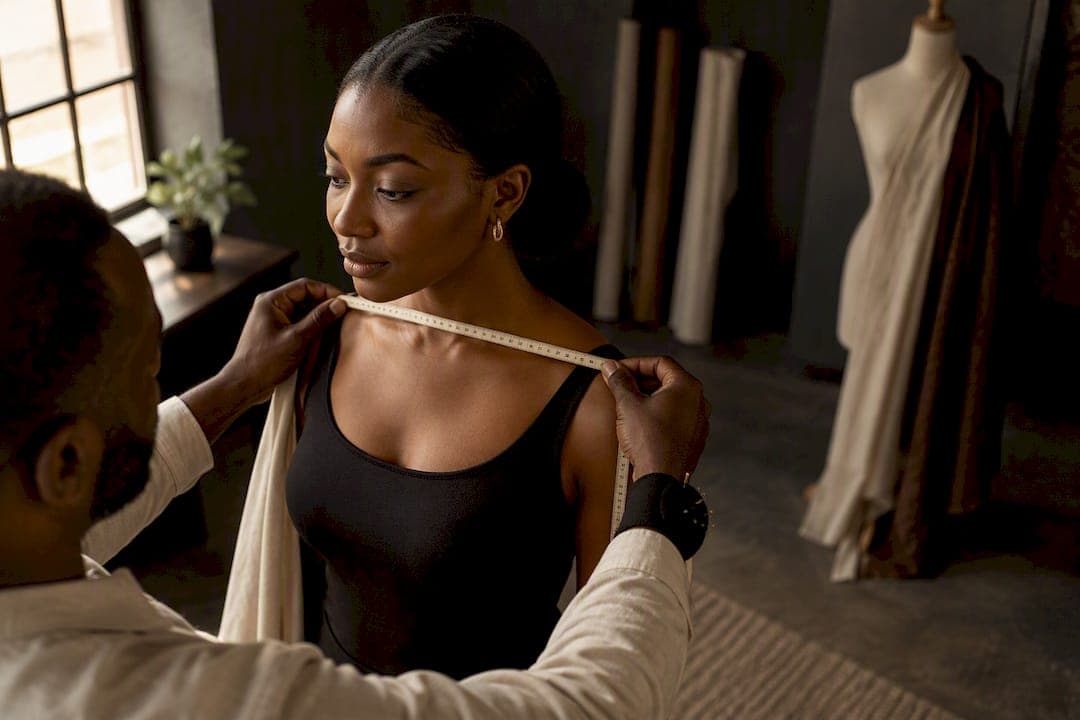
Convert African clothing sizes by using your body measurements as the source of truth, not the label sewn into the garment. Apply standard offsets as a starting point (EU to US runs about 30 numbers apart, UK to US about 4), then adjust for South African labels, which follow their own numeric scale. Prioritize bust or chest for tops and dresses, hips for skirts and pants, and shoulder or length for many traditional West African garments built for drape rather than a snug fit.
TL;DR:
- Using body measurements and standard offsets helps convert African clothing sizes more reliably than relying solely on label sizes, especially for traditional garments.
- South African sizing follows a distinct numeric scale loosely corresponding to letter sizes, making it essential to verify actual bust and hip ranges before purchasing.
- Traditional West African garments prioritize drape and movement, so sizing up is rarely necessary unless fabric stiffness or volume is desired.
- Accurate measurement of bust, hips, and length is crucial, especially for garments with specific fit preferences like agbadas and kaftans.
- Always check garment measurements and consult with the seller when possible to ensure proper fit, as size labels often do not match the actual dimensions.
Table of Contents
- African Clothing Size Conversion Charts for Women, Men, and Kids
- How to Take Accurate Body Measurements for African Garments
- Why African Garments Fit Differently Than Western Sizing Assumes
- A Shopping Checklist for Converting Sizes Before You Buy
- Sena Nukunu's Approach to Fit and Measurement Guidance
- Choosing Fit: Cultural Drape vs. Contemporary Tailoring
- Shop West African Fashion Built Around Your Measurements
- Sources
- FAQ
African Clothing Size Conversion Charts for Women, Men, and Kids
Every size chart is a starting point, never a guarantee. The garment's own measurements still decide the final fit, especially once fabric and cut enter the picture. Still, having the common offsets in front of you saves a lot of guesswork before you ever pick up a tape measure.
For women's clothing, the standard rule is to subtract roughly 30 from the EU number to land near the US size, while UK sizes run about 4 numbers higher than their US counterparts. South African sizing uses its own numeric system and does not directly align with EU or US size numbers.
| System | Example Size | Approximate Equivalent |
|---|---|---|
| EU (women) | 36 | US 6 |
| EU (women) | 38 | US 8 |
| EU (women) | 40 | US 10 |
| UK (women) | 12 | US 8 |
| South African | 34 | Medium (roughly US 8-10) |
| South African | 38 | Extra Large (roughly UK 14) |
South Africa's numeric system maps loosely to letter sizes: 30 lands near XS, 32 near S, 34 near M, 36 near L, 38 near XL, and 40 near XXL. A shopper who wears a US 8 in a Western brand might reasonably expect a South African 34, but always check the actual bust and hip ranges listed, since brands vary in how generously they cut each size.
Men's sizing follows a similar logic. An EU shirt size marked "40" typically corresponds to a medium in US or UK terms, while EU pant sizing usually equals the US waist measurement in inches, plus about 16. So a US 32 waist often shows up as an EU 48 on the tag.
Kids' clothing works differently across the board:
- US and UK children's sizes are typically age-based, which becomes unreliable once you factor in how much height varies within a single age group.
- EU children's sizing is usually height-based in centimeters, which tends to fit more consistently across different body types.
- Measuring a child's actual height before ordering European kidswear beats guessing from age alone almost every time.
Quick fact: EU sizing standards for adults and children trace back to EN 13402 and ISO 8559, the reference frameworks most conversion tools use as their baseline, even though individual brands still deviate from them.
Shoes deserve a separate mention here, since they run on entirely different scales (EU, UK, and US foot-length systems) that don't share the same math as clothing conversions. Never assume your clothing offset applies to footwear.
How to Take Accurate Body Measurements for African Garments
Grab a soft, flexible tape measure, wear thin undergarments, and stand naturally rather than pulling your shoulders back or holding your breath. Measuring in your normal posture produces numbers that actually match how the garment will sit on your body day to day.
- Bust or chest: Wrap the tape around the fullest part, keeping it level front to back.
- Waist: Measure at your natural waistline, the narrowest point, without pulling the tape tight.
- Hips: Circle the fullest part of your hips and rear, usually several inches below the waist.
- Shoulder width: Measure across the back from shoulder seam to shoulder seam.
- Inseam and garment length: Measure from crotch to ankle for pants, and from shoulder to hem for dresses or robes.
- Neck: Wrap the tape at the base of the neck for shirts and collared pieces.
Which of these numbers matters most depends entirely on what you're buying. Bust or chest rules for tops and dresses. Hips take priority for skirts and pants. For agbadas, kaftans, and other traditional silhouettes, shoulder width and overall length often matter more than the waist ever will.
Pro Tip: Write your measurements down and keep them saved on your phone. You'll use the same numbers every time you shop a new brand, and it saves you from remeasuring under deadline pressure before an event.
Why African Garments Fit Differently Than Western Sizing Assumes
Western sizing charts assume a fitted silhouette. Plenty of West African garments assume the opposite: drape, movement, and generous proportions built into the design itself, not accidents of a bad cut. That difference changes how you should read a size chart entirely.
- Traditional pieces like agbadas and many kaftans favor loose, adjustable fits, so a snug conversion often works against the intended shape.
- Shoulder width and length matter more than waist or hip numbers for these silhouettes, since the drape is doing the work a fitted seam would do in Western tailoring.
- Sizing up one size, rarely more, makes sense only when the fabric is stiff or the design calls for extra volume, not as a default habit.
- Woven fabrics with no stretch behave very differently from jersey or spandex blends, so a chart built for stretch fabric will fit differently in a woven piece.
Many contemporary West African brands now offer hybrid sizing, pairing traditional fit language with familiar international labels. That hybrid approach exists precisely because a straight numeric conversion misses what these garments are actually designed to do on the body.
A Shopping Checklist for Converting Sizes Before You Buy
- Take your own measurements first. Never start from your usual retail size.
- Decide which measurement matters most for that specific garment, whether that's bust, hips, shoulder, or length.
- Read the brand's actual garment measurements, not just the label size, since ready-to-wear and pattern sizing rarely match one another exactly.
- Check the return and exchange policy before checkout, since fit surprises happen even with careful measuring.
- Message the seller directly if measurements aren't listed. A quick question beats a guess every time.
The most common mistake is trusting the size label alone and ignoring fabric, ease, and cut entirely. A close second is misreading "free size" as one-size-fits-all rather than what it usually means: generous, adjustable, and forgiving across a range of body types. When you're stuck between two sizes, go smaller for modern tailored pieces and larger for traditional drape styles.
Pro Tip: If a product page doesn't list finished garment measurements, ask before you buy. A brand that can't answer that question probably hasn't measured its own pieces carefully, and that's worth knowing before you spend.
Sena Nukunu's Approach to Fit and Measurement Guidance
Every piece offered, from agbada ensembles to women's ready-to-wear sets, comes from limited-quantity production built by hand, not mass-run factory lines. That kind of craftsmanship rewards a measurement-first approach far more than a quick glance at a size label ever could.
Because these garments are made in small batches with attention to drape and detail, the fit conversations happen closer to the body than a typical retail purchase. Readers weighing bust, shoulder, and length numbers against a chart are already doing exactly what a well-made heritage piece deserves: showing up in the right shape, not just the right size. Reaching out directly with your measurements before ordering is a smart step whenever a fit question comes up.

Choosing Fit: Cultural Drape vs. Contemporary Tailoring
Fit is partly a style decision, not just a math problem. A flowing agbada worn for a wedding calls for different proportions than a fitted dress worn to the office, and neither one is more "correct" than the other.
Small tailoring adjustments, taking in a seam or shortening a hem, preserve the garment's intended character while improving how it actually wears on you. Measure first, buy with confidence, and let a tailor handle the last inch. That order of operations beats guessing every time.
— Sena
Shop West African Fashion Built Around Your Measurements
The designs emphasize authentic West African craftsmanship, ethical production, and limited runs that put real artistry into each stitch, not a factory template. That focus on the body first, and the label second, gives you a straightforward way to shop internationally without the anxiety that usually comes with converting sizes across systems you didn't grow up with.
Rather than gambling on a size chart alone, you can browse the Men's Agbada Ensembles, Men's Heritage, and Women's Collections with your own measurements in hand, and reach out with fit questions before you commit. If you're drawn to a specific silhouette, from the structured drape of Woven Nobility: Kings' Robe to the tailored ease of Woven Stride: Queen In Comfort, start by measuring bust, hips, and length, then visit the collections page to find the piece that matches those numbers.
Sources
FAQ
What size is an XL in South Africa?
In South African women's sizing, an XL typically corresponds to size 38, which often aligns with a UK 14. Always check the brand's own bust and hip ranges since letter sizes can shift slightly between labels.
Is a size 10 a 32 or 34?
In EU numbering, a US size 10 typically converts to roughly EU 40, not 32 or 34. The EU 32 and 34 range corresponds to much smaller US sizes, around a US 2 to 4, using the standard EU to US offset of about 30.
Is size 40 a large or XL?
A EU size 40 in women's clothing generally lands as a US size 10, which most Western brands label as a large. In South African numeric sizing, a 40 typically maps closer to XXL, so the same number means something different depending on the system it comes from.
What is a size 40 in women's clothing?
A EU women's size 40 roughly equals a US size 10 and a UK size 12, following the standard conversion offsets most charts use. Because brand cuts vary, comparing your own bust and hip measurements to the garment's stated measurements remains the most reliable check.
How do I convert my size when buying traditional African garments?
Start with your own body measurements, prioritizing shoulder width and length for drape-heavy pieces like agbadas and kaftans. Many West African brands, including Senanukunu, use hybrid sizing references that combine body measurements with recommended fit notes, so checking both before ordering gives you the clearest picture.