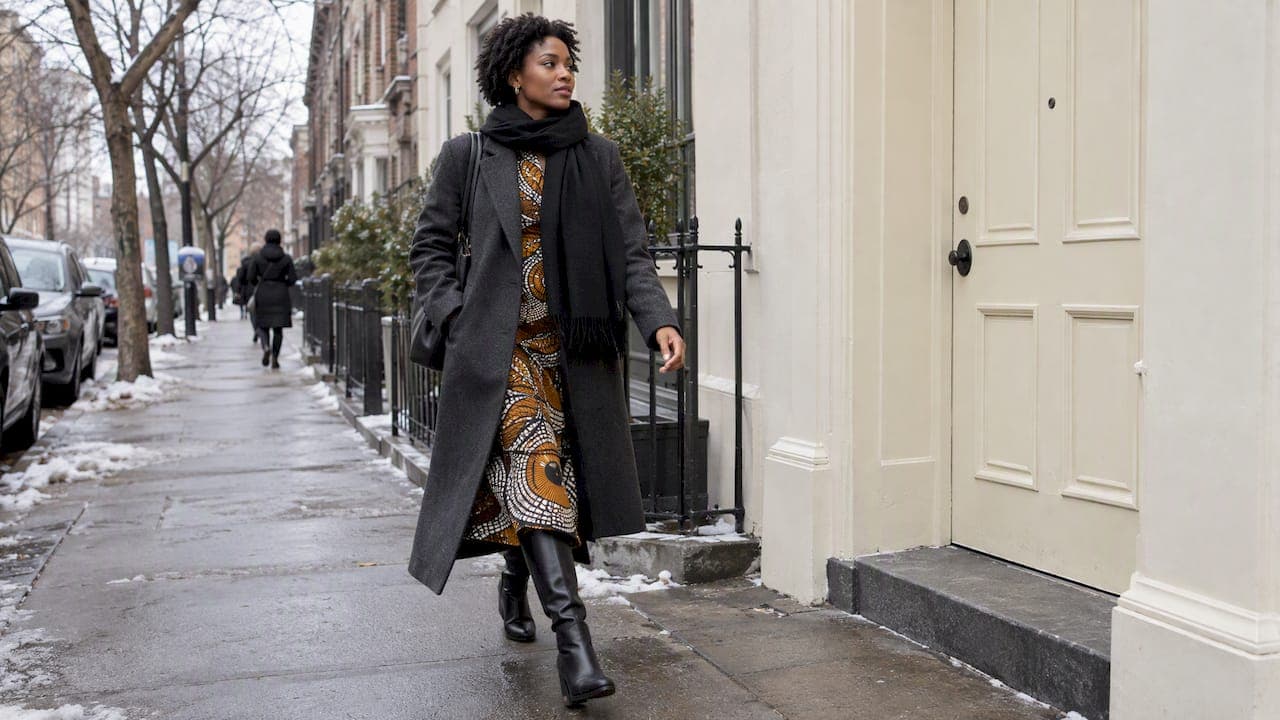
You can wear Ankara all winter. The trick is to treat the print as the focal point and let the layers around it do the work of keeping you warm: a thermal base, a well-fitted piece in the middle, and a coat with enough room to let the pattern show at the collar, the hem or the cuff. Below, we walk you through how to build those looks, from an Ankara dress under a wool coat to a kaftan with a jacket, with the cold-weather basics that keep you comfortable on a real January commute.
TL;DR
- Build from the skin out: a moisture-wicking base layer, your Ankara piece as the statement layer, then a coat roomy enough to wear over it.
- Skip cotton next to the skin in the cold. Merino wool or a synthetic base layer keeps you drier and warmer.
- Choose a neutral coat (camel, charcoal, black, cream) so the print is the star, and let it peek out at the hem, collar or sleeve.
- Kaftans and wrap gowns layer well under structured jackets, long cardigans and puffers, as long as nothing is cut so tight that it restricts circulation.
- Look for limited-run pieces you will wear for years. Our collections are made in small quantities with ethical production in mind.
Table of Contents
- Why Ankara belongs in your winter wardrobe
- The cold-weather basics that make any print work
- Ankara winter outfits by layering formula
- Fabrics, textures and colors that pair well
- Make a summer Ankara dress work in winter
- Our perspective: wear the story, not just the print
- Where to find winter-ready pieces from us
- Styling for the occasion
- Common mistakes to avoid
- Caring for your Ankara pieces through the season
- FAQ
- Sources
Why Ankara belongs in your winter wardrobe
Winter palettes lean muted: grey, navy, black, oatmeal. Bringing bold African prints into that landscape is a deliberate choice. Chic Chui frames it as a way to choose vibrancy over the season's typical muted colors, and as a way to show personality, culture and resilience when temperatures drop. We agree, and we would add one thing: it is also practical. A saturated print lifts a plain coat, and it photographs well against snow, brick and bare branches.
There is meaning in the cloth, too. The Smithsonian's National Museum of African Art notes that African textile traditions carry symbols that mark leadership, royalty and historical legacy, which is part of why a printed or woven garment can feel like more than decoration. If you want to understand where Ankara itself comes from before you invest in it, our guide to provenance tests for Ankara fabric is a good start.
The cold-weather basics that make any print work
Before styling, get the physics right. A beautiful outfit you cannot stand wearing for an hour will stay in the closet.
Start with the right base layer
The University of Alaska Fairbanks advises international students not to wear cotton against the skin in winter, because cotton holds moisture and speeds heat loss. Merino wool or synthetic fabrics such as polyester or polypropylene wick moisture away instead. For an Ankara outfit, that means:
- A thin long-sleeve merino or synthetic top under a dress, tunic or kaftan.
- Thermal leggings or tights under skirts and wrap gowns.
- Wool or wool-blend socks, since your feet are the first place you feel the cold.
These layers are thin enough to disappear under most silhouettes, so they will not fight with the lines of your garment.
Trap warm air, but leave room to breathe
Ohio State's health team explains that staying warm is about trapping warm air against your body, staying dry and layering. The same guidance says to keep layered garments loose enough that they do not restrict blood flow, since constricted circulation makes you feel colder. This matters for Ankara because tailored prints are often cut close. Try your layered combination at home with everything on before you commit to wearing it out.
Mind the wind and your activity level
Wind makes cold feel colder, and the more you move, the more moisture you generate. The same Alaska guide recommends windproof, breathable outer layers for active days and saving fully waterproof shells for heavy precipitation. If you walk fast to the train, a breathable coat will treat you better than a sealed one. If you mostly stand at a bus stop or move between car and office, insulation matters more than breathability.

Invest in the coat first
Fashion editors consistently describe a winter coat as a foundational purchase. Wool blends and structured leather are the kinds of fabrics that layer well, which is exactly what you want when the piece underneath is a statement. Choose a coat one size up from your usual if you plan to wear it over dresses, jackets or agbada sets.
Ankara winter outfits by layering formula
Here are five formulas that work across body types and budgets. Swap in your own pieces.
| Look | Base | Statement layer | Outer layer | Finish |
|---|---|---|---|---|
| Office-ready | Thin merino top, tights | Ankara midi dress | Camel wool coat | Knee-high leather boots |
| Weekend casual | Thermal tee | Ankara jacket | Dark denim, chunky knit underneath | Sneakers or lug-sole boots |
| Celebration | Thermal slip, tights | Wrap gown or matching set | Long tailored coat or faux fur wrap | Heeled boots, bold earrings |
| Relaxed elegance | Long-sleeve base layer | Kaftan | Structured jacket or long cardigan | Ankle boots, scarf |
| Cold-snap commute | Merino base, leggings | Ankara skirt or set | Puffer, long enough to cover the hem | Insulated boots, wool socks |
1. The Ankara dress under a wool coat
This is the simplest and most reliable formula. Wear a midi or maxi Ankara dress with opaque thermal tights and a thin base layer, then add a coat in a solid color. Let the hem fall a few inches below the coat so the print flashes with every step. Chic Chui suggests pairing an Ankara skirt with knee-high boots and thick tights, and notes that skirt slits add movement while the boots give a grounded silhouette.
If your dress has a lot of volume, choose a coat with a straighter cut so you do not add bulk. If your dress is slim, a swing coat or a cocoon shape feels balanced.
2. The Ankara jacket over a classic knit
An Ankara jacket is the easiest way into the trend if you are not ready for a full print outfit. Wear it over a turtleneck or fine-gauge sweater and straight-leg jeans. Chic Chui suggests pairing an Ankara jacket with wool, velvet or cashmere, and we like the contrast: the matte softness of knitwear against a crisp, graphic print.

For colder days, put the jacket between a knit and a larger coat only if the jacket has a slim sleeve. Otherwise it will bunch at the shoulder and you will be uncomfortable by lunchtime. A better move is to wear the jacket as your outer layer on milder days and a scarf or hat in a coordinating shade of the print.
3. The kaftan with a jacket
Kaftans are generous by design, which makes them wonderful for layering. A thermal base and leggings go underneath, and a structured jacket goes over the top. Blazers, cropped leather jackets and utility jackets all work, because they define the waist and keep the flow of the kaftan from swallowing you.
A few rules of thumb:
- Match the jacket length to the kaftan. A cropped jacket over a long kaftan creates a clean proportion, while a hip-length jacket over a knee-length kaftan can look stumpy.
- Keep the jacket solid if the kaftan is busy. Black, olive, chocolate or deep navy are reliable.
- Use a belt sparingly. A slim belt over the kaftan and under the jacket helps hold warmth in without squeezing.
- Add a long cardigan on indoor days. A draped cardigan echoes the kaftan's movement.
The same idea works for a dashiki-style top or tunic over trousers. If you like the look of a flowing garment with a sharper outer layer, you are already halfway to the right formula.
4. The matching set, layered up
A matching Ankara set is practically a winter outfit in one move, because the two pieces already look intentional together. Add a thermal base layer, then a long coat in a color pulled from the print. For a deeper dive into how sets work as a wardrobe building block, see our guide to limited-run Ankara matching sets.
On very cold days, wear the trousers or skirt of the set with a chunky sweater and keep the matching top for the evening, when you will be indoors. Rewearing separates this way makes a set work twice as hard.
5. Agbada and robe-style layers for men
Men's agbada ensembles are naturally layered garments: a wide outer robe over a top and trousers. In winter, the same principle applies with a few tweaks. Wear a thermal base layer beneath the inner top, choose wool or heavier trousers, and put a long overcoat on top for outdoor moments, then remove it indoors so the robe can be seen. Because the silhouette is voluminous, size your overcoat up so the sleeves are not crushed.
Fabrics, textures and colors that pair well
Ankara itself is typically a printed cotton, so it is not insulating on its own. That is why the layers matter. Here is how to pair it with other winter textures:
- Wool and cashmere: soft, matte surfaces calm a loud print.
- Leather and faux leather: the edge of a jacket gives a bold print a modern attitude.
- Velvet: a dressy pairing for holiday parties, in deep jewel tones.
- Corduroy and denim: casual and sturdy, ideal for daytime.
- Knit scarves and hats: pull one color out of the print for an easy match.
On color, a simple method is to pick the least dominant shade in the print and echo it in a scarf, boots or bag. If the print is orange, blue and gold, a cream coat feels fresh and a deep teal scarf will make the blue sing. If you are unsure which motifs and colors read as modern, our design guide to contemporary West African motifs can help you choose.
Make a summer Ankara dress work in winter
You probably already own one piece that can make the jump. Blogger Enma and I wrote a helpful walkthrough on wearing a signature Ankara dress in fall and winter, and the idea is straightforward: treat the dress as a layering piece rather than a warm-weather-only item. Our own version of the method:
- Add opaque tights and a long-sleeve base layer under the dress.
- Put a fitted knit or cropped jacket over the top.
- Finish with boots and a coat that is longer than the jacket.
- Keep accessories simple so the print leads.
If the dress is sleeveless, a turtleneck underneath turns it into a pinafore, which is a perfectly good winter silhouette.
Our perspective: wear the story, not just the print
We started Sena Nukunu because West African fashion deserves to be worn with pride, every day and every season. Winter is where that commitment gets tested. It is easy to pack a print away in October, and we understand why. But a garment made with care is meant to be lived in, and the cold months are when you most need something that lifts your mood.
Here is what we believe about winter Ankara:
- Plan the outfit from the outside in. Start with the coat you love and the climate you live in, then choose the print that makes you feel regal underneath it.
- Fewer, better pieces. We make our pieces in limited quantities, with ethical manufacturing and artisan craftsmanship at the center, so what you buy is meant to last through many seasons rather than one.
- Comfort is part of confidence. Our Women's Collections include lines such as Queen In Comfort, because we believe that feeling at ease in what you wear is what lets you carry it with presence.
- Let heritage show. Leave the collar open, the cuff turned back or the hem visible. The print is a story, and stories deserve to be seen.
We think of every stitch as carrying a legacy, and that does not hibernate when the temperature falls.
— Sena
Where to find winter-ready pieces from us
If you are building a cold-weather wardrobe around Ankara and West African-inspired fashion, start with our collections. You will find women's lines such as Woven Stride: Queen In Comfort, Woven Shields: Queens in Motion, Woven Radiance: Queens in Bloom and Woven Crowns: Radiant Rise, and for men, Woven Nobility: Kings' Robe alongside our agbada ensembles and Men's Heritage pieces. Every piece is ready to ship, made in limited quantities, and designed to be a statement you can layer around.
If you would like an example of a layering-friendly silhouette, take a look at our wrap gown in a peacock-inspired design. A wrap shape adjusts easily over a thermal layer, and it pairs well with a long coat. For more on how shoppers across the U.S. place and tailor Ankara, read our piece on how U.S. shoppers wear Ankara.
Styling for the occasion
Holiday gatherings and weddings
Winter is wedding and celebration season for many families, and Ankara is a natural fit. Pair a wrap gown or matching set with a tailored coat and heeled boots. Bring a shawl or a faux fur wrap for the arrival and the photographs outside, then leave it on a chair once inside. Because you will move between cold air and warm rooms, wear a thin base layer you will not mind keeping on all evening.
The office
An Ankara dress with a blazer and a wool coat reads polished and distinct. Keep the base layer sleek, choose opaque tights, and pick one pattern only. For ideas on wearing prints with confidence, our top tips for styling Ankara outfits goes into proportion and placement in more detail.
Nights out
For concerts and evenings out, think about the coat check. A coat you can take off easily, over an outfit that works without it, is the winning combination. We cover this in our guide to Ankara looks for Afrobeat concerts, and the same logic applies to any winter night with dancing in it.
Everyday errands
For the weekend, keep the print in one place: a jacket, a skirt or a head wrap. Add jeans, a knit and sturdy boots. If you are on your feet a lot, wear a breathable outer layer so you do not overheat when you move.
Common mistakes to avoid
- Layering too tightly. Tight stacked layers can restrict circulation and make you colder, not warmer.
- Wearing cotton next to your skin on cold, active days. A wicking base layer does more for warmth than another top.
- Choosing a coat shorter than your dress by accident. It can look unintentional unless the hem is clearly meant to show.
- Clashing two prints. Keep one print dominant and everything else solid.
- Forgetting the extremities. Gloves, hats and warm socks matter more than another thin layer.
- Washing too hot. Check the garment's care label, because prints and tailored layers last longer when you treat them gently.
Caring for your Ankara pieces through the season
Salt, slush and radiator heat are hard on fabric. Hang printed pieces to air out after wearing, rotate them instead of wearing the same one daily, and store them folded loosely or on padded hangers. Always follow the care label of the specific garment. When you put your Ankara away for spring, clean it first and keep it in a breathable garment bag so it is ready next year.
FAQ
Can you wear Ankara in winter?
Yes. Ankara is a printed fabric, so it works best as the visible layer in a system. Add a moisture-wicking base layer underneath and a coat on top, and the print will carry you through the season.
What do you wear under an Ankara dress in the cold?
A thin merino or synthetic long-sleeve top and opaque thermal tights are a good start. Cotton against the skin is best avoided when it is cold, because it holds moisture. Keep the layers loose enough that they do not restrict circulation.
How do you style a kaftan with a jacket?
Choose a structured jacket in a solid color, such as a blazer, cropped leather jacket or utility jacket, and match its length to the kaftan so the proportions stay balanced. Wear a thermal layer and leggings underneath. A slim belt under the jacket can define the waist without squeezing.
What coat color goes best with African prints?
Neutral coats in camel, charcoal, black, cream or deep navy let the print stand out. If you prefer color, pull a shade from the print so the coat feels intentional.
Sources
- Winter, but Make It With African Print, Chic Chui
- Dressing for Winter, International Student and Scholar Services, University of Alaska Fairbanks
- How to stay warm in the cold, Ohio State Health & Discovery
- The best autumn winter coats, Harper's Bazaar UK
- National Museum of African Art, Smithsonian
- How to wear my signature ankara dress in the fall/winter, Enma & I